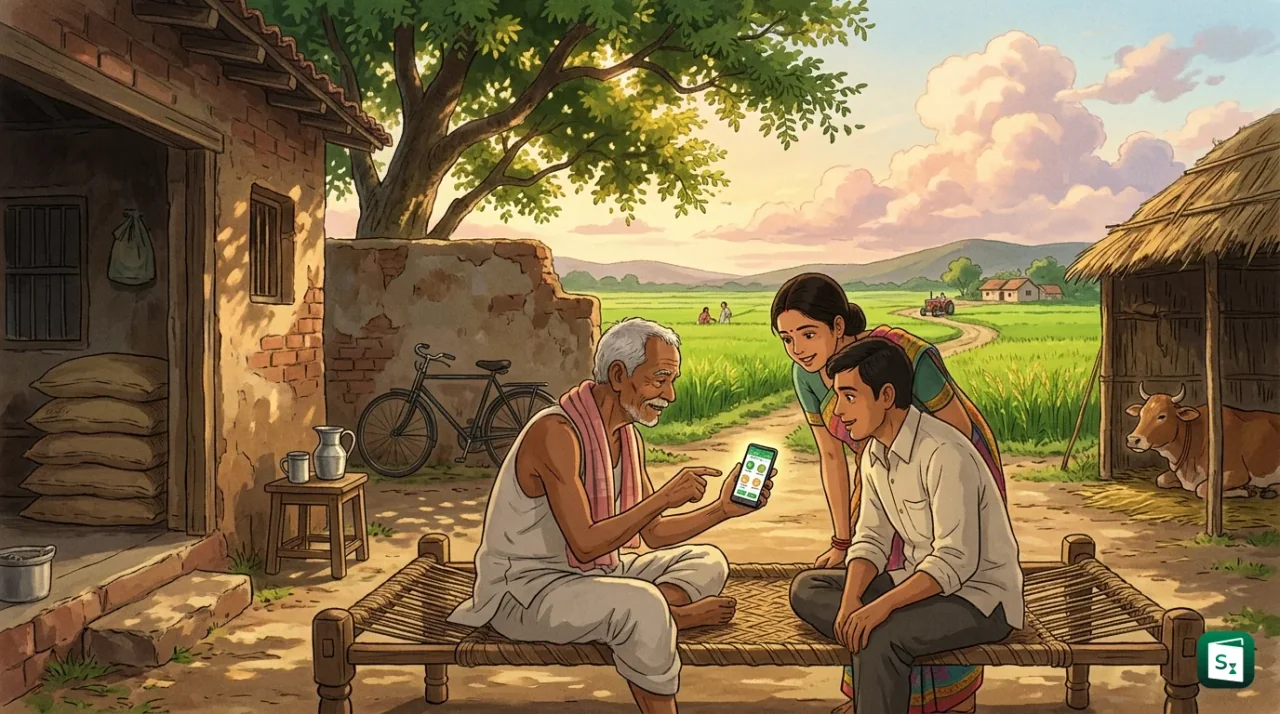
Union Minister for Agriculture and Farmers Welfare Shivraj Singh Chouhan launched the upgraded Agri Welfare Portal in New Delhi on 19 October 2026. The portal works as a single window on mobile phones for schemes such as PM KISAN, PM Fasal Bima Yojana and AgriStack linked services. It aims to cut office visits and middlemen by letting farmers check eligibility, apply online and get reliable farm information in one place.
What Is the Agri Welfare Portal
The Agri Welfare Portal is a mobile friendly single window platform of the Ministry of Agriculture and Farmers Welfare that brings schemes, subsidies, rules and digital services together in one place. Farmers can use it to read scheme details, check eligibility, submit applications and track financial assistance. The design reflects the Digital India goal of keeping government services live on the mobile phone.
The Ministry developed the upgraded portal with support from its Digital Agriculture Division and the National Informatics Centre (NIC), which is the technology arm that builds most central government websites. The portal follows the Digital Brand Identity Manual 3.0 and the Guidelines for Indian Government Websites 3.0 issued by the Ministry of Electronics and Information Technology (MeitY). These standards set rules for look, security and easy use across government sites.
Access was a central focus. The portal is lightweight, so it runs on basic smartphones and in areas with weak internet. It also supports screen readers and simple navigation for persons with disabilities. The launch event took place at Krishi Bhawan in New Delhi in the presence of Agriculture Secretary Atish Chandra and Additional Secretary Pramod Meherda.
PM KISAN Integration in Agri Welfare Portal
What Is PM KISAN Samman Nidhi
The Pradhan Mantri Kisan Samman Nidhi (PM-KISAN) is a central sector income support scheme that pays ₹6,000 per year to eligible landholding farmer families. The amount is paid in three equal instalments of ₹2,000 directly into Aadhaar seeded bank accounts through Direct Benefit Transfer (DBT).
PM-KISAN became operational on 1 December 2018 and was formally launched on 24 February 2019. It is a Central Sector Scheme with 100 percent funding from the central government. Family for the scheme means husband, wife and minor children. State governments identify eligible families as per scheme guidelines.
The scale is large. The 23rd instalment was released on 20 June 2026 from Tarakeswar in Hooghly, West Bengal, with over ₹18,880 crore transferred to more than 9.44 crore farmers, including over 2.18 crore women farmers. Total disbursal since launch has crossed ₹4.46 lakh crore, which makes PM-KISAN one of the largest DBT programmes in the world. The Union Cabinet has approved continuation of the scheme from 2026-27 to 2030-31 with an outlay of ₹3.15 lakh crore.
The Agri Welfare Portal makes these processes easier to use. Farmers can find eligibility criteria, complete eKYC, which is mandatory for registered farmers, check PM KISAN status and beneficiary list, and follow instalment dates from one login. This reduces confusion caused by multiple websites and spelling variants of the scheme name that circulate online.
Crop Insurance Access via Portal
What Is PM Fasal Bima Yojana
The Pradhan Mantri Fasal Bima Yojana (PMFBY) is a national crop insurance scheme that protects farmers against crop loss from sowing to post harvest. It covers drought, flood, cyclone, hailstorm, pests, disease and localised risks on an area approach basis for notified crops.
The scheme was launched on 18 February 2016 to bring maximum farmers under crop insurance. Farmers pay a low premium. The maximum share is 2 percent for Kharif foodgrain and oilseed crops, 1.5 percent for Rabi foodgrain and oilseed crops and 5 percent for commercial and horticultural crops. The central and state governments jointly pay the balance of the actuarial premium, generally in a 50:50 ratio.
This keeps insurance affordable. The Union Budget for 2026-27 has allocated ₹12,200 crore for PMFBY. In the last ten years till Rabi 2025-26, more than 92.46 crore farmer applications were insured and claims worth over ₹2.06 lakh crore were paid on more than 26.33 crore applications. For Kharif 2026, about 241.38 lakh farmers covering 278.12 lakh hectares were insured as of 27 August 2026.
Technology now supports faster settlement through platforms such as the National Crop Insurance Portal (NCIP), DigiClaim, Crop Cutting Experiment App, YES-TECH for technology based yield estimation and WINDS for weather data. The Agri Welfare Portal links farmers to this system. It explains eligibility, last dates such as the Kharif and Rabi cut offs, how to apply online, how to use Common Service Centre (CSC) login, and how to check application and claim status.
Farmer Registry and Farmer ID Linkage Through AgriStack
What Is AgriStack
AgriStack is a farmer focused Digital Public Infrastructure (DPI) built as a public good for faster delivery of services to farmers. It creates one verified record that links farmer identity, land records and crops sown. It is the backbone of the Digital Agriculture Mission, which the Union Cabinet approved in September 2024 with a total outlay of ₹2,817 crore.
AgriStack has three foundational registries built and maintained by states. The table below explains them in simple terms.
| Registry | What It Holds |
|---|---|
| Farmer Registry | Details of landholding farmers, including tenants and sharecroppers where onboarded, with a digital Farmer ID |
| Geo-Referenced Village Maps | Digital maps of village and farm boundaries for correct land identification |
| Crop Sown Registry | Plot wise data on crops sown each season through the Digital Crop Survey |
The Farmer ID is an 11 digit number generated after verification with Aadhaar and digitised land records. It works as a permanent identity for agriculture services, in the same way Aadhaar works for general identity. The target is to create Farmer IDs for 11 crore farmers by 2026-27. As of 3 August 2026, more than 10.31 crore Farmer IDs had been created. During Rabi 2025-26, the Digital Crop Survey covered 648 districts and more than 31.3 crore plots.
States already use this ID for delivery. Chhattisgarh has linked Farmer ID and Digital Crop Survey to paddy procurement at Minimum Support Price (MSP) for over 32 lakh farmers in a single season. Maharashtra has used AgriStack for scheme delivery, disaster relief and transfer of over ₹14,000 crore to 89 lakh farmers for Kharif 2025 crop losses. Farmer ID is also being used for enrolment under PMFBY in Maharashtra, Karnataka, Madhya Pradesh and Uttar Pradesh, and for Kisan Credit Card (KCC) loans.
The Agri Welfare Portal connects farmers to this registry system. It guides users on AgriStack registration, login, registration status check, Farmer ID download and correction of land or mobile details. This helps farmers who are confused between old state portals and the new national registry.
How the Portal Works for Farmers
The Ministry has listed five practical benefits that shape daily use. Information on schemes, subsidies, rules and digital services sits on one portal. This saves time spent moving between offices and websites. Online eligibility checks and direct application reduce paperwork. Financial help moves through Direct Benefit Transfer (DBT), where money goes straight to the bank account of the beneficiary. This limits the role of middlemen and improves transparency.
The portal also supplies field level information. Farmers can access authentic updates on weather, scientific farming practices, availability of seeds and fertilisers, and market prices for produce. This matters most during sowing and harvest, when wrong advice on inputs or late weather warnings can cause heavy loss.
Design choices address rural realities. The pages are simple and use plain language for small and marginal farmers, including those with limited formal education. The system is built to work on low cost phones and slow networks. For users with disabilities, it offers screen reader support and simple navigation.
Minister Chouhan has directed officials to keep content accurate and current. The Minister said outdated information can damage trust in the system. Regular updates on guidelines, dates and contact details will therefore decide how useful the portal remains after launch.
Wider Ecosystem and Training Support
The portal is not limited to individual farmers. It brings together Farmer Producer Organisations (FPOs), which are collectives of farmers that handle inputs, processing and joint marketing, and Primary Agricultural Credit Societies (PACS), which are village level cooperative credit bodies. It also connects agricultural scientists, researchers and agri startups on the same platform. This common space can improve coordination between those who frame schemes, those who create knowledge and those who use it on the field.
Training will decide actual adoption. The Ministry will run a special campaign through Krishi Vigyan Kendras (KVKs) across the country to teach farmers how to use the portal and other digital tools. KVKs are district level farm science centres set up by the Indian Council of Agricultural Research (ICAR) for testing and transfer of farm technology. The network has grown to 731 KVKs nationwide. Around 10,000 FPOs have been registered across the country as of July 2026, so linking these institutions to one digital gateway can extend scheme awareness quickly.
The larger value lies in continuity. Earlier steps such as e-NAM, launched in 2016 for online farm trade, and PM-KISAN, launched in 2019 for direct income support, moved markets and payments online. The Agri Welfare Portal adds the missing information layer. If onboarding in low connectivity areas succeeds and data stays fresh, the portal can become the first screen farmers check before sowing, insuring, borrowing or selling.
Key Takeaways
- The upgraded Agri Welfare Portal was launched by Shivraj Singh Chouhan on 19 October 2026 at Krishi Bhawan, New Delhi as a mobile friendly single window for farm schemes.
- PM-KISAN provides ₹6,000 per year in three instalments of ₹2,000 through DBT and was formally launched on 24 February 2019.
- PM Fasal Bima Yojana, launched on 18 February 2016, charges a maximum premium of 2 percent for Kharif, 1.5 percent for Rabi and 5 percent for commercial crops.
- AgriStack is the DPI backbone of the Digital Agriculture Mission approved in September 2024 with an outlay of ₹2,817 crore.
- The Farmer ID is an 11 digit identity linked to Aadhaar and land records, with more than 10.31 crore IDs created as of August 2026 against a target of 11 crore by 2026-27.
- Farmer training for the portal will run through 731 Krishi Vigyan Kendras set up by the Indian Council of Agricultural Research (ICAR).