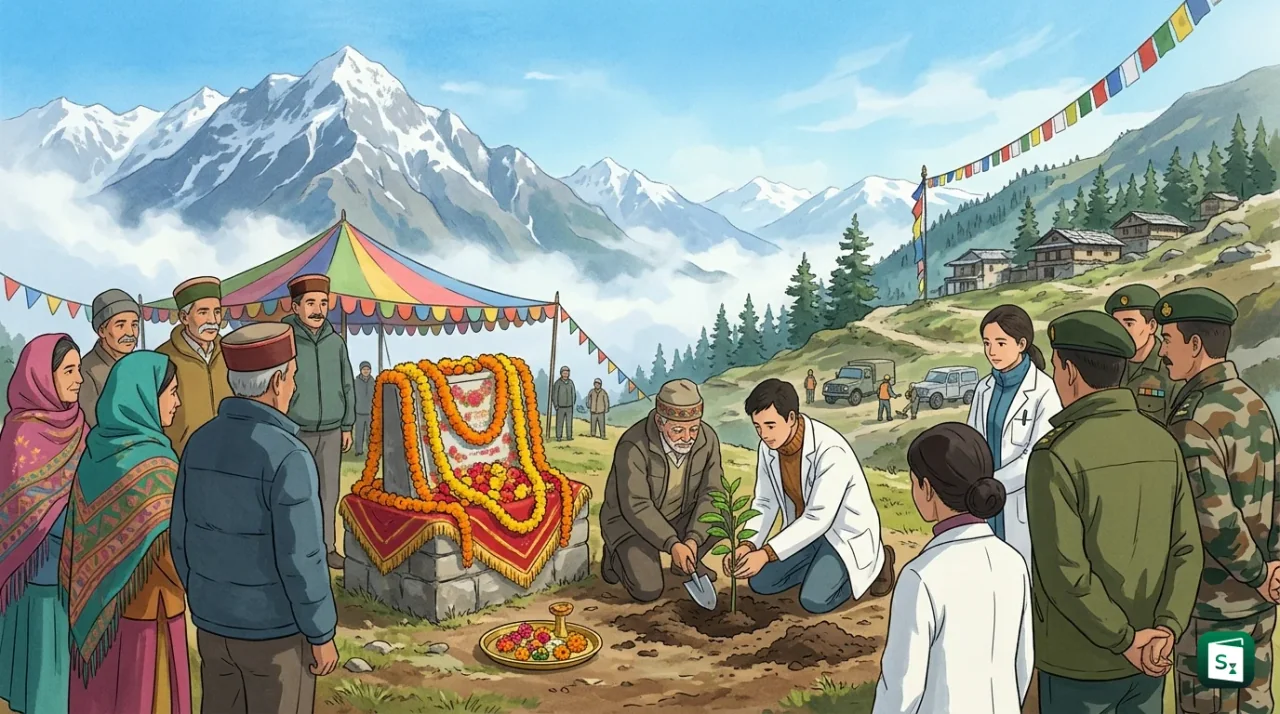
Union Health Minister Jagat Prakash Nadda laid the foundation stone for the ICMR Centre for High Altitude Medicine and Public Health Research (ICMR-CHAMP) at Keylong in Lahaul and Spiti district of Himachal Pradesh on 12 October 2026. The facility is the first dedicated centre of the Indian Council of Medical Research (ICMR) for high altitude medicine and mountain public health. It will upgrade ICMR’s decade-old field station at Keylong into a year-round laboratory to study thin-air health risks and improve care for Himalayan communities and soldiers posted at high altitude.
What Is ICMR and What Will the New Keylong Centre Do?
The Indian Council of Medical Research (ICMR) is India’s apex body for the formulation, coordination and promotion of biomedical research. It functions as an autonomous organisation under the Department of Health Research in the Ministry of Health and Family Welfare, with its headquarters at V. Ramalingaswami Bhawan in Ansari Nagar, New Delhi.
ICMR was set up in 1911 as the Indian Research Fund Association (IRFA) under British rule. It was renamed ICMR in 1949 after Independence, with a wider mandate for medical research. It is often confused with a statutory body, but ICMR is not created by an Act of Parliament. It is a government-funded autonomous body, and the Secretary of the Department of Health Research holds additional charge as its Director General. Rajiv Bahl holds this dual role (as of October 2026).
The ICMR network includes more than 26 national institutes such as the National Institute of Nutrition (NIN) in Hyderabad, the National Institute for Research in Tuberculosis (NIRT) in Chennai and the National Institute of Epidemiology (NIE) in Chennai, along with six regional medical research centres. The new ICMR Centre for High Altitude Medicine and Public Health Research (ICMR-CHAMP) at Keylong will be ICMR’s first dedicated centre for high altitude zones. It converts a seasonal field station, active for nearly ten years, into a permanent, multidisciplinary hub for research, training and policy support for climate-sensitive Himalayan regions.
Keylong in Himachal Pradesh: Why This Location Matters
Keylong is the district headquarters of Lahaul and Spiti, the largest district by area in Himachal Pradesh. The town sits at about 3,080 metres above sea level on the banks of the Bhaga river, on the Manali-Leh highway. Some district records place the town centre at 3,156 metres. Both figures place Keylong well above the altitude where human health begins to respond to low oxygen.
Lahaul and Spiti was formed in 1960 by merging the Lahaul and Spiti tracts. It remains among the least populated districts in India, with a largely tribal population spread across remote valleys. The region stays cut off for months in winter, with road links through the Rohtang Pass and the Atal Tunnel providing the main connection to Manali. Kunzum Pass at 4,551 metres links Lahaul to Spiti, while Baralacha La at 4,890 metres connects the area toward Ladakh.
This setting gives researchers natural year-round access to high altitude residents, seasonal migrants, tourists and troops moving toward Ladakh. Long-term studies need such a stable base. They can track the same families across seasons and measure how thin air, extreme cold, ultraviolet exposure and changing rainfall shape health over years. The border location also matters. Findings from Keylong will directly apply to Ladakh, Jammu and Kashmir, Uttarakhand, Sikkim and Arunachal Pradesh.
What Is High Altitude Sickness and Why Does It Need Special Research?
High altitude sickness, also called altitude illness or mountain sickness, is a group of health problems caused by rapid exposure to low oxygen at high elevation. As altitude rises, air pressure falls and each breath carries less oxygen. This condition of oxygen shortage is called hypoxia. Cold, dehydration, hard physical work and fast ascent make the effect worse.
Mountain residents adapt over generations through larger lung capacity and changes in blood and circulation. Visitors, soldiers on rapid deployment and workers on new infrastructure projects do not have this adaptation. They face headaches, breathlessness and poor sleep within hours of arrival. Research at the actual altitude where people live and serve is therefore more reliable than studies done in lowland hospitals.
At What Elevation Does Altitude Sickness Start?
High altitude in medicine generally means elevations above 2,500 metres (about 8,200 feet). Most unacclimatised people face clear risk when they sleep above this level, especially if they climb more than 500 metres in a day above 3,000 metres. Sensitive persons can develop symptoms as low as 2,000 metres.
Keylong itself sits above this threshold, so patients, volunteers and field workers at the centre live inside the study environment. That allows doctors to record blood pressure changes, breathing changes, sleep quality and blood oxygen in real conditions rather than in simulation chambers.
Three Main Forms: AMS, HAPE and HACE
Doctors group acute altitude illness into three related conditions. Acute Mountain Sickness (AMS) is the most common and mildest form. High Altitude Pulmonary Edema (HAPE), where fluid collects in the lungs, and High Altitude Cerebral Edema (HACE), where the brain swells, are uncommon but can cause death within hours without descent and oxygen.
| Condition | Full Name | Typical Signs | Why It Is Serious |
|---|---|---|---|
| AMS | Acute Mountain Sickness | Headache plus nausea, fatigue, dizziness and disturbed sleep within 6 to 12 hours of ascent | Affects up to 25 percent of rapid climbers above 2,500 metres. Usually improves with rest, but can progress if ascent continues |
| HAPE | High Altitude Pulmonary Edema | Breathlessness on mild effort, drop in exercise capacity, dry cough that turns wet, chest tightness and pink frothy sputum | A form of non-cardiac lung failure due to high lung artery pressure. Needs immediate descent and oxygen, with fatality up to 50 percent if untreated |
| HACE | High Altitude Cerebral Edema | Loss of coordination while walking, confusion, unusual drowsiness and slurred speech, often after severe AMS | Brain swelling from excess blood flow and fluid leak. Can lead to coma within a day. Needs immediate descent and medical care |
Standard prevention is slow, staged ascent with rest days for acclimatisation. The drug acetazolamide, sold as Diamox, helps the body adjust and is widely used for prevention of AMS. The steroid dexamethasone is used for treatment of severe AMS and HACE under medical supervision, while nifedipine is used in HAPE protocols. Definitive treatment for severe illness remains descent by at least 300 to 1,000 metres and supplemental oxygen where available.
Research Mandate and Health Focus of the Centre
The Keylong centre will study how thin air, extreme cold and climate variability shape disease in the Himalaya. Its mandate spans basic physiology and practical public health. On the physiology side, scientists will measure how low oxygen affects lungs, heart, brain and sleep, and how soldiers and newcomers acclimatise at different speeds. On the public health side, they will track infections, chronic diseases and nutrition in the same population over time.
Maternal and child health receives special attention. Pregnancy at high altitude carries higher risk of low birth weight and high blood pressure disorders. Child growth, anaemia and iodine deficiency behave differently in cold deserts with limited diet diversity in winter. Mental health, occupational health of road and hydropower workers, and medicine for disasters such as avalanches, flash floods and landslides are also part of the plan.
| Research Stream | What Scientists Will Study |
|---|---|
| High altitude physiology and mountain medicine | Oxygen levels, acclimatisation schedules, early warning signs of AMS, HAPE and HACE |
| Climate-sensitive and emerging infections | Changing patterns of respiratory infections, vector borne diseases moving to higher valleys, surveillance of new outbreaks |
| Non-communicable diseases | High blood pressure, heart disease and chronic lung disease in cold and hypoxic conditions |
| Maternal, newborn and child health | Pregnancy outcomes, birth weight, child growth, nutrition and anaemia in tribal families |
| Environment, occupation and disaster medicine | Cold injury, ultraviolet harm, worker safety at dam and road sites, response to avalanches and earthquakes |
| Digital health and delivery innovation | Telemedicine links, real-time disease surveillance, drone-based transport of medicines and samples, and use of artificial intelligence for early diagnosis |
The technology focus is practical. Doctors in Keylong cannot refer every serious case to Shimla or Chandigarh in winter. The centre will test whether teleconsultation, portable oxygen systems and drone delivery can keep care local. Lessons from these pilots are expected to guide health services across the Himalayan states, where distance and weather create similar barriers.
Who Is Building and Supporting the Centre?
The Ministry of Health and Family Welfare funds the project through ICMR. The foundation ceremony on 12 October 2026 included a traditional Bhumi Pujan, unveiling of the foundation stone and planting of native Himalayan saplings under the Green ICMR Campus Initiative. The programme also featured a science exhibition for school students, the launch of the centre website and institutional video, and the release of a commemorative postal cover.
The centre will work closely with the Armed Forces Medical Services (AFMS), which manages health of troops in Siachen, eastern Ladakh and other high posts. Union Minister of State for Defence Sanjay Seth attended the event as guest of honour. The partnership links ICMR research strength with the daily field experience of military doctors. It will help frame safer induction schedules, nutrition plans and evacuation rules for rapid deployment to extreme heights.
Civilian collaboration is equally broad. The Defence Research and Development Organisation (DRDO) brings relevant experience through the Defence Institute of High Altitude Research (DIHAR) at Leh, which works on cold desert agriculture, animal science and medicinal plants, and the Defence Institute of Physiology and Allied Sciences (DIPAS) in New Delhi, which studies human adaptation to extreme environments. AIIMS Bilaspur, set up under Phase V of the Pradhan Mantri Swasthya Suraksha Yojana with its foundation stone laid in October 2017 and first MBBS batch admitted in January 2021, will join studies on how visiting patients respond to altitude. The Government of Himachal Pradesh and local residents are partners for field surveys and long-term cohort studies. ICMR Director General Rajiv Bahl has stated that local people will act as research partners, not just subjects, with the goal of better health rather than papers alone.
The Way Forward
The immediate next step is construction of permanent laboratories, housing for scientists and high altitude clinical facilities at Keylong. Once staff positions are filled, the station will shift from seasonal camps to continuous data collection through winter. That continuity is critical. Many altitude effects appear only during prolonged cold exposure and fuel shortage months.
In the medium term, the centre is expected to produce region-specific treatment guidelines for AMS, HAPE and HACE in Indian conditions, nutrition charts for high altitude pregnancy and childhood, and standard protocols for drone-based supply in snowbound valleys. Its data will feed into national priorities for tribal health, disaster preparedness and digital health, and into global knowledge on mountain medicine. Success will be judged not by buildings but by fewer preventable evacuations, safer induction of soldiers, and stronger primary care that functions even when passes close.
Key Takeaways
- The ICMR Centre for High Altitude Medicine and Public Health Research (ICMR-CHAMP) foundation stone was laid at Keylong in Lahaul and Spiti on 12 October 2026 by Union Health Minister Jagat Prakash Nadda.
- ICMR stands for the Indian Council of Medical Research, established in 1911 as IRFA and renamed in 1949, with headquarters in New Delhi.
- Keylong sits at about 3,080 metres above sea level and serves as headquarters of Himachal Pradesh’s largest district, Lahaul and Spiti, formed in 1960.
- Altitude illness generally appears above 2,500 metres and includes Acute Mountain Sickness (AMS), High Altitude Pulmonary Edema (HAPE) and High Altitude Cerebral Edema (HACE).
- The Keylong centre will research acclimatisation, maternal and child health, nutrition, mental health, disaster medicine and drone-enabled delivery with partners including AFMS, DRDO and AIIMS Bilaspur.