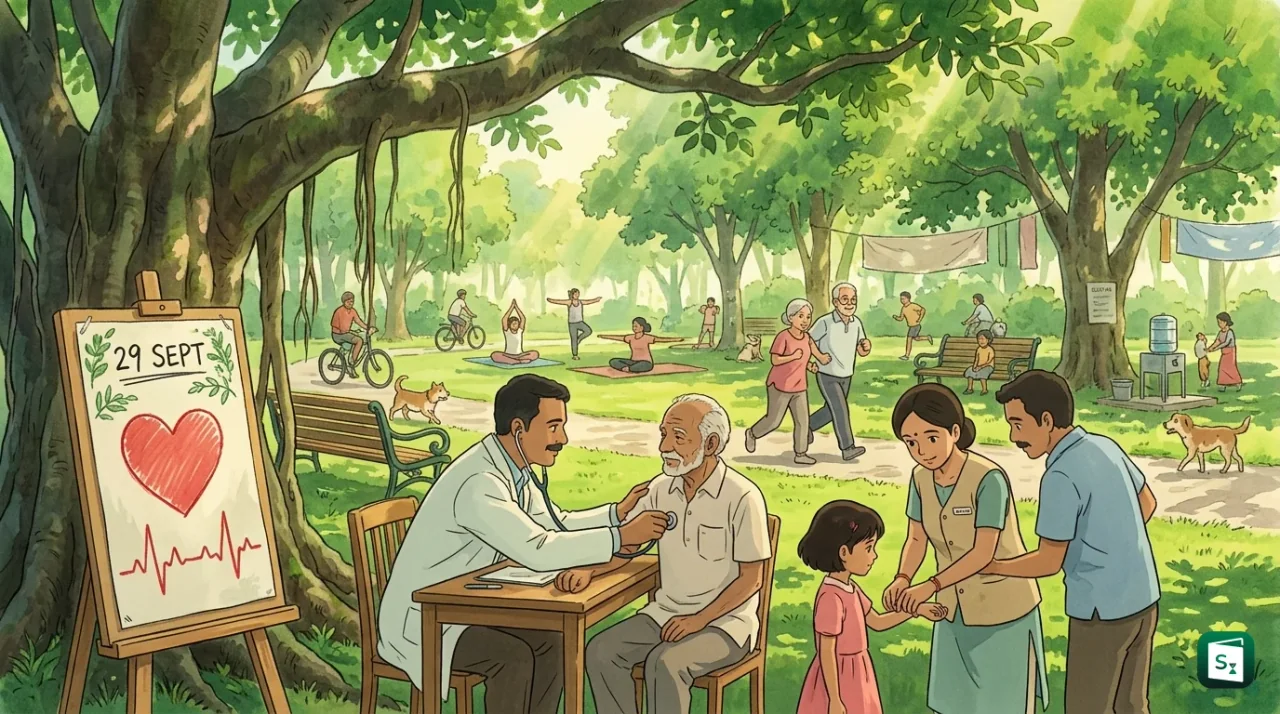
World Heart Day was observed across the world on 29 September 2026 with the theme Don’t Miss a Beat. The World Heart Federation (WHF), based in Geneva, led the global campaign to draw attention to hidden symptoms of heart disease. The day reminds people and governments that heart disease remains the world’s biggest killer, yet most of its burden can be prevented with early action.
What Is World Heart Day?
World Heart Day is a global awareness day observed every year on 29 September to inform people about cardiovascular disease (CVD), a group of disorders of the heart and blood vessels that includes heart attack and stroke. The World Heart Federation leads the day with support from the World Health Organization (WHO) and brings together heart foundations, medical societies and patient groups in more than 100 countries.
The aim is simple. It asks individuals to check their own risk and adopt heart healthy habits. It also asks governments to give heart health a higher place in public policy, with better detection, treatment and access to care. Over the years, it has grown into the largest public platform in the world for heart health messages.
When Is World Heart Day 2026?
World Heart Day 2026 was observed on Monday, 29 September 2026. The date is fixed, so the day falls on 29 September every year. The theme for 2026 was Don’t Miss a Beat.
The theme continues from 2025, when the Federation first used it to mark 25 years of World Heart Day. The repeat in 2026 keeps the focus on one idea. Heart disease often hides in plain sight, and missed signs cost lives. Search interest for the 2026 edition started rising sharply from August 2026, which shows how schools, hospitals and community groups begin preparations weeks before the final week of September.
Why Is World Heart Day Celebrated on 29 September?
World Heart Day is celebrated on 29 September to give countries a common date to speak about heart health and push for stronger prevention. The idea came from Spanish cardiologist Antoni Bayes de Luna, who was President of the World Heart Federation from 1997 to 1999. He proposed the day in 1999 after talks with member foundations and societies across the world.
The Federation planned the first observance with the World Health Organization and UNESCO (United Nations Educational, Scientific and Cultural Organization). At first, the day was kept on the last Sunday of September. So the first World Heart Day was held on 24 September 2000 with the slogan Let it Beat, which linked physical activity with a healthy heart. The launch gained wide attention because it coincided with the Sydney Olympic Games and was backed by Queen Sofia of Spain and Juan Antonio Samaranch, then President of the International Olympic Committee. A special music and dance event in Barcelona added to the reach.
From 2011 onward, the Federation fixed the date as 29 September to give the campaign a stable identity. Each year carries a fresh focus within the same larger goal. Early themes spoke about physical activity, women and heart disease, children and heart health, and knowing personal risk. Later campaigns used short calls such as Use Heart, Know Heart and Use Heart for Action. The table below traces this journey in brief.
| Year | Milestone or Theme Focus |
|---|---|
| 1999 | Idea proposed by Antoni Bayes de Luna |
| 2000 | First observance on 24 September, slogan Let it Beat |
| 2003 to 2004 | Focus on women, and then on children and young people |
| 2008 to 2009 | Focus on Know Your Risk and healthy workplaces |
| 2011 | Date fixed as 29 September every year |
| 2020 to 2022 | Use Heart series on compassion, connection and care for every heart |
| 2023 | Use Heart, Know Heart, stress on knowing personal risk |
| 2024 | Use Heart for Action, call for national heart health plans |
| 2025 | Don’t Miss a Beat, 25th anniversary edition |
| 2026 | Don’t Miss a Beat continued, focus on hidden symptoms |
Who Organises World Heart Day?
The World Heart Federation organises World Heart Day. The Federation is a non governmental body based in Geneva, Switzerland and serves as the leading non governmental partner of the WHO for heart disease prevention.
The Federation was formed in 1978 through the merger of the International Society of Cardiology and the International Cardiology Federation. The merged body was first called the International Society and Federation of Cardiology. It took the present name, World Heart Federation, in 1998 during the World Congress of Cardiology in Rio de Janeiro.
Today the Federation connects more than 200 heart foundations, scientific societies and patient groups in over 100 countries. Its stated mission is cardiovascular health for everyone. It works through advocacy, training and sharing of science, with a special focus on low and middle income countries where the burden is highest. The President of the Federation is Prof. Jagat Narula (as of September 2026), with headquarters at Rue de Malatrex in Geneva.
What Does the 2026 Theme Don’t Miss a Beat Mean?
The 2026 theme Don’t Miss a Beat warns that heart disease can stay silent until it turns serious. A heart problem does not always start with strong chest pain. Breathlessness, unusual tiredness, swelling in the legs, irregular pulse, dizziness and discomfort in the neck, jaw or arm can also point to trouble. The campaign says people should see such signs early instead of ignoring them.
The Federation built the 2026 campaign around three clear calls.
First, see the signs. The Federation released an Are You Heart Smart Quiz on its website and app. The quiz tests knowledge of myths, hidden symptoms and risk factors and asks users to share results with the hashtag #DontMissABeat.
Second, protect your heart. The message lists daily steps that lower risk. These include regular movement, a balanced diet low in salt and trans fat, quitting tobacco, limiting alcohol, controlling blood pressure, blood sugar and cholesterol, getting enough sleep and managing stress. The Keep the Beat challenge asked people through September to pledge a small habit such as a daily walk, cycling to work or a change at dinner.
Third, demand action. The Federation points out that fewer than 20 countries have a standalone national plan for heart disease, even though it is the top cause of death. Through a global open letter and petition, it urged every government to adopt a heart health plan and ensure fair access to detection and treatment. The Federation also declared 2026 as the Year of Neglected Cardiac Diseases to bring less discussed conditions such as rheumatic heart disease and congenital heart defects into the main debate.
Why Heart Health Needs Urgent Attention
Cardiovascular disease is the leading cause of death in the world. The WHO estimates that about 19.8 million people died from CVD in 2022, which was close to 32 percent of all deaths in that year. About 85 percent of these deaths were due to heart attack and stroke. More than three quarters of them took place in low and middle income countries, where early testing and regular treatment are often missing.
Up to 80 percent of premature heart attacks and strokes can be prevented, according to global heart health reports. Yet progress has slowed. Death numbers rose from about 12.1 million in 1990 to over 20 million in 2021 because populations are growing and ageing, even as age adjusted rates fell faster in rich countries than in poorer ones.
| Fact | Figure |
|---|---|
| Share of all global deaths due to CVD, 2022 | About 32 percent, 19.8 million deaths |
| Share of CVD deaths due to heart attack and stroke | About 85 percent |
| Share of CVD deaths in low and middle income countries | More than 75 percent |
| Premature CVD share among early deaths from non communicable diseases | About 38 percent |
| Premature heart attacks and strokes that can be prevented | Up to 80 percent |
India carries a large part of this load. The World Heart Observatory recorded 3,165,172 deaths from CVD in India in 2024. Studies note that heart disease in India starts at least a decade earlier than in Western populations, and more than half of CVD deaths in India occur before the age of 70. High blood pressure, high blood sugar, tobacco use, unhealthy diets high in salt and fat, physical inactivity, air pollution and high cholesterol are the main drivers.
The WHO South East Asia Region reports that eight people die every minute due to CVD in the region and almost half of these deaths are premature, in people below 70 years of age. As many as 85 percent of people living with hypertension and diabetes in the region do not have these conditions under control. India has responded with large primary care efforts, legislation against industrially produced trans fat, tobacco control under the MPOWER package, and a national target under the SEAHEARTS initiative to bring millions living with hypertension and diabetes under protocol based care.
How Is World Heart Day Observed in India and the World?
World Heart Day is marked by health camps, walks, school events and media drives. Hospitals set up free ECG, blood pressure, blood sugar and cholesterol checks. Medical colleges hold talks on CPR (cardiopulmonary resuscitation) and the use of AED (automated external defibrillator), a portable device that gives an electric shock to restart a normal heart rhythm. Schools organise poster making, debates, runs and quizzes.
In 2026, hospitals across Indian cities offered free ECG screening in housing societies, offices and community centres. Walkathons were held in several cities, including a Don’t Miss a Beat walk in Jammu from Bikram Chowk to the Government Super Speciality Hospital. In Bengaluru, nursing colleges ran basic life support training for about 160 students. In Kashmir, the Central University of Kashmir held a programme on prevention, diagnostics and community awareness. Health groups also used the day to press employers to add annual heart checks to staff welfare and to press state health systems to add regular heart risk checks in primary health centres and wellness clinics.
Globally, the Federation asked people to share personal heart stories, take the Heart Smart Quiz, log activity on the World Heart Day app and sign the open letter seeking national heart plans. The campaign visual kit, logo and posters carried the Don’t Miss a Beat line, which also explains the high search interest around posters, images, slogans, speeches and activities in September each year.
Key Takeaways
- World Heart Day is observed every year on 29 September, and the 2026 edition used the theme Don’t Miss a Beat.
- The day was proposed by Antoni Bayes de Luna in 1999 and first observed on 24 September 2000 with the slogan Let it Beat.
- The World Heart Federation, formed in 1978 and based in Geneva, Switzerland, organises the day with support from the WHO and UNESCO.
- Cardiovascular disease caused about 19.8 million deaths in 2022, close to 32 percent of all global deaths, with up to 80 percent of premature cases preventable.
- India recorded 3,165,172 CVD deaths in 2024, with heart disease starting earlier and causing high premature loss before age 70.