World Rivers Day 2026 was observed on 27 September, the fourth Sunday of September, with participation from more than 100 countries. The global celebration highlighted the values of rivers for drinking water, food, livelihoods and biodiversity and called for better care of degraded waterways. The 2026 theme, waterways in our communities, placed the focus on protecting healthy rivers and restoring damaged ones close to where people live.
When Is World Rivers Day Celebrated in 2026?
World Rivers Day is observed on the fourth Sunday of September every year. In 2026, World Rivers Day fell on 27 September, while in 2025 it was observed on 28 September. The rule of the fourth Sunday keeps the date flexible but ensures a weekend celebration for community events worldwide.
World Rivers Day follows a weekend rule rather than a fixed calendar date, so the date shifts each year but always falls in late September. This timing helps schools, local bodies and volunteer groups organise outdoor events such as cleanups and riverside walks. The annual frequency has been maintained without break since the first global celebration in 2005.
| Year | Date | Day |
|---|---|---|
| 2024 | 22 September | Sunday |
| 2025 | 28 September | Sunday |
| 2026 | 27 September | Sunday |
What Is World Rivers Day?
World Rivers Day is a global celebration of the world’s waterways observed in more than 100 countries. It highlights the many values of rivers for water, food, energy, transport and nature. It also builds public awareness and encourages improved care, conservation and restoration of rivers facing pollution and climate pressure.
World Rivers Day treats rivers as living systems that support cities, farms, fisheries, forests and oceans. The celebration reminds people that rivers in almost every country face threats from pollution, over extraction, encroachment, dams and changing rainfall patterns. Only active public involvement, from local cleanups to better policies, can keep them healthy for the years ahead. The founder of the day described rivers as the arteries of the planet and as lifelines in the truest sense.
How World Rivers Day Began
World Rivers Day grew out of BC Rivers Day, a provincial celebration started in western Canada in 1980 by river advocate Mark Angelo. Angelo, a Canadian conservationist from Burnaby in British Columbia, first organised a cleanup float trip on the Thompson River with about 40 volunteers. The idea caught on quickly, and within a few years almost every community in the province held its own rivers event.
In 2005, the United Nations launched the Water for Life Decade, a ten year programme from 2005 to 2015 to build awareness for better care of water resources. Angelo proposed a world level rivers day based on the British Columbia model. Agencies of the United Nations saw a strong fit with the aims of the decade and approved the proposal. River groups around the world then came together to organise the first global event in 2005 across dozens of countries.
Since that first event, World Rivers Day has grown into one of the largest environmental celebrations on the planet. The 2026 observance was the 21st annual World Rivers Day, while BC Rivers Day marked its 46th anniversary in the same year. Angelo, who later served as the inaugural chair of the Rivers Institute at the British Columbia Institute of Technology (BCIT), has paddled close to 1,000 rivers in more than 100 countries and has received the Order of Canada and the Order of British Columbia for his conservation work.
World Rivers Day 2026 Theme
The theme for World Rivers Day 2026 was waterways in our communities. The theme asked people to value the streams, creeks and rivers that run through their own towns and cities. It stressed two linked goals, to protect rivers that remain in a healthy state and to restore those that were damaged in the past.
Many events also highlighted smaller focus areas within this broad theme. One focus was the impact of climate change on rivers, from floods and droughts to melting glaciers that feed Himalayan rivers. Another focus was the link between rivers and oceans, since about 80 percent of ocean plastic reaches the sea through land runoff, drains and rivers. The 2024 celebration had used the theme Waterways of Life, which carried a similar message about rivers as the base of human and ecological health.
How the World Celebrates Rivers Day
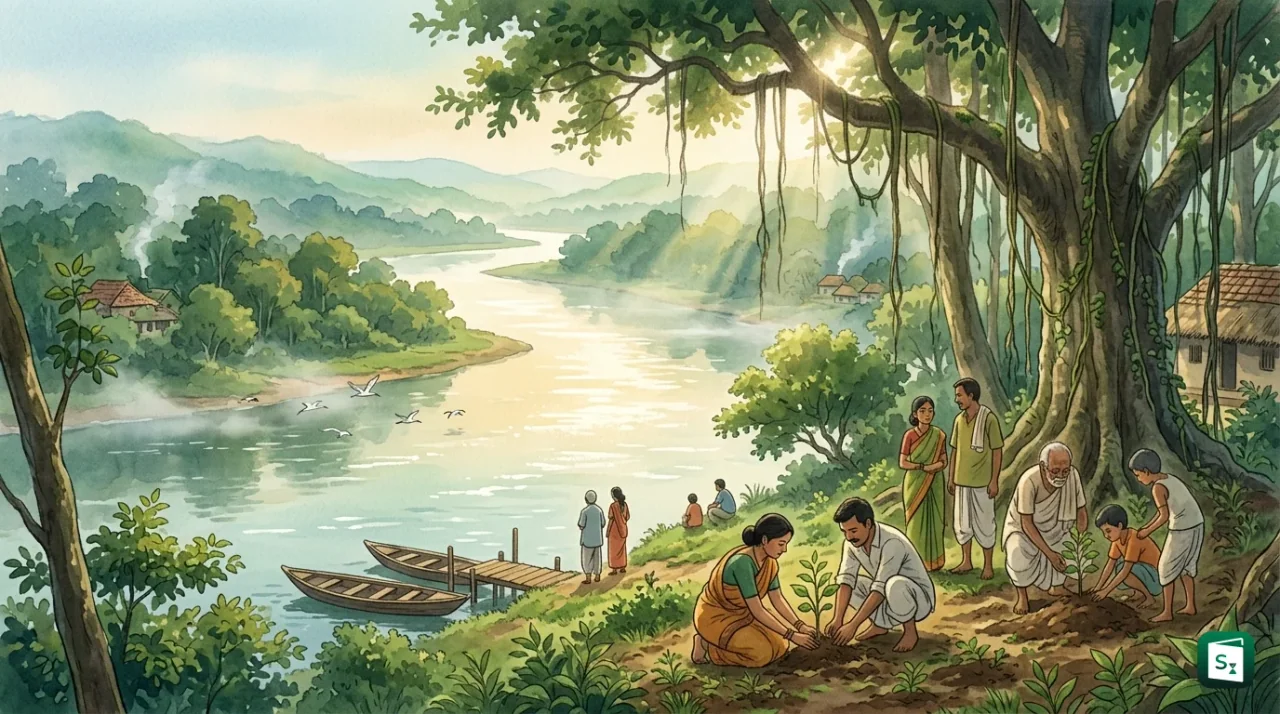
World Rivers Day is marked by physical and virtual events across six continents, from Canada and England to India, Bangladesh, Australia, Nigeria and Dominica. Common activities include stream cleanups, tree planting on riverbanks, removal of fish barriers, habitat restoration, educational outings, riverside picnics, seminars and community festivals. Schools often hold drawing, poster making, essay, speech and quiz contests to connect students with their local river.
In India, local groups have organised lake walks, such as the Shamirpet Lake walk near Hyderabad, and hillside cleanups, such as the Bhagsu riverside cleanup at Dharamshala. In Canada and the United Kingdom, many groups use the day for practical restoration, such as improving fish passage and cleaning urban creeks. Event organisers encourage every community to start its own simple action and then share the story so others can learn from it.
Indian Rivers System in Focus
India’s drainage is commonly divided into Himalayan rivers, which flow all year with rain and snowmelt, and peninsular rivers, which depend mainly on monsoon rain. The Ganga-Brahmaputra-Meghna basin is the largest river basin in India, with a catchment of about 11 lakh square kilometres, which is more than 43 percent of the catchment of all major rivers in the country. The country has 12 major river basins with a catchment of 20,000 square kilometres and above, and the total catchment of these basins is about 25.3 lakh square kilometres.
The Ganga, about 2,525 kilometres long, rises as the Bhagirathi from the Gangotri Glacier in Uttarakhand and becomes the Ganga at Devprayag where it meets the Alaknanda. Its largest tributary, the Yamuna, rises at the Yamunotri Glacier and joins the Ganga at Prayagraj. The Brahmaputra, about 2,900 kilometres long in total, starts as the Yarlung Tsangpo near Mount Kailash in Tibet, enters Arunachal Pradesh as the Dihang, flows through Assam and then enters Bangladesh as the Jamuna before joining the Ganga system and draining into the Bay of Bengal.
Among peninsular rivers, the Godavari, about 1,465 kilometres long, is the longest and is often called the Dakshin Ganga. It rises at Trimbakeshwar near Nashik in Maharashtra. The Krishna, about 1,400 kilometres long, rises at Mahabaleshwar and the Narmada, about 1,312 kilometres long, rises at Amarkantak in Madhya Pradesh and flows west into the Arabian Sea. Most east flowing rivers form deltas on the east coast, while west flowing rivers such as the Narmada and Tapi form estuaries. Majuli in Assam, formed by the Brahmaputra, is one of the largest river islands in the world.
Major World Rivers List and Facts
The debate on the longest river centres on the Nile in Africa and the Amazon in South America. The Nile, which flows north into the Mediterranean Sea, is usually listed at about 6,650 kilometres from its farthest stream in Burundi, with its main source in Lake Victoria. The Amazon, which flows east into the Atlantic Ocean, is listed at about 6,400 kilometres to 6,992 kilometres depending on how its farthest source in the Peruvian Andes and its distant mouth are measured. The Amazon is clearly the largest river by volume of discharge, releasing about 209,000 cubic metres per second.
The next longest systems are the Yangtze in China at about 6,300 kilometres and the Mississippi-Missouri system in the United States at about 6,275 kilometres. Other very long rivers include the Yenisei, Yellow River or Huang He, Ob-Irtysh, Parana, Congo and Amur. The Congo is the deepest river in the world and the second largest by discharge, while the Yellow River is known for heavy silt and floods.
| River | Continent | Approx. Length | Drains Into |
|---|---|---|---|
| Nile | Africa | 6,650 km | Mediterranean Sea |
| Amazon | South America | 6,400 km | Atlantic Ocean |
| Yangtze | Asia | 6,300 km | East China Sea |
| Mississippi-Missouri | North America | 6,275 km | Gulf of Mexico |
| Yellow River | Asia | 5,464 km | Bohai Sea |
| Congo | Africa | 4,700 km | Atlantic Ocean |
| Ganga | Asia | 2,525 km | Bay of Bengal |
World Rivers Day vs Related Observances
World Rivers Day is often confused with two March observances, but the three days differ in date, aim and history. World Water Day is observed every year on the fixed date of 22 March. It became a United Nations observance in 1993 after the 1992 Earth Summit in Rio de Janeiro and focuses on freshwater and sanitation for all. The 2026 theme for World Water Day was Water and Gender, with the slogan Where water flows, equality grows, to draw attention to women’s roles in water management and the goal of clean water and sanitation for all by 2030 under Sustainable Development Goal 6.
The International Day of Action for Rivers is observed on 14 March every year. It was adopted in March 1997 at the first International Meeting of People Affected by Dams in Curitiba in Brazil and is led by river communities and groups such as International Rivers. Its 2026 theme was Protect Rivers, Protect People, with a strong focus on free flowing rivers, dam impacts and community rights. In simple terms, World Water Day in March covers all freshwater issues, the Day of Action in March centres on dams and community defence of rivers, and World Rivers Day in September celebrates rivers and promotes care and restoration through public events.
Key Takeaways
- World Rivers Day 2026 was observed on 27 September, the fourth Sunday of September, in more than 100 countries.
- World Rivers Day was proposed by Canadian river advocate Mark Angelo and first observed globally in 2005 during the UN Water for Life Decade.
- The global day grew from BC Rivers Day, started by Angelo in 1980 in British Columbia, Canada.
- The 2026 theme was waterways in our communities, focused on protecting healthy rivers and restoring damaged ones.
- The Nile (about 6,650 km) is usually listed as the longest river, while the Amazon is the largest river by discharge volume.
- World Water Day is observed on 22 March, while the International Day of Action for Rivers is observed on 14 March.