On 4 October 2026, Uttar Pradesh Chief Minister Yogi Adityanath announced in Bhadohi that Bhadohi district will now be officially known as Sant Ravidas Nagar Bhadohi. The new combined name honours 15th century Bhakti saint Sant Ravidas while retaining the globally recognised Bhadohi name linked to its carpet industry. The decision completes a promise first made in Varanasi on 29 July 2026 during events marking the saint’s 650th birth anniversary.
What Is the New Name and What Was Announced?
The Uttar Pradesh government has changed the official name of Bhadohi district to Sant Ravidas Nagar Bhadohi. The order keeps both parts in the name. Sant Ravidas Nagar honours the saint, and Bhadohi preserves the older place identity.
Chief Minister Yogi Adityanath made the formal announcement on 4 October 2026 at Bhikharipur Abhayanpur in Bhadohi. The event also covered the inauguration and foundation laying of 112 development projects worth about ₹1,340 crore, including 65 completed projects worth about ₹440.84 crore and 47 new projects worth about ₹899.27 crore.
The Chief Minister had first promised the change on 29 July 2026, which was Guru Purnima day. The promise came at the launch of the Shri Guru Ravidas Maharaj Samrasta Sankalp Abhiyan in Varanasi. The campaign marks the 650th Prakash Parv (birth anniversary) of Sant Ravidas and will conclude on Maghi Purnima on 20 February 2027. Deputy Chief Minister Keshav Prasad Maurya was also present at the Varanasi programme and confirmed that the government would restore the Sant Ravidas Nagar name.
Where Is Bhadohi and Is It a District?
Bhadohi is a district in eastern Uttar Pradesh in northern India. It lies in the plains of the Ganga river, about 42 to 45 km west of Varanasi. The district headquarters is at Gyanpur. It is part of Mirzapur division.
The district covers 1,015 sq km, which makes it the smallest district by area in Uttar Pradesh. The Ganga forms its southwestern border, while the Varuna and Morva are the other main rivers. Bhadohi town is located on the Varanasi to Delhi rail line and on the Varanasi to Prayagraj road link. The nearest major airport is Lal Bahadur Shastri Airport at Varanasi, connected by a four lane road.
Administratively, the Uttar Pradesh government organises the district into 3 tehsils and 6 development blocks. The three tehsils are Bhadohi, Gyanpur and Aurai. The six blocks are Bhadohi, Suriyawan, Gyanpur, Deegh, Abholi and Aurai. There are more than 1,000 populated villages, along with 489 gram panchayats. The district has nine police stations and a mix of nagar palika parishads and nagar panchayats in its towns.
| District Fact | Detail |
|---|---|
| State | Uttar Pradesh |
| Division | Mirzapur |
| Headquarters | Gyanpur (at Sarpataha) |
| Largest town | Bhadohi (Pin Code 221401) |
| Area | 1,015 sq km |
| Population (Census 2011) | 15,78,213 |
| Borders | Jaunpur (north), Varanasi (east), Mirzapur (south), Prayagraj (west) |
| Lok Sabha seat | Bhadohi (also recorded as Sant Ravidas Nagar) |
| Vehicle registration | UP-66 |
When Was Bhadohi District Established?
Bhadohi district was created on 30 June 1994 as the 65th district of Uttar Pradesh. It was carved out of the western part of Varanasi district by the then state government led by Mulayam Singh Yadav.
The name Bhadohi itself is old. Local history links it to the Bhar Raj, which had Bhadohi as its capital. Ruined mounds and old tanks named after Bhar rulers are still cited as traces of that past. During the rule of Mughal Emperor Akbar, Bhadohi was made a dastur in the sarkar of Allahabad. By the 15th century, Monas Rajputs gained control, and later the area passed to the Benares estate. In 1911, Bhadohi came under the newly created princely state of Benares under Maharaja Prabhu Narayan Singh and remained linked to Benares till 1947.
After 1994, the district name changed several times. Bahujan Samaj Party chief Mayawati, after coming to power, renamed the district as Sant Ravidas Nagar to honour the saint. The change is recorded in 1994 announcements and a government order dated 4 December 1997 in different official summaries. On 12 November 1999, Chief Minister Ram Prakash Gupta added Bhadohi to the name to protect the carpet brand, making it Sant Ravidas Nagar Bhadohi. On 6 December 2014, the Cabinet led by Chief Minister Akhilesh Yadav decided to restore the simple name Bhadohi on the recommendation of the district magistrate. The October 2026 decision returns to the combined form Sant Ravidas Nagar Bhadohi.
| Year | Event |
|---|---|
| 30 June 1994 | Bhadohi created as 65th district from Varanasi |
| 1994 to 1997 | Renamed Sant Ravidas Nagar by Mayawati government |
| 12 November 1999 | Renamed Sant Ravidas Nagar Bhadohi by Ram Prakash Gupta government |
| 6 December 2014 | Renamed back to Bhadohi by Akhilesh Yadav government |
| 29 July 2026 | Promise to restore Sant Ravidas Nagar name announced in Varanasi |
| 4 October 2026 | Formally renamed Sant Ravidas Nagar Bhadohi |
Who Was Sant Ravidas?
Sant Ravidas, also called Raidas, was a 15th century mystic poet and social reformer of the Bhakti movement. He was born at Seer Govardhanpur near Varanasi in present day Uttar Pradesh. Tradition places his birth on Magh Purnima, with scholars citing years such as 1377 CE and 1450 CE because exact records from that period are limited.
Sant Ravidas belonged to a family of leather workers. His father is named as Santokh Dass and his mother as Kalsi in most accounts. He worked as a shoemaker and earned his living through manual work, which later gave moral force to his teaching that honest labour is itself worship. Tradition counts him among the twelve disciples of saint Ramanand. He is also remembered as a contemporary who exchanged ideas with Sant Kabir and Guru Nanak.
Sant Ravidas taught Nirgun Bhakti, which means devotion to a formless God beyond rituals and outward display. He rejected caste hierarchy and taught equality of all people. His most famous vision is Begumpura, a sorrowless city where all people live without fear, hunger or division by caste. About 40 of his hymns are included in the Guru Granth Sahib, the holy scripture of Sikhism. His verses are also preserved in the Panch Vani tradition and in the Amritbani Guru Ravidass Ji. Rajput queen Mirabai is remembered as his disciple.
The main shrine linked to his life is the Shri Guru Ravidass Janam Asthan Mandir at Seer Govardhanpur in Varanasi, believed to be his birthplace. His birth anniversary, Sant Ravidas Jayanti, is observed every year on Magh Purnima. The Uttar Pradesh government has linked the 2026 renaming to his 650th birth anniversary, while the Union government has also named Adampur airport in Punjab as Sri Guru Ravidas Ji Airport and Ayodhya airport after Maharishi Valmiki as part of honouring saint traditions.
What Is Bhadohi Famous For?
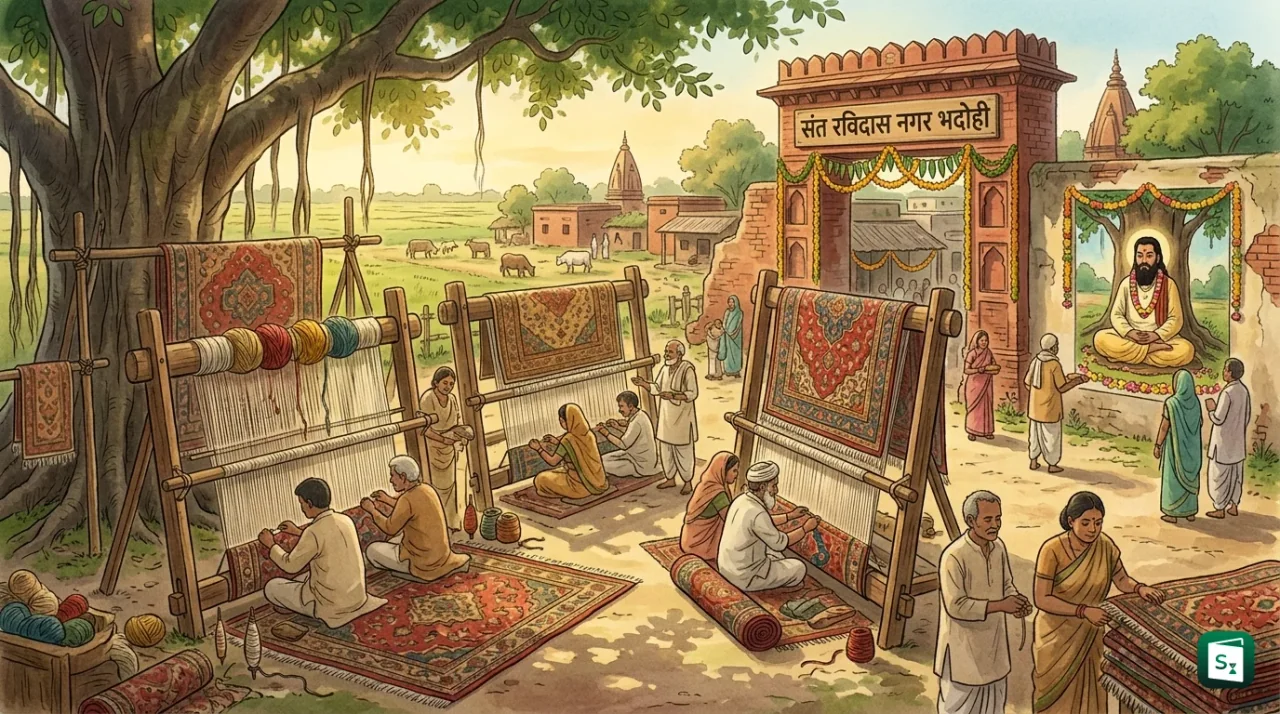
Bhadohi is famous as the Carpet City of India. It is home to the largest hand knotted carpet weaving hub in South Asia. Weaving in the Mirzapur Bhadohi belt dates back to the 16th century during the reign of Mughal Emperor Akbar, when Iranian weaving skills blended with local craft.
The industry is almost fully export oriented. Uttar Pradesh accounts for about 60 percent of India’s carpet exports, and Bhadohi is the core of that share. Estimates place the national handmade carpet turnover around ₹17,740 crore, with Bhadohi contributing a large part. About 98 percent of Bhadohi’s production is exported, mainly to the United States and Europe, while domestic use is very small. The Mirzapur Bhadohi region engages around 20 to 32 lakh people, including more than 10 lakh weavers in and around Bhadohi, with a large share of home based workers and about one fifth women workers.
Bhadohi carpets carry a Geographical Indication (GI) tag. A GI tag is an official label that links a product’s quality and reputation to its place of origin. The Bhadohi handmade carpet tag covers nine districts of eastern Uttar Pradesh, including Bhadohi, Mirzapur, Varanasi, Ghazipur, Sonebhadra, Kaushambi, Prayagraj, Jaunpur and Chandauli. Well known varieties include cotton dhurry, Chhapra Mir carpets and Persian pattern hand knotted carpets.
The state has built the Carpet Expo Mart on 7.5 acres at Bhadohi to support exports. The mart has 94 permanent shops, a 7,000 sq metre exhibition hall and a design studio, and is managed with support from the Carpet Export Promotion Council (CEPC). The council organises the India Carpet Expo, one of Asia’s largest handmade carpet fairs, twice a year. Bhadohi is also the One District One Product (ODOP) district for carpets. ODOP is a Uttar Pradesh scheme under which each district promotes one special product for jobs and exports.
This export link explains the combined name. Carpet exporters feared that dropping Bhadohi would weaken the Bhadohi carpet brand in foreign markets. Retaining Bhadohi along with Sant Ravidas Nagar protects that market identity while adding the saint’s name.
Uttar Pradesh District Framework and Position of Bhadohi
Uttar Pradesh has 75 districts grouped into 18 divisions for administration (as of October 2026). Each district is headed by a District Magistrate from the Indian Administrative Service, with a Superintendent of Police heading district police. Each division is headed by a Divisional Commissioner.
Bhadohi belongs to Mirzapur division, along with Mirzapur and Sonbhadra. Some older lists placed Bhadohi under Varanasi division because it was carved out of Varanasi, but current district records place it in Mirzapur division. The state capital is Lucknow, about 234 km from Bhadohi. Uttar Pradesh sends 80 members to the Lok Sabha and 31 members to the Rajya Sabha, the highest for any state.
The renaming has political and social meaning. Bahujan Samaj Party president Mayawati welcomed the 2026 announcement and thanked the state government, noting that her government had created the Sant Ravidas Nagar identity. She also requested restoration of other names from her tenure, such as Kanshiram Nagar and Bhimnagar, ahead of Kanshiram’s death anniversary on 9 October. The state government has presented the move as part of honouring saints and social reformers, along with plans for Sant Ravidas residential schools, slum development schemes in the names of Sant Ravidas and Maharishi Valmiki, and leather parks named after Sant Ravidas.
Key Takeaways
- Bhadohi district in Uttar Pradesh is now officially named Sant Ravidas Nagar Bhadohi, as announced on 4 October 2026.
- Bhadohi was created on 30 June 1994 as the 65th district of Uttar Pradesh after separation from Varanasi.
- The district headquarters is at Gyanpur, the area is 1,015 sq km and the 2011 Census population was 15,78,213.
- Sant Ravidas was a 15th century Bhakti saint born at Seer Govardhanpur near Varanasi who taught equality and Nirgun Bhakti.
- Bhadohi is known as Carpet City and its handmade carpets hold a GI tag covering nine districts of eastern Uttar Pradesh.
- Uttar Pradesh has 75 districts and 18 divisions, and Bhadohi is part of Mirzapur division.