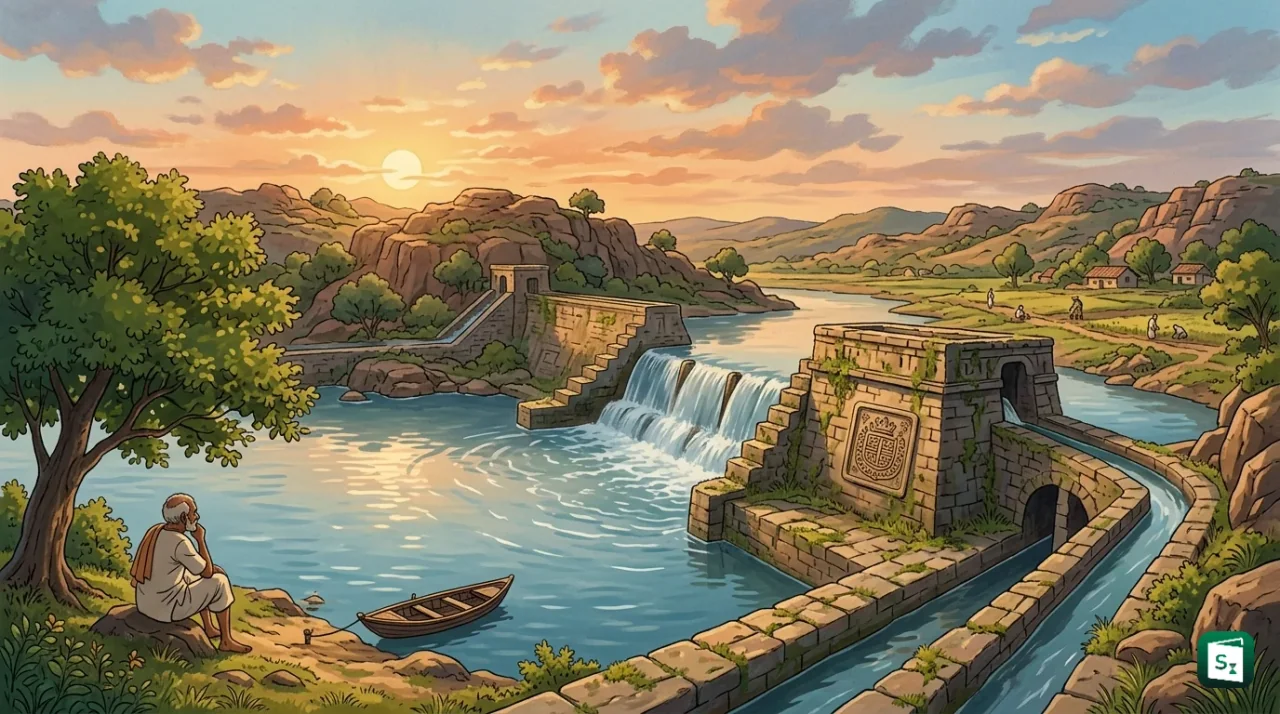
The 140-year-old Parichha Weir across the Betwa river in Jhansi, Uttar Pradesh, has been designated a World Heritage Irrigation Structure (WHIS) by the International Commission on Irrigation and Drainage (ICID). The honour, which recognises irrigation structures more than a century old that are still serving their original purpose, will be formally presented in France in October 2026. The weir was originally proposed in 1855 by Captain Strachey to bring water to the drought-prone Bundelkhand region.
What Is the World Heritage Irrigation Structure Recognition?
The International Commission on Irrigation and Drainage (ICID) was established on 24 June 1950 as a scientific, technical, not-for-profit international organisation. It brings together experts in irrigation, drainage, and flood management from around the world, and its headquarters is located in New Delhi, India. India is a founding member of the organisation.
In 2014, ICID launched a scheme to recognise historical irrigation structures of international significance. This works in a similar spirit to the UNESCO World Heritage Sites list, but it is focused specifically on water management heritage. Structures are judged by a Panel of Judges set up by ICID each year and, once selected, are entered into the ICID Register of Heritage Irrigation Structures and receive a plaque.
To qualify, a structure must generally be more than 100 years old, must continue to be functional, should contribute to food security, and should have archival value. A National Committee, which in India is the Indian National Committee on Irrigation and Drainage (INCID) headed by the chairman of the Central Water Commission (CWC), sends nominations to ICID. Nominations for 2026 closed on 31 May 2026, and the selected structures will be honoured during the 26th ICID International Congress and 77th International Executive Council (IEC) meeting to be held in Marseille, France, in October 2026.
How the Parichha Weir Came to Be Built
The idea of a canal system for Bundelkhand dates back to 1855, when Captain Strachey proposed the project after conducting a detailed survey of the region. The plan was put on hold after the uprising of 1857, which severely disrupted British administration across central India. Work finally began in 1881, at an estimated cost of about ₹40 lakh, and the weir was commissioned in 1886.
The weir is built in rubble-stone masonry and is 1,174 metres long, rising 16.8 metres above the riverbed. It consists of two main sections separated by a small island in the river. Over time, the installation of 318 steel falling shutters raised the storage capacity of its reservoir from 1,700 million cubic feet to 2,400 million cubic feet. Several original British-era features, including iron and wooden components from the time of its commissioning, are still preserved at the site.
A weir is a low barrier built across a river that raises the water level and diverts a portion of the flow into canals, without storing large quantities of water like a dam. The Parichha Weir serves as the headworks, meaning the intake point, of the Betwa Canal System, which distributes the diverted water through a vast network of channels.
The Betwa Canal System
The Betwa Canal System is one of the oldest and largest irrigation networks of central India. At its head, the canal has a designed discharge of 5,052 cusecs (a cubic foot per second). Around 30.9 km downstream of the weir, it splits into two main branches, the Kuthond Branch on the left and the Hamirpur Branch on the right.
The canal network extends over roughly 2,654 km and irrigates about 4,28,360 hectares of farmland. It serves parts of five districts across Uttar Pradesh and Madhya Pradesh, including Jhansi, Jalaun, and Hamirpur in Uttar Pradesh. The system has been in continuous operation for well over a century, which is a key reason it qualified for heritage recognition.
The weir also works with the Dhukwan Weir, built upstream between 1905 and 1909 as subsidiary storage, to maintain canal supplies during low-flow months. Another historic structure, the Sukwa-Dukwan Weir in Jhansi, was already placed on the ICID heritage list in 2022, making the Parichha Weir the second major structure from the Jhansi region to receive the honour.
Why Bundelkhand Needed This Water
Bundelkhand is a historic region of central India, now spread over 13 districts across two states. Seven of these districts, including Jhansi, Jalaun, Hamirpur, Lalitpur, Mahoba, Banda, and Chitrakoot, lie in Uttar Pradesh, while six, including Datia, Tikamgarh, Chhatarpur, Panna, Sagar, and Damoh, lie in Madhya Pradesh.
The region sits on a semi-arid plateau bounded by the Yamuna river in the north and the Vindhya range in the south. Its rivers are mostly seasonal, so the region depends heavily on the erratic monsoon. Historically, this made Bundelkhand one of the most drought-prone parts of India. Famines and scarcities in the nineteenth century caused repeated crop failures and migration, and it was precisely this vulnerability that prompted the British to plan an irrigation system for the region.
The Betwa river, on which the Parichha Weir stands, is the region’s lifeline. The river rises in the Vindhya range near Bhopal in Raisen district, Madhya Pradesh, and flows northeast before joining the Yamuna at Hamirpur in Uttar Pradesh. It is estimated to provide water to about half of Bundelkhand. Even today, the region faces severe water stress, with groundwater levels falling in several districts and agriculture remaining vulnerable to weak monsoons.
The Weir’s Many Roles Today
Beyond irrigation, the reservoir supplies cooling and process water to the adjoining Parichha Thermal Power Project, a coal-fired plant operated by the Uttar Pradesh Rajya Vidyut Utpadan Nigam Limited (UPRVUNL), with an installed capacity of 920 MW. The plant draws its water from the Betwa through the weir’s reservoir.
The weir has also become a popular tourist attraction. During the monsoon, water cascades spectacularly over its sluice gates, drawing visitors to the site near the town of Parichha, about 25 km from Jhansi on the road towards Kalpi.
The structure is also expected to play a role in the ambitious Ken-Betwa river-linking project, the first inter-river water transfer project under the National Perspective Plan for interlinking rivers. The project, which received Union Cabinet approval in December 2021, aims to transfer surplus water from the Ken river to the Betwa basin to irrigate parts of the drought-prone Bundelkhand region and provide drinking water. This plan to modernise and expand water supply in the region builds directly on the network that the Parichha Weir has anchored for nearly a century and a half.
India’s Presence on the WHIS List
The Parichha Weir is one of four Indian structures selected for the WHIS recognition in 2026. India has a strong record under the scheme, having received multiple awards each year in recent years, and the total number of Indian structures on the ICID heritage register has been steadily growing.
Among countries, Japan has the highest number of WHIS sites, followed by China, with India among the leading countries on the list. The recognition matters for more than prestige. Being listed draws the attention of governments to the need to preserve and maintain these structures, and ICID may also provide small-scale technical guidance to keep heritage structures safe and sustainable.
The WHIS tag for the Parichha Weir therefore highlights not just the engineering skill of the past, but the enduring value of a working water system that continues to feed the fields of Bundelkhand after more than a century of service. It also serves as a reminder that the region’s water problems are old, and that the answer lies in both preserving old assets and building new ones.
Key Takeaways
- The 140-year-old Parichha Weir on the Betwa river in Jhansi, Uttar Pradesh, has been designated a World Heritage Irrigation Structure (WHIS) by the International Commission on Irrigation and Drainage (ICID).
- The weir was originally proposed by Captain Strachey in 1855; construction began in 1881 at a cost of about ₹40 lakh, and the structure was commissioned in 1886.
- The weir is 1,174 metres long, rises 16.8 metres above the riverbed, and uses 318 steel falling shutters that raised the reservoir capacity to 2,400 million cubic feet.
- It forms the headworks of the Betwa Canal System, a network of about 2,654 km that irrigates roughly 4,28,360 hectares across five districts of Uttar Pradesh and Madhya Pradesh.
- The honour will be formally presented at the 26th ICID International Congress and 77th IEC meeting in Marseille, France, in October 2026.
- The International Commission on Irrigation and Drainage, established in 1950, is headquartered in New Delhi, and the Indian National Committee on Irrigation and Drainage (INCID) handles India’s nominations.
- The Parichha Weir is the second structure from the Jhansi region on the ICID heritage list, after the Sukwa-Dukwan Weir, which was recognised in 2022.