The National Institute of Indian Medical Heritage (NIIMH), Hyderabad, which works under the Central Council for Research in Ayurvedic Sciences (CCRAS) of the Ministry of Ayush, has signed a Memorandum of Understanding (MoU) with the Sevadhi Museum and Indological Research Institute (SEMIRI), Kottayam, Kerala. The agreement covers the systematic digitisation and preparation of a descriptive catalogue of SEMIRI’s collection of medical manuscripts. A dedicated team from NIIMH has already begun on-site digitisation work under the institute’s Collection, Digitization and Cataloguing of AYUSH Manuscripts and Rare Books project.
What Does the MoU Cover?
The partnership focuses on the medical manuscripts held by SEMIRI, a heritage and research facility in Kumaranalloor, near Kottayam in central Kerala. SEMIRI, which is managed by the Kumaranalloor Ooranma Devaswom (the trust that runs the local temple), protects a collection of more than 30,000 manuscripts. These include temple records and historically significant works connected with Ayurveda, as well as other branches of traditional knowledge.
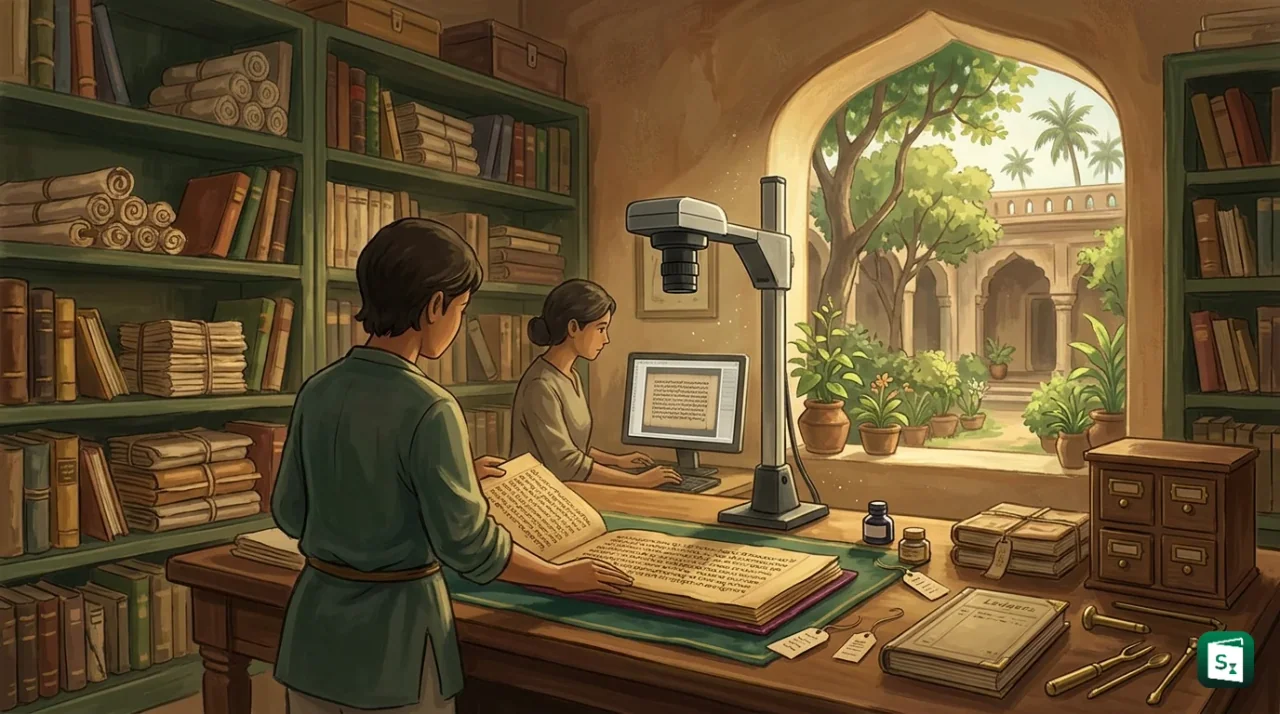
Under the agreement, NIIMH will apply its technical expertise in two main areas. First, it will create high-quality digital copies of hundreds of medical manuscripts, reducing the need for repeated physical handling of fragile originals. Second, it will prepare a descriptive catalogue, a structured record that captures details such as a manuscript’s title, author, subject, language, script, material, dimensions, number of folios, physical condition and provenance, wherever such information is available. These catalogue records will be prepared in the format used by the Ayush Manuscripts Advanced Repository (AMAR) portal.
A specialised expert team from CCRAS-NIIMH has already started meticulous on-site digitisation of the manuscripts. The work is being carried out under the institute’s Collection, Digitization and Cataloguing of AYUSH Manuscripts and Rare Books project.
Who Is NIIMH and What Does It Do?
The National Institute of Indian Medical Heritage (NIIMH) is the nodal institute of CCRAS for literary research and medico-historical studies. It is located in Gaddiannaram, Hyderabad, Telangana. Its mandate is to document the historical aspects of the AYUSH systems of medicine (Ayurveda, Yoga and Naturopathy, Unani, Siddha, Sowa Rigpa and Homoeopathy) as well as modern medicine.
NIIMH functions under the Central Council for Research in Ayurvedic Sciences (CCRAS), the apex autonomous body under the Ministry of Ayush for formulating, coordinating and promoting research in Ayurveda. CCRAS traces its roots to 1969, when the Central Council for Research in Indian Medicine and Homoeopathy was established. In 1978, it was split into separate research councils, with CCRAS taking charge of Ayurveda and Siddha. It was later renamed CCRAS, and today runs a network of around 30 institutes across the country.
A Legacy Built Over Seven Decades
The origins of NIIMH go back to 1956, when a Department of History of Medicine was established at Andhra Medical College, Visakhapatnam, before shifting to Hyderabad. In 1969, the department was handed over to the Indian Council of Medical Research (ICMR) and later came under the Central Council for Research in Indian Medicine and Homoeopathy. It was upgraded as the National Institute of Indian Medical Heritage on 15 December 2009 by the Department of Ayush.
The institute houses a medico-historical museum, a referral library with thousands of books and manuscripts, and digital repositories such as the AMAR portal, which has catalogued about 16,000 AYUSH manuscripts, and the Showcase of Ayurvedic Historical Imprints (SAHI) portal, which showcases nearly 800 medico-historical artefacts. In June 2024, the World Health Organization (WHO) designated NIIMH as a WHO Collaborating Centre for Fundamental and Literary Research in Traditional Medicine, making it the first such centre in this domain and the third WHO Collaborating Centre in traditional medicine in India. NIIMH also publishes the Journal of Indian Medical Heritage.
The Sevadhi Museum: A Repository of Kerala’s Heritage
The Sevadhi Museum and Indological Research Institute (SEMIRI) is a heritage and research facility dedicated to preserving the cultural, social and administrative history of Central Travancore. It is located inside the premises of the ancient Kumaranalloor Devi Temple in Kottayam district. The name “Sevadhi” is drawn from one of the nine treasures of Lord Kubera, the god of wealth in Hindu tradition, signifying a priceless storehouse of knowledge.
The institute houses a museum of temple history, a digitisation lab, a reference library for Indology, and a repository of hundreds of bundles of palm-leaf manuscripts. It also conducts courses and workshops in fields such as epigraphy (the study of inscriptions) and manuscriptology (the study of manuscripts). SEMIRI has already signed MoUs with a number of research institutes across the country to facilitate study and collaboration.
A Remarkable Discovery at Kumaranalloor
The collection at SEMIRI grew dramatically after a major discovery in February 2024. A large trove of palm-leaf manuscripts, most of them damaged, was found in the attic of the Kumaranalloor temple office. Over the following year, temple authorities, working with epigraphists, salvaged nearly 37,200 palm leaves, making it one of the largest recoveries of manuscripts from a temple in India.
Many of these documents are written in ancient scripts such as Vattezhuthu and Kolezhuthu, which are difficult to decipher, and only a small portion has been analysed so far. The collection includes not just medical texts but also temple records, land documents and rare works on astronomy, architecture and poetry. In November 2025, the Gyan Bharatam Mission under the Union Ministry of Culture approved SEMIRI as an independent research institute, formalising central support for its conservation efforts.
Why Digitisation Matters for Medical History
Palm leaves were used as writing material in the Indian subcontinent from early centuries BCE. In Kerala, scribes etched text onto dried and treated leaves using a sharp iron stylus called a narayam, and the leaves were then strung together into books known as thaliyola grantha or thaaliyola grantha. These manuscripts are fragile, and every physical handling can cause further damage to leaves that may already be brittle with age.
High-quality digital copies help protect the originals while keeping the knowledge accessible. For researchers, the SEMIRI collection is more than a record of old treatments. Its medical works can help trace the development of Ayurvedic thought, diagnostic practices, therapeutic methods and materia medica (the study of medicinal substances), as well as the scholarly traditions through which this knowledge was passed down generations.
A structured catalogue makes a practical difference for scholars. Often, researchers know that a collection exists but have little information about the individual works inside it. A detailed catalogue lets them identify potentially useful primary sources before undertaking deeper textual study. The resulting resources are expected to support historians of medicine, Ayurveda researchers and scholars working on Indian Knowledge Systems, while also creating material for future critical editions and scholarly publications.
Gyan Bharatam Mission: The Wider Umbrella
The NIIMH-SEMIRI partnership sits within the broader effort to preserve India’s manuscript heritage. The Gyan Bharatam Mission, announced in the Union Budget 2025-26, aims to survey, document and conserve more than one crore manuscripts lying with academic institutions, museums, libraries and private collectors across the country.
The mission is being implemented through the National Mission for Manuscripts (NMM), which was established in February 2003 by the Ministry of Culture, and its budget allocation was increased from ₹3.5 crore to ₹60 crore to accommodate the new mission. A national digital repository of Indian knowledge systems is also planned for sharing these materials. India is estimated to hold around one crore manuscripts, among the largest collections in the world, spanning many languages and scripts.
NIIMH has been working within this umbrella for years. The institute runs the AMAR portal, a web-based repository that provides structured metadata and descriptions of AYUSH manuscripts, rare books and periodicals. Earlier, NIIMH carried out projects to collect and digitise medical manuscripts from South India, Maharashtra and Madhya Pradesh, and published descriptive catalogues of its findings. The new MoU with SEMIRI extends this work to one of Kerala’s most significant manuscript collections.
Significance and the Way Forward
For SEMIRI, the collaboration offers a way to protect vulnerable material while opening new paths for academic study. The descriptive catalogue will make the collection easier for the outside world to find and use, potentially drawing more attention to Kerala’s heritage, particularly the material connected with Kumaranalloor and the wider Kottayam region.
For NIIMH and CCRAS, the agreement adds another major collection to ongoing efforts to document traditional medical knowledge in a form that modern researchers can locate, study and preserve for generations to come. It also deepens institutional ties in manuscriptology, digital preservation, textual studies and Ayurvedic literary research, going beyond simple scanning and cataloguing.
The challenge of manuscriptology is considerable. Ancient scripts, damaged leaves and fading text make transcription a slow, skilled task, and much of the work of interpretation remains deeply human. Yet the combination of digitisation, systematic cataloguing and wider digital access promises to keep these centuries of medical wisdom available for future study and research.
Key Takeaways
- The National Institute of Indian Medical Heritage (NIIMH), Hyderabad, signed an MoU with the Sevadhi Museum and Indological Research Institute (SEMIRI), Kottayam, to digitise and catalogue medical manuscripts.
- NIIMH is a unit of the Central Council for Research in Ayurvedic Sciences (CCRAS), an autonomous body of the Ministry of Ayush, and is located in Gaddiannaram, Hyderabad.
- SEMIRI, managed by the Kumaranalloor Ooranma Devaswom, safeguards more than 30,000 manuscripts, including about 37,200 palm leaves recovered from the attic of the Kumaranalloor Devi Temple in February 2024.
- The digitisation work is being carried out under the institute’s Collection, Digitization and Cataloguing of AYUSH Manuscripts and Rare Books project, and the catalogue will follow the format of the Ayush Manuscripts Advanced Repository (AMAR) portal.
- The Gyan Bharatam Mission, announced in the Union Budget 2025-26, aims to survey, document and conserve more than one crore manuscripts, and is implemented through the National Mission for Manuscripts established in 2003.
- NIIMH, established in 1956, was designated a WHO Collaborating Centre for Fundamental and Literary Research in Traditional Medicine in June 2024.