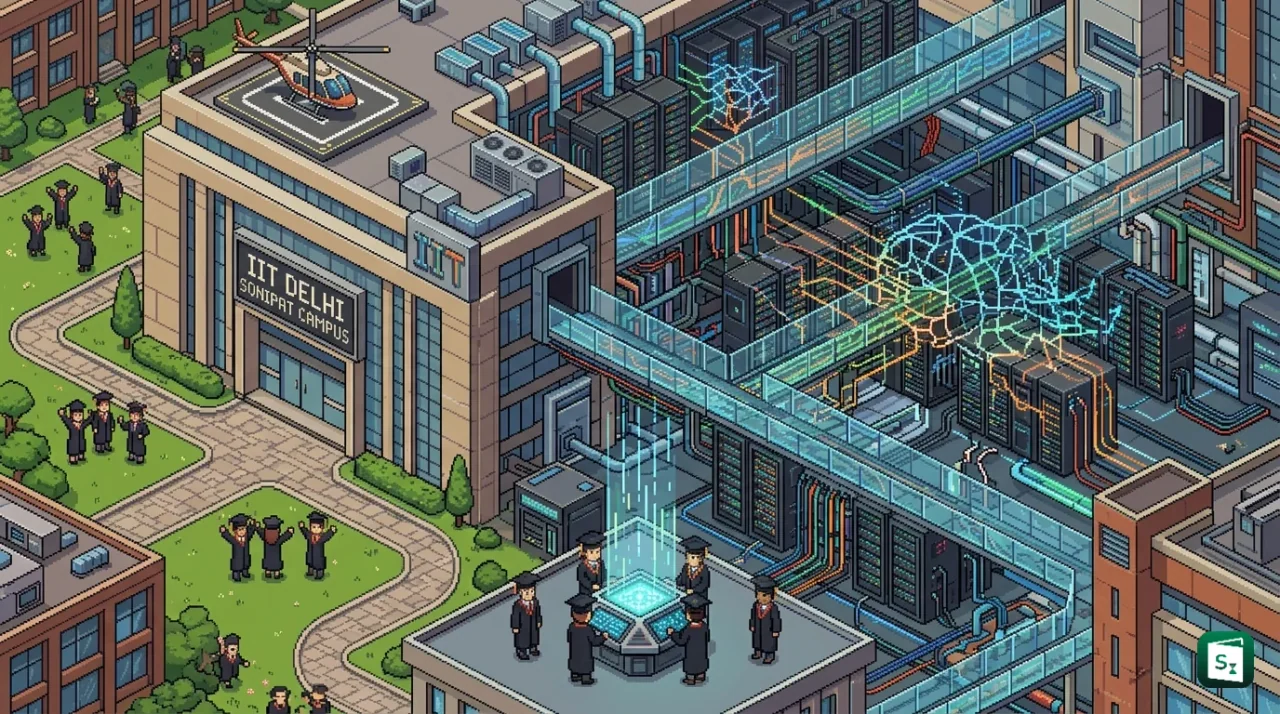
Prime Minister Narendra Modi inaugurated ‘Param Pragya’, an AI-enabled high-performance supercomputing facility, at the Sonipat (Haryana) campus of IIT Delhi on 8 August 2026. The inauguration happened during the 57th convocation of IIT Delhi, where he attended as the Chief Guest. The facility is designed to strengthen India’s research capacity in artificial intelligence, data science, and advanced computing.
What Is Param Pragya?
Param Pragya is an AI-powered high-performance computing (HPC) facility housed at IIT Delhi’s Sonipat campus in Haryana. The word Param comes from Sanskrit and means “supreme”, while Pragya means “wisdom” or “intelligence”. Together, the name reflects the facility’s purpose: supreme computing power for intelligent machines.
The facility is powered by 400 NVIDIA A100 80GB GPUs, which deliver an AI compute capacity of 250 AI petaflops. A petaflop equals one quadrillion floating-point operations per second, so this machine can perform 250 quadrillion such operations every second. In simpler terms, it can run the heavy mathematics needed to train large AI models at very high speed.
Alongside the processing power, Param Pragya comes with 10 petabytes of parallel file system storage, which lets researchers store and access enormous datasets quickly. The modern data centre that houses the machine draws about 800 kilowatts of power, ensuring stable, round-the-clock AI processing.
The 57th Convocation of IIT Delhi
The inauguration took place during IIT Delhi’s 57th convocation, held on 8 August 2026. More than 3,000 graduating students, including 587 PhD scholars, received their degrees at the ceremony. Among the PhD graduates, 245 were women. The youngest graduate was Anish Tanwar, a 19-year-old B.Tech student in Civil Engineering, while the oldest was Chandra Shekhar Prasad, a 74-year-old PhD graduate.
The Prime Minister presented some of the institute’s highest honours, including the President’s Gold Medal, the Director’s Gold Medal, the Dr Shankar Dayal Sharma Gold Medal, and the Perfect Ten Gold Medals. Union Education Minister Pralhad Joshi and NITI Aayog member Prof. Abhay Karandikar attended as guests of honour, while Harish Salve, Chairperson of the Board of Governors, presided over the ceremony.
In his address, the Prime Minister urged students to remain curious and keep learning, noting that their work over the next 30 to 35 years would shape India’s journey towards a Viksit Bharat, or developed India. He highlighted the government’s push for economic, technological, and industrial self-reliance and pointed to emerging sectors such as semiconductors, space, and drones as new opportunities for the youth.
The National Supercomputing Mission
Param Pragya is supported under the National Supercomputing Mission (NSM), India’s flagship programme for building domestic supercomputing capability. The NSM was launched in April 2015 with an outlay of ₹4,500 crore. It is jointly steered by the Ministry of Electronics and Information Technology (MeitY) and the Department of Science and Technology (DST).
The mission is implemented by the Centre for Development of Advanced Computing (C-DAC), based in Pune, and the Indian Institute of Science (IISc), Bengaluru. C-DAC, established in March 1988, is the nodal agency that designs, develops, and deploys most of India’s indigenous supercomputers.
The mission has progressed in three phases. Phase 1 focused on assembling supercomputers in India to build domestic skills. Phase 2 moved towards local manufacturing and software development. Phase 3 aims for full indigenisation, with the design, development, and manufacturing of all key components within the country.
Milestones Under the Mission
Under the NSM, 37 supercomputers with a cumulative capacity of about 39 petaflops have been commissioned across academic institutions, research labs, and government organisations. The most notable of these is PARAM Siddhi, a 6.5 petaflop system at C-DAC, Pune, which has served as India’s national AI facility.
The mission has also delivered key indigenous components. The Rudra HPC server, designed by C-DAC and manufactured by Indian electronics companies, powers the PARAM Rudra series. The Trinetra high-speed interconnect handles communication between computing nodes, and an indigenously developed software stack runs on top of the hardware. Over 27,500 people have been trained in high-performance computing, and more than 14,000 users from over 260 institutes have used NSM facilities.
The PARAM Journey: From PARAM 8000 to Param Pragya
The name PARAM has a long history in Indian computing. In the 1980s, India was denied supercomputer technology by the United States, which feared the machines could be used for nuclear and defence programmes. In response, the government set up C-DAC in 1988 and gave it the task of building a supercomputer indigenously.
Led by computer scientist Vijay P. Bhatkar, C-DAC unveiled PARAM 8000 in 1991, India’s first indigenous supercomputer. It was a breakthrough moment, and the machine was even exported to countries including Germany, the United Kingdom, and Russia. Since then, C-DAC has developed a series of PARAM machines, each more powerful than the last.
| Machine | Year | Computing Power | Key Fact |
|---|---|---|---|
| PARAM 8000 | 1991 | 1 gigaflop | India’s first indigenous supercomputer |
| PARAM 10000 | 1998 | 100 gigaflops | Advanced parallel computing system |
| PARAM Padma | 2002 | 1 teraflop | First Indian entry into the TOP500 global list |
| PARAM Yuva | 2008 | 54 teraflops | Ranked 69th in the world |
| PARAM Siddhi | 2020 | 6.5 petaflops | National AI supercomputing facility |
| PARAM Rudra | 2024 | 3 petaflops each | Built on indigenously designed Rudra servers |
| Param Pragya | 2026 | 250 AI petaflops | AI-focused facility at IIT Delhi |
Param Pragya joins a growing network of PARAM machines installed at institutes across the country, including IISc Bengaluru, IIT Madras, IIT Bombay, IIT Kharagpur, and several others.
Why the Sonipat Campus?
IIT Delhi’s main campus is located in Hauz Khas, in South Delhi. The Sonipat campus, spread over about 50 acres in Haryana, is the institute’s second major campus and sits within the Rajiv Gandhi Education City, a planned hub of educational institutions near Delhi.
The Sonipat campus focuses on research, innovation, and industry collaboration. It houses a high-end Central Research Facility (CRF), a SATHI (Sophisticated Analytical and Technical Help Institute) unit funded by the Department of Science and Technology, and a Centre of Excellence in Smart Manufacturing. It also supports start-up incubation and joint research laboratories set up with corporations.
Placing a supercomputer here makes strategic sense. The campus already serves thousands of researchers through its central facilities, and the new AI machine gives them access to advanced computing power on-site. It also connects easily to the Delhi-NCR research ecosystem, where many universities, labs, and technology companies are located.
Significance and the Bigger AI Picture
Param Pragya is not just an academic upgrade. It sits inside a larger national effort to build AI infrastructure. Training modern AI systems, such as large language models, requires huge numbers of graphics processing units (GPUs), the specialised chips that speed up the matrix mathematics behind AI. These chips are expensive and are mostly controlled by a handful of global companies.
The IndiaAI Mission, approved in March 2024 with an outlay of over ₹10,300 crore, is the government’s umbrella programme for building a shared AI compute ecosystem. Under the mission, the national compute capacity has crossed 38,000 GPUs, and the government aims to scale this towards 100,000 GPUs in the near future. Param Pragya adds 400 more top-end GPUs to this pool.
Who Stands to Benefit?
Researchers and PhD scholars at IIT Delhi and other institutions can train AI models and run large-scale computations without depending on foreign cloud services. Start-ups incubated at IIT Delhi can access GPU computing at subsidised rates, lowering the cost of building AI products. Interdisciplinary teams working on health, climate, materials, and language technology can also use the machine for projects that demand heavy computation.
A Broader Trend in Indian Academia
Param Pragya is part of a wider push to put supercomputers inside Indian universities and research institutes. Recently, IIT Madras received Param Shakti, a 3.1 petaflop indigenous machine, and IIT Bombay commissioned a 3 petaflop PARAM Rudra. These machines create a national network of computing resources that researchers can tap into regardless of their home institute.
The Way Forward
For Param Pragya to make a real difference, it needs to be used well. Experts point out that utilisation, not installation, is the real measure of success. If the machine’s computing queue stays open to researchers beyond IIT Delhi, the 250-petaflop capacity can translate into published papers, working AI models, and skilled graduates.
The government is also addressing the broader challenge of energy and cost. Supercomputers draw large amounts of electricity, and India is working on energy-efficient designs and green data centres. As the country moves towards its goal of full indigenisation under Phase 3 of the NSM, future machines are expected to rely increasingly on domestically designed components, reducing dependence on foreign hardware.
In the coming years, facilities like Param Pragya, combined with the IndiaAI Mission’s shared compute pool, are expected to help India build its own foundation models trained on Indian languages and data. The push reflects a simple goal: make India a producer of AI technology, not just a consumer.
Key Takeaways
- Param Pragya, an AI-powered supercomputing facility, was inaugurated by Prime Minister Narendra Modi on 8 August 2026 at IIT Delhi’s Sonipat campus in Haryana.
- The facility is powered by 400 NVIDIA A100 80GB GPUs and delivers 250 AI petaflops of compute power, with 10 petabytes of storage.
- Param Pragya is supported under the National Supercomputing Mission (NSM), launched in April 2015 with an outlay of ₹4,500 crore and jointly steered by MeitY and DST.
- The NSM is implemented by C-DAC, Pune, and IISc, Bengaluru, and has commissioned 37 supercomputers with a cumulative capacity of about 39 petaflops.
- India’s first indigenous supercomputer, PARAM 8000, was developed by C-DAC in 1991 under computer scientist Vijay P. Bhatkar, after the US denied India access to supercomputer technology.
- The IndiaAI Mission, approved in March 2024 with an outlay of over ₹10,300 crore, is the umbrella programme driving India’s shared AI compute capacity beyond 38,000 GPUs.