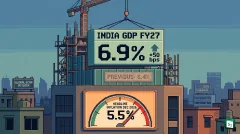
The Reserve Bank of India (RBI) released the results of its 101st Survey of Professional Forecasters (SPF) on 5 August 2026, projecting India’s real Gross Domestic Product (GDP) growth at 6.6% for the financial year 2026-27 (FY27) and 7.0% for 2027-28 (FY28). The FY27 estimate marks an upward revision from the 6.5% projected in the 100th round conducted in May 2026. The survey, which aggregates the views of professional economists and analysts, is one of the key inputs the central bank uses while framing monetary policy.
What Is the Survey of Professional Forecasters?
The Survey of Professional Forecasters (SPF) is a regular exercise in which the RBI collects forecasts on key macroeconomic indicators such as real GDP growth, retail inflation, merchandise trade and the current account deficit from a panel of professional forecasters. These panellists include economists from banks, financial institutions, rating agencies, research firms and other organisations that track the Indian economy.
The RBI has been conducting this survey since September 2007. It was initially a quarterly exercise, but from the 28th round onwards it has been held bi-monthly, which means about six rounds are released every year. The results of each round are published as the median of the panellists’ responses, and the report is released on the RBI website. The survey reflects the independent views of the panellists and does not represent the RBI’s own assessment.
The SPF is part of a wider set of forward-looking surveys that the RBI conducts to gauge expectations about the economy. Others in this family include the Consumer Confidence Survey, the Inflation Expectations Survey of Households and the Industrial Outlook Survey. Together, these surveys help the Monetary Policy Committee (MPC) understand where inflation and growth are headed, which is central to its decisions on the policy repo rate.
Key Projections in the 101st Round
Annual Growth Outlook
The panellists placed India’s real GDP growth for FY27 at 6.6%, a 10 basis point improvement over the 6.5% projected in the 100th round. For the next financial year, FY28, they expect growth to firm up to 7.0%, again a 10 basis point rise from the 6.9% projected earlier.
There is, however, a wide spread of views among the panellists. Individual forecasts for FY27 ranged between 6.0% and 7.2%, while for FY28 the range was between 6.5% and 7.8%. Such a gap shows the uncertainty surrounding the outlook, with some experts expecting a sharper slowdown and others anticipating stronger momentum.
Quarterly Growth Path
For the current quarter, Q1 of FY27 (April to June 2026), the median projection for real GDP growth is 6.8% on a year-on-year basis. Over the following four quarters, growth is expected to stay broadly steady, within a range of 6.4% to 7.0%.
| Quarter | Projected Real GDP Growth (year-on-year) |
|---|---|
| Q1 FY27 (Apr-Jun 2026) | 6.8% |
| Next four quarters (Q2-Q4 FY27 and Q1 FY28) | 6.4% to 7.0% |
Inflation Expectations
Along with growth, the panellists also revised their inflation projections. Retail inflation, measured by the Consumer Price Index (CPI), is now expected to average around 5.0% in FY27, up from the 4.9% projected in the 100th round. This is above the MPC’s medium-term target of 4%, but well inside the tolerance band of 2% to 6%.
For FY28, headline inflation is projected to ease to about 4.5%, moving closer to the target. The panellists expect the pressure to remain mainly supply-driven, coming from food and fuel prices, while core inflation, which strips out these volatile items, is likely to stay moderate.
External Sector Outlook
The 101st round also brought a brighter picture for India’s external sector. Merchandise exports are now projected to grow by 7% in FY27, a sharp upward revision from the 5% estimated in the previous round. At the same time, the growth of merchandise imports is expected to slow to 9.9%, down from the earlier projection of 10.5%.
Because exports are rising faster than imports, the current account deficit (CAD) is expected to narrow. The CAD, which is the difference between the money India earns from abroad and the money it spends overseas, is now projected at 1.4% of GDP for FY27, a significant improvement from the 2.1% forecast in the 100th round. For FY28, it is seen easing further to 1.1% of GDP.
A narrower current account deficit reduces India’s dependence on foreign capital inflows to finance its external payments. This supports the stability of the rupee and keeps the overall balance of payments comfortable, which matters for investor confidence.
How the SPF Compares With the RBI’s Own Estimates
The SPF and the RBI’s internal projections often differ, since they are based on different models and samples. In the bi-monthly monetary policy review announced on the same day, 5 August 2026, the RBI projected FY27 real GDP growth at 6.7%, which is 10 basis points higher than the SPF’s 6.6%. On inflation, however, the two converged, with both pegging FY27 CPI inflation at 5.0%.
The RBI’s growth projection of 6.7% was an upgrade from its earlier estimate of 6.6%, made after the economy performed better than expected in the first quarter. The MPC kept the policy repo rate unchanged at 5.25% and continued with a neutral stance, signalling that future rate decisions will depend on incoming data.
The RBI Governor has noted that the economy continues to grow on the strength of resilient domestic demand, expanding manufacturing and services, and robust exports. At the same time, the central bank has flagged risks to the outlook from the south-west monsoon, weather-related shocks, geopolitical tensions and global trade policies, and has said it wants greater clarity on the inflation path before changing policy.
Why These Forecasts Matter
The SPF is an important cross-check on the central bank’s own thinking. Since it aggregates the views of economists who closely track the economy, it captures market expectations and often serves as an early warning of shifts in sentiment. When the panellists revise their forecasts, it signals how the broader financial community is reading the latest data.
The upward revision in FY27 growth, from 6.5% to 6.6%, comes on the back of India’s strong performance in the previous year. The economy grew by 7.7% in FY26, up from 7.1% in FY25, making India one of the fastest-growing major economies in the world. The projected moderation to 6.6% in FY27 is not a contraction, but a return towards a more sustainable pace of expansion after two years of exceptionally strong growth.
The path back to 7% growth in FY28 is significant because sustained growth at this level is needed to create jobs and lift incomes. It is also central to India’s ambition of becoming a $4 trillion economy and eventually the world’s third-largest economy. For the RBI, the key challenge is to bring inflation down towards the 4% target without choking growth, a balancing act that the current forecasts capture well.
Key Takeaways
- The 101st Survey of Professional Forecasters (SPF), released by the RBI on 5 August 2026, projects India’s real GDP growth at 6.6% for FY27 and 7.0% for FY28.
- Panellists placed the FY27 growth forecast in the range of 6.0% to 7.2% and the FY28 forecast in the range of 6.5% to 7.8%.
- Quarterly real GDP growth is projected at 6.8% in Q1 FY27, staying between 6.4% and 7.0% over the subsequent four quarters.
- The SPF pegs CPI inflation at around 5.0% for FY27 and about 4.5% for FY28, above the MPC’s medium-term target of 4%.
- The current account deficit is expected to narrow to 1.4% of GDP in FY27 and 1.1% of GDP in FY28.
- The RBI has been conducting the SPF since September 2007, moving from a quarterly to a bi-monthly schedule from the 28th round onwards.