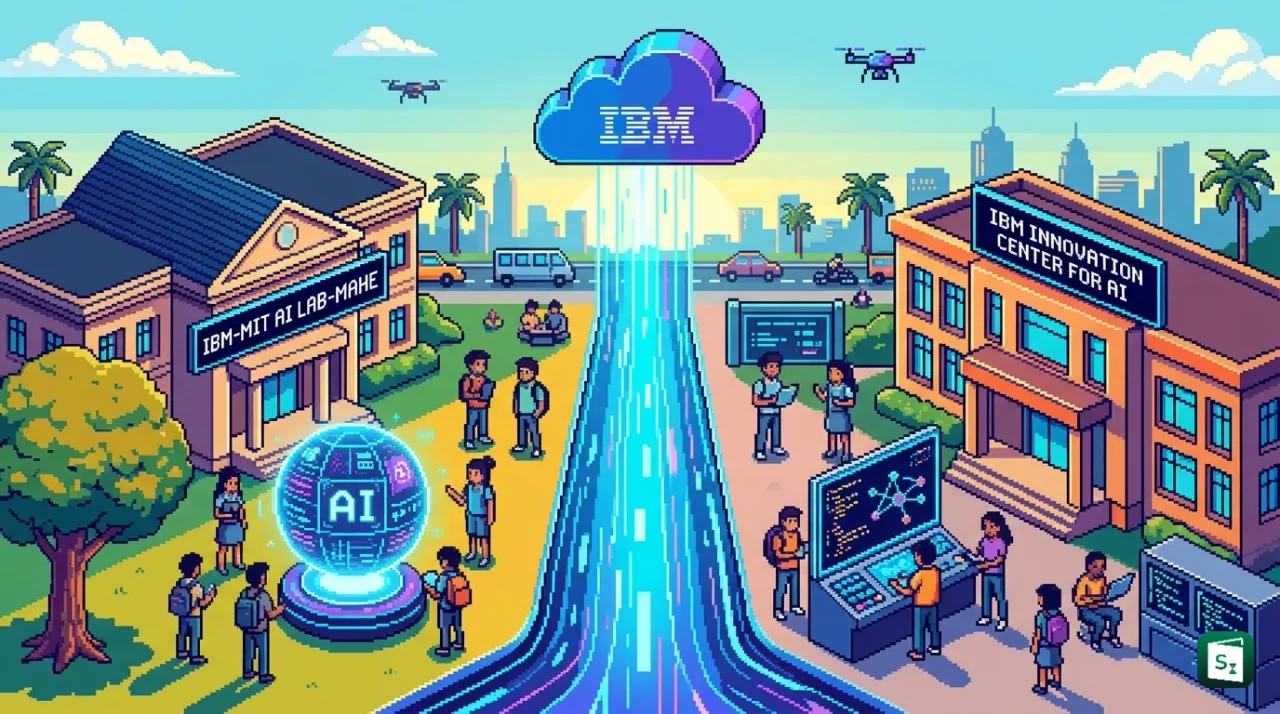
International Business Machines (IBM) Corporation has expanded its artificial intelligence footprint in Bengaluru with two new academic partnerships. On 10 August 2026, IBM and Manipal Institute of Technology (MIT) Bengaluru, a constituent unit of the Manipal Academy of Higher Education (MAHE), inaugurated the IBM-MIT AI Lab - MAHE Intelligence GPU (MIG) on the MIT Bengaluru campus. The very next day, IBM and CHRIST (Deemed to be University) announced the IBM Innovation Center for Artificial Intelligence to promote AI education, research and innovation.
Who Are the Partners in These Initiatives?
IBM Corporation, full name International Business Machines Corporation, is one of the world’s oldest and largest technology companies. Founded in 1911 and headquartered in Armonk, New York, it is a leading provider of hybrid cloud, artificial intelligence and consulting services, with operations in more than 175 countries. IBM entered India in 1951, and today its India subsidiary is headquartered in Bengaluru, which also hosts one of its largest development and research facilities outside the United States.
MAHE is a private deemed university that began in 1953 with the establishment of India’s first self-financing medical college. It was granted deemed university status in 1993 and was declared an Institution of Eminence by the Ministry of Education in October 2020. MAHE operates campuses in Manipal, Mangaluru, Bengaluru and Jamshedpur in India, and one offshore campus in Dubai. MIT Bengaluru, formerly the Bengaluru campus of Manipal Institute of Technology, is one of its constituent institutions offering engineering and computing programmes.
CHRIST (Deemed to be University) was founded in 1969 as Christ College in Bengaluru and was declared a deemed university in 2008 under Section 3 of the University Grants Commission (UGC) Act, 1956. It is managed by the Carmelites of Mary Immaculate (CMI) congregation and has grown into a multidisciplinary institution serving more than 42,000 students across its campuses, with NAAC ‘A+’ accreditation.
What Does the IBM-MIT AI Lab Offer?
The IBM-MIT AI Lab - MAHE Intelligence GPU (MIG) is built around a High-Performance Computing (HPC) facility designed to widen access to artificial intelligence for students, researchers and faculty. The lab is powered by advanced GPU-enabled computing infrastructure (graphics processing units, the chips best suited to train AI models) that can support 30 high-performance computing workloads at the same time.
The lab supports research in fields such as machine learning, deep learning, generative AI, computer vision, natural language processing (NLP), cybersecurity, healthcare, intelligent systems and data analytics. Beyond research, it will provide digital skilling opportunities and serve as a platform for industry-sponsored projects, interdisciplinary research, faculty development, hackathons, internships and startup incubation.
The facility was inaugurated by Prof. Madhu Veeraraghavan, Pro Vice Chancellor of MAHE Bengaluru, and Nisha Gopinath, Vice President of Human Resources at IBM India and South Asia. Sandip Patel, Managing Director of IBM India and South Asia, described India as being at a pivotal moment in its AI journey, with the talent and digital foundations to lead the next wave of global AI innovation.
The Skilling Component: IBM SkillsBuild
As part of the collaboration, MIT Bengaluru and IBM will run an AI Learning Initiative through IBM SkillsBuild, IBM’s free technology education programme. The initiative includes AI awareness workshops, immersive bootcamps, hands-on training in AI and machine learning, IBM SkillsBuild digital credentials, and mentorship from MIT faculty and student volunteers.
A distinctive feature of the programme is its focus on reaching students from Tier 2 and Tier 3 institutions, with the stated goal of reducing the digital divide and improving access to industry-relevant AI skills. The wider IBM SkillsBuild platform already offers more than 1,000 free courses in AI, cybersecurity, quantum computing, cloud, data and workplace skills, and has more than 16 million learners worldwide. In December 2025, IBM committed to skilling 5 million people in India in AI, cybersecurity and quantum computing by 2030 through this platform.
What Is the IBM Innovation Center for Artificial Intelligence at CHRIST University?
Announced on 11 August 2026, the IBM Innovation Center for Artificial Intelligence at CHRIST (Deemed to be University) will give students, faculty, researchers and PhD scholars access to enterprise-grade AI technologies and real-world use cases. The centre will support learning and experimentation across generative AI, agentic AI, large language models (LLMs), retrieval-augmented generation (RAG), intelligent automation and responsible AI.
Participants will build enterprise AI applications using IBM’s technology stack, which includes:
| Technology | Role |
|---|---|
| watsonx.ai | AI development studio for building and deploying AI models |
| watsonx Orchestrate | Agentic control plane for scaling and governing AI agents |
| IBM Bob | AI development partner that supports the full software lifecycle |
The centre will also support collaborative research, industry engagement, internships, hackathons and innovation challenges. IBM Expert Labs will conduct training and enablement workshops for faculty and postgraduate researchers to deepen expertise in enterprise AI deployment. Vishal Chahal, Vice President of IBM India Software Lab, noted that AI is fundamentally reshaping how software is built, and that working with IBM Bob will let students see how AI can accelerate every stage of the software lifecycle.
Why Bengaluru, and Why These Centres Matter
The two initiatives reinforce Bengaluru’s position as India’s technology capital and a growing global hub for artificial intelligence. The city already hosts the IBM Agentic AI Innovation Center, opened in July 2025, which lets enterprises, startups and developers experiment with autonomous AI agents. The new academic centres extend this push from industry into the classroom, building a bridge between university research and the technologies companies actually use.
For students, the benefits are practical: access to expensive GPU computing that most individual institutions cannot afford, hands-on exposure to enterprise software, and industry-recognised credentials through IBM SkillsBuild. For IBM, the partnerships help create a future-ready talent pool and strengthen the industry-academia collaboration that is vital for deploying AI at scale.
The centres also align with India’s broader ambition of building a skilled, AI-ready workforce. By deliberately reaching students from smaller towns and Tier 2 and Tier 3 institutions, the IBM-MIT lab addresses the concern that AI opportunities should not remain confined to a few privileged institutions. As Prof. Madhu Veeraraghavan put it, AI must become an enabler for everyone, not just a privileged few.
Key Takeaways
- The IBM-MIT AI Lab - MAHE Intelligence GPU (MIG) was inaugurated on 10 August 2026 at the MIT Bengaluru campus, a constituent unit of MAHE.
- The lab houses a High-Performance Computing (HPC) facility that can support 30 high-performance computing workloads simultaneously using GPU-enabled infrastructure.
- The IBM Innovation Center for Artificial Intelligence at CHRIST (Deemed to be University) was announced on 11 August 2026 to promote AI education, research and innovation.
- IBM, founded in 1911 and headquartered in Armonk, New York, entered India in 1951 and runs its India operations from Bengaluru.
- MAHE was established in 1953 and received Institution of Eminence status from the Ministry of Education in October 2020.
- IBM SkillsBuild, IBM’s free education platform with more than 1,000 courses, supports the skilling drive, and IBM has committed to skill 5 million people in India in AI, cybersecurity and quantum computing by 2030.