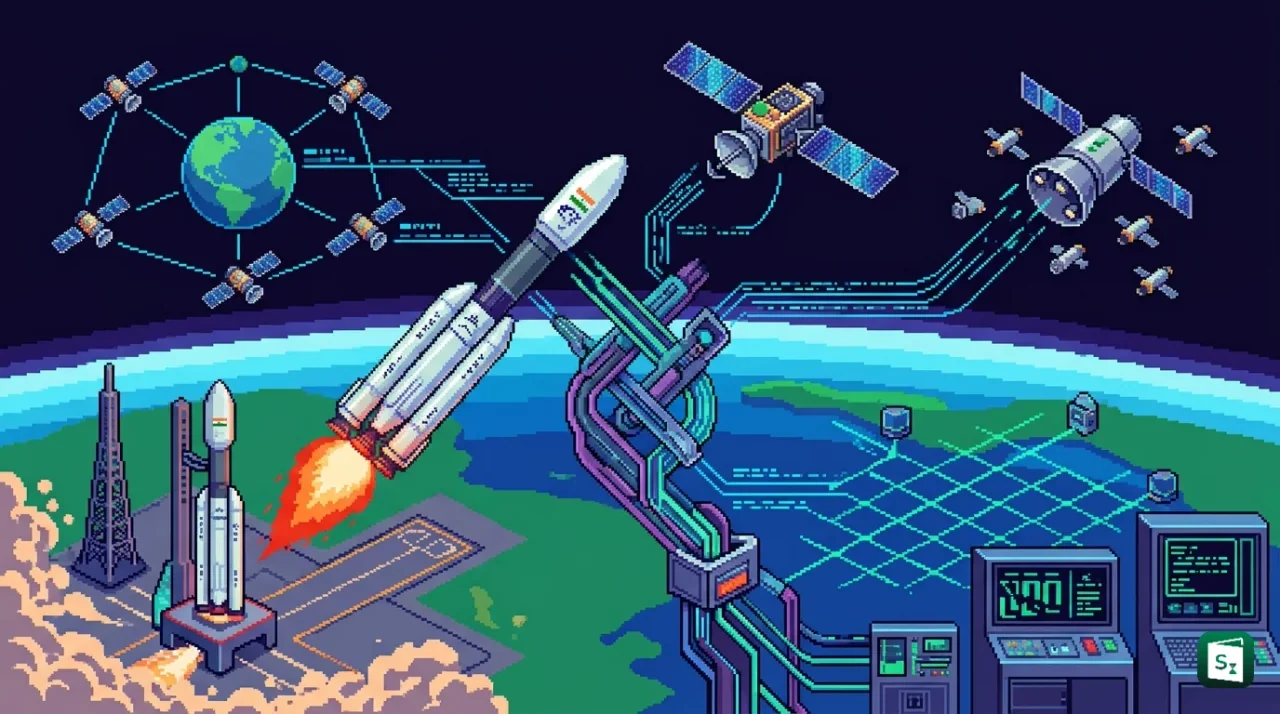
Skyroot Aerospace Pvt Ltd has signed a Multi-Launch Agreement (MLA) with HEX20, a Kerala-based space technology company, for three dedicated Vikram-series missions beginning in the fourth quarter of 2027. The launches will support HEX20’s Earth Observation constellation, in-orbit payload demonstration missions, and rideshare capacity for third-party spacecraft. The agreement is Skyroot’s first major commercial launch contract after the successful maiden orbital flight of its Vikram-1 rocket in July 2026.
The Agreement at a Glance
A Multi-Launch Agreement (MLA) is a commercial contract in which a launch provider reserves a fixed number of dedicated missions for a customer over a period of time. Under this deal, HEX20 has purchased three dedicated launches from Skyroot, to be flown aboard the Vikram series of launch vehicles.
The agreement was signed in Hyderabad by Naga Bharath Daka, Co-founder and Chief Operating Officer of Skyroot, and MB Aravind, Co-founder and Chief Operating Officer of HEX20. The first mission is scheduled for the fourth quarter of 2027, with subsequent launches to follow according to HEX20’s constellation deployment plans.
What the Three Missions Cover
The three dedicated missions will be used for three distinct purposes:
| Purpose | What It Involves |
|---|---|
| Earth Observation constellation | Deployment of HEX20’s own satellites that image the Earth for applications such as agriculture, disaster management and environmental monitoring |
| In-orbit payload demonstration | Testing and validating new satellite technologies in the space environment before they are used on operational missions |
| Rideshare capacity | Carrying third-party spacecraft alongside HEX20’s satellites, using spare payload capacity on the same launch |
In a rideshare mission, multiple small satellites from different owners are carried on a single rocket, splitting the launch cost among all customers. This arrangement lets smaller companies, universities and research institutions reach space at a fraction of the cost of a dedicated launch.
Skyroot Aerospace: From ISRO Lab to India’s First Private Orbital Rocket
Skyroot Aerospace Private Limited is an Indian aerospace manufacturer and commercial launch service provider headquartered in Hyderabad, Telangana. The company was founded in 2018 by Pawan Kumar Chandana and Naga Bharath Daka, both former scientists of the Indian Space Research Organisation (ISRO) and graduates of IIT Kharagpur.
Skyroot builds small-satellite launch vehicles using in-house technologies such as propulsion systems, all-carbon composite structures and rapid manufacturing methods. The company’s facilities are spread across campuses in Hyderabad, including its advanced Infinity Campus for rocket assembly.
The Vikram Series of Launch Vehicles
The rockets are named after Dr Vikram Sarabhai, widely regarded as the father of India’s space programme. The family currently includes:
| Vehicle | Details |
|---|---|
| Vikram-S | Suborbital sounding rocket launched on 18 November 2022 under Mission Prarambh, making Skyroot the first private Indian company to reach space |
| Vikram-1 | India’s first privately developed orbital-class rocket, a four-stage vehicle with three solid stages and a liquid-powered orbital adjustment module |
| Vikram-II | A larger vehicle under development with a cryogenic engine, aimed at carrying heavier payloads |
The Vikram-1 can place payloads of up to 350 kg into Low Earth Orbit (LEO), roughly 450 km above the Earth. Its lightweight carbon-composite body and a 3D-printed liquid engine help keep costs competitive. Skyroot positions its vehicles as an on-demand launch service, a model the company calls a “cab service to space”.
Mission Aagaman and the Road to Commercial Launches
On 18 July 2026, Skyroot launched Mission Aagaman (Sanskrit for “arrival”), the maiden orbital flight of Vikram-1, from the Satish Dhawan Space Centre (SDSC) in Sriharikota. The rocket injected its payloads into a 450 km orbit at a 60-degree inclination, completing the mission in just under 18 minutes.
The flight carried technology demonstration payloads from companies including Grahaa Space (a nanosatellite), Cosmoserve Space (a robotic arm demonstration for space debris capture) and Germany’s DCubed, alongside Skyroot’s own SCOPE satellite. The success made India only the third country in the world, after the United States and China, with a private company capable of orbital launches. It also gave Skyroot flight heritage for all major subsystems, supporting its plan to scale up to as many as 12 launches a year.
HEX20: Kerala’s Emerging Satellite Builder
HEX20 is a small-satellite company headquartered at Technopark in Thiruvananthapuram, Kerala. It designs satellite platforms, mission services and in-orbit testing solutions for customers in India and abroad. The company was founded in 2020 by a group of friends, including Amal Chandran, MB Aravind, Ashwin Chandran, Lloyd Jacob Lopez and Anurag Raghu, alumni of the College of Engineering, Thiruvananthapuram.
HEX20 now has a presence in the United States, the United Arab Emirates and Taiwan. Its work spans the entire satellite lifecycle, from spacecraft design and payload integration to ground operations and mission management.
From Nila to KOYO
HEX20 built Nila, widely described as India’s first private-sector rideshare satellite. It was launched in March 2025 aboard a SpaceX mission, making HEX20 the first Kerala startup to partner with the American launch provider. The satellite was named after the Nila river (also called the Bharathapuzha), Kerala’s longest river, and after the Technopark building where HEX20 operates.
In July 2026, the company launched its second satellite, KOYO (Kinetic Optical Yaw Observer), for Taiwan’s National Central University, aboard SpaceX’s Transporter-17 rideshare mission. KOYO space-qualified HEX20’s solar panel deployment mechanisms and added flight heritage to its AX CubeSat platform.
Looking ahead, HEX20 is building larger satellites, including MAYA-V (Multi-Application Yearly Assimilated Vehicle) for hosted payloads and DINK-N (Direct Imaging Networking Node), a bigger Earth Observation constellation satellite planned for launch in 2028. The company is also planning six satellite missions over the coming year, which makes a reliable, dedicated launch provider a critical requirement.
Why This Deal Matters for India’s Space Ecosystem
For Skyroot, this agreement is a clear sign that its launch vehicles are finding commercial buyers. The deal gives the Vikram series early order books, providing revenue and a public validation of the technology proven during Mission Aagaman. A steady stream of missions is essential for a young launch company to reduce costs and build reliability through repeated flights.
For HEX20, the benefit is guaranteed, predictable access to space. Indian satellite makers have so far depended heavily on foreign rockets such as SpaceX for their launches. Securing dedicated slots on a domestic rocket reduces foreign-exchange outflow, shortens waiting periods and gives HEX20 control over its constellation deployment timeline.
For the Indian space ecosystem as a whole, the deal is significant for several reasons:
- It demonstrates a domestic supply chain in the making, where an Indian satellite company books launches with an Indian rocket company.
- It creates a closed loop within India’s space economy, covering both spacecraft manufacturing and launch services.
- It supports the vision of Atmanirbhar Bharat in the space sector, reducing dependence on foreign launch providers.
- The rideshare slots on these missions will open affordable launch opportunities for smaller startups, universities and research institutions.
The Bigger Policy Picture: Indian Space Policy 2023
The deal is a direct outcome of the Indian Space Policy 2023, approved by the Union Cabinet in April 2023. The policy opened up the space sector to private participation and clearly divided roles among the main institutions:
| Institution | Role |
|---|---|
| Department of Space (DoS) | Overall administration of space activities, working directly under the Prime Minister |
| ISRO | Focus on research and development of advanced technologies, human spaceflight and planetary exploration, moving away from routine manufacturing |
| IN-SPACe | The Indian National Space Promotion and Authorisation Centre, the single-window regulator that authorises space activities by private entities |
| NSIL | NewSpace India Limited, the commercial arm of the Department of Space, which manages ISRO’s commercial launch and satellite services |
The policy is part of reforms that began in June 2020, when the government allowed Non-Government Entities (NGEs) to undertake end-to-end space activities. Before these reforms, Indian private companies could only act as suppliers or vendors to ISRO, building components to government specifications.
The results have been rapid. India’s space economy is currently estimated at around $8.4 billion, and the government projects it could reach $40 to $45 billion over the next decade. The number of space startups has grown from just one registered in 2014 to more than 400 today. The country’s share of the global space economy, currently about 2 to 3 per cent, is targeted to rise to 8 per cent by 2030. An agreement of this kind, connecting a private launch provider with a private satellite company, is exactly the kind of growth the policy was designed to encourage.
The Way Forward
The first of the three Vikram missions is expected to lift off in the fourth quarter of 2027. Before commercial flights begin, Skyroot plans further test flights of Vikram-1 to complete its flight qualification, and the company has also announced plans to build its own dedicated launch pad to increase its launch frequency beyond the facilities it currently shares with ISRO at Sriharikota.
For HEX20, the dedicated launch slots come as it transitions from small demonstration satellites to larger operational constellations. The deal positions the company to serve customers in India and overseas, including in the US, the UAE and Taiwan, through a reliable and predictable launch schedule.
If these missions succeed, they could set a template for more such agreements between Indian satellite companies and Indian launch providers. Each successful flight builds the flight heritage and trust that private space companies need, moving India closer to its target of a $40 to $45 billion space economy and a larger share of the global commercial space market.
Key Takeaways
- Skyroot Aerospace, a Hyderabad-based company founded in 2018 by former ISRO scientists, signed a Multi-Launch Agreement (MLA) with HEX20 for three dedicated Vikram-series missions.
- The first of the three missions is scheduled for the fourth quarter of 2027, with launches supporting HEX20’s Earth Observation constellation, in-orbit payload demonstrations and rideshare capacity.
- Skyroot’s Vikram-1 is India’s first privately developed orbital-class rocket, which reached a 450 km orbit on its maiden Mission Aagaman on 18 July 2026 from Sriharikota.
- India became only the third country, after the United States and China, with a private company capable of orbital launches following the Vikram-1 success.
- HEX20, headquartered at Technopark in Thiruvananthapuram, built Nila, India’s first private-sector rideshare satellite, launched aboard a SpaceX mission in 2025.
- The agreement is a product of the Indian Space Policy 2023, which opened space activities to private entities under the authorisation of IN-SPACe, the sector’s single-window regulator.