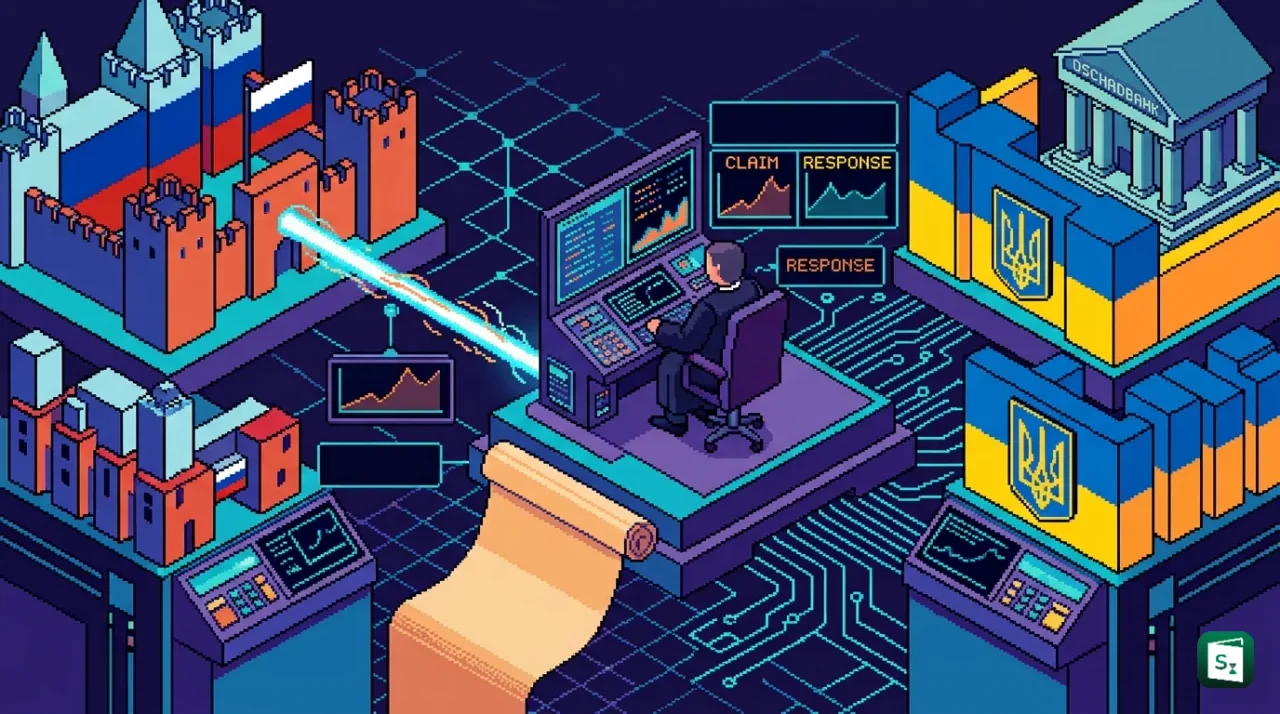
Russia has appointed DY Chandrachud, a former Chief Justice of India (CJI), as its designated arbitrator in an investment treaty dispute initiated by Oschadbank, the state-owned savings bank of Ukraine. The case will be decided by a three-member international arbitral tribunal constituted under the 1998 bilateral investment treaty between Ukraine and Russia. The appointment places one of India’s most respected retired judges at the centre of a high-stakes legal battle flowing from the Russia-Ukraine war.
The Appointment at a Glance
The appointment, which became public in early August 2026, places Chandrachud on the tribunal in the investor-state arbitration. Ukraine’s Oschadbank is the claimant seeking compensation from Russia, and Chandrachud is the arbitrator chosen by the respondent, Russia.
Each side in an arbitration appoints one arbitrator, and the two arbitrators help select the third, who chairs the tribunal. This is the standard method for constituting a three-member arbitral panel under most investment treaties.
The Three-Member Tribunal
The tribunal that will hear Oschadbank’s claim consists of three members, each drawn from a different country:
| Role | Name | Country | Appointed By |
|---|---|---|---|
| President | Dyalá Jiménez | Costa Rica | Jointly chosen by both sides |
| Arbitrator | Stavros Brekoulakis | Greece | Oschadbank (Ukraine) |
| Arbitrator | DY Chandrachud | India | Russia |
Dyalá Jiménez is a Costa Rican arbitrator and a former trade minister, and she will preside over the proceedings after being selected by both parties together. Stavros Brekoulakis, a Greek arbitrator and a professor at the National University of Singapore, was chosen by Oschadbank to represent its side.
Chandrachud’s Earlier Refusal of Russia’s Approaches
The new appointment is notable because Chandrachud had previously turned down Russia’s requests to serve as its arbitrator in two other treaty disputes. These were cases brought by Wintershall Dea, a German energy company, and Ukrenergo, the state-owned power transmission operator of Ukraine.
Those approaches were reportedly made on the same day that the Permanent Court of Arbitration (PCA) designated Chandrachud as the appointing authority in the Wintershall proceedings. An appointing authority is the body or person tasked with filling a vacancy on a tribunal when the parties cannot agree. After disclosing the communications he had received from Russia, Chandrachud stepped down from that role to avoid any appearance of a conflict. His acceptance this time, after refusing earlier, marks a shift in his position.
Who Is DY Chandrachud?
Dhananjaya Yeshwant Chandrachud served as the 50th Chief Justice of India from 9 November 2022 to 10 November 2024, when he retired at the age of 65. Born on 11 November 1959, he is the son of YV Chandrachud, India’s longest-serving Chief Justice, who held the office from 1978 to 1985.
He was elevated to the Supreme Court in May 2016 after serving as a judge of the Bombay High Court and as Chief Justice of the Allahabad High Court. He holds a Master of Laws from Harvard Law School and is known for landmark rulings, including the judgment that struck down the Electoral Bond Scheme, the decision reading down Section 377 of the Indian Penal Code, and the recognition of the right to privacy as a fundamental right. He was also the first Chief Justice to preside over live-streamed constitutional bench hearings.
After retirement, retired Supreme Court judges in India are barred from practising law in any Indian court, so many turn to international arbitration as a permissible field of work. Chandrachud has continued his engagement with law through lectures, university positions, and now arbitration work. He has previously spoken in favour of drawing on India’s growing pool of arbitration professionals rather than relying only on retired judges.
Understanding the Dispute
An investor-state dispute settlement (ISDS) case is a form of arbitration in which a foreign investor sues a government directly, outside its domestic courts. This mechanism lets investors enforce the protection promised to them under investment treaties. Oschadbank’s claim against Russia is one such case, and it is the bank’s second treaty claim against Moscow.
Who Is Oschadbank?
Oschadbank, formally the State Savings Bank of Ukraine, is one of the largest financial institutions in the country and is wholly owned by the Ukrainian state. Its name means “savings bank” in Ukrainian, and its origins trace back to the Soviet-era savings bank network, which was reorganised after the collapse of the Soviet Union. The bank, which is headquartered in Kyiv, is the only Ukrainian bank whose deposits are fully guaranteed by the state by law, and it is the main channel through which pensions and social benefits are paid out.
What Oschadbank Is Claiming
In this case, Oschadbank claims that it lost substantial assets and the ability to run its operations in four regions of south-eastern Ukraine: Donetsk, Luhansk, Kherson, and Zaporizhzhia. The bank says these losses resulted from Russia’s military actions, especially following the full-scale invasion of Ukraine that began in February 2022. The claim is understood to be worth hundreds of millions of dollars.
The proceedings followed a notice of dispute that Oschadbank served on Russia in July 2025, which the bank says went unanswered. After waiting for a response, the bank formally initiated arbitration proceedings against Russia in April 2026. Russia has now engaged with the process by naming its arbitrator.
The Earlier Crimea Arbitration
This is not Oschadbank’s first fight with Russia. After Russia’s annexation of Crimea in March 2014, Oschadbank lost its branch on the peninsula and brought a first treaty claim. A Paris-seated tribunal constituted under the UNCITRAL Arbitration Rules and administered by the Permanent Court of Arbitration (PCA) found Russia liable for unlawful expropriation and awarded Oschadbank approximately $1.1 billion in damages in 2018, an amount that grew to about $1.3 billion with interest.
That award has had a turbulent history. A French court set it aside in 2021 after accepting Russia’s argument that the treaty’s offer to arbitrate applied only to investments made after the bank opened its Crimean branch. The French Court of Cassation, the highest court in France, reinstated the award in 2022, holding that the relevant treaty provision was not open to review by the French courts. The tribunal later rejected Russia’s requests to revise the award, and in 2025 the Paris Court of Appeal upheld it. The current dispute is separate from this earlier Crimea case.
The 1998 Ukraine-Russia Bilateral Investment Treaty
The new arbitration is being heard under the Agreement between the Government of the Russian Federation and the Cabinet of Ministers of Ukraine on the Encouragement and Mutual Protection of Investments, signed in Moscow on 27 November 1998. A bilateral investment treaty (BIT) is an agreement between two countries that protects investments made by investors of one country in the territory of the other. The treaty entered into force on 27 January 2000.
Under the treaty, each country promises fair and equitable treatment, protection against expropriation without compensation, and the freedom to transfer funds. Most importantly for this case, the treaty allows an investor to take an unresolved dispute directly to international arbitration instead of relying on the courts of the host country.
How Investor-State Arbitration Works
International arbitration is a method of resolving disputes outside courts, through private judges called arbitrators. In a typical ISDS case, the investor appoints one arbitrator, the respondent state appoints another, and the two choose a third who chairs the tribunal. Arbitrators are expected to act as impartial judges, not as advocates for the side that appointed them.
Analogy · A Referee, Not a Player Expand analogy
An arbitrator appointed by Russia is like a cricket umpire chosen by one of the two teams. The team may have picked him, but once on the field he must call fair decisions for both sides. Being appointed by Russia does not make Chandrachud Russia’s lawyer.
Tribunals of this kind may be administered by institutions such as the International Centre for Settlement of Investment Disputes (ICSID), based in Washington, or the Permanent Court of Arbitration (PCA), headquartered at the Peace Palace in The Hague. Alternatively, they may run as ad hoc proceedings under the UNCITRAL Arbitration Rules, the procedural rules framed by the United Nations Commission on International Trade Law. Awards issued under a treaty are final and binding, and can be enforced in the courts of countries that have signed up to the relevant enforcement conventions.
The Treaty’s Twilight and the Sunset Clause
In the wake of the 2022 invasion, Ukraine moved to exit the treaty. A law terminating the Ukraine-Russia BIT was passed in August 2023, and the termination took effect on 27 January 2025. However, the treaty contains a sunset clause in Article 14(3), which keeps its protections alive for a further ten years for investments made before the termination. This means investments made before 27 January 2025 remain protected until 27 January 2035, which is why Oschadbank can still bring its claim despite the treaty’s formal end.
Why This Appointment Matters
From the Lawyer to the Judge
In the earlier Wintershall case, Russian arbitrator Hamid Gharavi had resigned from the tribunal after Moscow launched anti-arbitration proceedings in its own courts. Chandrachud was at that time the PCA-appointed authority responsible for picking a replacement, a task that carried obvious sensitivity given Russia’s simultaneous approaches to him. His decision to recuse himself then, and to accept the Oschadbank appointment now, shows the careful line that respected retired judges must walk in politically charged disputes.
The case also reflects the broader reality of investment arbitration after the invasion. Russian actions in Ukraine have produced a wave of treaty claims by Ukrainian companies, state entities, and even Western firms such as Finnish energy company Fortum, Danish brewer Carlsberg, and German Uniper. Oschadbank’s case is part of this larger movement of investors seeking compensation through international law rather than the battlefield.
India’s Rising Place in Global Arbitration
The appointment is a recognition of Chandrachud’s standing, but also of India’s growing presence in international arbitration. Indian judges and lawyers have increasingly been named to international tribunals, and institutions such as the Permanent Court of Arbitration maintain panels of arbitrators nominated by member states, with India among the members. India’s own arbitration law was modernised through the Arbitration and Conciliation Act, 1996, which reflects the UNCITRAL Model Law, and a series of amendments have sought to make the country a more attractive venue for resolving disputes.
For Oschadbank, the immediate significance is procedural. The constitution of the tribunal means the case can now move to its merits stage, where the panel will first examine whether it has jurisdiction, including whether the bank’s investments qualify for protection under the treaty. Only if jurisdiction is established will the tribunal assess Russia’s liability and the quantum of damages.
The Way Forward
With all three arbitrators now in place, the tribunal can begin its work in earnest. The first phase of most ISDS cases is a jurisdictional challenge, in which Russia is likely to argue that the tribunal has no authority to hear the claim, perhaps on grounds such as the timing of the investment or the territorial reach of the treaty. The earlier Crimea case shows that such arguments can be fought through arbitration and national courts for years.
A notable feature of this dispute is that Russia, which refused to participate in the earlier Crimea arbitration, has this time appointed an arbitrator and chosen to engage with the process. Its choice of a respected former Chief Justice of India, known worldwide for his independence, suggests that Russia wants the proceedings to be seen as fair and credible. In doing so, it also gives an Indian jurist a seat on one of the most closely watched tribunals arising from the war in Ukraine.
The outcome will be watched closely, both for the specific compensation owed to Oschadbank and as a precedent for the many other claims being prepared against Russia over its military actions in Ukraine.
Key Takeaways
- DY Chandrachud, the 50th Chief Justice of India (9 November 2022 to 10 November 2024), has been appointed by Russia as its arbitrator in Oschadbank’s investment treaty claim.
- The three-member tribunal comprises Dyalá Jiménez (Costa Rica, president), Stavros Brekoulakis (Greece, appointed by Oschadbank), and Chandrachud (India, appointed by Russia).
- The arbitration is brought by Oschadbank, the state-owned savings bank of Ukraine headquartered in Kyiv, over assets it lost in Donetsk, Luhansk, Kherson, and Zaporizhzhia after the 2022 Russian invasion.
- The case is being heard under the 1998 Ukraine-Russia Bilateral Investment Treaty, which entered into force on 27 January 2000.
- Oschadbank had earlier won a $1.1 billion award in 2018 against Russia over the 2014 annexation of Crimea, an award upheld by the French Court of Cassation in 2022.
- The Permanent Court of Arbitration (PCA) administers many such cases from its seat at the Peace Palace in The Hague, and the treaty’s sunset clause keeps investments protected until 27 January 2035.