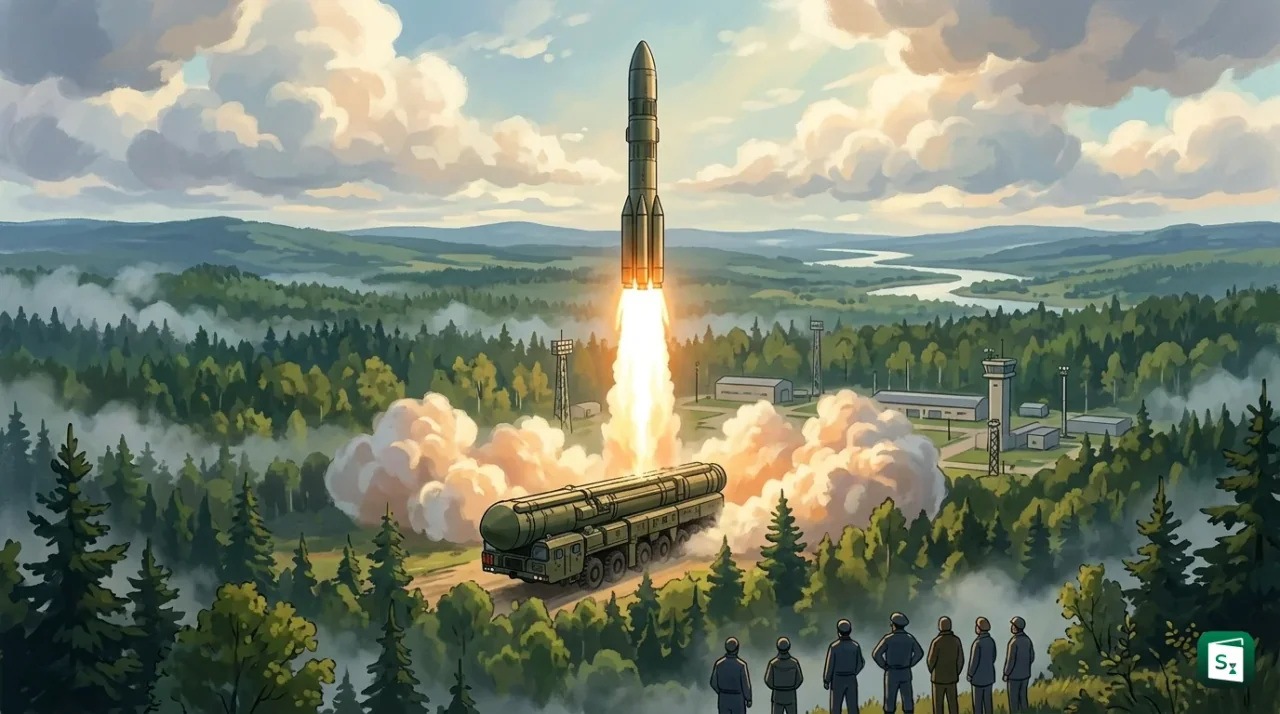
Russia’s Strategic Missile Forces successfully test launched a mobile, solid fuel intercontinental ballistic missile from the Plesetsk Cosmodrome on 28 August 2026. The training warheads travelled more than 6,700 km and landed at the Kura test range in Kamchatka, confirming the system’s flight and technical performance. The missile, identified by independent analysts as the RS-24 Yars, can strike targets beyond 10,000 km and can deliver several nuclear warheads to different targets using MIRV technology.
What Happened in the Latest Yars Test?
Russia’s Defence Ministry said the launch took place on 28 August 2026 from the Plesetsk Cosmodrome in the Arkhangelsk region of northwestern Russia. Plesetsk is Russia’s main military spaceport and missile test centre. It also serves as a training ground for the Strategic Missile Forces, the branch that operates land based nuclear missiles.
Before the launch, a mobile launcher unit moved to a remote field location and prepared the missile for firing. This exercise tested how quickly crews can leave their permanent base, hide in the field and carry out a launch. The missile flew east across the full width of Russia and covered more than 6,700 km before its training warheads reached the Kura test range on the Kamchatka Peninsula in the Russian Far East. Kura has served as Russia’s main impact area for long range missile tests since 1957 because it is remote and far from population centres.
The ministry said the purpose was to confirm the tactical, technical and flight characteristics of the system. It added that all assigned tasks were completed and the missile followed its planned path without deviation. The official statement did not name the missile type. It described it only as a mobile, solid fuel intercontinental ballistic missile. Launch video showed the missile rising from a Krona shelter, a protected garage used for mobile missiles at Plesetsk. Based on this detail and the flight profile, independent researchers identified the missile as the RS-24 Yars. A similar Yars launch from Plesetsk to Kura had taken place in May 2026 during a larger strategic forces exercise.
What Is an ICBM and How Does It Work?
ICBM stands for Intercontinental Ballistic Missile. It is a long range missile that can travel more than 5,500 km, which allows it to cross continents. A ballistic missile is a missile that is powered for only the first few minutes of flight. After its engines switch off, it follows a curved path under gravity, much like a ball thrown high into the air, before falling back to earth on its target.
A typical ICBM flight has three parts. In the boost phase, solid or liquid fuel engines push the missile up through the atmosphere within three to five minutes. In the midcourse phase, the missile coasts through space at a very high altitude, often above 1,000 km, and releases its warheads. In the terminal phase, the warheads re enter the atmosphere at speeds above Mach 20, or more than 24,000 km per hour, and strike their targets. Yars uses inertial guidance supported by GLONASS, which is Russia’s satellite navigation system similar to GPS, to stay on course.
ICBMs can be launched from a fixed underground silo or from a mobile launcher mounted on a heavy truck called a Transporter Erector Launcher (TEL). Silos offer protection inside hardened concrete, while mobile launchers offer secrecy because they can move and hide in forests or field positions. Russia, the United States, China, France, the United Kingdom, India and North Korea all operate ballistic missiles, though only a few possess true intercontinental range. Defence against ICBMs is very difficult because of their speed, height and short warning time. Interceptors can try to hit the missile in its early boost phase or hit individual warheads later, but the success rate remains low, especially against missiles that carry multiple warheads and decoys.
What Is MIRV Technology and Why Does It Matter?
MIRV stands for Multiple Independently Targetable Re-entry Vehicle. It means that one missile can carry several warheads, and each warhead can be sent to a different target. A single warhead missile must be fired separately for each target. A MIRV equipped missile can strike several cities or military bases spread hundreds of kilometres apart with one launch. Some advanced systems can spread warheads over an area as wide as 1,500 km.
The system works through a part called the bus or post boost vehicle. After the main rocket engines push the bus into space, the bus uses small motors and an onboard computer to change direction and speed. It releases one warhead on one path, then moves to a new position and releases the next warhead on a different path. This process continues until all warheads are released. The bus can also release decoys, balloons and metal strips called chaff that confuse enemy radar.
MIRV offers three clear military advantages. First, it increases damage from one missile, so fewer missiles are needed for the same effect. Second, it can overwhelm missile defence systems because the defender needs many interceptors to stop many incoming warheads. Third, it allows accurate strikes with smaller warheads because accuracy matters more than size. The United States first deployed MIRV on the Minuteman III missile in 1970. The Soviet Union followed in the late 1970s. Today, Russia, the United States, the United Kingdom, France and China deploy MIRV systems. India demonstrated the technology on 11 March 2024 when the Defence Research and Development Organisation tested the Agni-5 missile with MIRV under Mission Divyastra from Dr A P J Abdul Kalam Island in Odisha.
RS-24 Yars Missile: Range, Speed and Key Features
The RS-24 Yars is Russia’s main modern land based intercontinental ballistic missile. Its NATO reporting name is SS-29, and it is also called SS-27 Mod 2 because it grew out of the earlier Topol-M design. It was first tested on 29 May 2007 and entered service with the Strategic Missile Forces in 2010. It was designed by the Moscow Institute of Thermal Technology and built at the Votkinsk Machine Building Plant. Yars now forms the backbone of Russia’s ground based nuclear force, replacing older Soviet era missiles.
Yars is a three stage, solid fuel missile. Solid fuel means the propellant is pre packed inside the rocket, like fuel sealed inside a cracker. The missile can stay ready for years and launch within minutes. It is about 22.5 metres long, 2 metres wide and weighs about 49,600 kg at launch. Open assessments place its maximum range between 10,500 km and 12,000 km and its top speed near Mach 25, which is about 30,600 km per hour. It can carry three to six MIRV warheads, each with an estimated yield of 150 to 300 kilotons. Russia does not publish the exact number of warheads or the cost of the system, and some sources mention higher numbers, so these figures are based on public estimates.
| Feature | Detail of RS-24 Yars |
|---|---|
| Type | Three stage, solid fuel intercontinental ballistic missile |
| NATO name | SS-29 (also listed as SS-27 Mod 2) |
| Designer and maker | Moscow Institute of Thermal Technology, Votkinsk Plant |
| In service | 2010 to present, operated by Strategic Missile Forces |
| Length and diameter | 22.5 metres long, 2 metres wide |
| Launch weight | About 49,600 kg, payload about 1,200 kg |
| Range | 10,500 km to 12,000 km, operational range above 10,000 km |
| Speed | About Mach 25, near 30,600 km per hour |
| Guidance | Inertial guidance with GLONASS satellite support |
| Launch platforms | Silo and road mobile TEL vehicle MZKT-79221 |
| Warheads | 3 to 6 MIRVs of 150 to 300 kilotons, plus decoys |
Why Mobile and Solid Fuel Design Matters
Yars can fire from a fixed silo or from a road mobile launcher. The mobile version travels on a large MZKT-79221 truck that can leave base, drive 500 km and launch from a forest clearing or prepared field site. This mobility makes the missile very hard for satellites to track and very hard to destroy before launch. The solid fuel design adds to this advantage because it needs little preparation and can fire in about seven minutes after the order.
Solid fuel also differs clearly from liquid fuel. Liquid fuel missiles can carry heavier loads over longer distances but need lengthy fuelling before launch, which exposes them to attack. Solid fuel missiles stay ready at all times and have a fast initial climb, which shortens the time when they can be seen and hit. For Russia, which keeps large forces spread across vast territory, this mix of secrecy, speed and constant readiness is central to keeping a secure retaliatory force.
Yars vs Sarmat vs Topol-M: How Russian Missiles Compare
Russia operates three generations of land based strategic missiles at the same time. The RT-2PM2 Topol-M is the older single warhead system from the 1990s. The RS-24 Yars is its MIRV equipped successor and the current workhorse. The RS-28 Sarmat, also called Satan-II in western media, is a much heavier liquid fuel missile meant to replace Soviet era heavy missiles like the R-36M. Sarmat had its first successful launch in April 2022 and has faced reported test delays since then, while Yars tests continue on a regular cycle.
| Feature | Topol-M (RT-2PM2) | Yars (RS-24) | Sarmat (RS-28) |
|---|---|---|---|
| Fuel and stages | Three stage, solid fuel | Three stage, solid fuel | Liquid fuel, heavy class |
| Basing | Silo and road mobile | Silo and road mobile | Silo only |
| Range | About 11,000 km | 10,500 km to 12,000 km | 10,000 km to 18,000 km |
| Launch weight | About 47,200 kg | About 49,600 kg | About 208,100 kg |
| Warheads | Single warhead, about 800 kilotons | 3 to 6 MIRVs of 150 to 300 kilotons | 10 to 15 MIRVs or glide vehicles |
| Role | Previous generation, still in service | Main mobile force since 2010 | Future heavy missile for large payloads |
The table shows a clear division of work. Yars provides mobility and numbers. Sarmat provides massive throw weight and range, including the ability to fly over the South Pole to avoid northern radars. Topol-M provides continuity while older units stay in service. Together, they give Russia a mix of hidden mobile missiles and powerful silo missiles.
Cruise Missile vs Ballistic Missile: The Key Difference
Readers often confuse cruise missiles with ballistic missiles, and the Yars test is a good moment to fix the distinction. A ballistic missile like Yars is powered only at the start. It leaves the atmosphere, coasts through space and then falls on its target at hypersonic speed. A cruise missile like BrahMos stays inside the atmosphere for its full flight. It flies like a pilotless aircraft, often very low to avoid radar, and uses an air breathing engine through the journey.
| Point | Ballistic Missile (Yars, Agni-5) | Cruise Missile (BrahMos, Tomahawk) |
|---|---|---|
| Flight path | High arc through space, then steep fall | Low, level flight inside atmosphere |
| Speed | Very high, Mach 20 to Mach 25 at re entry | Supersonic or subsonic, BrahMos near Mach 3 |
| Range | Intercontinental, above 5,500 km for ICBM | Mostly hundreds to a few thousand km |
| Guidance | Inertial plus satellite, fixed path after burnout | Can change course during flight, terrain matching |
| Defence challenge | Short warning, very fast, needs space tracking | Low flight hides from radar, needs air defence |
In simple terms, BrahMos is not a ballistic missile. It is a supersonic cruise missile developed jointly by India and Russia. Yars and Agni-5 belong to the ballistic family. Ballistic missiles suit long range nuclear deterrence, while cruise missiles suit precise conventional strikes at shorter distances.
Why the Test Matters for Global Security and India
The launch is officially a routine training check, but its timing gives it wider meaning. Russia has kept a steady test cycle through 2026, with Yars launches in May and August and a Sarmat related activity earlier in the year. The Defence Ministry presented the August launch as proof that crews, mobile launchers and flight systems remain ready. In a period of continued fighting around Ukraine and strain in arms control talks, such tests also act as a visible signal of secure retaliatory strength.
For global stability, the spread of MIRV technology remains a central concern. Nine states are known to possess nuclear weapons. They are the United States, Russia, the United Kingdom, France, China, India, Pakistan, North Korea and Israel. Among them, Russia and the United States hold the largest arsenals. Russia is estimated to keep about 1,530 deployed strategic warheads on about 575 launchers. MIRV increases the number of warheads that can be placed on each missile, which makes defence harder and raises the value of striking first in a crisis. This is why agreements like New START, the last remaining strategic arms pact between Washington and Moscow, set limits on deployed launchers and warheads.
For India, the Yars test offers a useful reference point. India’s longest range missile, Agni-5, has a range above 5,000 km and can reach most of China. After Mission Divyastra, India joined the small group of states that have tested MIRV. India follows a doctrine of credible minimum deterrence and no first use, with a nuclear triad of aircraft, land missiles and the Arihant class submarines. Pakistan tested the MIRV capable Ababeel medium range missile in 2017, while China fields MIRV on the DF-5B and DF-41. The Yars story therefore helps place India’s own missile progress within a larger pattern where major powers seek secure, mobile and hard to intercept forces.
Key Takeaways
- Russia test launched the RS-24 Yars ICBM on 28 August 2026 from Plesetsk Cosmodrome to the Kura range over 6,700 km away.
- ICBM means Intercontinental Ballistic Missile with range above 5,500 km, while Yars has an operational range of 10,500 km to 12,000 km.
- MIRV means Multiple Independently Targetable Re-entry Vehicle, which lets one missile strike several targets up to 1,500 km apart.
- Yars is a three stage, solid fuel missile in service since 2010, with NATO name SS-29 and launch weight near 49,600 kg.
- India tested MIRV on Agni-5 under Mission Divyastra on 11 March 2024 from Dr A P J Abdul Kalam Island in Odisha.