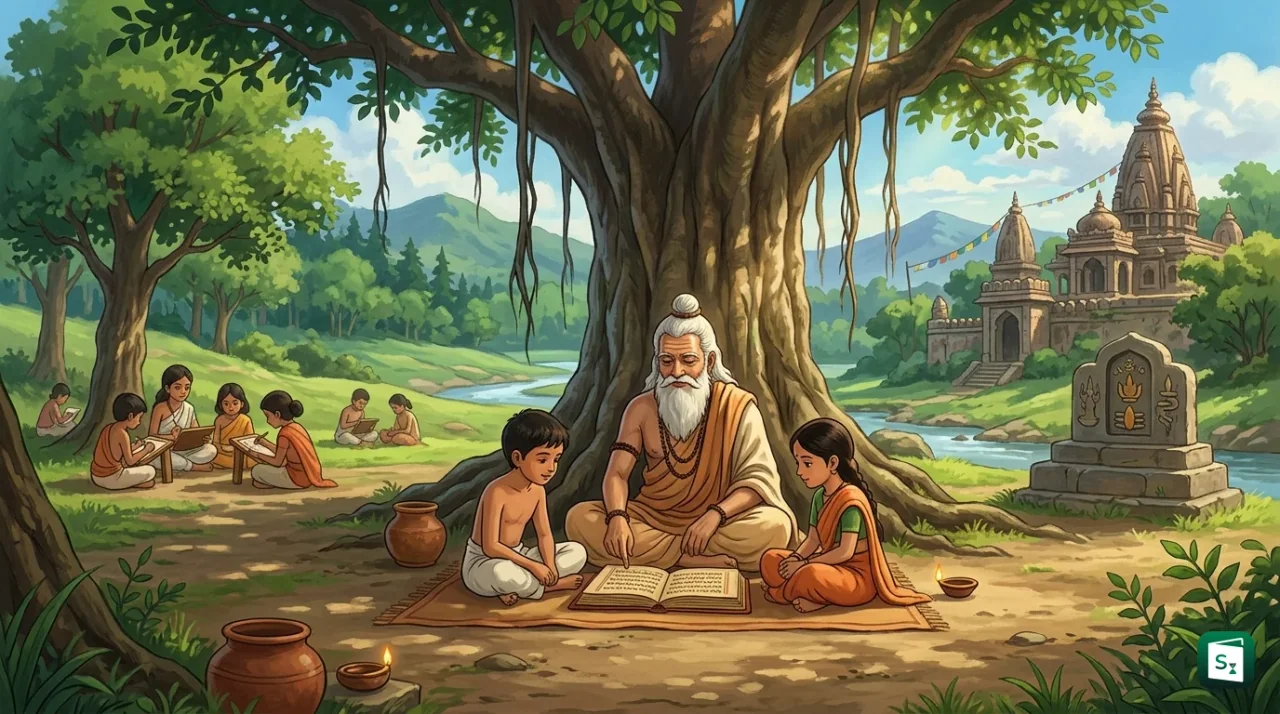
World Sanskrit Day 2026 is observed on August 28, which coincides with Shravana Purnima, the full moon day of the Hindu month of Shravana. Also known as Vishwa Sanskrit Diwas or Sanskrit Diwas, the day honours Panini, the ancient grammarian whose Ashtadhyayi gave Classical Sanskrit its precise and enduring form. The observance celebrates Sanskrit as one of the world’s oldest classical languages and draws attention to its living contribution to literature, philosophy and knowledge systems.
What Is World Sanskrit Day and Why Is It Celebrated on Shravana Purnima?
World Sanskrit Day, also called Vishwa Sanskrit Diwas, Sanskrit Diwas or Sanskrit Language Day, is an annual observance dedicated to promoting and preserving the Sanskrit language. The question what is World Sanskrit Day is answered simply, it is a day to honour Sanskrit’s literary heritage and to encourage new generations to learn, use and research the language.
The date is fixed by the traditional Hindu calendar. It is celebrated every year on Shravana Purnima, the full moon day of the month of Shravana, which usually falls in August in the Gregorian calendar. In 2026, this full moon falls on Friday, August 28, which is also Raksha Bandhan. Because the lunar calendar shifts each year, the Gregorian date of Sanskrit Day changes annually, but its tithi remains the same.
The choice of Shravana Purnima is not random. In ancient learning traditions this day was observed as Shravani or Upakarma, when students in gurukulas renewed their yajnopavita, the sacred thread, and resumed the formal study of the Vedas after a break. Priests tied raksha sutras for protection and sages, regarded as the original sources of Sanskrit literature, were remembered and worshipped. For this reason the day is also called Rishi Parv, the festival of sages. Since the academic year in ancient India began on this day, it was seen as the ideal occasion to honour the language of the sages. The voluntary organisation Samskrita Bharati, which works for the revival of Sanskrit, plays a central role in popularising the observance alongside schools and universities.
How the Observance Began: From 1969 to Today
Official observance of Sanskrit Day began in 1969. In that year the Ministry of Education of the Government of India issued instructions to both Central and State governments to celebrate Sanskrit Day at the national and local levels. The objective was to revive interest in Sanskrit, promote Sanskrit education, preserve its manuscripts and literature, and create public awareness about its cultural value.
Since then the day has been marked every year across the country. On the occasion, institutions organise Sanskrit Kavi Sammelans, writers’ seminars, student speeches, verse recitation and debate competitions, shloka chanting, essay writing and manuscript exhibitions. These events give students, poets and writers a platform to engage with the language.
In 2026 the observance drew national attention. Prime Minister Narendra Modi greeted the nation in Sanskrit on Shravana Purnima and described Sanskrit as a continuous vehicle of India’s knowledge, thought and creativity, noting its positive influence across diverse fields. Vice President C. P. Radhakrishnan called Sanskrit the timeless language of India’s knowledge, philosophy and civilisation and urged collective efforts to preserve and propagate it. Union Home Minister Amit Shah, Uttar Pradesh Chief Minister Yogi Adityanath, Delhi Chief Minister Rekha Gupta and other leaders also extended greetings, underlining Sanskrit as the foundation of India’s knowledge tradition. Celebrations were reported from centres such as Delhi, Varanasi, Ujjain, Sringeri, Pune and Tirupati, with seminars on the relevance of Sanskrit for science, technology and sustainability.
There is no officially declared central theme for World Sanskrit Day 2026 that has been notified by the government, so institutions have adopted their own focus areas such as preservation of manuscripts, Indian Knowledge Systems and digital innovation in Sanskrit learning.
Who Was Panini and Why Is He Honoured on This Day?
World Sanskrit Day especially commemorates Panini, regarded as the father of Sanskrit grammar. He was an ancient Indian linguist and grammarian whose work codified the language with a scientific precision that still astonishes modern linguists.
Historical details about his personal life are limited. Later evidence, including 8th century copper plate inscriptions of the Maitraka ruler Siladitya VII and the accounts of the 7th century Chinese traveller Xuanzang, identify his native place as Shalatula or Salatura in ancient Gandhara, near the junction of the Indus and Kabul rivers in present day northwestern Pakistan. Scholars date him to the mid first millennium BCE, variously between the 6th and 5th century BCE and the 4th century BCE, but his influence is undisputed.
Panini lived at a time when efforts were already underway to preserve the correct pronunciation and grammar of Vedic hymns. He built on earlier grammatical traditions and created a system so complete that it marks the beginning of Classical Sanskrit as a refined and standardised language.
The Ashtadhyayi: Eight Chapters and Nearly 4000 Sutras
Panini’s masterwork is the Ashtadhyayi, a Sanskrit term that literally means eight chapters. It is the foundational text of Vyakarana, which is one of the six Vedangas, the auxiliary disciplines linked to the study of the Vedas.
The text consists of about 3,959 to 4,000 sutras, short aphoristic rules often only a few syllables long. These sutras are organised into eight adhyayas, each divided into four padas, making 32 sections in total. It does not contain long explanations, but instead uses a highly compressed technical method to generate correct Sanskrit words.
Three ancillary lists support the sutras. The Aksharasamamnaya, also called the Shiva Sutras or Maheshvara Sutras, contains 14 groups of sounds that organise the entire Sanskrit sound system. Through a device called pratyahara, Panini can refer to any set of sounds with just two syllables, an early index system similar to modern coding. The Dhatupatha lists about 2,000 verbal roots and the Ganapatha lists groups of words that behave in similar ways. Using these lists as input, the rules of the Ashtadhyayi function like an algorithm to produce well formed words.
The work is both descriptive and generative. It describes the spoken Sanskrit of educated speakers of his time, called shishta, while also accounting for older Vedic forms and dialectal variations. It distinguishes between everyday usage and the sacred language of texts. On the basis of under 4,000 rules, Panini built virtually the whole structure of the language, a structure that has changed very little for more than two thousand years. Scholars often compare his achievement to Euclid’s geometry for its logical rigour.
The Ashtadhyayi also contains different types of rules, including vidhi sutras that perform operations, paribhasha sutras that act as meta rules, adhikara sutras that set the scope for a group of rules, and atidesha sutras that extend properties from one element to another.
Panini and Patanjali: Two Pillars of Sanskrit Grammar
A common comparative query is Panini and Patanjali. The two are distinct but connected figures in the history of Sanskrit grammar.
| Aspect | Panini | Patanjali |
|---|---|---|
| Period | Around 6th to 4th century BCE | Around 2nd century BCE |
| Major work | Ashtadhyayi, the foundational grammar | Mahabhashya, the great commentary on the Ashtadhyayi |
| Role | Created the original system of nearly 4,000 sutras | Explained, defended and expanded Panini’s rules with detailed analysis |
| Significance | Marks the start of Classical Sanskrit and formal linguistics | Made Panini’s highly compressed rules accessible and shaped later grammatical tradition |
While Panini created the system, Patanjali’s Mahabhashya is the most famous bhashya, or commentary, that helped generations of students understand it. Together with Katyayana, who wrote the Varttika corrections, they form the celebrated trio of Sanskrit grammarians.
Significance of Sanskrit: Classical Language and Cultural Heritage
Sanskrit occupies a central place in India’s civilisational story. The word Sanskrit itself means refined, cultured or perfected, reflecting its status as a polished literary language. It was the medium of learning, administration, literature and intellectual exchange across large parts of the Indian subcontinent for centuries.
Classical Language and Constitutional Status
Sanskrit was declared a Classical Language by the Government of India on 25 November 2005. It was the second language after Tamil, which received the status on 12 October 2004, to be so recognised. The criteria include high antiquity of early texts over 1500 to 2000 years, a body of ancient literature considered valuable heritage, and an original literary tradition. As of October 2024, India has 11 Classical Languages, with Marathi, Pali, Prakrit, Assamese and Bengali added most recently. Sanskrit is also listed in the Eighth Schedule of the Constitution, which currently contains 22 languages. While Classical status is an academic and cultural recognition managed by the Ministry of Culture and the Sahitya Akademi, Eighth Schedule inclusion has constitutional implications under Article 344 and Article 351. Article 351 directs the Union to promote Hindi by drawing on forms and vocabulary primarily from Sanskrit and secondarily from other languages.
Literary and Intellectual Legacy
The Vedas, composed in Vedic Sanskrit, are among the oldest surviving texts in the world. Classical Sanskrit literature includes epics such as the Ramayana and Mahabharata, poetry and drama such as Kalidasa’s Abhijnanashakuntalam, Raghuvamsha and Kumarasambhava, the play Mricchakatika, and philosophical, grammatical and scientific treatises. Authors such as Kalidasa, Bhavabhuti and Ashvaghosha are celebrated in this tradition.
Beyond literature, Sanskrit texts preserve extensive knowledge in philosophy, grammar, mathematics, astronomy, medicine, Ayurveda, economics and arts. Works such as Aryabhata’s astronomy, the Charaka Samhita on medicine and Kautilya’s insights on statecraft are part of this heritage. Panini’s own work shows that linguistics itself was developed as a science in ancient India well before similar formal studies elsewhere.
Sanskrit has also shaped the vocabulary and literary development of many modern Indian languages. For centuries it served as a shared language of learning that connected different regions. Even today, its study helps in understanding the evolution of Indian languages and in reading historical sources.
The continued relevance is underlined by its presence in religious practice, philosophy, yoga, traditional medicine and contemporary research on Indian Knowledge Systems.
How India Celebrates: Institutions, Policy and Modern Promotion
Celebrations on World Sanskrit Day are centred in schools, colleges, universities and cultural bodies. Common activities include shloka recitation, speech and debate competitions, essay writing, quizzes, Sanskrit board decoration, rangoli, poster and drawing competitions, seminars and manuscript exhibitions. Many institutions also distribute greeting cards with Sanskrit verses, organise Sanskrit Saptah, or Sanskrit Week, programmes around the main day, and share social media greetings in Sanskrit.
Government promotion of Sanskrit rests on several pillars.
Three Central Sanskrit Universities: Through the Central Sanskrit Universities Act, 2020, passed by Parliament on 16 March 2020, three institutions were converted into Central Universities. These are the Central Sanskrit University in New Delhi, with multiple campuses across the country, Shri Lal Bahadur Shastri National Sanskrit University in New Delhi, and the National Sanskrit University in Tirupati. The Central Sanskrit University is the largest multi campus Sanskrit university in the world and acts as the nodal agency for Sanskrit related policies. The President of India is the Visitor and the Union Minister of Education is the Chancellor. Two earlier institutions in Tirupati and Delhi had been deemed universities before this upgrade.
National Education Policy 2020: The National Education Policy (NEP) 2020 provides for mainstreaming Sanskrit. It recommends offering Sanskrit as an option in the three language formula in schools and in higher education, strengthening Sanskrit universities as multidisciplinary institutions, and integrating Indian Knowledge Systems (IKS) into curricula.
Gyan Bharatam Mission and Digitisation: The government has launched the Gyan Bharatam Mission for the digitisation and preservation of manuscripts. Alongside, schemes provide financial assistance to Adarsh Sanskrit Mahavidyalayas and Shodha Sansthans, merit scholarships to students from pathshala to college level, grants to scholars under the Shastra Chudamani scheme, aid for publication and reprint of rare books, and the Ashtadashi programme with eighteen projects to sustain Sanskrit growth. The Non Formal Sanskrit Education (NFSE) programme supports learning centres in institutions such as IITs, Ayurveda colleges and modern universities. The Central Sanskrit University also coordinates Sanskrit learning centres, while Samskrita Bharati promotes spoken Sanskrit through camps and public programmes. Presidential awards honour 16 senior and 5 young Sanskrit scholars each year.
Recent combined festivals such as Utkarsh Mahotsav, jointly organised by the three Central Sanskrit Universities, showcase innovations in research, pedagogy, EdTech and interdisciplinary studies aligned with NEP 2020.
The Way Forward
The future of Sanskrit depends on connecting its deep heritage with present needs. Digitisation of manuscripts under missions like Gyan Bharatam can save fragile palm leaf and paper texts and make them searchable for global researchers. Integrating Sanskrit and Indian Knowledge Systems into school and university curricula, as envisaged by NEP 2020, can help students see the language not only as grammar and verses but as a gateway to science, medicine, logic and aesthetics.
Promoting spoken Sanskrit through non formal centres, supporting research that applies Paninian grammar to modern computational linguistics and natural language processing, and encouraging translation of classical texts will widen the circle of learners. On Shravana Purnima each year, the simple act of renewing study, much like renewing the sacred thread, reminds teachers and students that a language survives because each generation chooses to bind itself to it anew.
Key Takeaways
- World Sanskrit Day 2026 was observed on August 28, 2026, on Shravana Purnima, the full moon day of the month of Shravana, which also coincides with Raksha Bandhan.
- The day has been officially observed in India since 1969, when the Ministry of Education instructed Central and State governments to celebrate it.
- It commemorates Panini, the ancient grammarian from Shalatula in Gandhara, whose Ashtadhyayi contains nearly 4,000 sutras in eight chapters and is the foundational text of Vyakarana, one of the six Vedangas.
- Sanskrit was declared a Classical Language on 25 November 2005 and is also listed in the Eighth Schedule of the Constitution, which contains 22 languages.
- The Central Sanskrit Universities Act, 2020 established three Central Sanskrit Universities, the Central Sanskrit University in New Delhi, Shri Lal Bahadur Shastri National Sanskrit University in New Delhi, and the National Sanskrit University in Tirupati.
- The Ashtadhyayi is complemented by the 14 Shiva Sutras, Dhatupatha and Ganapatha, and its most famous commentary is Patanjali’s Mahabhashya from the 2nd century BCE.