Oyo Nyimba Kabamba Iguru Rukidi IV, the 13th Omukama (king) of the Tooro Kingdom in western Uganda, died on 27 August 2026 in the United States at the age of 34. He had occupied the Tooro throne for almost 31 years after being enthroned as a three year old child in 1995, a distinction that earned him recognition from Guinness World Records as the world’s youngest reigning monarch. His death has placed the spotlight on Tooro’s two century old monarchy, Uganda’s system of cultural kingdoms, and the question of succession to the throne.
Who Was King Oyo Nyimba Kabamba Iguru Rukidi IV?
King Oyo’s full royal name was Rukirabasaija Oyo Nyimba Kabamba Iguru Rukidi IV. In the Rutooro language, Omukama means king and Rukirabasaija means the greatest of men. He was born on 16 April 1992 to Omukama Patrick David Matthew Kaboyo Olimi III and Queen Mother Best Kemigisa Akiiki. He belonged to the Babiito dynasty, the royal clan from which the kings of both Tooro and neighbouring Bunyoro are chosen.
His father died suddenly on 26 August 1995. Less than three weeks later, on 12 September 1995, the three year old prince was enthroned as the 13th Omukama of Tooro. The early morning rituals included a mock battle at the palace entrance, a test of his royal blood by the head of the royal clan, and the sounding of the Nyalebe, the sacred drum of the earlier Chwezi rulers. His first meal as king was millet dough, the staple food of the region. Because of his age, the event drew attention around the world and brought him entry into Guinness World Records as the youngest reigning monarch.
What Is the Tooro Kingdom?
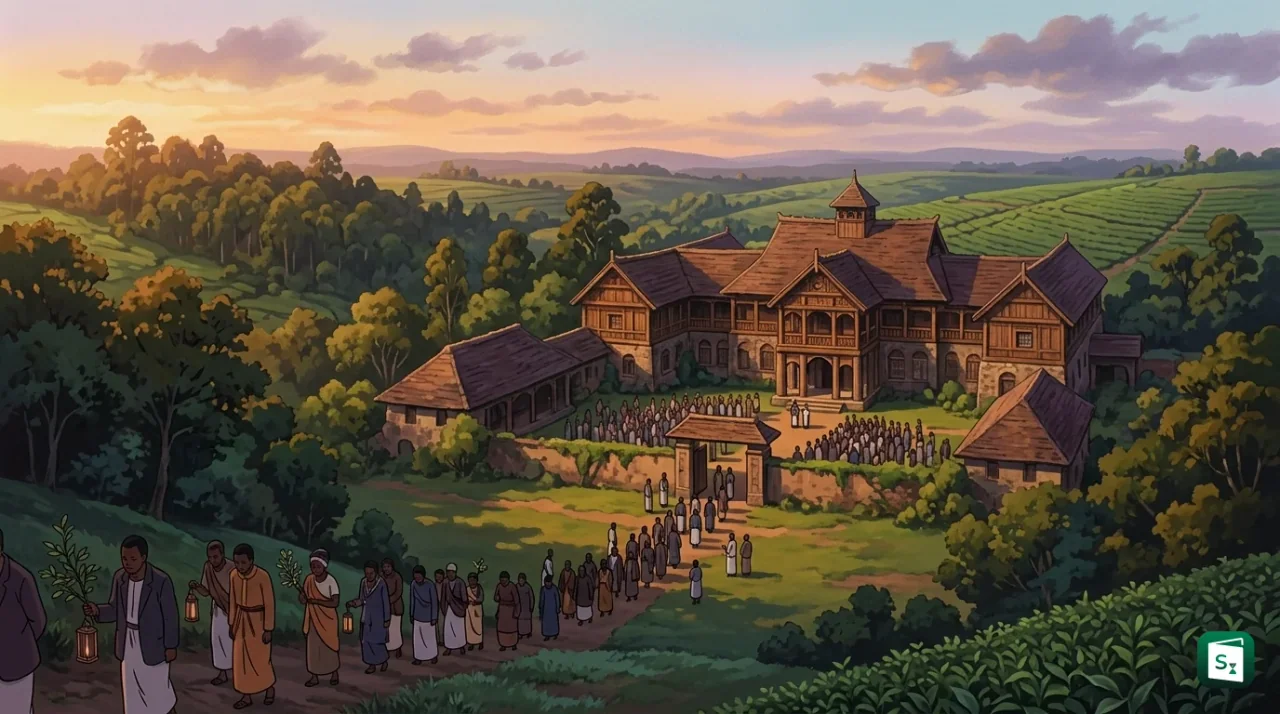
The Kingdom of Tooro, also written as Toro and called Obukama bwa Tooro in the local language, is a Bantu kingdom in western Uganda. Its capital is Fort Portal, a tourism city at the foothills of the Rwenzori Mountains, and its royal seat is the Karuziika Palace on Karuziika Hill overlooking the town. The native people are the Batooro, who speak Rutooro, and the kingdom also includes Bakonzo, Bamba, Batuku and other communities. The kingdom’s anthem is Agutamba.
Tooro was founded in 1830 when Prince Kaboyo Olimi I, the eldest son of the king of Bunyoro, broke away from the larger Bunyoro-Kitara Empire and set up an independent kingdom. It was absorbed back into Bunyoro in 1876, regained independence in 1891 with support from the British colonial administration, and continued as a local administration under British rule. Like Buganda, Bunyoro, Busoga and Ankole, the Tooro monarchy was abolished in 1967 by President Milton Obote. It was restored as a cultural institution in 1993 under President Yoweri Museveni through the Traditional Rulers (Restitution of Assets and Properties) Act, 1993.
Today Tooro has no political or tax powers. It functions as a constitutional and cultural monarchy headed by the Omukama, assisted by a prime minister called the Omuhikirwa and a supreme council called the Orukurato. The kingdom covers the Tooro sub region, which includes the districts of Kabarole, Kamwenge, Kyenjojo, Kyegegwa, Bunyangabu, Kitagwenda and Ntoroko, with a population of more than two million people. The area is known for crater lakes, tea gardens, the Kibale National Park, and the Amabere Caves near Fort Portal.
From Child King to Full Charge at 18
When Oyo was enthroned at the age of three, he was too young to manage the affairs of the kingdom. A regency was therefore formed to act on his behalf. The regents included his mother Queen Mother Best Kemigisa, who served as defender and regent of the crown, along with senior royals such as Princess Elizabeth Bagaaya and Prince James Mugenyi. During these years Oyo attended school under close protection, first spending two years in London, then studying at Aga Khan Primary School in Kampala and Kampala International School Uganda. He later earned a bachelor’s degree in Business Management from the University of Winchester in the United Kingdom in October 2013.
Oyo assumed full operational control of the kingdom when he turned 18. A major coronation ceremony was held at Fort Portal on 17 April 2010, a day after his 18th birthday, which was attended by President Museveni and thousands of subjects. This explains why he is sometimes described both as a king since age three and as a ruler who took charge at 18. The first refers to his enthronement and the second to the end of the regency. He went on to reign for almost 31 years, celebrating his 30th coronation anniversary in 2025.
Education, Health and Development Work
As a cultural king without governing powers, Oyo used his position to promote social causes, especially among young people. In 2016, at the age of 24, he was appointed by the Joint United Nations Programme on HIV/AIDS (UNAIDS), which is headquartered in Geneva, Switzerland, as a Champion and Goodwill Ambassador for ending AIDS among young people in Eastern and Southern Africa. In that role he campaigned for HIV testing, prevention of mother to child transmission, antenatal care for pregnant women, and keeping adolescent girls in school.
Within Tooro he linked culture with development. In 2021 he launched the Tooro Kingdom Vision 2045, a 25 year plan focused on agriculture, education, health, tourism, culture, jobs and poverty reduction. The kingdom distributed coffee and cocoa seedlings to youth, set up incubation centres for farming and entrepreneurship, and opened an information technology hub at its headquarters in Muchwa to teach computer and digital skills. Through the Tooro scholarship programme, more than 300 needy students received support for secondary and university education in 2026. Other projects associated with his reign included protection of the River Mpanga, promotion of responsible farming, support for sports through events like the Masaza Cup football tournament, and the construction of the King Oyo Children’s Hospital in Kyenjojo District.
Death and Question of Succession
King Oyo died at about 10 pm East Africa Time on 27 August 2026 while receiving medical treatment in the United States. The Tooro prime minister, Calvin Armstrong Rwomiire Akiiki, announced the death and described it as an immeasurable loss to the royal family, the people of Tooro and the nation of Uganda. The kingdom did not initially disclose the cause, but President Yoweri Museveni later stated that the king had suffered from an aggressive form of cancer and that the government had supported his treatment first in Germany and then in the United States.
The timing carried a painful symmetry. His father had died on 26 August 1995 and Oyo died on 27 August, almost 31 years later, just weeks before the annual Empango coronation anniversary on 12 September. His body was flown back to Entebbe Airport, where the President was among those who received it, and the kingdom declared a nine day mourning period.
Succession follows a hereditary system within the Babiito royal clan, but Oyo was not officially married and had not installed a queen consort. The prime minister announced that continuity of the crown was assured because Oyo leaves behind a young prince whose identity would be revealed later as per Tooro customs. This claim has led to public debate, as the head of the Babiito clan has said he has no knowledge of the child and has argued that the choice of heir is a cultural process for the clan, not the prime minister’s office. The government has urged the public to avoid speculation and to rely only on official announcements from the kingdom.
Uganda’s Traditional Kingdoms in Brief
Uganda has no national king. The President is the head of state. Traditional kingdoms exist as cultural institutions recognised under the Constitution of Uganda. They preserve language, customs, clan systems and heritage, but they do not make laws, collect taxes or control territory in a political sense.
The main recognised kingdoms help place Tooro in context.
| Kingdom | People and Capital | Key Fact |
|---|---|---|
| Buganda | Baganda people, capital at Mengo in Kampala, headed by the Kabaka | The largest and most influential kingdom, restored in 1993 with the coronation of Kabaka Ronald Muwenda Mutebi II as the 36th king |
| Bunyoro-Kitara | Banyoro people, capital at Hoima, headed by the Omukama | The oldest kingdom in the region, from which Tooro broke away in 1830 |
| Tooro | Batooro people, capital at Fort Portal, headed by the Omukama | Founded by Olimi I in 1830, restored in 1993, ruled by Oyo from 1995 to 2026 |
| Busoga | Basoga people, headed by the Kyabazinga | A confederation of chiefdoms rather than a single dynasty |
| Ankole | Banyankole people | Monarchy abolished in 1967 and not fully restored due to clan disputes |
All these monarchies were abolished in 1967 and restored only for cultural purposes in 1993. This history explains why King Oyo’s role was cultural and developmental rather than political, and why his work with schools, hospitals, farmers and health campaigns mattered more than any formal power.
Key Takeaways
- Oyo Nyimba Kabamba Iguru Rukidi IV, the 13th Omukama of Tooro, died on 27 August 2026 in the United States at the age of 34.
- Oyo was enthroned on 12 September 1995 at the age of three and recognised by Guinness World Records as the world’s youngest reigning monarch.
- The Tooro Kingdom, founded in 1830 by Kaboyo Olimi I after breaking away from Bunyoro, has its capital at Fort Portal and its palace at Karuziika.
- Oyo assumed full control of the kingdom in 2010 after a regency led by Queen Mother Best Kemigisa, and graduated in Business Management from the University of Winchester in 2013.
- In 2016, UNAIDS appointed Oyo as Champion for ending AIDS among young people in Eastern and Southern Africa.
- Tooro follows a hereditary succession within the Babiito dynasty, and the kingdom has stated that Oyo leaves behind a young prince whose identity will be revealed as per custom.