The Indian Institute of Science (IISc) Bengaluru has established the Foundation for Quantum Computing Innovation (FQCI) to function as the Quantum Computing Thematic Hub (QC T-Hub) under the National Quantum Mission (NQM). The hub was announced on 31 August 2026 and is implemented through the Department of Science and Technology (DST) as a Section 8 not-for-profit company. It will anchor India’s push to build indigenous quantum computers and create skilled talent through five dedicated programmes for students, researchers and startups.
What Is Quantum Computing in Simple Terms?
Quantum computing is a new way of processing information that uses the laws of quantum mechanics, the physics of very small particles like atoms, electrons and photons. A regular computer stores information as bits, which can be only 0 or 1. A quantum computer uses quantum bits or qubits, and the basic unit of information in quantum computing is called a qubit.
A qubit is special because it can be 0, 1, or both at the same time. This property is called superposition. You can imagine it like a spinning coin that is both heads and tails until it lands. When you measure a qubit, it settles into either 0 or 1. Another key property is entanglement, where two or more qubits become linked so that the state of one instantly tells you the state of the other, even if they are far apart. These two properties allow quantum computers to explore many possibilities at once, which can make them far faster than classical computers for certain tasks like drug discovery, materials design, cryptography and large scale optimisation.
Building qubits is difficult because they are very fragile. Tiny heat, noise or vibration can make them lose their quantum state, a process called decoherence. Current research therefore focuses on different hardware platforms such as superconducting circuits, photonics, semiconducting or silicon-spin qubits, neutral atoms and trapped ions, along with quantum algorithms that tell the quantum hardware what to compute.
What Is the National Quantum Mission?
The National Quantum Mission (NQM) is the Government of India’s flagship programme to build scientific and industrial capability in Quantum Technologies (QT). It was approved by the Union Cabinet on 19 April 2023 and is implemented by the Department of Science and Technology (DST) under the Ministry of Science and Technology. The Mission runs from 2023-24 to 2030-31, an eight year period, with a total outlay of ₹6,003.65 crore. The Mission Director is Dr J B V Reddy and the governance includes a Mission Governing Board chaired by Dr Ajai Chowdhry, co-founder of HCL, and a technical advisory council.
The Mission aims to make India self-reliant, or Atmanirbhar, in quantum hardware, communications, sensing and materials. Its objectives cover four verticals, Quantum Computing, Quantum Communication, Quantum Sensing and Metrology, and Quantum Materials and Devices. Concrete targets include building intermediate scale quantum computers with 20 to 50 physical qubits in three years, 50 to 100 qubits in five years, and 50 to 1000 physical qubits in eight years across platforms such as superconducting and photonic systems. Other goals are satellite based secure quantum communications over 2000 km within India, inter-city quantum key distribution over 2000 km, multi-node quantum networks with quantum memories, high sensitivity magnetometers and atomic clocks for timing and navigation, and new quantum materials including superconductors and topological materials along with single photon sources and entangled photon sources.
To deliver these goals, the Mission created four Thematic Hubs (T-Hubs) through a competitive selection process. Each hub is a Section 8 not-for-profit company that acts as a centre of excellence and follows a hub-spoke-spike model, where the central hub leads research, spokes are project clusters and spikes are individual research groups.
| Hub No. | Host Institution | Technology Domain | Web Platform |
|---|---|---|---|
| T-Hub 01 | Foundation for QC Innovation at IISc Bengaluru | Quantum Computing | qcinnovation.co.in |
| T-Hub 02 | IIT Madras with C-DOT, New Delhi (Samgnya Technologies Foundation) | Quantum Communication | samgnya.in |
| T-Hub 03 | QMet Tech Foundation at IIT Bombay | Quantum Sensing and Metrology | qmettech.com |
| T-Hub 04 | QMD Foundation at IIT Delhi | Quantum Materials and Devices | qmdhub.co.in |
In total, 152 researchers from 43 institutions across 17 states and 2 Union Territories are involved through 14 Technical Groups under these hubs. The Mission also supports startups, with eight quantum startups supported so far and dedicated guidelines for funding, plus rolling calls through the T-Hubs. It has aligned with national priorities such as Digital India, Make in India, Skill India, Start-up India and Sustainable Development Goals and is one of the initiatives under the Prime Minister’s Science Technology Innovation Advisory Council (PM-STIAC).
Foundation for Quantum Computing Innovation: The Quantum Computing Thematic Hub at IISc
The Foundation for Quantum Computing Innovation (FQCI) is the Quantum Computing Thematic Hub (QC T-Hub) set up by IISc Bengaluru. IISc, established in 1909 through the vision of Jamsetji Nusserwanji Tata with land donated by the Maharaja of Mysore, Krishnaraja Wodeyar IV, and support from the Government of India, is India’s premier institute for science and engineering research. It launched the IISc Quantum Technology Initiative (IQTI) in September 2020 and started the M Tech in Quantum Technology in August 2021, the first such programme in the country.
FQCI is registered as a Section 8 company under NQM and is led by Project Director Prof Shankar Kumar Selvaraja of the Centre for Nano Science and Engineering (CeNSE) at IISc. The foundation brings together a consortium of 21 institutes and 52 researchers with a committed funding of ₹653 crore for the quantum computing vertical. Its stated vision is to establish India as a global hub for quantum computing innovation by developing scalable, indigenous technologies and nurturing a world class ecosystem.
What the Hub Will Build
The technical work spans five key platforms, superconducting qubits, semiconducting or silicon-spin qubits, neutral atom and ion trap systems, photonics, and quantum algorithms. The hub is creating shared, central facilities for device fabrication, characterisation, testing and technology development, resources that individual labs or early stage firms often cannot afford alone. These facilities will support work on control electronics, cryo systems, photonic chips, ion trap setups and algorithm development.
The hub also connects to older strengths at IISc. Its groups have recently demonstrated India’s first 6-qubit photonic quantum computing system, along with work on quantum teleportation and entanglement based quantum random number generators now used by national agencies. FQCI coordinates Technical Groups across partner institutions such as Raman Research Institute (RRI) Bengaluru, IITs, TIFR, IISERs, NISER and C-DAC, operating in the hub-spoke-spike framework.
Beyond hardware, FQCI is tasked with human resource development, entrepreneurship, industry engagement and global collaboration. It regularly organises workshops, such as the Familiarisation Workshop on Quantum Computing in September 2025 and February 2026, and events like the Quantum Pitch Fest 2026 on 22-23 May 2026 with Quantum Research Park (QuRP) and IQTI, which bring together researchers, students, startup founders and investors.
Five Programmes to Build Talent and Entrepreneurship: QC Rise, QC Bridge, QC Leap, QC Accel and QC Quest
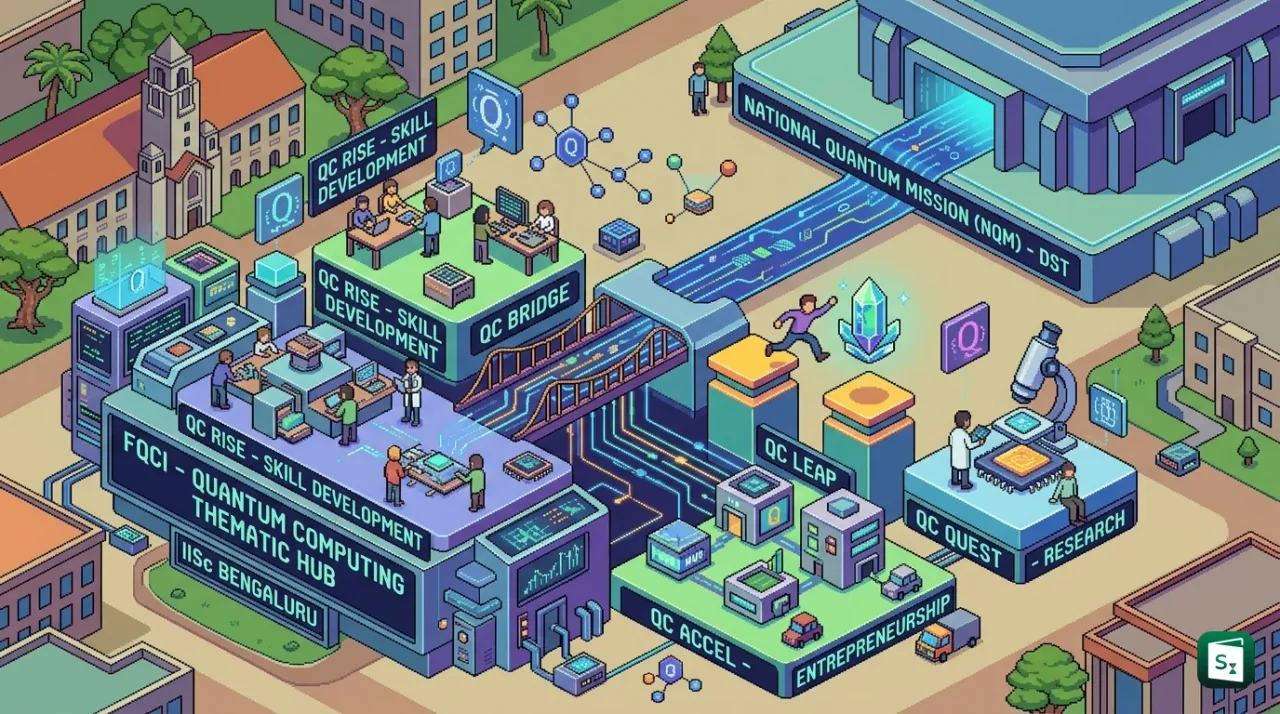
FQCI has launched five structured programmes that together cover the full journey from student training to startup creation and industry collaboration. The goal is to create a continuous pipeline where classroom ideas move to labs, then to prototypes and finally to products.
| Programme | Full Form and Focus | Who It Supports | What It Offers |
|---|---|---|---|
| QC Rise | Research Internship and Skill Enhancement | Undergraduate students in 7th semester and first year postgraduate students | Six month internship and 12 month project thesis on site at IISc and partner institutes, hands on work on photonic quantum computing, superconducting processors, neutral atoms, spin qubits and FPGA based control systems, stipend support and mentorship. Minimum CGPA 8.0 or 75 percent required |
| QC Bridge | Bridging Research, Industry, Development, Growth and Excellence | Young PhD holders or scholars who have submitted thesis, preferably below 32 years | Post-Doctoral Fellowship of ₹1,00,000 per month plus HRA and ₹2,00,000 per year contingency, tenure 1 year extendable up to 3 years based on publications, patents and commercialisation potential |
| QC Leap | Leveraging Entrepreneurship and Productization | Indian startups in quantum computing | Funding for hardware sub-assemblies like cables and driver electronics and quantum algorithms, guidance on technology readiness level, mentorship and access to central facilities |
| QC Accel | Academia Industry Collaboration for Commercialization, Excellence and Leadership | Joint teams of academic faculty and industry or startup partners | 18 month projects where problem statements are framed by industry, funding to academic partner, support for patents, proof of concept acceleration and translation of lab work to market |
| QC Quest | Quantum Education, Outreach, Exchange, Synergy and Training | AICTE approved institutions, universities and research organisations | Financial support to organise seminars, symposia, workshops and conferences in quantum computing technologies to build awareness and networks |
The approach is deliberately staged. QC Rise and QC Bridge build skilled manpower, QC Leap funds startups to build products, QC Accel ties academic research to real industry problems, and QC Quest spreads knowledge through events. This mirrors the Mission’s emphasis on the hub-spoke-spike network, where knowledge and infrastructure are shared rather than isolated in one lab.
How Does Quantum Computing Differ from Classical Computing?
A classical computer uses bits and processes information step by step through logic gates. Even the fastest supercomputer tries one path at a time, though very quickly. A quantum computer uses qubits that can hold many possibilities at once through superposition and coordinate through entanglement.
For example, finding the shortest path in a complex maze requires a classical machine to test paths sequentially. A quantum machine can test many paths at the same time and use quantum interference to amplify the correct answer and cancel out wrong ones. This makes quantum computers promising for problems involving many variables, such as simulating molecules for new drugs, designing advanced materials for batteries, optimising supply chains and traffic, and breaking or strengthening encryption.
At present, quantum computers are not replacements for everyday computing. They are special purpose machines that will work alongside classical systems. Challenges remain, including error correction, coherence time, gate fidelity and scaling to many reliable qubits. That is why missions worldwide focus on steadily increasing physical qubit counts before reaching error corrected, logically useful qubits.
Quantum Computing and Related Technologies
Quantum computing is often discussed alongside quantum communication and quantum cryptography. While computing aims at faster calculation, communication uses entanglement and quantum key distribution (QKD) to make data transfer secure, because any attempt to intercept entangled photons disturbs their state and alerts the users. FQCI’s work therefore connects with the other T-Hubs in communication, sensing and materials to build the full quantum stack.
Why the IISc Hub Matters for India
India’s investment in quantum technology addresses strategic and economic needs. Secure communications, precision navigation and high sensitivity sensing directly support sectors such as telecommunications, defence, finance, healthcare, energy, space and banking. The Mission explicitly links quantum work to drug design, climate modelling and secure financial transactions, where quantum simulation and quantum safe cryptography will matter most.
Locating the computing hub at IISc Bengaluru leverages existing strengths. Bengaluru is already India’s major hub for startups and deep tech, and Karnataka is supporting a Quantum Research Park (QuRP) through the Foundation for Science Innovation and Development (FSID) at IISc with support from the Karnataka Innovation and Technology Society (KITS). Placing shared fabrication and testing facilities there reduces duplication, gives startups access to expensive clean rooms and cryogenic setups, and helps retain talent that might otherwise move abroad for quantum training.
The hub also strengthens India’s broader skill ecosystem. The All India Council for Technical Education (AICTE) in collaboration with DST has developed B Tech Minor and M Tech curricula in Quantum Technology. Combined with FQCI’s internship and postdoctoral programmes, this helps build a quantum ready workforce for Viksit Bharat 2047, a vision highlighted in the symposium co-sponsored by FQCI at Ramaiah University of Applied Sciences on 24 June 2026.
On the global stage, the Mission places India alongside programmes such as national quantum initiatives in the United States, China, European Union and United Kingdom. India’s approach is distinctive because it ties research grants directly to startup formation and industry proof of concepts rather than funding academic research in isolation.
The Way Forward
FQCI at IISc will be judged by how quickly it turns consortium research into working hardware, trained people and market products. Near term priorities include operationalising the central fabrication and characterisation facility, completing calls for QC Leap startup funding 2025 and follow on rolling calls, and delivering the 20 to 50 qubit systems targeted in the Mission’s first three years.
For students and institutions, the immediate entry points are QC Rise internships, QC Bridge fellowships and QC Quest event grants, with applications routed through qcinnovation.co.in. For industry, QC Accel offers a direct channel to place research problems inside academic labs with Mission support. As the four hubs mature, coordination between computing, communication, sensing and materials will be critical to achieve the flagship goals of 2000 km satellite and fiber links and scalable quantum networks.
Key Takeaways
- The Foundation for Quantum Computing Innovation (FQCI) was established by IISc Bengaluru on 31 August 2026 as the Quantum Computing Thematic Hub (QC T-Hub) under the National Quantum Mission.
- The National Quantum Mission, approved on 19 April 2023 and implemented by the Department of Science and Technology (DST), has an outlay of ₹6,003.65 crore for 2023-24 to 2030-31.
- The basic unit of information in quantum computing is called a qubit, which can exist in superposition and show entanglement, unlike a classical bit which is only 0 or 1.
- The Mission has set up four Thematic Hubs at IISc Bengaluru (Computing), IIT Madras with C-DOT (Communication), IIT Bombay (Sensing and Metrology) and IIT Delhi (Materials and Devices).
- FQCI runs five programmes, QC Rise, QC Bridge, QC Leap, QC Accel and QC Quest, covering internships, postdoctoral fellowships, startup funding, industry academia projects and event support.
- QC Bridge offers a Post-Doctoral Fellowship of ₹1,00,000 per month plus HRA and connects 21 institutes and 52 researchers with ₹653 crore committed for the computing hub.