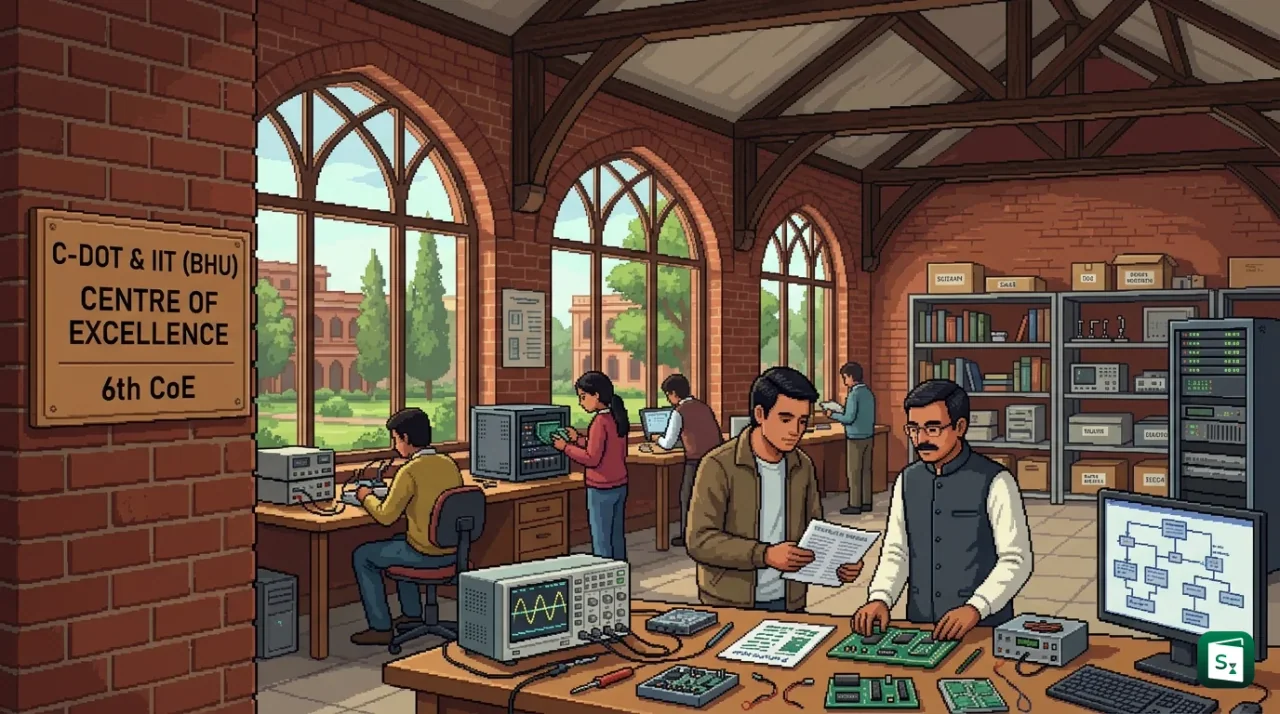
The Centre for Development of Telematics (C-DOT) signed a Memorandum of Understanding (MoU) with the Indian Institute of Technology (BHU) Varanasi on 23 October 2026 to establish its sixth Centre of Excellence (CoE) for telecom research. The new centre at IIT BHU will focus on 5G Advanced and 6G technologies, quantum communications, cybersecurity and AI-driven communication systems. It expands C-DOT’s national academic network and pushes India’s drive for homegrown telecom technology.
What Did C-DOT and IIT BHU Agree To?
The Centre for Development of Telematics (C-DOT) signed the MoU with IIT BHU Varanasi on 23 October 2026. The signing took place in the presence of Dr. Pankaj Kumar Dalela, Executive Vice President of C-DOT, and Professor Amit Patra, Director of IIT BHU, along with faculty members and senior officials. The ceremony was followed by the inauguration of the Centre of Excellence on the IIT BHU campus.
The MoU creates a dedicated platform for collaborative research, technology development and capacity building in emerging communication technologies. Researchers, faculty members, students and C-DOT technology experts will work together on joint projects and share knowledge on a continuous basis. The aim is to connect classroom and laboratory research with real requirements of telecom networks.
Under C-DOT’s CoE framework, the collaboration can take several practical forms. These include joint research and development projects, projects supported by the Telecom Technology Development Fund (TTDF), co-funded and sponsored research, consultancy assignments, joint supervision of students, training programmes and joint seminars. Outputs can include joint publications, patent filings, prototypes, testbeds and support for startups.
What Is C-DOT in India?
The Centre for Development of Telematics (C-DOT) is the autonomous telecom research and development centre of the Department of Telecommunications (DoT) under the Ministry of Communications. Established in August 1984 as a registered society, C-DOT is headquartered at Mehrauli, New Delhi, with a second campus at Electronic City, Bengaluru.
C-DOT began with a clear national task. In the 1980s it designed a family of digital electronic switching systems suited to Indian conditions. Its small rural exchanges brought affordable telephone connectivity to villages. The famous RAX (Rural Automatic Exchange) of 128 lines, first installed at Kittur in Karnataka in 1986, showed that India could build its own exchanges at low cost.
Over four decades, C-DOT grew into a full telecom technology institution. It works on optical communication, switching, wireless systems, network management and security. Its portfolio now covers 4G, 5G, M2M and IoT, artificial intelligence (AI) applications and quantum communication. C-DOT is also a public funded research institution recognised by the Department of Scientific and Industrial Research.
The most visible recent success is the indigenous 4G stack. C-DOT developed the core network, while Tejas Networks supplied the radio access network and Tata Consultancy Services (TCS) acted as the system integrator for Bharat Sanchar Nigam Limited (BSNL). The cloud native stack is described as 5G ready. By late 2025, close to 98,000 swadeshi 4G towers had been commissioned, placing India among a small group of countries with fully homegrown 4G technology. C-DOT has also developed an indigenous 5G standalone core and an Open RAN radio system, and it runs a 5G O-RAN testing lab for startups and academic institutions.
What Is Telematics and How Does It Work?
The word telematics combines telecommunications and informatics. In the context of C-DOT, telematics means the science of sending, receiving and processing information over telecom networks, including telephone exchanges, optical fibre, wireless systems and data networks that carry voice and data across the country.
Telematics is sometimes confused with vehicle telematics. A vehicle telematics device uses a small control unit, GPS and mobile connectivity to record speed, location and engine data and send it to a server for fleet tracking or safety alerts. C-DOT’s mandate is much broader. C-DOT builds the underlying network systems that carry all such data, from rural exchanges and broadband equipment to 4G and 5G cores, quantum-safe communication and AI-based network management.
What Will the New Centre of Excellence Research?
The IIT BHU Centre of Excellence will focus on four broad domains. These are wireless communications, quantum technologies, cybersecurity and AI-driven communication systems. Within these domains, the partners have identified specific frontier areas for joint work.
| Research Area | What It Means in Simple Terms |
|---|---|
| 5G Advanced and 6G | Next stage mobile networks with higher speed, extremely low delay and support for smart machines and sensors |
| Very large-scale MIMO | Use of many antennas together to send more data to many users at the same time |
| Integrated Sensing and Communication | One system that both communicates and senses the surroundings, useful for transport and disaster alerts |
| AI-native networks and devices | Networks that use AI from the design stage to manage traffic, save energy and block faults |
| Quantum and post-quantum communication | New methods to keep messages secure even when powerful quantum computers arrive |
Quantum communication uses properties of light particles to detect any attempt to intercept a message. Post-quantum cryptography means new mathematical codes that even a quantum computer cannot easily break. Both areas matter for defence, banking and government communication.
AI-driven communication covers data-driven wireless design, energy efficient operation and stronger security. For example, AI tools can predict network congestion, shift capacity to busy areas and flag unusual patterns that may signal a cyber attack. The centre will also work on prototypes, testbeds and intellectual property that can move from laboratory to industry.
How Is the National CoE Network Expanding?
The IIT BHU unit is the sixth Centre of Excellence in C-DOT’s academic network. Each CoE is governed by a broad MoU, while specific studies are taken up through separate project agreements. The model supports collaborative research, TTDF projects, sponsored research, consultancy, training and joint guidance for students.
| Centre Location | Status and Focus |
|---|---|
| IIT Kanpur | Early partner in the CoE network for advanced telecom research |
| IIT Gandhinagar | MoU signed on 8 November 2025 for telecom, cybersecurity, quantum communication and advanced AI |
| IIT Roorkee | MoU signed on 27 November 2025 for wireless communication, quantum technologies, cybersecurity and AI applications, including 5G and 6G and RF circuits |
| IIT Hyderabad | Partner in the CoE network for future ready communication technologies |
| IISc Bengaluru (through FSID) | Partnership routed through the Foundation for Science Innovation and Development for research and talent development |
| IIT BHU Varanasi | Sixth CoE, established on 23 October 2026, focused on 5G Advanced, 6G, large MIMO, sensing, AI-native networks and quantum communication |
Together, the six centres link C-DOT’s product experience with the research strength of leading institutes. The network is meant to build prototypes in India, file patents, train skilled people and give startups access to labs and test facilities.
Why This Partnership Matters for Indigenous Telecom
India relied on foreign suppliers for 2G, 3G and 4G equipment. The recent swadeshi 4G rollout changed that pattern. To keep the momentum, India needs domestic research in the next wave of technologies before global standards freeze. The IIT BHU CoE places students and faculty directly inside that effort.
The work aligns with the Bharat 6G Vision, released in March 2023. The vision sets a goal that India will design, develop and deploy 6G technologies by 2030 based on affordability, sustainability and ubiquity. The Bharat 6G Alliance, launched in July 2023, brings industry, academia and research labs together to contribute to global standards. Research on 6G radio, AI-native design and sensing at IIT BHU feeds into this national roadmap.
Security is a second driver. Telecom networks carry banking transactions, power grid controls and government communication. Quantum-safe methods and stronger cybersecurity reduce the risk of interception and disruption. Domestic ownership of core designs also limits dependence on outside vendors for critical parts.
Talent is the third driver. The Department of Telecommunications, which functions under the Ministry of Communications from Sanchar Bhawan, New Delhi, administers C-DOT and funds innovation through the TTDF and 100 5G and 6G labs across institutions. CoEs create a steady pipeline of engineers trained on real systems. C-DOT leaders have described the new centre as an investment in future capability, while IIT BHU sees it as a path to turn academic ideas into working solutions for self reliance in advanced communication.
IIT BHU Varanasi: Institutional Profile
IIT BHU Varanasi is located inside the Banaras Hindu University (BHU) campus in Varanasi, Uttar Pradesh. Engineering education at BHU began in 1919 with the establishment of the Banaras Engineering College (BENCO) through the efforts of Pandit Madan Mohan Malaviya, the founder of BHU.
Two more colleges followed, the College of Technology and the College of Mining and Metallurgy. In 1968, the three colleges merged to form the Institute of Technology, BHU (IT-BHU). Admission to undergraduate courses has been through the IIT Joint Entrance Examination since 1972. On 29 June 2012, IT-BHU became IIT BHU Varanasi through the Institutes of Technology (Amendment) Act, 2012. It holds the status of an Institute of National Importance.
The institute has engineering departments along with science, humanities and interdisciplinary schools, and it works closely with industry and public agencies on research. Professor Amit Patra is the Director of IIT BHU (as of October 2026). For C-DOT, the Varanasi location adds research capacity in eastern Uttar Pradesh and connects the CoE network to a century old engineering tradition.
Key Takeaways
- The sixth C-DOT Centre of Excellence was established at IIT BHU Varanasi through an MoU signed on 23 October 2026.
- The Centre for Development of Telematics (C-DOT), established in August 1984, is the autonomous R&D centre of the Department of Telecommunications under the Ministry of Communications.
- The new CoE will research 5G Advanced and 6G, very large-scale MIMO, integrated sensing and communication, AI-native networks and quantum and post-quantum communication.
- C-DOT’s CoE network includes IIT Kanpur, IIT Gandhinagar, IIT Roorkee, IIT Hyderabad, IISc Bengaluru and IIT BHU Varanasi.
- IIT BHU Varanasi traces its origin to Banaras Engineering College (1919) and became an IIT on 29 June 2012 under the Institutes of Technology (Amendment) Act, 2012.
- The partnership supports the Bharat 6G Vision (March 2023), which targets Indian leadership in 6G design and deployment by 2030.