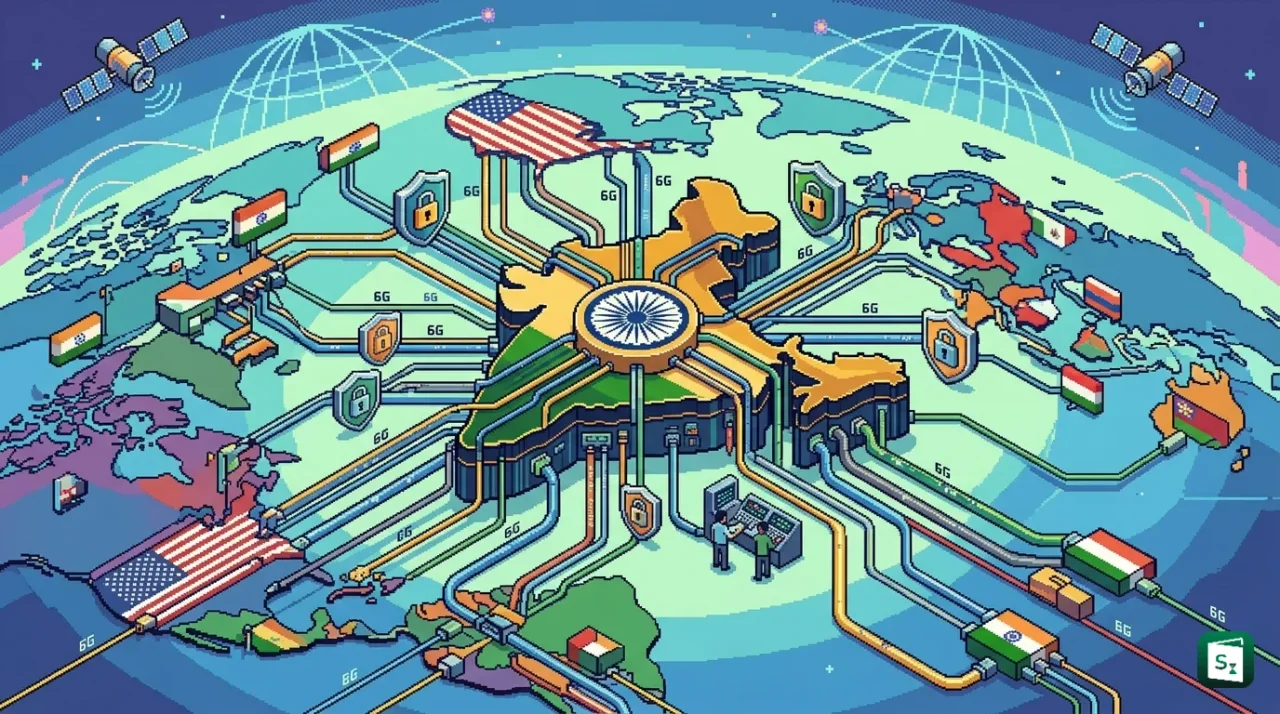
India endorsed the global Call to Action for 6G Leadership and Security on 9 September 2026, joining the United States and 24 other nations to shape the future of sixth generation mobile networks. The endorsement was announced on the sidelines of the G20 Innovation Ministerial held on 1 and 2 September 2026 in Chapel Hill, North Carolina. The Department of Telecommunications (DoT) will lead India’s follow up work with industry, academia and government agencies.
What Is the Call to Action for 6G Leadership and Security
The Call to Action for 6G Leadership and Security is a joint political commitment by like minded governments to guide how sixth generation wireless networks are designed, built and run. The National Telecommunications and Information Administration (NTIA), the telecom policy arm of the United States Department of Commerce, launched it on 27 July 2026 in Washington. It carries forward the December 2025 United States Presidential Memorandum on Winning the 6G Race, which treats next generation networks as vital for national security, foreign policy and economic strength.
At launch, more than 20 partner governments from Europe, the Indo Pacific and the Western Hemisphere joined the United States. These included Australia, Canada, Japan, the Republic of Korea, the Philippines, the United Kingdom, France, Germany, Italy, Sweden, Norway, Denmark, Finland, Estonia, Latvia, Lithuania, Czechia, Greece, Romania, Albania, Costa Rica, Honduras, Panama and Paraguay. Other like minded countries were invited to join later, and India’s entry has taken the wider circle to the United States plus 25 partners in India’s announcement.
The partners agree that secure digital infrastructure is essential for competitiveness, prosperity and security, and that advanced telecom networks form the heart of that infrastructure. They want 6G to be open, interoperable, secure, resilient, supported by trusted artificial intelligence, resource efficient and driven by innovation and competition. In simple terms, open means equipment from different makers can work together, interoperable means networks across countries can connect smoothly, and resilient means services keep running during stress or attack. The initiative also stresses strong supply chains, coordinated planning for radio spectrum and continued reliance on industry led global standards bodies, without duplicating their technical work.
How India Joined the Initiative
India’s endorsement was finalised around the G20 Innovation Ministerial held on 1 and 2 September 2026 in Chapel Hill, North Carolina. The meeting was hosted by the United States Department of Commerce and the White House Office of Science and Technology Policy (OSTP), which advises the United States President on science and technology. At the end of the meeting, G20 ministers issued an Innovation Ministerial Statement noting that emerging technologies can unlock prosperity, raise productivity and expand opportunity.
The Indian delegation was led by Jitin Prasada, Minister of State for Commerce and Industry and for Electronics and Information Technology. He was accompanied by Ajit Kumar, Joint Secretary in the Ministry of Electronics and Information Technology (MeitY), along with senior officials from MeitY, the Department of Science and Technology (DST), the Department for Promotion of Industry and Internal Trade (DPIIT) and the Embassy of India in the United States.
On the sidelines, Prasada held a bilateral meeting with United States Secretary of Commerce Howard Lutnick. The two sides discussed cooperation in semiconductors, artificial intelligence and data centres, including more United States investment in the second phase of the India Semiconductor Mission, closer partnership on artificial intelligence technology and safeguards for artificial intelligence. After this meeting, the United States Department of Commerce announced that India had joined the United States and 24 other countries in the 6G effort to ensure future networks reflect shared security interests, strengthen competitiveness and drive innovation.
The formal Indian announcement followed on 9 September 2026 through the Ministry of Communications. Union Minister of Communications Jyotiraditya M. Scindia said India was joining 24 like minded nations to advance an open, interoperable, secure and resilient next generation network, and that the partnership would help coordinate national strategies well before the expected 6G rollout in the 2030s. For India, he linked the move to ongoing work in global standardisation and spectrum forums as the country aims to secure 10 percent of global 6G standards. The Department of Telecommunications, which functions under the Ministry of Communications, will coordinate the follow up with government agencies, industry, academia and other stakeholders.
Phased Roadmap Under the Call to Action
The Call to Action sets clear timelines for the next 12 months and beyond, so that political intent turns into joint work. Each government will act as per its own priorities and resources, but all will stay connected through a shared contact group of designated experts. For India, this means the Department of Telecommunications will name expert points of contact and a nodal unit to manage communication with partners.
| Timeline | What Partner Governments Will Do |
|---|---|
| Within one month | Identify expert 6G points of contact and share contact details, designate a responsible agency for coordination, and prepare a preliminary list of relevant telecom industry and academic stakeholders |
| Within three months | Engage telecom companies and researchers to map the political and economic landscape for 6G, identify barriers to leadership, meet jointly to compare findings, and list economic and financial resources that can support competitiveness |
| Within six months | Hold expert level talks and exchange papers on how to support secure, resilient and sustainable 6G supply chains, and start reflecting 6G leadership and security in national or regional strategies and action plans |
| Within 12 months | Meet in person in 2027 to review joint progress, share lessons and best practices, set priorities for the next 12 months, and assess the strategic landscape along with industry stakeholders, with regular progress reporting through the contact group |
The roadmap also clarifies that participation does not limit any government’s freedom to take its own positions in international bodies. It asks partners to avoid duplication with industry driven technical bodies and instead build useful links with private companies for strategic awareness and network security.
What Is 6G and Why It Matters
6G means sixth generation wireless technology, the successor to 5G. It is still under development around the world and is expected to be available around 2030 under the global framework called IMT-2030. IMT stands for International Mobile Telecommunications, and the framework is set by the International Telecommunication Union (ITU), the United Nations agency for telecom headquartered in Geneva, Switzerland and founded in 1865.
While 5G offers speeds of about 40 to 1,100 megabits per second with a peak near 10,000 megabits per second, 6G is expected to offer ultra low delay with speeds up to 1 terabit per second, which is about 1,000 times the top speed of 5G. 6G will use higher radio frequencies than 5G, so it can carry vast amounts of data at once with almost no lag. It will improve advanced imaging, precise location tracking and lifelike virtual experiences. When combined with artificial intelligence, the network can decide on its own where to store, process and share data, which makes services faster and more efficient.
The ITU has outlined the vision for IMT-2030 through Recommendation M.2516, with six usage scenarios including ubiquitous connectivity, which means coverage everywhere. Technical performance targets have been fixed under its Working Party 5D. The 3rd Generation Partnership Project (3GPP), the global body that writes mobile standards, has started exploratory studies under Release 20 to identify key technologies and designs beyond 5G Advanced. These studies will later become detailed specifications that guide equipment makers and telecom operators.
Spectrum, which means the radio waves used for mobile services, is central to 6G planning. The ITU is studying the bands 4400 to 4800 megahertz, 7125 to 8400 megahertz and 14.8 to 15.35 gigahertz for IMT use. A final decision on these bands is expected at the World Radiocommunication Conference in 2027, often called WRC-27. In India, bands such as 600, 700, 800, 900, 1800, 2100, 2300, 2500, 3300 megahertz and 26 gigahertz are already approved for mobile services, and operators holding spectrum there can deploy any technology as devices become ready.
Governments view 6G as far more than faster phones. 6G networks are expected to support artificial intelligence, advanced manufacturing, defence uses, public safety, smart infrastructure and autonomous systems. That is why the Call to Action links 6G to economic competitiveness, security, public safety and strategic capability.
India’s Own 6G Push Under Bharat 6G Vision
India’s participation in the global pact builds on a domestic mission that started well before 2026. Prime Minister Narendra Modi released the Bharat 6G Vision document on 23 March 2023. It aims to make India a frontline contributor to the design, development and deployment of 6G by 2030. The vision rests on three principles of affordability, sustainability and ubiquity, which means high quality connectivity that is low cost, green and available everywhere.
The vision was prepared by the Technology Innovation Group on 6G (TIG-6G), set up in November 2021 with members from ministries, research bodies, academia, standards organisations, telecom operators and industry. To carry the vision forward, the Department of Telecommunications helped set up the Bharat 6G Alliance, an industry and academia led group of telecom providers, equipment makers, startups, research institutions and standards bodies. The Alliance started with 14 institutions and grew to 85 members by March 2026. It works through seven working groups on spectrum, devices, technology and components, alliances, green and sustainability, outreach and use cases, with quarterly review by the ministry.
India has set a clear target of nearly 10 percent of global 6G patents and standards. The government has stated that around 4,000 patents have already been contributed, and that India’s proposal on ubiquitous connectivity has been accepted by both 3GPP and ITU as part of the 6G framework. Research is supported through the Telecom Technology Development Fund (TTDF), launched on 1 October 2022 to fund telecom research by domestic firms, startups, small firms, academia and research institutes. By late 2025, about 115 projects for 5G and 6G worth ₹310.6 crore had been approved, including more than 100 projects focused on 6G research. The government has also funded two testbeds for terahertz communication and advanced optical communication, sanctioned 100 5G labs in academic institutions to build a 6G ready workforce, and showcased an indigenous 4G stack and one lakh indigenous 4G towers as the base for future systems. Official assessments project that the 6G ecosystem could add nearly $1.2 trillion to GDP by 2035.
Why This Global Partnership Matters for India
Timing is the biggest gain for India. 6G standards and spectrum rules will be fixed in the next few years, before commercial rollout in the 2030s. By joining now, India can press its priorities on open systems, common standards and coverage for all at the table where the rules are shaped. This directly supports its 10 percent patents goal and its accepted proposal on ubiquitous connectivity. Early coordination also helps Indian firms, startups and researchers align their products with global specifications instead of adjusting later at higher cost.
Security and supply strength form the second gain. The pact wants diverse and trusted supply chains so that no single source can control critical parts. For India, which is building domestic telecom manufacturing and an indigenous technology stack, this opens doors for joint research, trusted vendor ecosystems and shared testing. Coordination on spectrum planning ahead of WRC-27 also helps India protect its national needs while staying aligned with global harmonisation, which lowers device costs and improves roaming.
The third gain is linkage across technologies. The Call to Action treats trusted artificial intelligence as central to how 6G networks will run, from self optimising operations to secure data handling. India’s parallel talks with the United States on semiconductors, artificial intelligence and data centres therefore connect naturally with the 6G agenda. Stronger cooperation in chips, AI systems and large computing facilities will feed directly into AI native networks, smart factories, precise navigation, disaster warning and secure defence communication. In this way, the endorsement fits India’s wider push toward self reliance in technology and its long term goal of a developed India by 2047.
Key Takeaways
- India endorsed the Call to Action for 6G Leadership and Security on 9 September 2026, joining the United States and 24 other nations.
- The United States National Telecommunications and Information Administration (NTIA) launched the initiative on 27 July 2026 to promote open, interoperable, secure and AI supported 6G.
- India’s endorsement was finalised around the G20 Innovation Ministerial held on 1 and 2 September 2026 in Chapel Hill, North Carolina.
- The Department of Telecommunications (DoT) will lead India’s follow up, including naming expert 6G points of contact within one month.
- India’s Bharat 6G Vision, released on 23 March 2023, targets frontline leadership by 2030 with nearly 10 percent of global 6G patents.
- The Bharat 6G Alliance grew from 14 to 85 members by March 2026, while 115 projects worth ₹310.6 crore were approved under the Telecom Technology Development Fund.