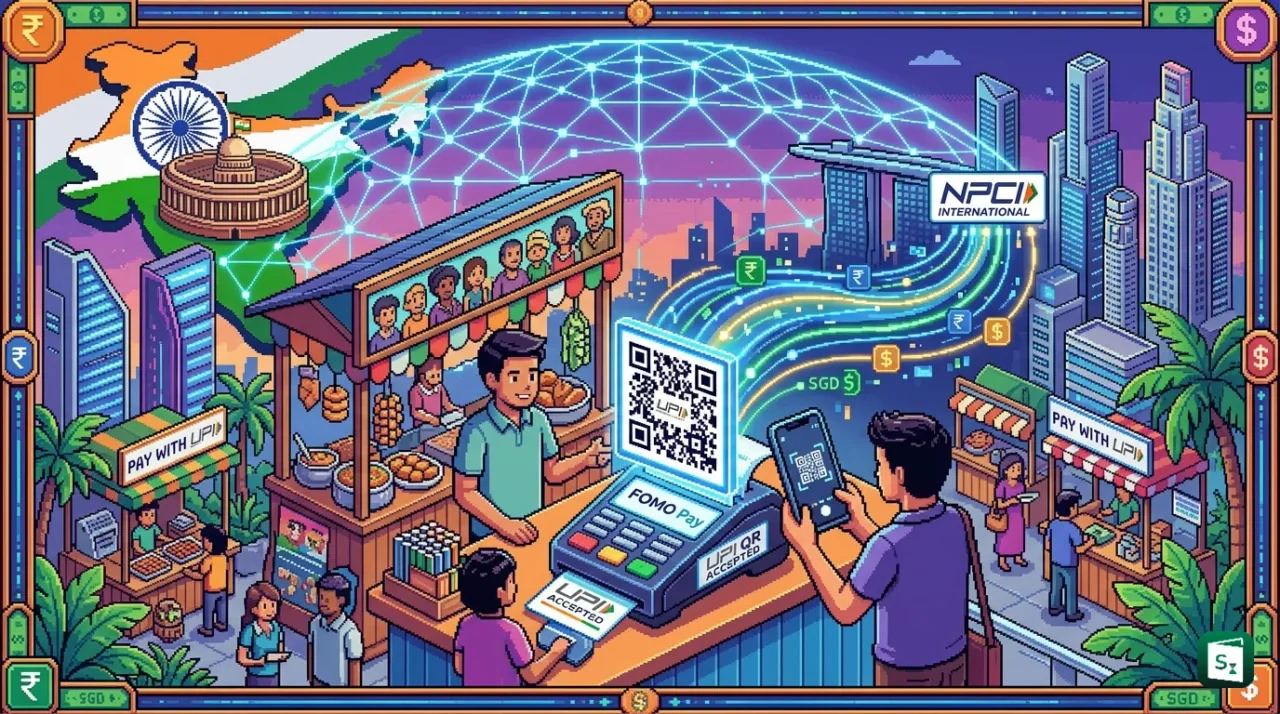
NPCI International Payments Ltd (NIPL) has partnered with Singapore based FOMO Pay to allow merchants across Singapore to accept payments through UPI QR codes. The partnership was announced on 9 September 2026 at the Global Fintech Fest 2026, with Resorts World Sentosa as the first live merchant. It will let Indian visitors pay in Indian rupees using their usual UPI apps while merchants in Singapore receive the amount in Singapore dollars.
What Does the NIPL-FOMO Pay Partnership Involve?
NPCI International Payments Ltd (NIPL) is the international arm of the National Payments Corporation of India (NPCI). It was incorporated on 3 April 2020 as a wholly owned subsidiary of NPCI to take NPCI products such as the Unified Payments Interface (UPI) and RuPay to other countries. UPI is a real time payment system that links multiple bank accounts to a single mobile app and allows instant transfer between two bank accounts using a mobile phone. A UPI QR code is a square barcode shown by a shop or website which a customer scans with a UPI app to pay.
FOMO Pay is a Singapore headquartered payment company founded in 2015. It is licensed by the Monetary Authority of Singapore (MAS), which is the central bank and financial regulator of Singapore, as a Major Payment Institution with licence number PS20200145. This licence allows it to provide domestic money transfer, cross border money transfer, merchant acquisition and digital payment token services. Merchant acquisition means signing up shops and websites so that they can accept digital payments through its system.
Under the new partnership, UPI acceptance will be enabled step by step across the merchants that already use FOMO Pay network in Singapore. Instead of building a new network from zero, NIPL will use FOMO Pay existing merchant base and payment routes to reach shops faster. The first merchant to go live is Resorts World Sentosa (RWS), a large integrated resort on Sentosa Island that houses Universal Studios Singapore, the Singapore Oceanarium and Adventure Cove Waterpark, along with hotels, restaurants and retail stores. Indian visitors can now use apps such as BHIM, PhonePe and Google Pay to book and pay for experiences on the official RWS website before they start their trip.
How Will the Payment Work for Travellers and Merchants?
The process is designed to feel the same as paying with UPI in India. The traveller must first activate international payments in the UPI app while still in India, since verification needs an Indian mobile number. At the time of payment on a participating website or at a shop, the customer scans the UPI linked QR code and confirms the amount in the app. The money is debited from the Indian bank account in Indian rupees, and the payment is completed in seconds.
The currency conversion happens in the background. The Indian customer pays in Indian rupees (₹), while the Singapore merchant receives the final settlement in Singapore dollars (SGD) through FOMO Pay. This removes the need to carry large amounts of cash or to type card details for every small transaction. For merchants, the benefit is direct access to a large base of Indian customers who already prefer UPI at home. More than 550 million people actively use UPI in India, and UPI now processes over 24 billion transactions in a month.
In the first phase, the focus is on online payments through the Resorts World Sentosa website. This allows Indian families to plan, book tickets and hotels, and pay for attractions from India itself with greater confidence. Over time, the same facility is expected to extend to other online and offline merchants in the FOMO Pay network across retail, food and beverage, and tourism categories.
Why Singapore Matters for UPI Expansion
Singapore is one of the most important overseas markets for UPI because of close trade links, high tourist flows and a large Indian community. Singapore received a record 1.2 million Indian visitors in 2025, and India is among its fastest growing visitor markets. The Indian diaspora, including workers and students, forms more than 9 percent of the population of Singapore. For these travellers and residents, the ability to pay with a familiar home app reduces cost and confusion.
The partnership also builds on an existing digital bridge between the two countries. India and Singapore already operate the UPI-PayNow linkage for person to person remittances. PayNow is the fast payment system of Singapore which allows people to transfer money instantly using only a mobile number or a Virtual Payment Address (VPA), which is a unique ID linked to a bank account. The linkage was announced by the Reserve Bank of India (RBI) and the Monetary Authority of Singapore in September 2021 and launched on 21 February 2023. It was the first linkage of its kind in the world to use cloud based infrastructure and to include a non bank institution from the start.
In July 2025, the linkage was expanded to include 19 banks in India for receiving money from Singapore, including State Bank of India, ICICI Bank, HDFC Bank, Punjab National Bank, Canara Bank and Bank of Baroda. Customers of DBS Singapore and Liquid Group can use the service in Singapore. The new NIPL and FOMO Pay tie up adds the missing merchant payment leg to this story. While UPI-PayNow serves money transfers between people, the QR acceptance serves payments to shops and websites.
Background: UPI Growth and Global Reach
UPI was launched on a pilot basis in April 2016 with 21 member banks and opened to the public in August 2016. It was developed by NPCI, which was set up in 2008 as an umbrella body for retail payments in India and works under the oversight of the RBI. BHIM, which stands for Bharat Interface for Money, was launched in December 2016 as a government supported app to push UPI based direct bank transfers.
In ten years, UPI has grown into the backbone of retail digital payments in India. Annual transaction volume rose from about 1.78 crore in financial year 2016-17 to more than 24,162 crore in financial year 2025-26. Annual transaction value rose from ₹0.07 lakh crore to about ₹314 lakh crore in the same period. By July 2026, 741 banks were live on UPI, monthly volume touched 2,365.8 crore transactions, and UPI accounted for about 84 percent of digital payments in India and nearly 49 percent of global real time payment volumes.
This domestic scale has made UPI a model for export. NIPL now enables UPI merchant payments, also called person to merchant payments, in several countries through tie ups with local banks and payment networks. Singapore has been part of this network since August 2021, when acceptance started through partners such as NETS, HitPay and LiquidPay. As of 2026, UPI is accepted for merchant payments in about 10 to 11 countries.
| Country | Local Partner Network | Live Since |
|---|---|---|
| Bhutan | Royal Monetary Authority of Bhutan | July 2021 |
| Singapore | NETS, HitPay, LiquidPay, now FOMO Pay | August 2021 |
| UAE | Mashreq Bank NeoPay, Network International | April 2022 |
| France | Lyra Network | February 2024 |
| Mauritius | Bank of Mauritius | February 2024 |
| Sri Lanka | LankaPay | February 2024 |
| Nepal | FonePay | March 2024 |
| Qatar | Qatar National Bank | September 2025 |
| Greece | Eurobank | May to June 2026 |
| Cambodia | ACLEDA Bank through KHQR | June 2026 |
Significance and the Way Forward
For Indian travellers, the immediate gain is ease and cost saving. They can avoid cash handling and high card fees and pay through an app they already trust. They can also complete bookings before travel, which helps in planning budgets and itineraries. For Singapore merchants, the gain is higher sales from Indian customers, faster settlement and better cash flow management, since digital payments reduce dependence on physical currency.
For India, the partnership supports a larger goal of making UPI a global payment standard. It shows a shift in method, from building acceptance shop by shop to plugging into a licensed local acquirer that already serves thousands of merchants. A similar model was used with HitPay, where more than 9,000 merchants in Singapore had UPI enabled by March 2025. The FOMO Pay route can now repeat this at a wider scale, since a Major Payment Institution has no caps on transaction volumes but follows strict rules on fund safety.
The next steps will be watched closely. The partners plan to progressively add more merchants from the FOMO Pay network after the Resorts World Sentosa launch. Success will depend on clear pricing for currency conversion, strong fraud controls under NPCI security frameworks, and smooth activation of international UPI in customer apps. If the rollout works well in a mature market like Singapore, the same template can be used in other countries where NIPL has signed agreements for sharing digital public infrastructure.
Key Takeaways
- NIPL partnered with Singapore based FOMO Pay on 9 September 2026 to enable UPI QR code acceptance for merchants across Singapore.
- Resorts World Sentosa is the first live merchant, allowing Indian visitors to book and pay on its website using BHIM, PhonePe and Google Pay.
- Customers pay in Indian rupees while merchants receive settlement in Singapore dollars through FOMO Pay.
- FOMO Pay, founded in 2015, is a Major Payment Institution licensed by the Monetary Authority of Singapore with licence number PS20200145.
- The UPI-PayNow linkage, launched on 21 February 2023 by the RBI and MAS, already enables real time person to person remittances, and the new pact adds merchant payments to the corridor.
- UPI, launched in April 2016 and developed by NPCI, processed over 24,162 crore transactions worth ₹314 lakh crore in FY 2025-26 and is now accepted in about 10 to 11 countries.