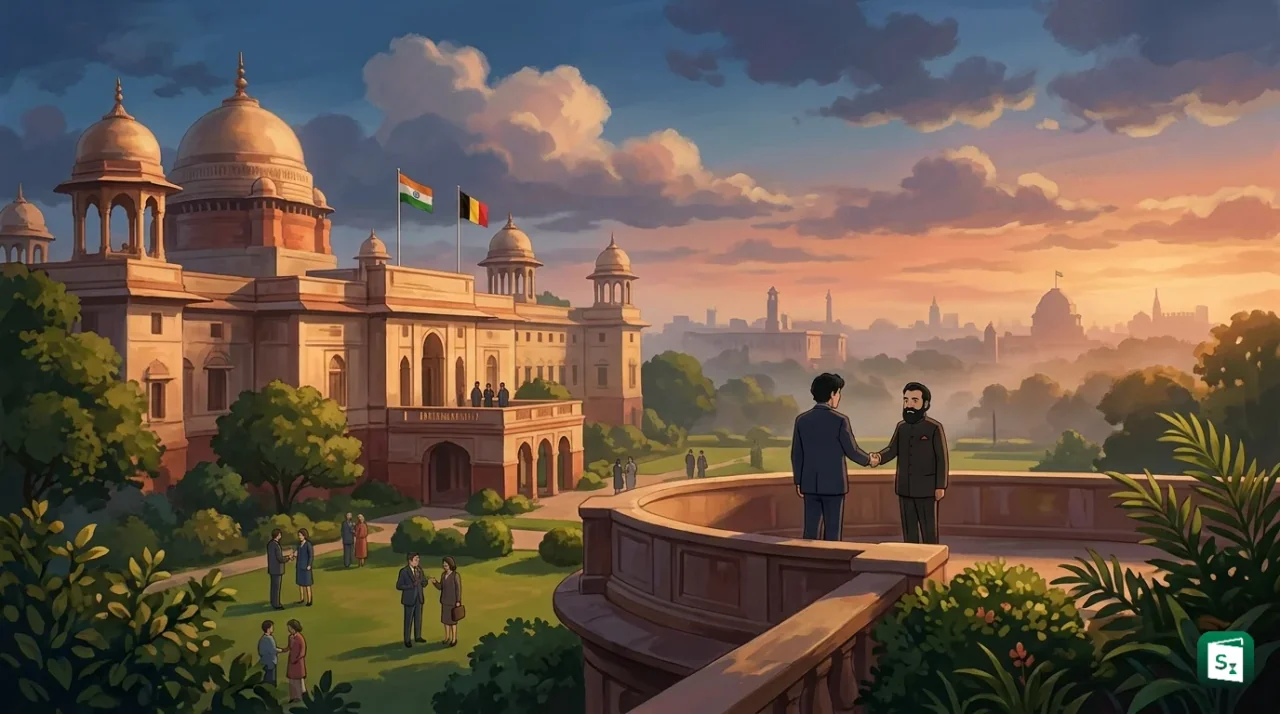
Belgian Prime Minister Bart De Wever visited India from 2 to 4 September 2026 at the invitation of Prime Minister Narendra Modi. The visit, the first by a Belgian Prime Minister in nearly two decades, included bilateral talks at Hyderabad House in New Delhi and business engagements in Mumbai. The two sides signed five cooperation documents and set a target to double bilateral trade in five years, linking the partnership closely to the concluded India-European Union (EU) Free Trade Agreement (FTA).
First Belgian Prime Ministerial Visit to India in Two Decades
Bart De Wever became Prime Minister of Belgium on 3 February 2025 as leader of the New Flemish Alliance (N-VA). He had earlier served as Mayor of Antwerp from 2013 to 2025. His India trip from 2 to 4 September 2026 was his first official visit to India in that office. He was accompanied by Belgium’s Minister of Defence and Foreign Trade, Theo Francken, along with senior officials and business leaders. Minister of State for Defence Sanjay Seth received him in New Delhi.
The New Delhi programme began with homage to Mahatma Gandhi at Rajghat, where De Wever laid a wreath and signed the visitors book. He then held talks with Modi at Hyderabad House, first in a restricted format and later with full delegations. Modi hosted a lunch for the visiting delegation. This was the first time since November 2006, when then Prime Minister Guy Verhofstadt visited, that a Belgian Prime Minister held talks with the Indian Prime Minister in India. Modi had visited Belgium in 2016.
The visit built on recent momentum. A Belgian Economic Mission led by Princess Astrid had come to India in March 2025 with 338 participants from companies, universities and public bodies and produced 38 cooperation documents. The two countries also launched the first India-Belgium Strategic Dialogue in Brussels on 15 July 2026, co chaired by India’s External Affairs Minister and Belgium’s Deputy Prime Minister and Foreign Minister. The dialogue created a regular channel for cooperation on trade, green transition, technology, connectivity, defence, security and people to people ties. During the September visit, De Wever invited Modi to visit Belgium at a mutually convenient time.
Five Agreements That Defined the New Delhi Talks
The talks produced ten key outcomes, which included five signed documents and five additional announcements. The Ministry of External Affairs described the overall focus in three words, which were trade, technology and talent. The five signed documents covered defence, industry, clean energy, law enforcement and diplomacy.
| Document | Signed Between | Main Purpose |
|---|---|---|
| Letter of Intent on Defence Cooperation | Ministry of Defence of India and Ministry of Defence of Belgium | Regular staff talks, education and training, research ties and defence industry partnership |
| Defence Industry MoU | Belgian Security and Defence Industry Association (BDSI) and Society of Indian Defence Manufacturers (SIDM) | Link companies for co design, co development, co production and investment |
| Renewed MoU on Renewable Energy | India and Belgium (building on the 2015 framework) | Cooperation on green hydrogen, solar, energy storage, offshore wind, bio energy, small hydropower and pumped storage |
| MoU on Crime Cooperation | Central Bureau of Investigation (CBI) of India and Federal Police of Belgium | Information sharing and capacity building against transnational organised crime, cybercrime and tracing of fugitives |
| MoU on Diplomatic Training | Sushma Swaraj Institute of Foreign Service and Federal Public Service (FPS) Foreign Affairs of Belgium | Joint training, curriculum exchange and exchanges between diplomats |
The Letter of Intent builds on an understanding reached between the defence ministers in March 2025. It supports maritime security cooperation, work on emerging technologies and exchanges in the Indo Pacific. Concrete plans linked to it include a visit by the Belgian frigate Leopold I to India from 5 to 8 November 2026, a study tour by the College of Defence Management, Secunderabad to Belgium in October 2026, and a plan by the Belgian Defence College to hold its World Study Trip in India in 2027. Defence Minister Rajnath Singh also met Francken separately to discuss industry ties.
The other five outcomes strengthened the support system for the relationship. India announced a resident Defence Attache in its Embassy in Brussels. The two sides launched the India-Belgium Investment Fast-Track Mechanism to help investors and solve bottlenecks. They agreed to make the India-Belgium Business Forum a regular platform and to start a Consular Dialogue for easier movement of students, professionals and travellers. They also set the political goal to double bilateral trade in the next five years.
Trade, Diamonds and Investment: The Economic Foundation
Belgium is the 24th largest economy in the world and an important European partner for India. Merchandise trade between the two countries stood at $13.01 billion in 2025-26. India’s exports were $6.60 billion, up by 4.4 percent, while imports were $6.41 billion, down by 2.8 percent. This created a small surplus of $190 million for India, after a deficit of about $270 million in the previous year. Both Prime Ministers agreed to work toward doubling this trade in the next five years, which would mean reaching about $26 billion. That goal will need growth of nearly 15 percent every year and a shift beyond traditional goods into higher value sectors.
Foreign direct investment, which means investment to set up or expand business operations, is another pillar. Investment inflows from Belgium to India were about $4.2 billion between April 2000 and December 2025. This made Belgium the 18th largest source of such investment for India. To raise this level, the two sides launched the Investment Fast-Track Mechanism. It will act as a single contact point to guide Belgian investors in India and Indian investors in Belgium and to fix delays. Belgium’s sovereign wealth fund, SFPIM, and India’s National Investment and Infrastructure Fund (NIIF) will also work toward a formal economic and investment corridor. The India-Belgium-Luxembourg Economic Union Joint Economic Commission, a joint body to review economic ties, is expected to hold its 19th session later this year.
Diamonds remain the historic heart of the trade. Antwerp is one of the world’s largest diamond trading centres, while Mumbai and Surat are India’s main centres for cutting, polishing and trading. In Mumbai, De Wever visited the Bharat Diamond Bourse in Bandra Kurla Complex and opened the expanded grading laboratory of HRD Antwerp. The expansion raised capacity by 30 percent to 2,000 diamonds per day and added 40 full time jobs. The leaders agreed to protect this historic link while adding new areas such as lab grown diamonds, joint design, certification and mutual recognition of standards. Maharashtra Chief Minister Devendra Fadnavis proposed a Mumbai to Antwerp corridor for trade, technology, talent and trust, along with a state team to work with Belgian agencies.
Defence, Clean Energy and Technology Cooperation
Defence and security formed a key pillar of the visit. The two defence industry bodies will now give companies a direct channel to share technology and set up joint manufacturing in India. This supports India’s Make in India and Atmanirbhar Bharat goals, which aim to build more defence equipment within the country. Modi cited cooperation on modern equipment such as the Zorawar light tank as an example of the growing partnership. Training and education exchanges will increase alongside industry ties.
Law enforcement cooperation was strengthened in parallel. The CBI and the Belgian Federal Police will share information faster, train personnel together and exchange best practices. A stated aim is better tracing of fugitives and joint action against organised crime and cybercrime. The two leaders also took a clear position against terrorism. De Wever condemned the attack on civilians in Pahalgam in April 2025 and both sides said terrorism in any form cannot be justified and its perpetrators must face the law.
Clean energy was the second strategic pillar. The renewed renewable energy MoU expands work on green hydrogen, green ammonia, solar energy, energy storage, offshore wind, bio energy, small hydropower and pumped storage plants. Pumped storage plants store energy by pumping water to a higher reservoir and releasing it to make power when needed. Modi pointed to one of the world’s largest green ammonia projects being developed in Kakinada in Andhra Pradesh as a sign of scale. The two sides also noted existing hydrogen links, including cooperation between GH2 India, the Belgian Hydrogen Council and Flanders Investment and Trade, and exchanges through the Egmont Institute in Brussels.
Technology and supply chains formed the third pillar. The leaders agreed to expand cooperation on semiconductors, critical minerals, chemicals, pharmaceuticals and nuclear energy. Semiconductors are the tiny chips that power phones, cars and computers. Belgium brings research strength through its leading institute imec, while India brings manufacturing scale and design talent. The plan is to link imec with Indian firms, universities, the ChipIN Centre and the Centre for Development of Advanced Computing (C-DAC). On critical minerals, which are minerals vital for batteries and clean technology, the focus will be on processing and recycling to make supply chains more reliable.
Mumbai Dialogue and the India-EU Free Trade Agreement
After New Delhi, De Wever travelled to Mumbai on 4 September for trade and logistics engagements. He was received by Maharashtra Minister Jaykumar Rawal. The main event was the India-Belgium High-Level Dialogue on the India-EU FTA, attended by Commerce and Industry Minister Piyush Goyal and Chief Minister Devendra Fadnavis. De Wever had also addressed a Confederation of Indian Industry (CII) business event in New Delhi on the same theme. The Mumbai discussions covered gems and jewellery, ports, pharmaceuticals, food processing, maritime services, green hydrogen, semiconductors, defence and advanced manufacturing.
Ports and logistics were at the centre. De Wever pitched the Port of Antwerp-Bruges, Europe’s second largest seaport, as India’s gateway to Europe. He said two thirds of European purchasing power lies within trucking distance of Antwerp, so goods arriving there are already inside the main market. The port offers inland barge, rail and road links from Antwerp and deep water and roll on roll off facilities from Bruges. It already handles almost all Indian shrimp entering northwest Europe and offers an unbroken cold chain for medicines from quay to warehouse. He said the port community, including firms from terminals, logistics, chemicals and energy, will visit India in February 2027 to agree on joint projects.
| India-EU FTA Fact | Detail |
|---|---|
| Negotiations concluded | 27 January 2026 at the 16th India-EU Summit by Modi and European Commission President Ursula von der Leyen (talks first started in 2007, paused in 2013, restarted in 2022) |
| Market size | About 2 billion people, nearly 25 percent of global GDP and a $24 trillion market |
| Tariff cuts | Duties to be removed or reduced on more than 95 percent of goods exports; EU firms to save about €4 billion per year; over 99 percent of Indian exports by value to get preferential entry |
| Autos and farm goods | Car duties to fall from 110 percent to 10 percent over five years within a quota of 250,000 vehicles per year; dairy, cereals, poultry, beef, rice and sugar remain protected |
| Pending steps | Early conclusion of the Investment Protection Agreement and the Geographical Indications Agreement sought; timely implementation urged |
Both sides called the FTA a historic milestone for two of the world’s largest democratic economies. They also welcomed progress under the India-EU Trade and Technology Council, whose ministerial meeting was held in Brussels in July 2026, and endorsed the Joint India-EU Comprehensive Strategic Agenda for 2030. On mobility, they noted the EU pact on a cooperation framework for movement of people and a pilot EU Legal Gateway Office in India. They agreed that easier movement of skilled workers, students, researchers and business travellers is essential and will continue talks on a migration and mobility agreement. Modi invited Belgian universities to open campuses in India, and both sides asked airlines to study direct air links between the two countries.
Key Takeaways
- Belgian PM Bart De Wever visited India from 2 to 4 September 2026, the first visit by a Belgian Prime Minister in nearly two decades since Guy Verhofstadt in 2006.
- Talks at Hyderabad House produced five documents, including a Letter of Intent on defence, a BDSI-SIDM industry MoU, a renewed renewable energy MoU, a CBI-Federal Police MoU and a diplomatic training MoU.
- India and Belgium set a target to double bilateral trade from $13.01 billion in 2025-26 to about $26 billion in five years.
- The India-Belgium Investment Fast-Track Mechanism was launched and India announced a resident Defence Attache in Brussels.
- The Mumbai India-Belgium High-Level Dialogue pitched the Port of Antwerp-Bruges as India’s gateway to Europe ahead of implementation of the India-EU FTA concluded on 27 January 2026.