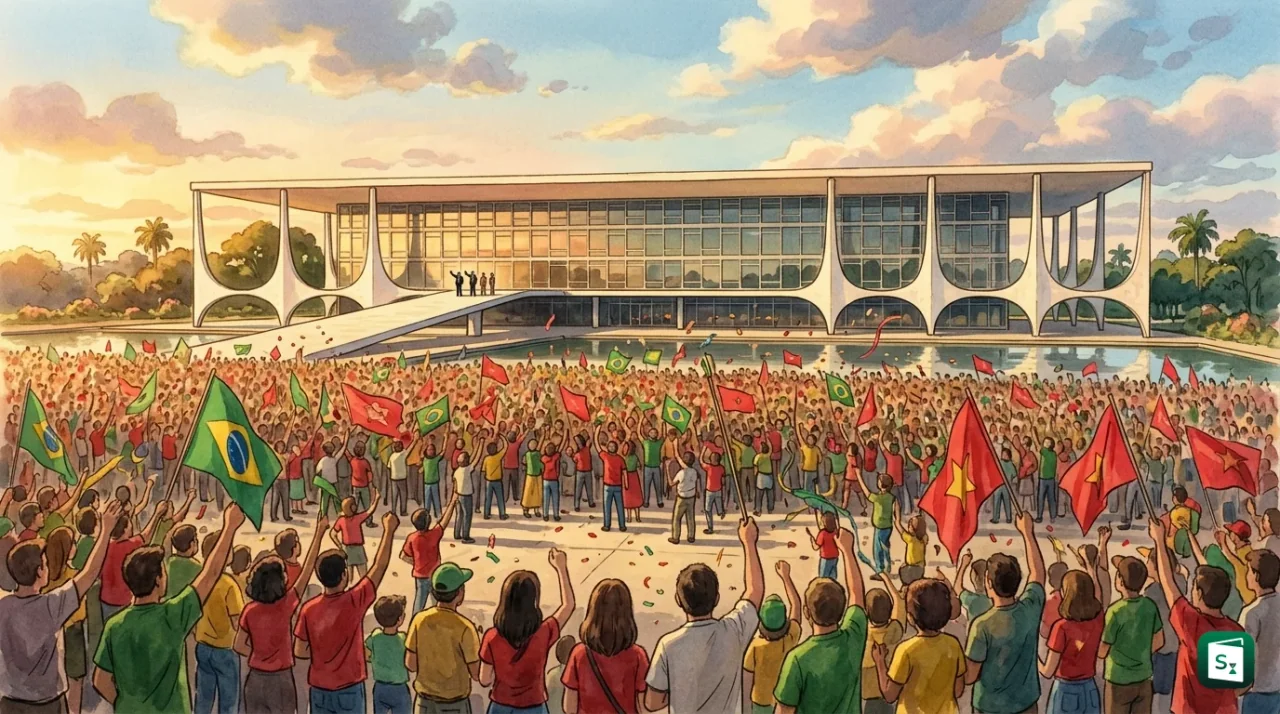
Luiz Inacio Lula da Silva has been re-elected as the President of Brazil for a fourth non-consecutive term after winning the runoff on 25 October 2026. The Workers Party leader defeated Flavio Bolsonaro with 51.79 percent of votes. At 81, he is the oldest president to assume office in Brazil.
Who Is President of Brazil in 2026?
The President of Brazil in 2026 is Luiz Inacio Lula da Silva, whose full name is Luiz Inacio Lula da Silva. He was born on 27 October 1945 in Garanhuns in Pernambuco, is 81 years old, belongs to the Workers Party, and is serving as the 39th President of Brazil after winning a historic fourth term.
Lula is commonly called Lula, a nickname he later added to his legal name. He has led Brazil before, serving as its 35th President from 2003 to 2011 and returning as the 39th President from 1 January 2023. His Vice President is Geraldo Alckmin. Brazil follows a presidential system where the president is both head of state and head of government and lives and works at the Palacio do Planalto in Brasilia, with the official residence at the Palacio da Alvorada.
How Brazil Elects Its President
Brazil is a federal presidential republic governed under the Constitution of 1988. The president and vice president are elected together on one ticket by direct popular vote for a term of four years.
A candidate must win an absolute majority, which means more than half of the valid votes, to win in the first round. Blank and null votes are not counted in this total. If no candidate crosses this mark, the top two candidates face each other in a runoff, called the second round.
Voting is compulsory for literate citizens aged 18 to 70 and optional for those aged 16 to 17, those above 70, and those who cannot read and write. The Superior Electoral Court (TSE) conducts and declares the results of national elections.
Brazil allows only one consecutive re-election. This means a president can serve two terms in a row, but can return later after a gap. Lula used this rule. He served two straight terms from 2003 to 2011, stayed out for 12 years, returned in 2023, and has now won again. From 2027, under Constitutional Amendment 111, new presidential terms begin on 5 January instead of 1 January.
What Were the Brazil Election 2026 Results?
Brazil held general elections on 4 October 2026 for the president, National Congress, governors and state legislatures. No presidential candidate secured a majority in the first round, so a runoff was held on 25 October 2026.
In the first round, Senator Flavio Bolsonaro of the Liberal Party (PL) led with 47.03 percent of valid votes. Lula stood second with 45.16 percent. More than 158 million Brazilians were eligible to vote, and abstention in the first round was around 21 percent.
In the runoff, Lula reversed the lead and won with 64,256,232 votes (51.79 percent) against 59,826,041 votes (48.21 percent) for Flavio Bolsonaro. The margin was about 4.43 million votes.
| Round | Date | Lula da Silva (PT) | Flavio Bolsonaro (PL) |
|---|---|---|---|
| First round | 4 October 2026 | 45.16 percent (about 53.87 million votes) | 47.03 percent (about 56 million votes) |
| Runoff | 25 October 2026 | 51.79 percent (64,256,232 votes) | 48.21 percent (59,826,041 votes) |
This result created two firsts since Brazil returned to democracy in the 1980s. No candidate who finished second in the first round had ever won the runoff, and no person had ever been elected president four times. Flavio Bolsonaro is the eldest son of former president Jair Bolsonaro. He had campaigned on close ties with the United States and a promise to pardon his father, who is serving a 27 year sentence for plotting a coup after his 2022 defeat. He called the 2026 result inexplicable and said he would seek annulment, but the TSE confirmed Lula after counting 97 percent of ballot boxes on election night.
Who Is Lula da Silva: From Metalworker to President
Lula was born as the seventh of eight children of farming parents in the poor northeastern hinterland. His family moved to Sao Paulo when he was a child. He learned to read at age 10 and left school early to work as a shoeshine boy, street vendor and warehouse worker.
At 14, he trained as a lathe operator through the National Service for Industrial Learning (SENAI) and became a metalworker. He lost the little finger of his left hand in a factory accident in 1964. He rose to lead the Metalworkers Union of Sao Bernardo do Campo and Diadema in 1975 and led the great ABC strikes of 1978 to 1980 that challenged the military dictatorship which ruled Brazil from 1964 to 1985. He was jailed for 31 days under the National Security Law.
Lula contested and lost three presidential elections in 1989, 1994 and 1998 before winning in 2002 with 61.27 percent in the runoff and again in 2006. His first two terms are known for strong growth and social programmes such as Bolsa Familia that helped lift around 30 to 40 million people from poverty. Barred from a third straight term, he was succeeded by Dilma Rousseff in 2011.
He was convicted in corruption cases linked to Operation Car Wash in 2017 and spent 580 days in prison from April 2018. In March 2021, the Supreme Federal Court annulled the convictions on procedural grounds and restored his political rights. In 2022, he defeated incumbent Jair Bolsonaro with 50.90 percent of votes, becoming the first to defeat a sitting president and the first to win a third term. He turned 81 on 27 October 2026, two days after the 2026 runoff. His registered birth date in official papers is listed as 6 October 1945, a difference his institute attributes to a clerical error at registration.
What Does the Workers Party Stand For?
The Workers Party, known in Portuguese as Partido dos Trabalhadores (PT), was founded on 10 February 1980 in Sao Paulo by Lula with trade unionists, intellectuals, artists and Catholic grassroots groups linked to liberation theology. It was registered in 1982 and is headquartered in Sao Paulo and Brasilia.
The party began with a socialist and left wing platform that demanded land reform, bank nationalisation and rejection of foreign debt. Over time it moved toward the centre left. By the 2002 campaign, Lula issued the Letter to the Brazilian People promising fiscal discipline, tax and pension reform and cooperation with the International Monetary Fund. Scholars now describe the party as social democratic with a strong focus on social justice, labour rights, participatory democracy and poverty reduction.
The PT is currently the ruling party of Brazil. Its symbol is a red star, and its politics around Lula is often called Lulism, which combines market stability with large welfare transfers to the poorest families.
Brazil at a Glance: Capital, Currency, Language and Population
Brazil, officially the Federative Republic of Brazil, is the largest country in South America and the fifth largest in the world by area. It shares borders with every South American country except Chile and Ecuador.
| Fact | Detail |
|---|---|
| Capital | Brasilia, a planned city inaugurated in 1960 |
| Largest city | Sao Paulo |
| Continent | South America |
| Population | Over 212 million, seventh largest in the world and first in South America |
| Language | Portuguese, the only Portuguese speaking country in the Americas |
| Currency | Brazilian Real (BRL), symbol R$, divided into 100 centavos |
| Government | Federal presidential republic with a National Congress of 513 deputies and 81 senators |
| Independence Day | 7 September 1822 |
Brasilia was designed by urban planner Lucio Costa and architect Oscar Niemeyer and is a UNESCO World Heritage Site. Portuguese became the national language under Article 13 of the Constitution after more than three centuries of Portuguese rule. The real was introduced in 1994 under the Plano Real to end hyperinflation and is issued by the Banco Central do Brasil.
What Lula Fourth Term Means for India and BRICS
Lula is one of the founding architects of BRICS, the grouping of major emerging economies that includes Brazil, Russia, India, China and South Africa along with newer members. He supports multipolarity, South South cooperation, trade in local currencies and reform of the United Nations, International Monetary Fund and World Trade Organization.
For India, his continuity matters. Brazil is India’s largest trading partner in Latin America. Bilateral trade rose from $12.20 billion in 2024 to $15.21 billion in 2025, a rise of more than 25 percent. During Prime Minister Narendra Modi visit to Brazil in July 2025 and Lula visit to India in February 2026, the two sides set a target to raise trade to $30 billion by 2030 and signed pacts on digital partnership, critical minerals and rare earths, pharmaceuticals and mining supply chains. Brazil holds the world’s second or third largest rare earth reserves, which India sees as key to diversify supply and support energy transition.
Lula had skipped the 18th BRICS Summit held in New Delhi in 2026 to focus on the campaign, with Foreign Minister Mauro Vieira leading Brazil. His rival had said Brazil role in BRICS would be reconsidered and had promised closer alignment with Washington. Lula victory speech stressed that Brazil would not accept being anyone backyard and called the result a defeat of denialism and lies.
Lula will be sworn in for the new four year term on 5 January 2027 and will be 85 when it ends in January 2031. He will govern with a divided Congress where conservative forces hold strong ground, and his immediate agenda includes social spending, debt relief for families, curbs on online betting and tougher action on crime.
Key Takeaways
- Luiz Inacio Lula da Silva won the Brazil presidential runoff on 25 October 2026 with 51.79 percent of votes for a fourth non-consecutive term.
- Lula, born on 27 October 1945 and aged 81, is the oldest president to assume office in Brazil and the first to be elected four times.
- Lula belongs to the Workers Party (PT), founded on 10 February 1980, and his Vice President is Geraldo Alckmin.
- Brazil capital is Brasilia, its language is Portuguese, its currency is the Brazilian Real (BRL), and its president serves a four year term under the Constitution of 1988.
- India Brazil trade reached $15.21 billion in 2025 with a target of $30 billion by 2030, and Lula fourth term ensures continuity for BRICS and Global South cooperation.