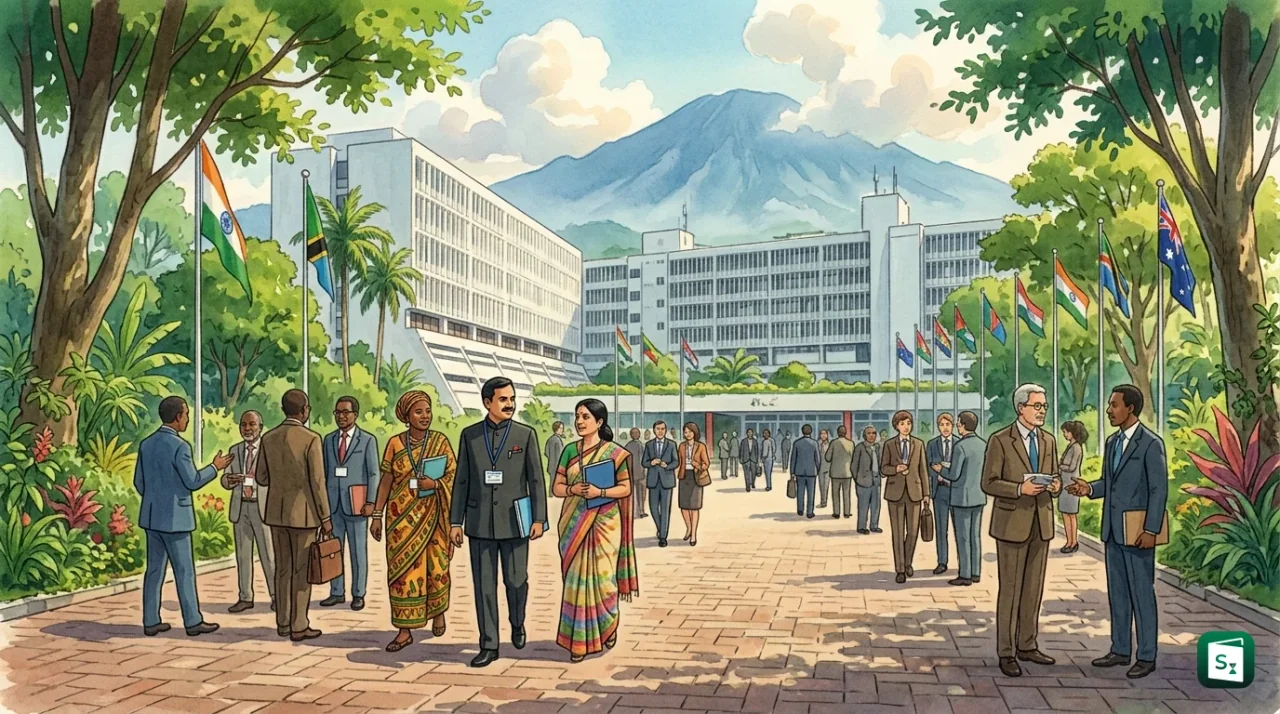
The 153rd Assembly of the Inter-Parliamentary Union was held from 5 to 9 October 2026 at Arusha in Tanzania. Over 700 parliamentarians from more than 130 countries debated inclusive governance and community empowerment. The Assembly elected Milton Dick of Australia as the 32nd President of the IPU.
What Is the Inter-Parliamentary Union?
The Inter-Parliamentary Union, or IPU, is the global organisation of national parliaments. It brings together lawmakers from different countries to discuss peace, democracy, human rights and sustainable development.
The IPU was founded in 1889 in Paris by two parliamentarians, William Randal Cremer of Britain and Frederic Passy of France. It started as a small meeting to promote talks and arbitration between nations. Today it is recognised as the oldest international political organisation in the world.
The headquarters of the IPU is in Geneva, Switzerland. The office moved there in 1921 and is now called the House of Parliaments. The IPU also has observer offices in New York and Vienna to work closely with the United Nations (UN). The IPU has held Permanent Observer status at the UN since 2002.
The IPU now has 184 Member Parliaments and 15 Associate Members. Associate Members are mostly regional parliamentary bodies. At the Arusha Assembly, the parliament of Naoero, a small island nation in the Pacific earlier known as Nauru, joined as the 184th member. With this, the IPU covers 184 of the 189 functioning national parliaments in the world. Its slogan is For democracy. For everyone.
| Fact about the IPU | Detail |
|---|---|
| Founded | 30 June 1889, Paris |
| Founders | William Randal Cremer and Frederic Passy |
| Headquarters | Geneva, Switzerland (since 1921) |
| Members | 184 national parliaments |
| Associate Members | 15 regional bodies |
| UN status | Permanent Observer since 2002 |
| Main meeting | IPU Assembly, held twice a year |
153rd IPU Assembly in Arusha: Dates, Venue and Theme
The 153rd IPU Assembly was held from 5 to 9 October 2026 at the Arusha International Conference Centre (AICC) in Arusha, Tanzania. It was hosted by the Parliament of Tanzania. This was the first time Tanzania had hosted an IPU Assembly.
About 2,044 delegates took part. They included over 700 parliamentarians from more than 130 countries, along with 56 Speakers and 51 Deputy Speakers. Women formed 39.4 percent of the parliamentarians present. This was the highest share of women recorded at an IPU Assembly.
Arusha is often called the Geneva of Africa. The city hosts the East African Community and the African Court on Human and Peoples Rights. It has a long history as a centre for diplomacy in Africa.
The General Debate was held on the theme Enhancing good governance and empowering communities through inclusivity, trust and opportunities for all. The theme asked parliaments to rebuild public trust. It focused on open institutions, control of corruption, participation of youth and women, and equal opportunities for all communities.
The formal opening was attended by Samia Suluhu Hassan, the President of Tanzania. The Assembly closed with the adoption of the Arusha Communique and the Arusha Declaration, which called for people centred, accountable and inclusive governance.
Indian Parliamentary Delegation Led by Harivansh
The Indian Parliamentary Delegation was led by Harivansh Narayan Singh, the Deputy Chairman of the Rajya Sabha. The Rajya Sabha is the upper house of the Indian Parliament. The nine member team included seven members from the Lok Sabha and two from the Rajya Sabha.
Members included Anurag Singh Thakur, Aparajita Sarangi, Sanjay Jaiswal, Kamaljeet Sehrawat, Lata Wankhede, Bijuli Kalita Medhi and N. K. Premachandran from the Lok Sabha, and Sasmit Patra from the Rajya Sabha. Aparajita Sarangi is a member of the IPU Executive Committee.
Harivansh took part in the Governing Council, the General Debate, the debate on the emergency item and the hearing with candidates for IPU President. India cast its three allotted votes in the presidential election through Harivansh, Anurag Singh Thakur and Kamaljeet Sehrawat.
Indian members joined several IPU bodies. Sanjay Jaiswal attended the Committee on Health. Kamaljeet Sehrawat spoke on disability rights and inclusion. Bijuli Kalita Medhi joined the session on women leadership. Lata Wankhede attended the High Level Advisory Group on Countering Terrorism. Sasmit Patra attended the Standing Committee on UN Affairs and a panel on UN machinery for conflict prevention.
The delegation also held bilateral meetings with Milton Dick of Australia and Mussa Azzan Zungu, the Speaker of the Parliament of Tanzania. Anurag Singh Thakur supported the emergency item on climate disasters and joined talks on future resolution topics for the Standing Committee on Democracy and Human Rights.
Milton Dick Elected 32nd President of the IPU
The 153rd Assembly elected Milton Dick as the 32nd President of the IPU on 9 October 2026. He is the Speaker of the House of Representatives of Australia. He will hold the post for a three year term from 2026 to 2029. He is the first Australian to lead the IPU.
The election was held by secret ballot in the Governing Council. Dick won 182 votes, or 56 percent, in a single round. Sahiba Gafarova, Speaker of the Milli Majlis of Azerbaijan, received 124 votes. Rojo Edwards Silva, Senator from Chile, received 21 votes. The result was announced by outgoing President Tulia Ackson of Tanzania, whose three year term ended with this Assembly.
Dick has represented the seat of Oxley in Queensland since 2016. He was first elected Speaker in 2022 and was re elected unopposed in 2025. Within the IPU, he served as Vice President of the Executive Committee for the Asia Pacific Group and as Chair of the Sub Committee on Finance.
The IPU President is the political head of the organisation. The President chairs statutory meetings and represents the IPU at major global events. The President must remain a sitting member of parliament throughout the term.
After his win, Dick promised inclusive leadership. He said smaller nations, young people and civil society must get a stronger voice. He also listed climate action and youth participation as central priorities for his term.
What the Arusha Assembly Decided
Beyond the election, the Assembly adopted resolutions and outcome documents to guide parliamentary action.
The Standing Committee on Democracy and Human Rights prepared a resolution on inclusive social development for all. It sets out parliamentary strategies to promote the rights and empowerment of persons living with disabilities. The text asks parliaments to improve laws, budgets and oversight for accessibility and inclusion.
The Assembly also adopted an emergency item moved by Nepal. It calls for urgent parliamentary action to address climate related disasters and strengthen resilience in the Himalayan region and other vulnerable areas. The item was added after support from more than 50 countries. It links disaster preparedness with stronger early warning, public spending and community level response.
The Forum of Women Parliamentarians discussed gender equality and women leadership. It stressed gender sensitive social protection, care support for working women, and action against gender based violence. The Forum of Young Parliamentarians pushed for greater youth entry into legislatures and policy making.
Other panels covered subjects that affect daily governance. These included military uses of artificial intelligence, AI and the future of work, oversight of extractive industries and critical minerals, mental health, food systems in a changing climate, protection of mountain and ocean ecosystems, and maritime security.
A high level side event on women, children and adolescent health led to the Arusha Action Note. It asks parliaments to protect health budgets, track actual spending on maternal and child care, and hold governments to account for service delivery.
How the IPU Is Organised: Members, Headquarters and Leadership
The IPU Assembly is the main political body. It meets twice a year, either in Geneva or in a member country. It adopts resolutions on global issues through its standing committees.
The Governing Council is the policy making body. Each member parliament sends three representatives to it. The Council approves the annual programme and budget and elects the President and the Secretary General.
The Executive Committee manages the administration of the IPU. It includes the President, 15 elected members from different geopolitical groups, the President of the Bureau of Women Parliamentarians and the President of the Board of the Forum of Young Parliamentarians. The elected members serve a four year term.
The IPU works through four standing committees dealing with peace and international security, sustainable development, democracy and human rights, and UN affairs. It also runs the Committee on the Human Rights of Parliamentarians, the Committee on Middle East Questions, the Forum of Women Parliamentarians and the Forum of Young Parliamentarians. Its Parline database gives comparative data on all national parliaments, including women representation and election details. The IPU publishes a monthly ranking of women in national parliaments.
The Secretariat is headed by the Secretary General, who acts as the chief executive. The current Secretary General is Anda Filip of Romania. She was elected at the 152nd IPU Assembly in Istanbul in April 2026 and took office on 1 July 2026 for a four year term. She is the first woman and the first person from Eastern Europe to hold the post. She succeeded Martin Chungong of Cameroon.
154th IPU Assembly in Geneva
The 154th IPU Assembly will be held in Geneva, Switzerland, from 10 to 14 May 2027. Geneva hosts the IPU headquarters, so assemblies held there do not need a host parliament.
The Geneva meeting will carry forward the Arusha agenda on governance, inclusion and trust. It will also review the progress of the Arusha Declaration and the resolutions on disability inclusion and climate resilience. The new President and the Secretary General will guide the IPU into its 2027 to 2031 strategy period, with focus on stronger, younger and more gender balanced parliaments.
Key Takeaways
- The 153rd IPU Assembly was held from 5 to 9 October 2026 at the Arusha International Conference Centre in Tanzania.
- The General Debate theme was Enhancing good governance and empowering communities through inclusivity, trust and opportunities for all.
- The Indian delegation was led by Rajya Sabha Deputy Chairman Harivansh Narayan Singh and cast three votes in the presidential election.
- Milton Dick, Speaker of Australia House of Representatives, was elected the 32nd IPU President with 182 votes (56 percent) for the 2026 to 2029 term.
- The IPU was founded in 1889 in Paris and is headquartered in Geneva since 1921, with 184 members and Permanent Observer status at the UN since 2002.
- The 154th IPU Assembly will be held in Geneva from 10 to 14 May 2027.