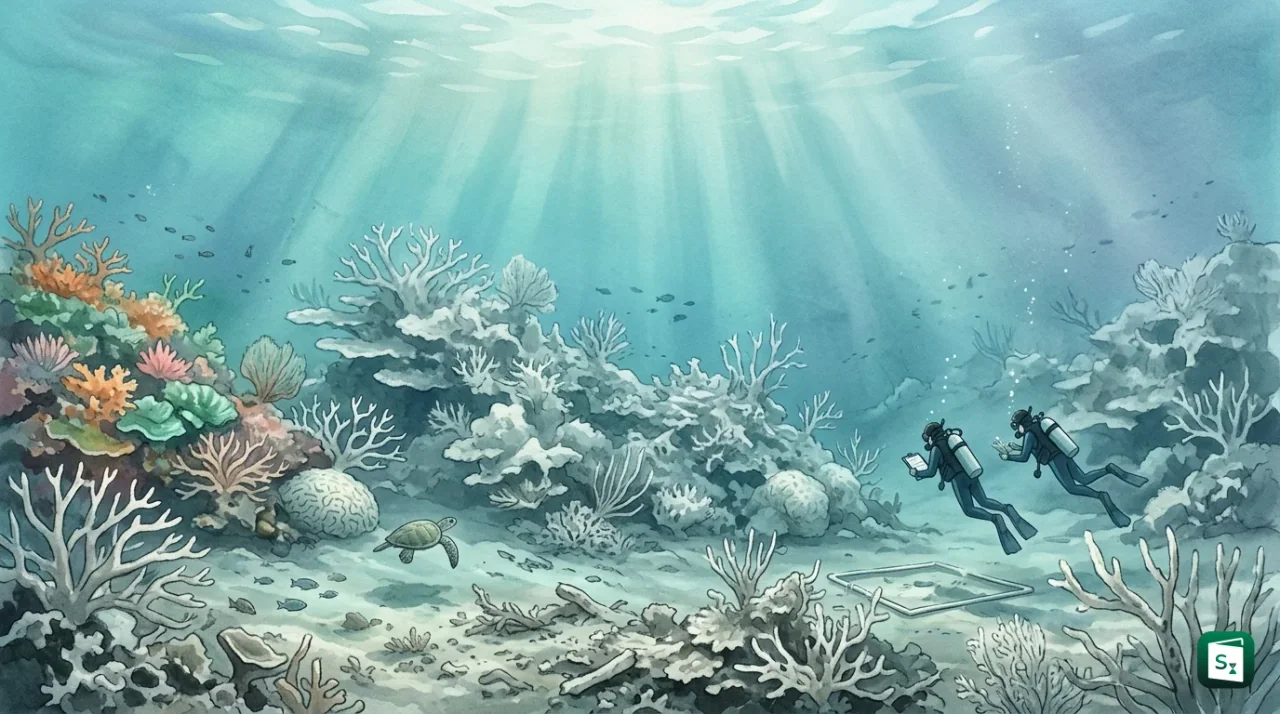
The International Union for Conservation of Nature released the first global coral reef assessment under its Red List of Ecosystems on 22 October 2026 at the CBD COP17 in Yerevan, Armenia. The assessment finds 122 of 127 shallow water coral reef ecosystems, or 96 percent, classified as Critically Endangered with an extremely high risk of collapse by 2075. The Great Barrier Reef, the Coral Triangle, the Mesoamerican Barrier Reef System and the Red Sea coral reefs are all in this highest threat category, mainly due to ocean warming and marine heatwaves.
What the First Global Coral Reef Assessment Found
The IUCN assessment is the first time all shallow water coral reefs have been judged together under one global standard. The work was coordinated by IUCN with the University of Melbourne and CORDIO East Africa, together with regional teams of the Global Coral Reef Monitoring Network. More than 250 experts in 10 regional teams studied reefs in more than 80 countries and territories.
The study divided warm, sunlit reefs into 127 ecosystem units called ecoregions, based on distinct species groups and local conditions. Together they cover 188,362 square km of reef. Deeper reefs, rocky reefs and cold water corals were not included. The assessment used decades of field data on corals, algae and fish, plus satellite records of sea surface temperature and future warming projections under the IPCC middle path scenario, known as SSP2-4.5, which projects about 2.7 degrees Celsius of atmospheric warming by 2100.
The headline result is stark. 122 of 127 ecoregions (96 percent) are Critically Endangered, covering 99.8 percent of the assessed reef area. One ecoregion, the Western Galapagos Islands, has already collapsed after the 1982 to 1983 El Nino event. Four ecoregions had too little data for a full result and are listed as Data Deficient.
The gap between present damage and future risk is the most important part of the finding. Based only on changes seen in the past 50 years, 30 ecoregions (24 percent) would be Critically Endangered. When projected heat stress for the next 50 years is added, the number jumps to 96 percent. In other words, many reefs still hold living coral today, but marine heatwaves are expected to return so often that reefs will not get enough time to recover between events. Critically Endangered does not mean lost. It means extremely high risk of collapse within 50 years unless warming slows and local pressures fall.
What Is Coral Reef and How Are Reefs Formed
A coral reef is a ridge of limestone built in warm, shallow sea water by tiny marine animals called coral polyps. Colonies of polyps secrete calcium carbonate skeletons that pile up over thousands of years to form a hard reef structure. Most reef building corals live in partnership with microscopic algae called zooxanthellae, which sit inside coral tissue, give corals colour and supply up to 90 percent of their food through photosynthesis.
Reefs form only where conditions suit both partners. Water must be warm, clear, sunlit and salty, usually in tropical and subtropical seas at depths of less than 50 metres. That is why coral reefs are found in shallow water. Sunlight must reach the algae, and heavy sediment, freshwater inflow and muddy water block light and smother polyps. This explains why India has no major reefs on much of its eastern mainland coast, where large rivers discharge heavy sediment and freshwater into the Bay of Bengal.
Reefs cover less than 0.2 percent of the ocean floor but support more than 25 percent of known marine species at some stage of their life. For this reason they are often called rainforests of the sea. They provide fish nurseries, coastal protection and livelihoods for hundreds of millions of people.
Types of Coral Reefs: Fringing Reef, Barrier Reef and Atoll
Scientists group coral reefs into three main forms based on shape and distance from shore.
| Type | How It Forms and Looks | Example |
|---|---|---|
| Fringing reef | Grows directly from the shore with little or no lagoon in between | Gulf of Mannar, Gulf of Kutch, Andaman and Nicobar Islands |
| Barrier reef | Lies offshore, separated from land by a wide, deep lagoon | Great Barrier Reef in Australia, Mesoamerican Barrier Reef System |
| Atoll reef | A ring of coral around a central lagoon with no central island, formed after a volcanic island sinks below the sea | Lakshadweep Islands, Maldives |
In India, most reefs are fringing reefs. Lakshadweep holds the only atolls in India, a chain of 36 islands grouped into 12 atolls in the Arabian Sea. Brain corals, which form large rounded colonies, and fire corals, which can sting on contact, are common examples of reef building groups.
What Is the IUCN Red List of Ecosystems
The International Union for Conservation of Nature (IUCN) is the oldest and largest global conservation network. It was founded in 1948 and is headquartered in Gland, Switzerland. It is an independent membership network, not a United Nations agency, and India has been a member since 1969. IUCN is best known for the Red List of Threatened Species, started in 1964, which judges extinction risk for individual species.
The Red List of Ecosystems (RLE) applies the same idea to whole ecosystems. It judges the risk of ecosystem collapse, which means near or complete loss of the living corals and functions that hold the system together. The global standard was adopted in 2014 and uses the IUCN Global Ecosystem Typology so that assessments can be compared across countries. The Red List of Ecosystems is also a headline indicator under the Kunming-Montreal Global Biodiversity Framework for tracking restoration and protection goals.
The new coral reef study is the first complete global RLE test for one major ecosystem group. It follows an earlier global RLE test for mangroves. A companion species study under the Red List of Threatened Species looked at 892 reef building coral species and found 44 percent threatened with extinction. One study measures loss of species. The other measures loss of the reef system itself.
IUCN Red List Categories and How Collapse Risk Is Judged
The RLE places each ecosystem in one of eight categories. Three of them together are called threatened: Critically Endangered (CR), Endangered (EN) and Vulnerable (VU).
| Category | Meaning |
|---|---|
| Collapsed (CO) | Ecosystem lost across its range, similar to extinct for species |
| Critically Endangered (CR) | Extremely high risk of collapse |
| Endangered (EN) | Very high risk of collapse |
| Vulnerable (VU) | High risk of collapse |
| Near Threatened (NT) | Close to threatened level |
| Least Concern (LC) | Low risk at present |
| Data Deficient (DD) | Too little data to judge |
| Not Evaluated (NE) | Not yet assessed |
Risk is checked against five rule based criteria, labelled A to E. The overall result is the highest risk found under any criterion.
| Criterion | What It Measures |
|---|---|
| A. Reduction in distribution | How much living reef area has been lost |
| B. Restricted distribution | Whether the reef is so small or isolated that one cyclone, bleaching event or disease outbreak could destroy it |
| C. Environmental degradation | How often and how severely heat stress causes bleaching, measured for the past 50 years and projected for the next 50 years |
| D. Disruption of biotic processes | Whether corals, algae and fish remain in balance |
| E. Quantitative analysis | Modelled chance of collapse within a set time |
For corals, criterion C for future heat stress made the biggest difference. It lifted the share of Critically Endangered systems from 24 percent on observed change alone to 96 percent overall.
Why Are Coral Reefs Dying: Heat Stress and Local Damage
Heat stress from climate change is the single most consistent threat to reefs worldwide. Ocean warming and repeated marine heatwaves trigger mass bleaching and coral death with growing frequency. Local human pressures then weaken the same reefs and slow recovery.
The assessment found clear patterns across the 127 ecoregions. In 63 percent of systems, the balance between corals, algae and fish has broken down. Overfishing removes plant eating fish such as parrotfish, which keep algae in check, and predators such as groupers that hold the food web together. Pollution and sediment then help algae grow over corals. In 45 percent of systems, reefs are so small or isolated that one cyclone, bleaching event or disease outbreak could wipe them out. In 25 percent, much of the living reef has already been lost.
What Is Coral Reef Bleaching and Why Does It Happen
Coral reef bleaching is the whitening of corals when stressed polyps expel the zooxanthellae algae that live in their tissue and supply colour and most of their food. Without the algae, the clear tissue reveals the white calcium carbonate skeleton below. The coral is not dead at this stage, but it is starved and highly prone to disease.
Bleaching starts when sea temperature stays even 1 to 2 degrees Celsius above the normal summer level for about four weeks. Excess heat damages photosynthesis in the algae, which then release toxic reactive oxygen molecules. To avoid poisoning, the coral expels the algae. If water cools quickly, corals can regain algae and recover. If heat lasts, corals die and algae and turf take over the reef surface.
Other pressures add to heat damage. Oceans absorb about 30 percent of carbon dioxide emissions, which forms weak acid and lowers ocean pH. This ocean acidification weakens coral skeletons and slows new growth. Nutrient runoff, sewage, plastic, sunscreen chemicals, dredging, coastal construction, blast fishing and anchor damage block light, smother polyps or break reef structures. Outbreaks of the coral eating crown of thorns starfish and coral diseases then spread faster on stressed reefs.
Great Barrier Reef to Coral Triangle: Reefs Most at Risk
All the largest and richest reef systems fall in the Critically Endangered group when future warming is included. The table below summarises their scale and why they matter.
| Reef System | Location and Scale | Why It Matters |
|---|---|---|
| Great Barrier Reef, Australia | Off Queensland, about 2,300 km long and 344,000 square km of marine park with 2,900 reefs and 900 islands | Largest reef system in the world and a World Heritage Site since 1981. Home to about 400 hard coral types and 1,500 fish species. Fifteen of its 17 ecoregions are already threatened on observed change alone. |
| Coral Triangle | Waters of Indonesia, Malaysia, the Philippines, Papua New Guinea, Timor-Leste and Solomon Islands, covering about 6 million square km | Richest marine area on Earth, with 76 percent of known coral species and more than 2,000 reef fish species. Called the Amazon of the Seas. All 25 ecoregions in East Asia are Critically Endangered overall. Managed partly through the Coral Triangle Initiative. |
| Mesoamerican Barrier Reef System | About 1,000 km along Mexico, Belize, Guatemala and Honduras | Largest barrier reef in the Western Hemisphere and second longest in the world. Holds more than 65 stony coral types and 500 fish species, plus one of the largest manatee groups and seasonal whale sharks. All 10 ecoregions are Critically Endangered. |
| Red Sea coral reefs | Fringing reefs along about 2,000 km of coast, including Egypt, Sudan, Eritrea and Saudi Arabia | Corals here tolerate very warm and salty water, and the northern Red Sea and Gulf of Aqaba are seen as a possible climate refuge. On observed change alone the north is Vulnerable and the south is Endangered, but all four ecoregions are Critically Endangered when future heat is added. |
Other regions show the same shift. In the Pacific, 19 of 21 ecoregions are already threatened. In South Asia, all 13 ecoregions across India, Sri Lanka, Maldives, Bangladesh and the Chagos Archipelago are already threatened, mainly because they are small and exposed to heat stress, and all 13 are Critically Endangered overall. In the Caribbean, all 10 ecoregions are already threatened. Brazil has five of eight ecoregions Critically Endangered and three Data Deficient. The Western Galapagos is the only system judged as collapsed.
Where Are Coral Reefs Found in India
Coral reefs in India occur in four main zones. Most are fringing reefs except Lakshadweep, which has atolls.
| Indian Reef Zone | Reef Type and Features |
|---|---|
| Andaman and Nicobar Islands | Fringing and barrier reefs. Largest and most diverse reef area in India, with rich fish and coral diversity. Damaged in places by the 2004 tsunami and later bleaching. |
| Lakshadweep Islands | Atolls in the Arabian Sea. Shallow lagoons ringed by coral. Live coral cover fell sharply after past bleaching, with renewed bleaching reported in 2024 and 2025 linked to high Arabian Sea temperatures. |
| Gulf of Mannar, Tamil Nadu | Fringing reefs between India and Sri Lanka, part of a Biosphere Reserve. Live cover fell from 37 percent in 2005 to 27.3 percent in 2021 due to heat stress, bottom trawling, runoff and invasive algae. |
| Gulf of Kutch, Gujarat | Fringing reefs, the northernmost reefs in India. Exposed to high sediment, salinity swings and temperature extremes. Small patches also occur at Ratnagiri, Malvan and Netrani on the west coast. |
No major reefs grow on most of the eastern mainland coast because river sediment and freshwater lower salinity and block sunlight.
Why Are Coral Reefs Important and What Collapse by 2075 Means
Coral reefs matter far beyond their beauty. They act as nurseries for fish, including tuna that support a multibillion dollar industry in the Coral Triangle. They break wave energy and protect low coasts from erosion and storm surge. They support diving and nature tourism valued at more than $12 billion a year in the Coral Triangle alone. They also sustain over 120 million people directly in that region and hundreds of millions more across the tropics through fisheries and coastal safety.
Collapse in RLE terms means near or complete loss of living hard corals so the reef can no longer sustain itself as a functioning system. If current warming trends continue, repeated severe bleaching will replace corals with algae and turf. Fish diversity will fall. Coastlines will lose natural protection. Less diverse reefs will still exist, but they will not deliver the same food and protection.
The report stresses that this future is not yet fixed. Reefs are still alive across most areas. Scientists call for two linked actions. First, deep cuts in greenhouse gas emissions to slow ocean warming, which is the main lever. Second, stronger local care to buy time for recovery. Priorities include protecting heat tolerant and well connected bright spots, cutting overfishing of plant eating fish, reducing runoff and sewage, expanding well managed marine protected areas and improving monitoring. Restoration can help in selected places where coral loss is high but algae remain low, yet it is costly and uncertain at large scale and cannot replace action on root causes. The assessment gives countries a common baseline to plan national RLE studies and track restoration and protection targets.
CBD COP17 in Yerevan: First Review of the Kunming-Montreal Framework
The assessment was released on 22 October 2026 at the 17th meeting of the Conference of the Parties to the Convention on Biological Diversity, known as CBD COP17. The meeting took place from 19 to 30 October 2026 in Yerevan, Armenia, under the theme Taking Action for Nature. It met together with sessions on biosafety and access to genetic resources.
The Convention on Biological Diversity is an international treaty for conservation, sustainable use and fair sharing of benefits from genetic resources. It opened for signature at the Earth Summit in Rio de Janeiro in 1992 and entered into force in 1993, and has 196 parties. Its governing body, the Conference of the Parties, meets to review progress and set rules.
COP17 was the first global review of the Kunming-Montreal Global Biodiversity Framework, adopted at COP15 in Montreal in December 2022. The framework sets a 2050 vision of living in harmony with nature and a 2030 mission to halt and reverse biodiversity loss. It has four long term goals for 2050 and 23 action targets for 2030. Target 2 calls for restoration of at least 30 percent of degraded land and sea areas. Target 3, known as 30 by 30, calls for effective conservation of at least 30 percent of land, inland water and sea areas. Other targets cover pollution, harmful subsidies, finance and business disclosure. The coral reef RLE serves as a headline indicator for ecosystem risk and supports national reporting on these goals.
Key Takeaways
- The first global coral reef assessment under the IUCN Red List of Ecosystems was released on 22 October 2026 at CBD COP17 in Yerevan, Armenia.
- 122 of 127 shallow water coral reef ecosystems, or 96 percent, are Critically Endangered and face extremely high collapse risk by 2075.
- Only 30 systems (24 percent) are Critically Endangered on past damage alone, showing that projected marine heatwaves drive the jump to 96 percent.
- The Great Barrier Reef, Coral Triangle, Mesoamerican Barrier Reef System and Red Sea reefs are all Critically Endangered, while the Western Galapagos has already collapsed.
- The IUCN, founded in 1948 and headquartered in Gland, Switzerland, uses eight RLE categories from Collapsed to Least Concern to guide Kunming-Montreal targets on restoration and 30 by 30 protection.