The WWF-India EIACP Programme Centre has launched a nationwide Green Diwali Campaign from 20 October to 8 November 2026 with support from the Ministry of Environment, Forest and Climate Change. The campaign calls on citizens to avoid firecrackers and celebrate a clean and eco friendly Diwali. It is anchored in Mission LiFE and gives special focus to 130 cities under the National Clean Air Programme.
What Is Green Diwali?
Green Diwali is a cracker free and low pollution way of celebrating Diwali that uses earthen diyas, energy efficient lights, natural decoration and low waste habits instead of firecrackers. It also means avoiding single use plastic, segregating waste and buying local and handmade products. Schools often express the same idea through posters, drawings, essays, slogans and rangoli under themes such as clean Diwali, safe Diwali and go green Diwali.
The idea grew out of the sharp spike in smoke, dust and noise seen in many north Indian cities during the Diwali week. Firecrackers release fine particles, toxic gases and loud sound in a short burst, and the effect is worst when cool winter air traps pollution close to the ground. A Green Diwali keeps the lights, sweets, gifts and community spirit of the festival while removing the most polluting part of the celebration.
What Are Green Crackers and How Are They Different?
Green crackers are firecrackers with a modified chemical mix that releases about 30 percent less particulate matter and lower levels of sulphur dioxide and nitrogen oxides than conventional crackers. They were developed by the Council of Scientific and Industrial Research (CSIR) through the National Environmental Engineering Research Institute (NEERI) in Nagpur. They still produce smoke and noise, so the 2026 campaign asks people to avoid all firecrackers rather than switch cracker types.
Conventional crackers use high amounts of aluminium, barium nitrate, potassium nitrate and sulphur to produce colour, brightness and loud sound. Green crackers cut or replace the most harmful of these chemicals and add special additives that trap dust or release water vapour. Barium salts, which give an attractive green colour but release poisonous gases that harm breathing, are restricted in approved green formulations. Sound levels must stay within the permitted limit of less than 120 decibels.
NEERI approved three main improved formulations, which are listed below:
| Formulation | Full Form | How It Lowers Pollution |
|---|---|---|
| SWAS | Safe Water Releaser | Releases tiny water droplets as vapour to suppress dust |
| STAR | Safe Thermite Cracker | Avoids potassium nitrate and sulphur to cut particles and sound |
| SAFAL | Safe Minimal Aluminium | Uses minimum aluminium and replaces part of it to lower sound and smoke |
Genuine green crackers carry a CSIR-NEERI green logo and a QR code on the box. Buyers can scan the code to check emission test details and confirm that the manufacturer is licensed. Certification involves emission testing at NEERI and approved laboratories, and clearance from the Petroleum and Explosives Safety Organisation (PESO). Crackers without the logo and QR code, especially those sold loose by street vendors, are not certified green crackers.
| Feature | Conventional Crackers | Certified Green Crackers |
|---|---|---|
| Particulate matter | High | About 30 to 40 percent lower |
| Sulphur dioxide and nitrogen oxides | High | About 35 to 40 percent lower |
| Barium nitrate | Often present | Restricted or absent |
| Identification | No special mark | Green logo plus QR code |
| Health and air impact | Higher | Lower, but still polluting |
Green Diwali Campaign 2026: What Citizens Are Asked to Do
The Green Diwali Campaign 2026 runs from 20 October to 8 November 2026. It covers schools, colleges, educational institutions, resident welfare associations and local communities across India. It gives special attention to the 130 cities covered under the National Clean Air Programme, including Delhi, Mumbai, Bengaluru, Jaipur, Bhopal and Raipur.
Citizens are asked to take the Green Diwali Pledge. The core promise is simple: celebrate a cracker free Diwali and encourage family, friends and neighbours to do the same. Schools and community groups are encouraged to organise pledge drives during assemblies, classes, rallies and neighbourhood meetings.
The campaign lists six practical actions for households:
- Light earthen diyas and energy efficient lights instead of firecrackers
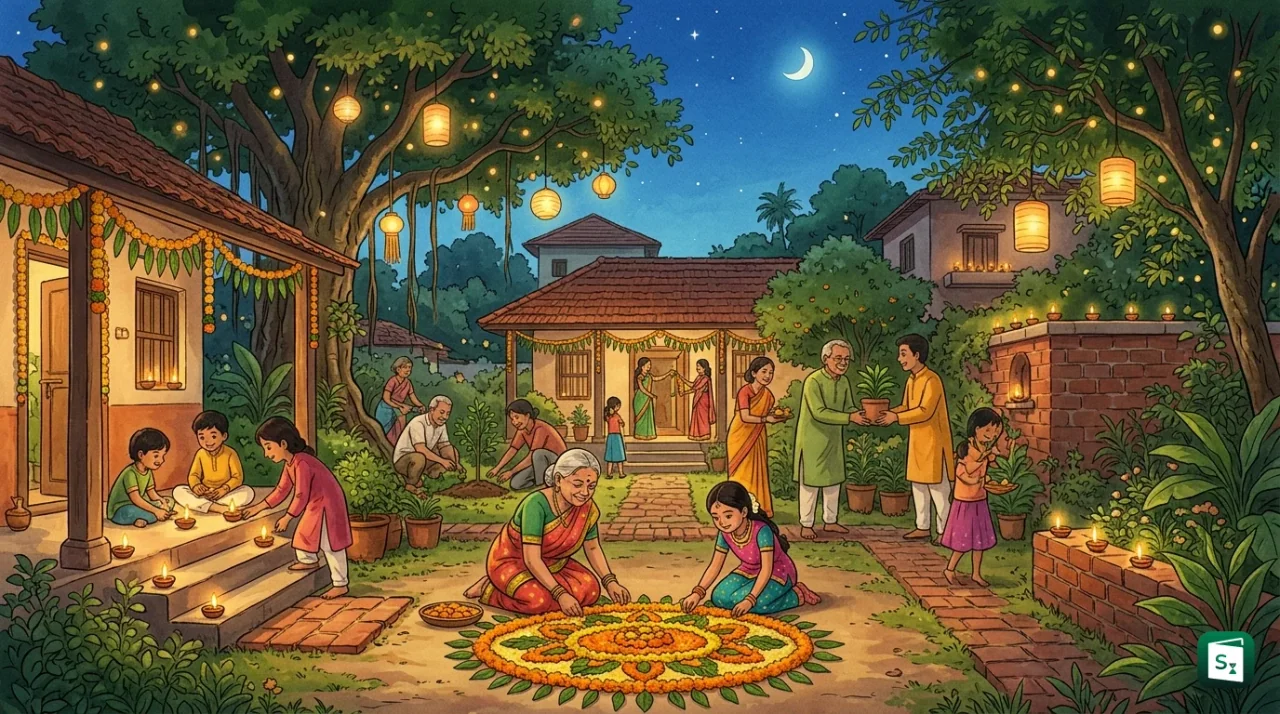
- Use natural decoration such as marigold flowers, rangoli made from rice flour, turmeric and petals
- Refuse single use plastic in gifts, packaging, plates and carry bags
- Segregate waste at home and hand it over separately for processing
- Buy local products and handmade gifts to support nearby artisans
- Walk, cycle or use public transport for festival visits where possible
Participants are also asked to take WWF-India’s Carbon Footprint Survey. The online survey asks about travel, electricity, cooking fuel, water use, food and waste habits. It shows users how daily choices add to their carbon footprint and suggests more sustainable habits.
Schools, colleges, EIACP centres and community groups must report their activities through an online form. Each entry should mention the institution name and location, activity type and date, number of people who took the pledge, geo tagged photographs and a short report. Selected entries may be shown on EIACP websites and social media pages.
Ministry of Environment, Forest and Climate Change and WWF India: Who Is Running the Campaign
The campaign is run by the WWF-India EIACP Programme Centre Resource Partner with support from the Ministry of Environment, Forest and Climate Change (MoEFCC). The Ministry is the nodal central authority for environment, forests, wildlife, pollution control and climate policy. EIACP centres function as its outreach and information network on the ground.
EIACP stands for Environmental Information, Awareness, Capacity Building and Livelihood Programme. It began as the Environmental Information System (ENVIS) in 1983 as a plan programme for collecting, storing and sharing environmental information. The scheme was later recast as EIACP under the umbrella of Environment Education, Awareness, Research and Skill Development for 2021-22 to 2025-26. The network has around 60 to 67 centres across India, grouped as Hubs hosted by state departments and Resource Partners hosted by expert institutions and reputed non governmental organisations. Each centre works on an assigned theme, maintains databases, spreads awareness, runs capacity building courses and supports Mission LiFE activities.
WWF-India, or World Wide Fund for Nature India, was set up as a public charitable trust on 27 November 1969. It began in a small office in Mumbai and now works from its secretariat at 172-B Lodi Estate in New Delhi with state and project offices across India. Its stated mission is to stop the degradation of the natural environment and build a future in which humans live in harmony with nature by conserving biological diversity, promoting sustainable use of resources and reducing pollution and wasteful consumption.
Mission LiFE and the Mission LiFE Portal: The Larger Link
Mission LiFE stands for Lifestyle for Environment. It is an India led global mass movement that asks individuals and communities to shift from mindless consumption to mindful use of resources. The idea was first presented at the UN Climate Conference COP26 in Glasgow in November 2021. It was formally launched as a movement in October 2022 at Kevadia in Gujarat in the presence of UN Secretary General Antonio Guterres.
Mission LiFE lists 75 individual actions grouped under seven themes: save water, save energy, reduce waste, reduce electronic waste, reduce single use plastic, adopt sustainable food systems and adopt healthy lifestyles. The plan works in three stages. First it tries to change demand by nudging daily habits. Then it influences supply by pushing markets toward green products. Finally it shapes long term policy. The Environment Ministry has reported mass mobilisation drives with more than 3.57 crore participants and over 1.6 million events organised in the run up to World Environment Day in 2023.
Citizens join the movement by taking the Mission LiFE Pledge on the MyGov pledge portal and the dedicated site missionlife-moefcc.nic.in. The portals also offer more than 100 creatives, videos, logos and knowledge materials for schools and organisations. A separate Meri LiFE portal allows ministries and institutions to upload event reports and track progress. The Green Diwali pledge and Carbon Footprint Survey feed directly into this system of pledges, events and reporting.
Why a Cracker Free Diwali Matters for Air Pollution and Health
Diwali fireworks add a sudden load of fine particles and gases to air that is already turning polluted in October and November. Crackers release PM10, PM2.5, sulphur dioxide and nitrogen oxides, plus metal dust from colours and fuel. PM10 means coarse dust particles and PM2.5 means very fine particles that can enter deep into the lungs and blood. Short exposure can cause burning eyes, cough, asthma attacks and chest tightness. Longer exposure raises risks for children, elderly people, pregnant women and patients with heart and lung disease. Loud bursts above safe limits also harm hearing and disturb animals.
The problem is sharpest in Delhi and nearby cities. Cool air, low wind and stubble smoke already push the Air Quality Index (AQI) toward poor, very poor and severe bands in late October. Firecracker smoke adds to road dust, vehicle exhaust, construction dust and waste burning, and pollution can remain trapped for days. This is why courts have restricted sales and bursting hours in the past. The Supreme Court in 2018 permitted only green crackers with low emissions and sound in Delhi and the National Capital Region, and later orders extended time and location limits in several states.
The campaign links the festival to the National Clean Air Programme (NCAP). NCAP was launched by the Environment Ministry in January 2019 as a time bound national strategy for 130 cities in 24 States and Union Territories. It targets a cut of up to 40 percent in PM10 levels by 2025-26 compared to 2017-18, or meeting the National Ambient Air Quality Standards. City specific Clean Air Action Plans address dust, vehicles, waste burning, construction and industry. Performance linked grants worth about ₹16,423 crore have been released for 2019-20 to 2025-26. Official data for 2025-26 shows 108 cities with lower PM10 than in 2017-18, with 72 cities down by more than 20 percent, 26 cities down by more than 40 percent, and 14 cities meeting the national standards.
How to Celebrate an Eco Friendly Diwali
An eco friendly Diwali keeps celebration central and pollution low. Families can start with light and decoration. Earthen diyas, solar lamps and star rated LED strings use less power and create less heat than many incandescent lights. Natural rangoli made with flowers, rice flour, turmeric and leaves replaces plastic stickers and chemical colours. Cloth torans, paper hangings and reusable boxes reduce packaging waste.
Gifts and food offer the next set of choices. Local sweets, dry fruits in reusable jars, seeds, plants and handmade diyas support neighbourhood makers and cut transport and plastic load. Cloth bags, paper wrap and newspaper liners replace single use carry bags and thermocol. Leftover food can be shared promptly, while peels and flowers can be composted and recyclables kept separate for collection.
Schools can turn the message into activity without extra cost. Poster making, drawing, essay writing, slogan writing, rangoli contests and short skits on say no to crackers help children explain the idea in their own words. Morning assemblies, rallies and community boards can display the Green Diwali pledge and the steps for waste segregation. Teachers can ask students to record how many homes in their lane stayed cracker free and submit photos and counts through the campaign form.
Key Takeaways
- The Green Diwali Campaign 2026 runs from 20 October to 8 November 2026 and urges a cracker free, eco friendly Diwali.
- The campaign is led by the WWF-India EIACP Programme Centre with support from the Ministry of Environment, Forest and Climate Change.
- It is aligned with Mission LiFE, launched in October 2022 at Kevadia, which promotes 75 actions under seven themes.
- Certified green crackers (SWAS, STAR, SAFAL) cut particulate matter by about 30 percent and carry a CSIR-NEERI logo and QR code.
- The drive focuses on 130 NCAP cities launched under the National Clean Air Programme in January 2019 to cut PM10 by up to 40 percent.