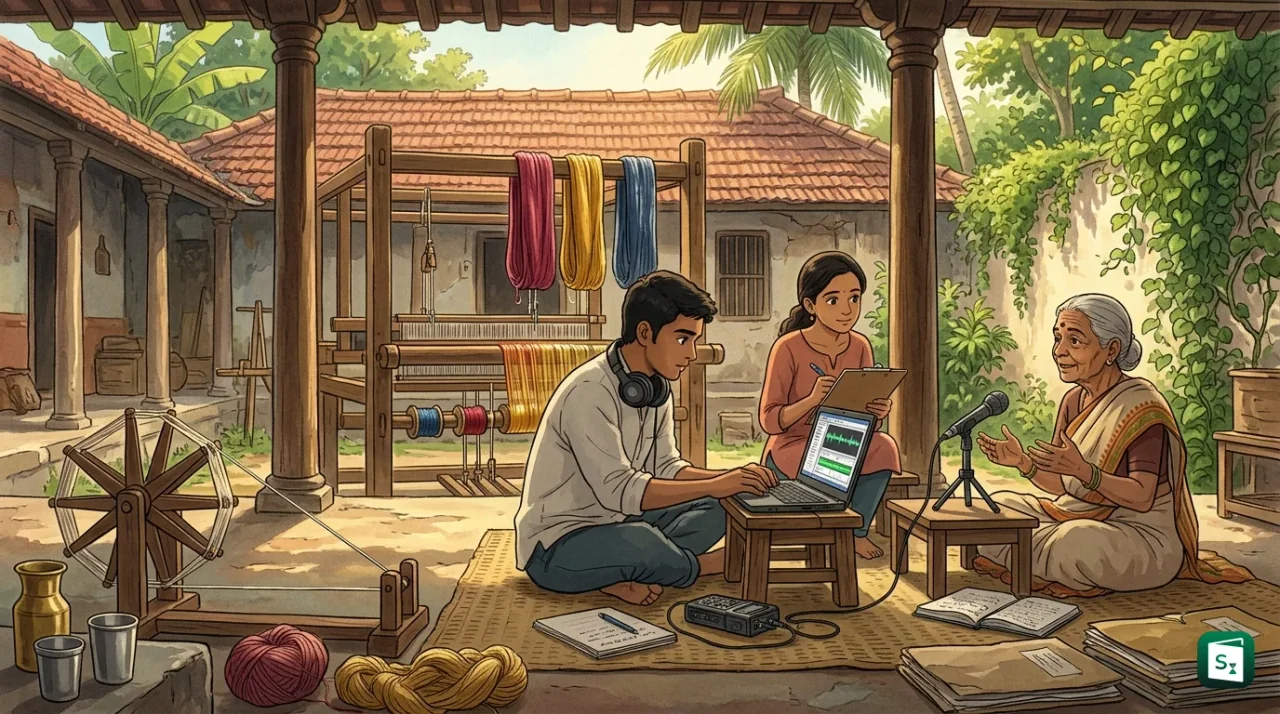
The Digital India BHASHINI Division and the SPIRE Lab of IISc Bengaluru have developed Text to Speech models for Sourashtra. Announced on 16 October 2026, the project creates AI voices that can read written Sourashtra text aloud in male and female voices. It aims to bring a digitally underrepresented minority language of Tamil Nadu into mobile apps, classrooms and public digital services.
What Is BHASHINI and Which Ministry Runs It?
BHASHINI stands for Bhasha Interface for India. It is the National Language Translation Mission launched by the Prime Minister on 4 July 2022 during Digital India Week 2022 in Gandhinagar, Gujarat. The mission works under the Ministry of Electronics and Information Technology (MeitY) and is implemented by the Digital India BHASHINI Division (DIBD) under the Digital India Corporation (DIC).
The goal of the BHASHINI mission is to remove language barriers in access to the internet and digital services. It builds open Artificial Intelligence models, tools and datasets for Indian languages and offers them as digital public goods. Developers, startups, universities and government departments can use these building blocks instead of building language technology from scratch.
The BHASHINI platform now supports text services in 36 Indian languages and voice services in 23 Indian languages, along with 35 international languages. It hosts more than 350 AI models for translation, speech recognition, speech synthesis and transliteration. BHASHINI reports more than 4 billion language inferences so far. Its services are already used in systems such as crop support apps, grievance portals, railway enquiry services and multilingual announcements at large public events.
What Is a Text to Speech Model and How Does It Work?
A Text to Speech (TTS) model is an AI system that converts written text into spoken audio in a natural human voice. A related system, Speech to Text (STT) or Automatic Speech Recognition (ASR), does the reverse and converts spoken audio into written text. TTS powers screen readers for visually impaired users, voice assistants, railway announcements, audiobooks and language learning apps.
A modern TTS system works in three basic stages. First, it analyses the text and cleans it, expanding numbers, dates and abbreviations into readable words. Second, an acoustic model predicts how the sentence should sound, including pronunciation, speed, pitch and pauses. Third, a vocoder converts those predictions into an actual sound wave file that can be played on a phone or computer.
Older systems needed a separate phonemizer, a tool that first converts letters into sound units called phonemes. The new Sourashtra models avoid this step. They work directly on characters, which simplifies the system and helps for languages that lack ready made dictionaries and linguistic tools.
What Is the Sourashtra Language and Where Is It Spoken?
Sourashtra, also spelled Saurashtra, is a minority Indo-Aryan language. This is notable because most languages around it in south India, such as Tamil, Telugu and Kannada, belong to the separate Dravidian family. The 2011 Census counted around 2.48 lakh speakers of Sourashtra, placing the language under Gujarati in census records.
The Sourashtra community lives predominantly in Tamil Nadu, with large concentrations in Madurai, Thanjavur and Salem, along with Dindigul, Tiruchirappalli, Tirunelveli, Kanchipuram, Ramanathapuram, Kanyakumari, Chennai, Tiruvannamalai and Vellore. Smaller groups also live in Tirupati in Andhra Pradesh and in parts of Karnataka. The community is traditionally known for silk weaving and dyeing and is called Pattunulkarar, or silk thread workers, in Tamil records.
Origin, Migration and the Sourashtra Script
The Sourashtra people trace their origin to the Saurashtra region of present day Gujarat, also known in history as Kathiawar or Sorath. Community tradition and historical accounts describe a long southward migration over many centuries through Malwa and Devagiri (Daulatabad) and later through the Vijayanagara Empire. The group finally settled in Tamil Nadu during and after the fall of Vijayanagara in 1565, with many families invited to Madurai by the Nayak rulers in the seventeenth century.
Sourashtra has its own Sourashtra script, a Brahmic script reformed and standardised with metal type in the 1880s by T. M. Rama Rai. It has 34 base letters and 11 vowel marks and is written left to right. In daily life, however, Sourashtra is most often written in the Tamil script, with extra marks to show sounds that Tamil letters do not have. Books have also been printed in Telugu and Devanagari scripts. Important texts such as the Bhagavad Gita and the Tirukkural have been translated into Sourashtra, and the Sahitya Akademi has honoured Sourashtra scholars with Bhasha Samman awards.
Inside the New Sourashtra TTS Models
The new models use the VITS architecture, short for Variational Inference with adversarial learning for end to end Text to Speech. VITS is a neural network design that learns directly from text and recorded speech and then generates new speech in one continuous process. It produces audio at 22,050 Hz, a sampling rate that gives clear sound suitable for mobile apps and web services.
Four model variants have been released:
| Variant | Voice | Input Script |
|---|---|---|
| Variant 1 | Male | Tamil script |
| Variant 2 | Male | Sourashtra script |
| Variant 3 | Female | Tamil script |
| Variant 4 | Female | Sourashtra script |
Each variant reads Sourashtra language text. The Tamil script option does not translate Tamil into Sourashtra. It simply lets users type Sourashtra words using familiar Tamil letters. The Sourashtra script option lets users type in the community script itself. This dual script choice matters because most Sourashtra speakers read Tamil script easily, while the native script carries cultural value.
How the SPIRE Lab Built the 28 Hour Speech Corpus
The models were trained on a dedicated corpus created at the Signal Processing Interpretation and Representation (SPIRE) Lab in the Department of Electrical Engineering at the Indian Institute of Science (IISc), Bengaluru. IISc, founded in 1909 in Bengaluru and recognised as an Institution of Eminence, leads the SYSPIN and SPICOR projects that build open speech corpora for Indian languages.
The new SPICOR TTS 3.0 Sourashtra Corpus contains more than 28 hours of studio recordings. It includes 13 hours 25 minutes from one male voice artist and 14 hours 43 minutes from one female voice artist. The male voice model was trained on about 10,000 utterances and the female voice model on about 11,400 utterances. The text covers general sentences as well as literary passages, with transcriptions provided in both Sourashtra and Tamil scripts.
The corpus is now listed on AIKOSH, the national AI datasets platform under the IndiaAI Mission. AIKOSH hosts more than 1,200 datasets and over 200 AI models from government departments, startups and academic institutions. Researchers and developers can request access to the Sourashtra corpus, build new tools on it and contribute improvements back to the open ecosystem.
Why This Matters for Digital Inclusion of Low Resource Languages
Low resource languages are languages that lack large digital collections of text, audio and dictionaries needed to train AI systems. Global speech services cover only a few dozen of the more than 7,000 languages in the world. Without data, a language cannot get keyboards, voice assistants, translation tools or screen readers. It slowly disappears from phones, classrooms and offices.
India lists 22 Scheduled languages in the Eighth Schedule of the Constitution and 99 non Scheduled languages, besides thousands of mother tongues. Many minority and tribal languages have almost no speech technology. BHASHINI is trying to close this gap by building datasets first and models next, even for languages outside the 22 Scheduled languages. Sourashtra is a clear test case. It has a stable speaking community but a weak digital footprint.
Practical benefits are direct. Students can hear lessons in Sourashtra while learning to read. Elderly users and persons with visual disabilities can listen to written notices. Community groups can create audiobooks, preserve stories and songs, and offer government information in the home language. For researchers, the open corpus provides a foundation for future Sourashtra translation, speech recognition and documentation work.
How to Access BHASHINI Voices, Apps and APIs
The BHASHINI ecosystem offers three main routes for the public and for developers. The BHASHINI mobile app provides translation, voice input and text to speech for supported Scheduled languages and can be used to access government services in the home language. The BHASHINI platform and API Setu provide open Application Programming Interfaces (APIs) for translation, speech to text and text to speech. A developer can add these APIs to an existing app to make it speak or listen in an Indian language without building a new AI model.
The related Bhasha Daan initiative lets citizens donate voice recordings, type sentences and check translations to enlarge datasets for Indian languages. This crowdsourced data helps BHASHINI and partners such as IISc, IIT Madras, IIT Bombay and IIIT Hyderabad improve quality and add new languages. Users looking for Sourashtra tools can track the BHASHINI portal, the Anuvaad service and AIKOSH for model availability. The current Sourashtra release is mainly a developer resource. A simple public demo will need further integration by app makers, schools or government departments.
Key Takeaways
- The Digital India BHASHINI Division and IISc Bengaluru SPIRE Lab developed Sourashtra TTS models announced on 16 October 2026.
- The models use the VITS architecture to generate speech at 22,050 Hz directly from character level text in Tamil and Sourashtra scripts.
- The training used the SPICOR TTS 3.0 Sourashtra Corpus of more than 28 hours, with about 10,000 male utterances and 11,400 female utterances.
- Sourashtra is a minority Indo-Aryan language with around 2.48 lakh speakers in the 2011 Census, concentrated in Madurai, Thanjavur and Salem in Tamil Nadu.
- BHASHINI, launched on 4 July 2022 under MeitY, supports text in 36 Indian languages and voice in 23 Indian languages through open APIs and the AIKOSH platform.