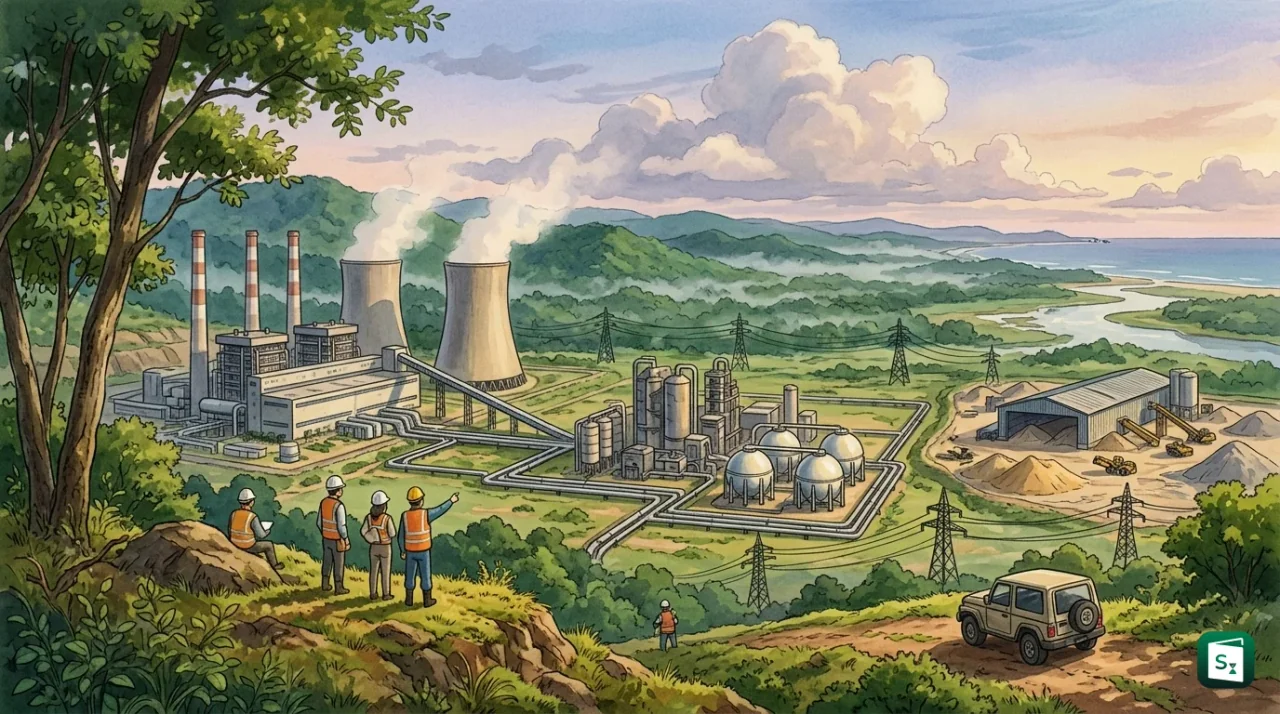
NLC India Limited signed three MoUs with the Industrial Promotion and Investment Corporation of Odisha in Mumbai on 22 October 2026 for projects worth about Rs 37000 crore in Odisha. The plan covers a 3200 MW ultra-supercritical coal power plant, a beach sand mineral processing facility and a study on coal gasification for fertiliser production. The agreements expand NLCIL’s growing footprint in Odisha at a time when India is pushing gasification to cut costly imports of fuel and fertilisers.
What Is NLCIL and What Did It Agree With IPICOL?
NLC India Limited (NLCIL) is a Navratna public sector company under the Ministry of Coal that mines lignite and coal and generates thermal and renewable power from its base at Neyveli in Tamil Nadu. The company was incorporated on 14 November 1956 as Neyveli Lignite Corporation Limited and took its present name in March 2016. It has its registered office in Chennai and corporate office in Neyveli.
Industrial Promotion and Investment Corporation of Odisha Limited (IPICOL) is the investment promotion agency of the Odisha government. It was incorporated on 12 April 1973 and now acts as the single window nodal agency for large industrial proposals in the state.
NLCIL signed the three MoUs with IPICOL in Mumbai on 22 October 2026. NLCIL Executive Director I S Jasper Rose and IPICOL Managing Director Aboli Sunil Naravane signed the documents in the presence of Odisha Chief Minister Mohan Charan Majhi, Additional Chief Secretary Hemant Sharma and NLCIL Chairman cum Managing Director Prasanna Kumar Acharya.
NLCIL today operates three opencast lignite mines at Neyveli with a combined capacity of about 28 million tonnes per year, one lignite mine at Barsingsar in Rajasthan of 2.1 million tonnes per year, and coal mines at Talabira in Odisha of 20 million tonnes per year and Pachwara South in Jharkhand. Its installed power capacity is about 6071 MW, including lignite based stations at Neyveli and Barsingsar, a 1000 MW coal station at Thoothukudi through its subsidiary, and solar and wind capacity of more than 1400 MW. The Government of India holds about 79.2 percent of its equity.
Three Projects Covered Under the Rs 37000 Crore Plan
The MoUs describe proposed investments, not sanctioned projects. The figures on cost and jobs are estimates that will depend on land, clearances, feasibility reports and final investment approvals.
| Project | Proposed investment | Size and jobs |
|---|---|---|
| 3200 MW ultra-supercritical coal power plant in Odisha | Rs 35000 crore | Four units of 800 MW each, jobs for about 4000 people |
| Beach sand mineral processing facility | Rs 2000 crore | Processing of heavy minerals from coastal sand, jobs for about 500 people |
| Coal gasification linked to fertiliser production | Feasibility study stage, cost not fixed | Study of technical feasibility and production of synthesis gas for fertiliser use |
3200 MW ultra-supercritical power plant
The largest proposal is a 3200 MW coal based plant using ultra-supercritical technology. In such plants, steam is heated to very high temperature (around 600 degrees Celsius) and very high pressure. Higher steam conditions raise efficiency. More power is produced from each tonne of coal, and carbon dioxide per unit of power falls compared to older subcritical plants.
Beach sand mineral processing facility
The second MoU covers a facility to process beach sand minerals. Odisha has a long coastline with deposits of heavy minerals such as ilmenite, rutile, garnet, zircon, monazite and sillimanite. These minerals are used in paints, ceramics, electronics, nuclear fuel and other industries. The proposal focuses on processing within the state rather than selling raw sand. Location and capacity details have not been announced yet.
Coal gasification for fertilisers
The third MoU is only for exploration. NLCIL will study whether coal in Odisha can be gasified and whether the resulting gas can feed fertiliser plants. Coal gasification is a heat driven chemical process that converts coal into synthesis gas (syngas), a mixture made mainly of carbon monoxide and hydrogen. Syngas can then be turned into methanol, ammonia, urea, synthetic natural gas and other chemicals.
Why a New 3200 MW Plant When the Talabira Project Is Already Underway?
NLCIL is already building a large pithead station in Odisha. A pithead station sits close to the coal mine, so transport cost stays low.
The Talabira Thermal Power Project at Tareikela in Jharsuguda district was planned for 3200 MW in two stages. Phase one covers 2400 MW with three units of 800 MW each. The central government approved the project, environmental clearance came on 2 February 2021, and the engineering contract worth Rs 18255 crore went to Bharat Heavy Electricals Limited (BHEL) in January 2024. Prime Minister Narendra Modi laid its foundation stone on 3 February 2024. The first unit is expected around 2028 to 2030, with later units at six month gaps.
The Talabira plant links directly to NLCIL’s Talabira II and III captive coal blocks, which hold about 553 million tonnes of reserves. Power purchase agreements already tie up much of this power for Tamil Nadu (1500 MW), Kerala (400 MW), Puducherry (100 MW) and Odisha (800 MW in two phases).
Company officials have said the new 3200 MW proposal under the IPICOL MoU is additional to the Talabira plant now under construction. Land and location details are at an advanced stage of finalisation. Like Talabira, it would benefit from Odisha’s coal belt around Jharsuguda and Sambalpur, a region often called the powerhouse of Odisha because of its concentration of mines and thermal stations.
How Coal Gasification and Fertiliser Link Fits National Policy
India holds large coal reserves of about 378 billion tonnes. Nearly 80 percent of mined coal now goes to thermal power plants. The government wants to use part of this coal more cleanly to make chemicals that India now imports in large volumes.
The National Coal Gasification Mission, launched in 2020, set a target of gasifying 100 million tonnes of coal by 2030. By July 2026, about 22.6 million tonnes per year of capacity was operational or under work. This includes projects of Jindal Steel, Talcher Fertilisers and eight projects approved under an earlier incentive scheme.
Two central incentive schemes support this push:
| Scheme | Outlay | Support |
|---|---|---|
| Scheme approved on 24 January 2024 | Rs 8500 crore | Grant of 15 percent of project cost for PSU, private and demonstration projects across three categories |
| Scheme approved on 13 May 2026 for surface coal and lignite gasification | Rs 37500 crore | Grant of up to 20 percent of plant and machinery cost, with a cap of Rs 5000 crore per project and higher caps for select products |
The government has said India spent about Rs 2.77 lakh crore in 2024-25 on imports of substitutable products such as LNG, urea, ammonia, methanol and related chemicals. Gasification can help replace some of these imports. It offers a domestic route to urea and ammonium nitrate for fertilisers, methanol for fuel and chemicals, and synthetic natural gas for city gas and power. The Ministry of Coal has also allowed a 50 percent rebate in revenue share for coal used in gasification, created a separate sub sector for syngas production, and extended long term coal linkages of up to 30 years.
NLCIL already has experience in this field through its lignite to methanol work. A gasification fertiliser link in Odisha would connect well with existing projects in the state, such as the Talcher fertiliser plant and the joint venture of Coal India with BHEL at Lakhanpur for ammonium nitrate.
Who Is IPICOL and Why Odisha Is Courting Large Investments
IPICOL functions as Odisha’s single window nodal agency for proposals above Rs 50 crore. It receives applications, guides investors on land, water and power needs, coordinates approvals across departments, and tracks projects until production starts. Proposals above Rs 1000 crore go to a High Level Clearance Authority headed by the Chief Minister.
The NLCIL MoUs were signed on the sidelines of an industry outreach in Mumbai and in the run up to events such as India Chem 2026, where Odisha sought chemical and petrochemical investments. For Odisha, the three proposals promise stronger power supply, value addition from minerals, and new jobs. For NLCIL, Odisha offers pithead coal, port access for equipment and minerals, and a state system built to clear large projects quickly.
The company has said its next steps include finalising land, completing feasibility work on gasification and mineral processing, and seeking statutory clearances. Actual construction and job creation will follow only after these approvals and final investment decisions.
Key Takeaways
- NLC India Limited signed three MoUs with IPICOL in Mumbai on 22 October 2026 for a proposed Rs 37000 crore investment in Odisha.
- The largest proposal is a 3200 MW ultra-supercritical power plant with four 800 MW units at a cost of Rs 35000 crore and about 4000 jobs.
- A Rs 2000 crore beach sand mineral processing facility is proposed to process heavy minerals with about 500 jobs.
- NLCIL will study coal gasification to produce synthesis gas for fertiliser use, in line with the 100 million tonne gasification target for 2030.
- NLCIL, a Navratna company under the Ministry of Coal set up in 1956, operates mines and about 6071 MW of power capacity with headquarters at Neyveli.