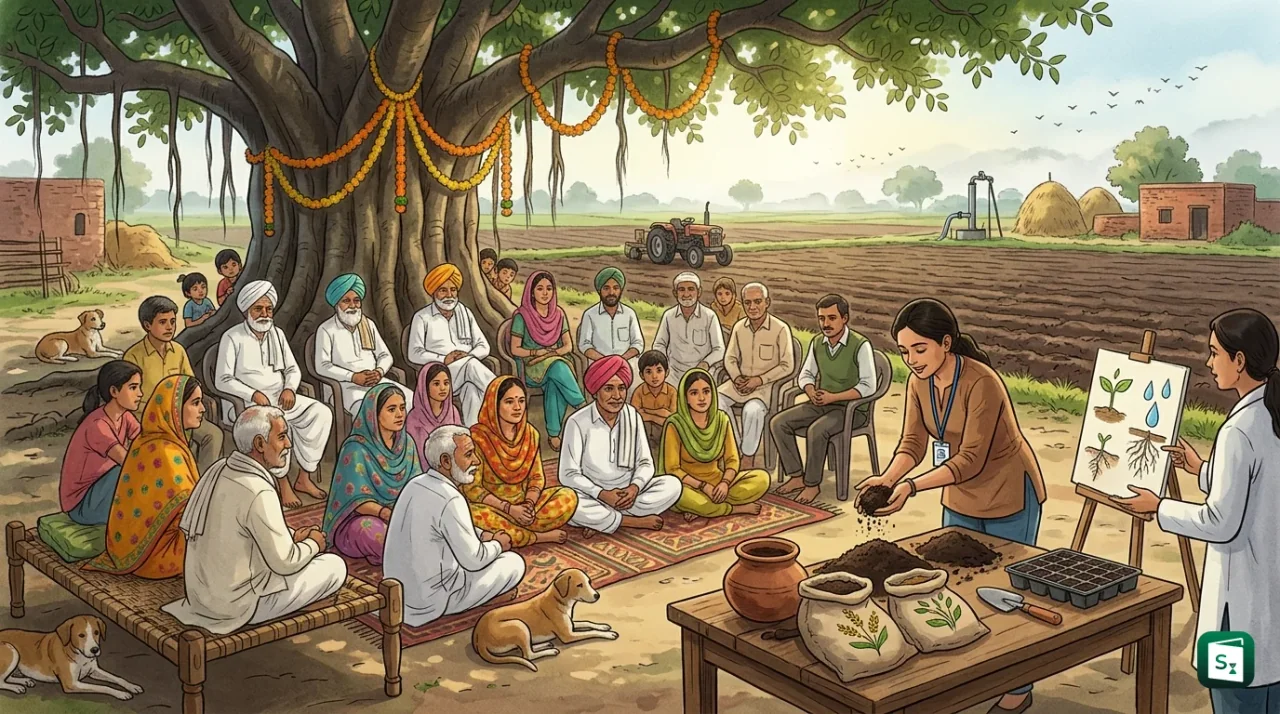
Union Minister for Agriculture and Farmers Welfare Shivraj Singh Chouhan launched the nationwide Khet Bachao Abhiyan Rabi 2026 on 22 October 2026 from Taraori in Karnal district of Haryana. The 40 day campaign will run till 30 November 2026 and aims to reach about one crore farmers through village meetings, field demonstrations and Krishi Vigyan Kendras. It focuses on soil health, balanced fertiliser use based on soil tests, crop diversification and proper management of paddy stubble after harvest.
What Is Khet Bachao Abhiyan Rabi 2026?
The Khet Bachao Abhiyan Rabi 2026 is a nationwide farm awareness campaign of the Ministry of Agriculture and Farmers Welfare. In Hindi, khet means field, bachao means save and abhiyan means campaign, so the name means Save the Fields Campaign for the Rabi 2026 winter crop season. The first national edition was launched on 22 October 2026 and will run till 30 November 2026.
The campaign is timed for the weeks just after paddy harvest, when lakhs of fields in north India lie empty and farmers prepare for winter sowing. Its core message is simple. Test the soil first, apply only the fertilisers the soil needs, use empty fields productively, and do not burn stubble.
The Ministry has listed clear goals for the 40 day period:
- promote sustainable farming and improve soil health for long term productivity
- encourage balanced and need based use of fertilisers and other inputs based on soil testing
- push crop diversification through pulses, oilseeds and horticulture
- ensure better use of fallow fields left vacant after paddy harvest
- train farmers in correct use of organic and bio based products and natural farming
- promote water conservation, rainwater harvesting and groundwater recharge
Why the Campaign Was Launched From Karnal
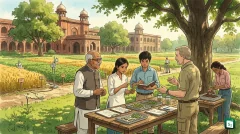
The national launch took place at Taraori in Karnal district of Haryana during a Kisan Chaupal, which is an open village meeting where farmers speak directly with ministers and scientists. Haryana Agriculture Minister Shyam Singh Rana, Indian Council of Agricultural Research (ICAR) Director General Mangi Lal Jat, scientists from ICAR and the National Dairy Research Institute (NDRI) at Karnal, and a large group of farmers attended the event. Lakhs of farmers, scientists and officials from Krishi Vigyan Kendras (KVKs) and farm universities joined the programme online from across the country.
Karnal was a practical choice. It lies in the rice wheat belt where paddy harvest in October leaves behind large volumes of straw and empty fields. Haryana farmers have reduced stubble burning in recent years, and officials presented Taraori as an example of better residue management and healthy organic carbon in soil. A live demonstration at the venue showed how a baler machine picks up loose straw and packs it into tight bales for sale and industrial use.
Chouhan asked farm university vice chancellors, ICAR scientists and field officers to leave their offices and hold village level meetings till 30 November. The target is to reach about one crore farmers with scientific advice on soil and inputs. At the end of the event, farmers raised their fists and pledged to use chemicals in a balanced way, change crop cycles, stop burning stubble and slowly adopt natural farming.
In his role as Rural Development Minister, Chouhan also handed over an approval letter for 28,422 permanent houses in Haryana under the Pradhan Mantri Awas Yojana Gramin. The sanction involves financial assistance of ₹1,343.06 crore for poor rural families in the state.
Soil Health Card Scheme: Year, Ministry and How It Works
The Soil Health Card Scheme was launched on 19 February 2015 at Suratgarh in Rajasthan. Prime Minister Narendra Modi launched the scheme with the slogan Swasth Dharaa Khet Haraa, which means Healthy Earth Green Farm. It is run by the Ministry of Agriculture and Farmers Welfare to help states issue soil reports to all farmers.
A Soil Health Card is a printed report for each land holding. It shows the nutrient level of the soil on 12 parameters and advises the farmer on the type and amount of fertiliser and soil treatment needed for better yield.
| Group | Parameters Tested |
|---|---|
| Macro nutrients | Nitrogen (N), Phosphorus (P), Potassium (K) |
| Secondary nutrient | Sulphur (S) |
| Micro nutrients | Zinc (Zn), Iron (Fe), Copper (Cu), Manganese (Mn), Boron (B) |
| Physical properties | pH (acidity or alkalinity), EC (electrical conductivity or salt level), OC (organic carbon) |
Soil samples are collected in a grid of 2.5 hectares in irrigated areas and 10 hectares in rainfed areas with GPS mapping. Samples are tested at soil testing labs, ICAR institutes, Krishi Vigyan Kendras and farm universities. Farmers can get their cards and recommendations through the Soil Health Card Portal, which works on web and mobile and issues cards in 22 languages.
The scale is large. More than 25.55 crore soil health cards had been distributed by mid November 2025. About 93,000 farmer training programmes and 6.8 lakh field demonstrations had been held by July 2025. The scheme now runs as the Soil Health component of the Rashtriya Krishi Vikas Yojana (RKVY). Its aim is integrated nutrient management through careful combined use of chemical fertilisers, organic manure and bio fertilisers.
Rabi Season in India: Sowing Time and Major Crops
The Rabi season is the winter cropping season in India. Sowing starts in October to November after the southwest monsoon retreats. Harvest takes place from February to April. The word rabi comes from Arabic and means spring, while kharif means autumn.
India follows a crop year from July to June. The Kharif season runs from July to October during the monsoon. The Rabi season runs from October to March in winter. Crops grown between March and June are called summer or zaid crops.
| Feature | Kharif Crops | Rabi Crops |
|---|---|---|
| Sowing season | July with monsoon onset | October to November after monsoon |
| Harvest season | September to October | February to April |
| Water source | Mainly monsoon rain | Soil moisture plus irrigation |
| Main examples | Rice, maize, cotton, soybean, groundnut, bajra | Wheat, barley, mustard, chickpea, lentil, peas |
The major Rabi crop is wheat, followed by barley, mustard, chickpea (gram), lentil, linseed and peas. In the northern plains of Punjab, Haryana and Uttar Pradesh, wheat, barley and mustard are sown from late October to early December. In Madhya Pradesh, Rajasthan and Gujarat, wheat, chickpea and mustard are sown from mid October to mid November. In Maharashtra and Karnataka, chickpea and sorghum sowing starts in early October. Green peas reach markets early, with peak supply from January to March.
This calendar explains the campaign dates. The period from 22 October to 30 November is the exact window when farmers decide seed choice, seed rate and first fertiliser dose for Rabi. Advice given now shapes the full winter harvest.
Three Practical Steps for Protecting Fields
Chouhan outlined three simple actions for farmers. Each action cuts costs and protects the soil for the next season.
Use fertilisers based on the Soil Health Card
Farmers were asked to check their Soil Health Cards on their phones and apply only the nutrients found missing. The Minister said cheap prices should not lead to excess use. The central government bears a fertiliser subsidy of more than ₹1.5 lakh crore so that a bag of urea costs only ₹266 and a bag of DAP costs ₹1,350. But more fertiliser does not mean more grain.
He compared excess fertiliser to taking strong medicine without illness. It wastes money and harms the soil. He also asked farmers to stop copying neighbours. If one farmer uses four bags, the next farmer should not feel forced to use four and a half bags. India is also moving toward green ammonia to become self reliant in fertiliser production in future.
Change the crop cycle with pulses and oilseeds
Farmers in the rice wheat belt were asked to break the repeated paddy followed by wheat cycle. Growing pulses such as chickpea, lentil and pigeon pea in rotation helps the soil because pulse roots fix nitrogen naturally and restore fertility.
This links to the Crop Diversification Programme, run since 2013-14 in Punjab, Haryana and western Uttar Pradesh under the Pradhan Mantri Rashtriya Krishi Vikas Yojana. It supports a shift from water heavy paddy to pulses, oilseeds, coarse cereals, cotton and horticulture. Haryana also runs its own Mera Pani Meri Virasat scheme from 2020 to save groundwater by rewarding farmers who leave paddy for other crops. At the national level, the National Mission on Edible Oils Oilseeds and pulse missions back the same shift.
Start natural farming on a small plot and stop burning stubble
Farmers with three to five acres were asked to try natural farming on at least half an acre to one acre first. They can prepare Beejamrit for seed treatment, Jeevamrit as a liquid microbial tonic and Ghanjeevamrit as a solid mixture using local cow dung, cow urine, jaggery, pulse flour and soil from under trees. These home made inputs feed soil microbes, improve organic carbon and lower input costs. The National Mission on Natural Farming, approved with an outlay of ₹2,481 crore, supports such clusters, demonstration farms at Krishi Vigyan Kendras and training through farmer trainers.
On stubble, the message was firm. Burning straw kills earthworms, useful insects and trillions of microbes in the topsoil. It also causes air pollution and harms health. Instead, farmers can cut paddy with a cutter, gather straw with a rake and pack it with a baler. Baled straw can be sold to industry for about ₹200 to ₹250 per quintal, which adds income while keeping the field fertile.
Why Soil Health and Crop Diversification Matter
Soil health means the ability of soil to support crops season after season. Healthy soil holds water well, recycles nutrients through microbes and gives stable yields. Poor soil needs more fertiliser and water for the same crop, so costs rise and income falls.
Good soil also protects the wider system. When organic carbon is high and microbes are active, fields need less chemical load and cope better with dry spells and heavy rain. Balanced use of nitrogen, phosphorus and potassium along with sulphur, zinc and organic manure keeps this balance. Returning straw to the soil instead of burning it feeds the same microbes.
Crop diversification means growing a wider mix of crops instead of the same two crops every year. In plain words, it is a shift from only paddy and wheat to pulses, oilseeds, millets, cotton and vegetables suited to local water and soil. This shift matters for three reasons. It saves groundwater because paddy needs far more water than mustard or chickpea. It cuts import dependence because India still buys large volumes of edible oils and pulses. And it spreads risk because a farmer with two or three crops is less hurt if one crop fails or prices fall.
The campaign also stresses water care through rainwater harvesting and groundwater recharge. Together, soil tests, right crop choice and residue use aim to keep fields productive for future generations while raising present farm income.
Key Takeaways
- The Khet Bachao Abhiyan Rabi 2026 was launched on 22 October 2026 from Taraori in Karnal, Haryana and will run till 30 November 2026 with a target of reaching one crore farmers.
- The Soil Health Card Scheme was launched on 19 February 2015 at Suratgarh in Rajasthan and is run by the Ministry of Agriculture and Farmers Welfare.
- A Soil Health Card reports 12 parameters, including nitrogen, phosphorus, potassium, sulphur, zinc, iron, copper, manganese, boron, pH, EC and organic carbon.
- The Rabi season runs from October to March, with sowing in October to November and harvest in February to April, and wheat is the main Rabi crop.
- Baled paddy straw can earn farmers about ₹200 to ₹250 per quintal instead of being burnt, which protects soil microbes and reduces air pollution.