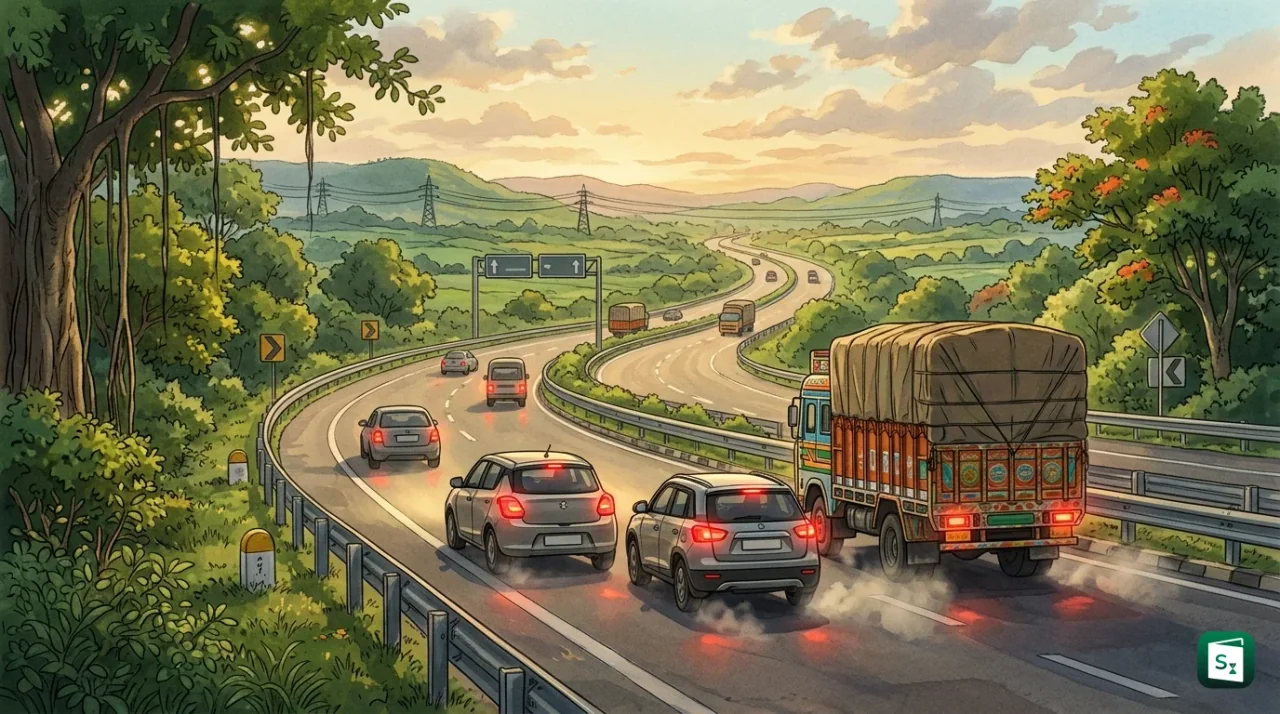
The Ministry of Road Transport and Highways has proposed mandatory Advanced Emergency Braking Systems for new M1 cars from 1 October 2030 and for all M1 cars from 1 October 2032. The same draft makes AEBS and Electronic Stability Control compulsory for trucks from 1 October 2027. The move aims to cut rear end collisions in India, where 4,87,707 road accidents claimed 1,77,175 lives in 2024.
What Is AEBS in Cars and Trucks?
Advanced Emergency Braking System (AEBS), also called automatic or autonomous emergency braking, is a safety system that detects a front collision and applies brakes on its own when the driver fails to act. In cars it targets car and pedestrian impacts, while in trucks it cuts rear end crashes.
AEBS is a key part of Advanced Driver Assistance Systems (ADAS), the set of radar and camera based aids that warn drivers or intervene in emergencies. The system first gives a collision warning through sound, light or vibration. If the driver still does not brake or steer away, it orders emergency braking with a demand of at least 5.0 metres per second squared to slow the vehicle quickly.
The driver can override the system at any time through a positive action such as pressing the accelerator hard, steering sharply or using the indicator. The system is designed to avoid false braking in normal driving. If AEBS develops a fault such as sensor blindness or misalignment, a constant yellow warning light alerts the driver, and manual switch off needs two deliberate actions and is not possible above 10 kmph.
Proposed Timelines for Mandatory AEBS and ESC
The Ministry of Road Transport and Highways published the proposal as a draft amendment to the Central Motor Vehicles Rules, 1989 in October 2026. The draft is not yet law. Under Section 212 of the Motor Vehicles Act, 1988, the Ministry has invited objections and suggestions for 30 days from the date the Gazette copies are made public, after which it will take a final decision.
The draft gives industry long lead time to change designs, test systems and manage costs. New models mean vehicle types getting type approval for the first time, while existing models mean types already approved before the cut off date.
| Date | What Becomes Compulsory |
|---|---|
| 1 October 2027 | Steering effort of all motor vehicles to conform to AIS-193, except motorcycles, invalid carriages and three wheelers without a steering wheel |
| 1 October 2027 | Revised braking under IS 11852:2019, Electronic Stability Control under AIS-162 and AEBS under AIS-162 for trucks and heavy passenger vehicles |
| 1 October 2028 | Any M1 car and N1 goods vehicle offered with AEBS must meet AIS-185, though fitment is still optional |
| 1 October 2029 | Automatic Command Steering Functionality under AIS-193 and Emergency Lane Keeping System under AIS-191 Part 1 mandatory for M1 vehicles registered as transport vehicles such as taxis |
| 1 October 2030 | AEBS under AIS-185 mandatory for all new M1 models |
| 1 October 2032 | AEBS under AIS-185 mandatory for all M1 models, including models already in production |
An earlier final rule, the Central Motor Vehicles Sixth Amendment Rules, 2025 notified as G.S.R. 834(E) on 11 November 2025, has already made AEBS, stability function and anti lock braking compulsory for M2, M3, N2 and N3 heavy vehicles from 1 January 2027 for new models and 1 October 2027 for all models. The October 2026 draft extends a similar protection to cars, which form the largest share of private vehicles on Indian roads.
How Automatic Emergency Braking Works in Cars
Automatic emergency braking uses three steps that run continuously while the car moves. First, sensors watch the road. Most cars with AEB use a millimetre wave radar for distance and speed plus a camera for object shape. Radar works in poor light and measures range well, while the camera identifies cars, pedestrians and lane lines. A control unit fuses both inputs to reduce false alarms.
Second, the system calculates time to collision from relative distance and speed. If the gap closes dangerously, it moves through stages. It warns the driver with beeps, flashing lights or a seat belt tug. It pre fills the brakes for faster response and may apply partial braking. If the driver still does not act and a crash looks unavoidable, it applies full braking on its own.
Third, the braking hardware acts. Modern cars build pressure through the Electronic Stability Control pump or an electronic booster, so AEBS depends on healthy service brakes and Anti lock Braking System (ABS). Under AIS-185, which is based on UN Regulation 152, the car to car function must work at least between 10 kmph and 60 kmph, and the car to pedestrian function between 20 kmph and 60 kmph during type approval tests on flat dry roads with good light.
The standard also tests two clear cases. Part 1 covers rear end in lane collision with a passenger car ahead, whether stationary or moving. Part 2 covers a pedestrian crossing at a constant 5 kmph. Tests allow a centre offset of up to 0.2 metres and need at least 1,000 lux light for car targets and 2,000 lux for pedestrian targets. Real world performance can fall in rain, fog, dust, glare, sharp curves or broken lane markings. The rule accepts this limit but requires that the system must not switch off unreasonably in such conditions.
What Is Electronic Stability Control and Why Trucks Need It
Electronic Stability Control (ESC) is a system that keeps a vehicle on its intended path during sudden turns or slippery conditions. It constantly compares the driver intention with actual motion using wheel speed sensors, a steering angle sensor, a yaw rate sensor and a lateral acceleration sensor. If it senses understeer, oversteer or wheel slip, it brakes individual wheels within milliseconds and can cut engine torque to restore balance.
Trucks need this help more than cars. A loaded truck has a high centre of gravity and long braking distance. Braking on a curve can push it into jack knife, rollover or lane departure. ESC under AIS-162 provides the vehicle stability function that corrects such motion before the driver loses control. The paired upgrade to IS 11852:2019 braking improves stopping consistency for the whole heavy fleet, which earlier applied fully only to buses built by original makers.
For heavy vehicles, AEBS under AIS-162 is tuned mainly for highway rear end crashes, based on UN Regulation 131. The system must stay active from 15 kmph up to the maximum design speed under all loads unless the driver deactivates it in the allowed way. Together, stable braking and automatic emergency braking address two top risks for trucks, which include night running, driver fatigue and mixed traffic with pedestrians and two wheelers in close proximity.
Which Vehicles and Standards Are Covered
Vehicle categories in India follow the Central Motor Vehicles Rules, 1989. The M1 category means a four wheeled vehicle for passengers with not more than eight seats in addition to the driver seat. Most hatchbacks, sedans and sport utility vehicles fall in this group. N1 means a goods vehicle with maximum mass up to 3.5 tonnes, such as small vans and pickups.
| Category | Use | Example |
|---|---|---|
| M1 | Passengers, up to 8 seats plus driver | Cars, SUVs |
| M2 | Passengers, more than 8 seats, mass up to 5 tonnes | Mini buses |
| M3 | Passengers, more than 8 seats, mass above 5 tonnes | Large buses |
| N1 | Goods, mass up to 3.5 tonnes | Small goods vans |
| N2 | Goods, mass above 3.5 tonnes up to 12 tonnes | Medium trucks |
| N3 | Goods, mass above 12 tonnes | Heavy trucks and trailers |
Automotive Industry Standards, or AIS, are technical codes framed by the Automotive Industry Standards Committee under the Ministry of Road Transport and Highways. Tests are done by agencies notified under Rule 126 such as the Automotive Research Association of India (ARAI) in Pune and the International Centre for Automotive Technology (ICAT).
| Standard | What It Covers | Applies To |
|---|---|---|
| AIS-185 | AEBS for light vehicles, car to car and car to pedestrian tests | M1 and N1 vehicles |
| AIS-162 | AEBS for heavy vehicles, mainly rear end highway crashes | M2, M3, N2 and N3 vehicles |
| AIS-162 and IS 11852:2019 | Electronic stability and improved braking performance | Trucks from 1 October 2027 |
| AIS-193 | Steering effort and automatic steering functions | All motor vehicles with a steering wheel from 1 October 2027 |
| AIS-191 Part 1 | Emergency Lane Keeping System | M1 transport vehicles such as taxis from 1 October 2029 |
Motorcycles, invalid carriages and three wheelers without a steering wheel are exempt from the AIS-193 steering rule, since they do not use a car type steering system. Private M1 cars fitted voluntarily with automatic steering or lane keeping before the mandatory dates must still meet the same standards from 1 October 2027, so optional features cannot escape testing.
Why the Mandate Matters for Road Safety in India
India records the highest number of road deaths in the world. The Ministry report titled Road Accidents in India 2024 counted 4,87,707 accidents, 1,77,175 deaths and 4,71,441 injuries in one year. That is about 1,336 accidents and 485 deaths every day, or nearly 20 deaths every hour. Deaths rose by 2.5 percent over 2023, and accident severity rose to 36.3 deaths per 100 accidents.
Rear end collisions, recorded as hit from back, remain the single largest crash type. They caused 37,404 deaths, or 21.1 percent of all road deaths in 2024. Over speeding contributed to 70.3 percent of deaths. People aged 18 to 45 years accounted for 66.1 percent of deaths, which means the loss falls heavily on working age earners.
AEBS directly targets this pattern. Global studies show that automatic emergency braking can cut rear end crashes by up to 40 percent, since it reacts even when the driver is distracted or drowsy. For India, where straight roads accounted for about two thirds of accidents and mixed traffic brings sudden stops, an extra second of automatic braking can decide between a near miss and a fatal crash.
The proposal also supports the government goal to halve road accidents and deaths by 2030. It builds on steps already taken, such as the Bharat New Car Assessment Programme (Bharat NCAP) launched in 2023 for star ratings of M1 cars up to 3.5 tonnes, mandatory airbags, anti lock brakes and the 2025 rules for heavy vehicles covering lane departure warning, driver drowsiness warning, blind spot information and moving off information systems.
AEBS Compared With Other Braking and Safety Systems
Buyers often confuse similar short forms. The table below clears the difference.
| System | Full Form | What It Does | How It Differs From AEBS |
|---|---|---|---|
| ABS | Anti lock Braking System | Stops wheels from locking during hard braking so the driver can still steer | ABS only helps when the driver brakes, while AEBS brakes on its own |
| EBS | Electronic Braking System | Uses electronic signals instead of only air pressure to apply truck brakes faster and balance load | EBS improves brake response, while AEBS decides when emergency braking is needed |
| ESC | Electronic Stability Control | Brakes single wheels and cuts engine power to stop skidding on turns | ESC keeps direction stable, while AEBS stops a forward collision |
| AEB and AEBS | Automatic Emergency Braking and Advanced Emergency Braking System | Same core function of self braking, with AEBS being the formal regulatory term in India | No functional gap, only naming under AIS and UN rules |
| ADAS | Advanced Driver Assistance Systems | The full family of aids such as lane warning, blind spot alert, adaptive cruise and AEBS | AEBS is one member of ADAS, not the whole set |
Costs and limits matter for buyers and operators. AEBS needs radar, camera, wiring and calibration, which can raise the price of entry level cars. Sensors need clean windscreens, correct alignment and clear lane views. The system may warn late on Indian roads with faded markings, stray cattle, sudden two wheeler cuts or dense fog. Drivers must therefore stay alert and treat AEBS as a safety net, not as self driving.
Key Takeaways
- The MoRTH draft of October 2026 proposes AEBS under AIS-185 mandatory for new M1 models from 1 October 2030 and for all M1 models from 1 October 2032.
- Trucks and heavy vehicles must carry AEBS and Electronic Stability Control under AIS-162 with improved braking under IS 11852:2019 from 1 October 2027.
- M1 category means a passenger vehicle with not more than eight seats in addition to the driver seat.
- Steering effort for all motor vehicles with a steering wheel must meet AIS-193 from 1 October 2027, with motorcycles and three wheelers without a steering wheel exempted.
- India reported 4,87,707 accidents and 1,77,175 deaths in 2024, with rear end collisions causing 37,404 deaths or 21.1 percent of the total.