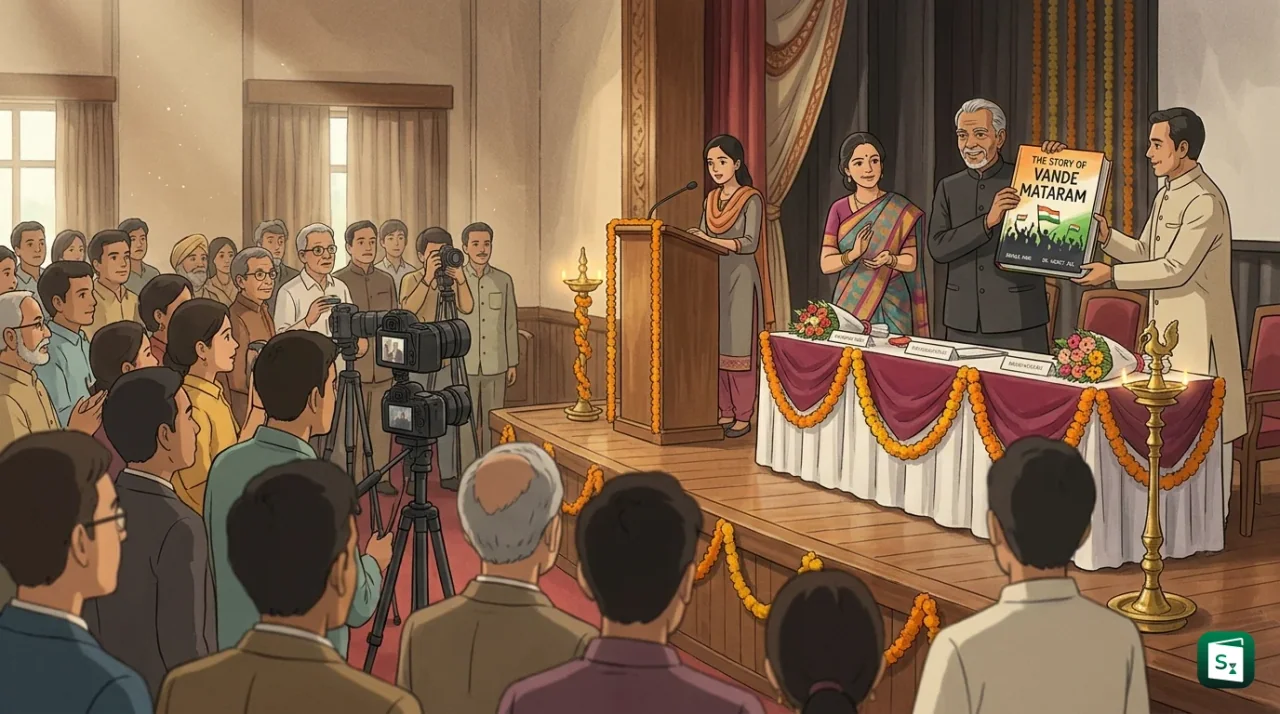
Former Kerala and Bihar Governor Arif Mohammad Khan released the English translation of The Story of Vande Mataram on 26 October 2026 at the Constitution Club in New Delhi. The book is the English version of a Malayalam work by the late Ranga Hari, translated by Dr. Mercy Jill and published by Indus Scrolls Press. The release comes during the year long commemoration of 150 years of Vande Mataram, observed from 7 November 2025 to 7 November 2026.
Book Released in New Delhi
The launch took place at the Deputy Speaker Hall in the Constitution Club of India Annexe on 26 October 2026. The programme was jointly organised by Pragya Pravah (Delhi unit) and Indus Scrolls Press, the publisher of the 276 page English paperback edition.
Former Kerala and Bihar Governor Arif Mohammad Khan released the book as chief guest. Delhi University Vice Chancellor Prof. Yogesh Singh attended as special guest, while Pragya Pravah National Convener J. Nandakumar presided over the function. Speakers at the event said the book traces the origin of Vande Mataram, its place in the freedom struggle, the public sentiment around it, and its continuing relevance. Khan described Ranga Hari as a distinguished scholar, an accomplished writer and a committed patriot.
Who Wrote and Translated the Book
The original Malayalam book was written by Ranga Hari, whose full name was R. Hari. He was born on 5 December 1930 in Ernakulam district in present day Kerala. He joined the Rashtriya Swayamsevak Sangh (RSS) as a student volunteer in the 1940s and became a full time pracharak in 1951.
Hari later served as Kerala Prant Pracharak from 1983 to 1994 and as Akhil Bharatiya Bauddhik Pramukh, the all India chief for intellectual training, from 1991 to 2005. He was a prolific author in Malayalam, Hindi, English and Konkani, with more than 50 books to his credit, and edited the journal Kurukshetra. He died in Kochi on 29 October 2023 at the age of 93. His Malayalam work on Vande Mataram became a bestseller in Kerala and was later published in Hindi.
The English translation has been done by Dr. Mercy Jill, an Assistant Professor of English associated with Delhi University. She works in English literature and knows Malayalam, Hindi, Tamil and Kannada, which helped carry the Malayalam original to a national readership.
What Is Vande Mataram
Vande Mataram is the national song of India. It means Mother, I Bow to Thee in English. The song praises the motherland as rich in water, fruit, greenery and strength. The Constituent Assembly honoured it equally with the national anthem Jana Gana Mana.
The song has six stanzas in its full version. Only the first two stanzas were adopted for official use as the national song. This choice was made in 1937 to keep the official version free from religious imagery found in the later stanzas. The official version takes about a minute to sing.
Vande Mataram Is Taken From Which Book
Vande Mataram is taken from the Bengali novel Anandamath. The novel was written by Bankim Chandra Chattopadhyay and published in book form in 1882. Earlier, the song had appeared on its own in the literary journal Bangadarshan, which Bankim founded and edited. The journal carried it on 7 November 1875 and again in its March to April 1881 issue.
Anandamath is set against the Sanyasi Rebellion of the late 18th century in Bengal. Its central characters are a group of ascetics called Santans, or children of the motherland, who dedicate their lives to freeing their land. The song appears in the novel as the hymn sung by these Santans. It presents the land as the mother goddess and lays out what the book calls the religion of patriotism.
When Vande Mataram Was Written and First Sung
Bankim Chandra Chattopadhyay wrote Vande Mataram in Sanskritised Bengali around 1875. Rabindranath Tagore later set it to music. Tagore first sang it at the 1896 Calcutta session of the Indian National Congress.
The song soon moved from literature to politics. It became a slogan and marching song during the Swadeshi movement after the partition of Bengal in 1905. The Congress adopted it for all India occasions at its 1905 Varanasi session.
| Year | Milestone in Vande Mataram history |
|---|---|
| 1875 | First published in Bangadarshan on 7 November |
| 1882 | Included in the novel Anandamath |
| 1896 | First sung by Tagore at Congress session in Calcutta |
| 1905 | First used as political slogan on 7 August during Swadeshi movement, adopted by Congress at Varanasi |
| 1906 | Sung by Tagore at Congress session in Calcutta, widely used in Barisal conference |
| 1907 | Words Vande Mataram carried on flag raised by Bhikaiji Cama at Stuttgart |
| 1937 | Congress Working Committee limits official rendering to first two stanzas |
The language of the song is often described as Bengali with a heavy mix of Sanskrit. This mix allowed readers across regions to grasp its meaning. That is why translations soon appeared in Hindi, Tamil, Telugu, Kannada, Malayalam, Marathi and other Indian languages.
Vande Mataram Meaning and English Translation
Vande Mataram literally means I praise thee, Mother. Here Mother stands for the motherland. The opening lines describe India as rich in water and fruit, cool with southern breezes, green with harvests and delightful to behold.
The English rendering by Sri Aurobindo captures this spirit. It calls the land a giver of bliss and bearer of brave strength. Later lines speak of seventy million voices chanting the name, which referred to the population of British ruled India at that time. The book underlines this blend of natural beauty, physical strength and devotion as the reason the song inspired freedom fighters for decades.
When Vande Mataram Was Adopted as National Song
The Constituent Assembly adopted Vande Mataram as the national song on 24 January 1950. Assembly President Dr. Rajendra Prasad made a statement that Jana Gana Mana would be the national anthem and that Vande Mataram would be honoured equally with it and have equal status with it. Members greeted the announcement with applause and then sang both songs in the House.
This decision closed a long debate. In 1937 the Congress Working Committee had set up a committee with Maulana Abul Kalam Azad, Jawaharlal Nehru, Subhas Chandra Bose and Narendra Deva, in consultation with Tagore, to examine the song. The committee recommended that only the first two stanzas be sung at national gatherings. The 1950 decision retained that position. The first two stanzas contain no reference to any goddess and focus only on the land.
Vande Mataram vs Jana Gana Mana
Vande Mataram and Jana Gana Mana differ in status and legal position. Jana Gana Mana was written by Rabindranath Tagore and first sung on 27 December 1911 at the Calcutta Congress session. It was adopted as the national anthem in 1950. Vande Mataram was adopted on the same day as the national song with equal honour, but the two do not have the same legal position.
| Feature | Vande Mataram | Jana Gana Mana |
|---|---|---|
| Status | National song | National anthem |
| Written by | Bankim Chandra Chattopadhyay in 1875 | Rabindranath Tagore in 1911 |
| First sung at Congress session | 1896 in Calcutta | 1911 in Calcutta |
| Official version | First two stanzas only | First stanza only |
| Legal protocol | No specific central law on singing protocol | Regulated by orders on the anthem and the Prevention of Insults to National Honour Act, 1971 |
| Constitutional duty | Article 51A(a) refers to the anthem and flag, not the song by name | Citizens must respect the anthem as a fundamental duty |
When both are sung at a function, Vande Mataram is sung at the beginning and Jana Gana Mana at the close. As a rule, official guidance prefers not to burden a short function with both.
Why Vande Mataram Is Controversial
Vande Mataram became controversial because its later stanzas identify the motherland with the Hindu goddess Durga. The lines speak of the Mother as Durga, Lakshmi and Saraswati and describe her with weapons and divine power. Some Muslim leaders in the 1930s said this imagery amounted to worship of an idol, which their faith does not permit.
The Congress committee of 1937 noted this concern. Tagore himself felt the full song could not unite all communities, though he valued the first two stanzas. The All India Muslim League under Muhammad Ali Jinnah opposed the song in 1937. To respect all sentiments, the Congress decided that organisers could sing any other unobjectionable song in place of Vande Mataram if they wished.
Questions still arise today about whether singing is mandatory in schools or at official events, and about a proposed Vande Mataram Bill to lay down the full version rule and protocol. Courts have held that respect is due, but no central law makes daily singing compulsory for every citizen. The new book examines these debates and seeks to clear myths by placing the text, the history and the freedom struggle record side by side.
Vande Mataram Completes 150 Years
The book launch is linked to the 150th anniversary of the song. The count starts from 7 November 1875, when Vande Mataram first appeared in Bangadarshan. The Union Cabinet approved country wide celebrations on 1 October 2025. Prime Minister Narendra Modi inaugurated the year long commemoration on 7 November 2025 at the Indira Gandhi Indoor Stadium in New Delhi.
The commemoration runs from 7 November 2025 to 7 November 2026. The Ministry of Culture runs a dedicated portal, vandemataram150.in, where citizens can record their rendition, take part in quizzes and download a participation certificate. A commemorative stamp and coin were released at the inaugural event, and mass singing of the full version was held across states at 10 am on the opening day. The English edition of Ranga Hari work extends this outreach by taking a Malayalam bestseller to readers across India.
Key Takeaways
- The Story of Vande Mataram in English was released on 26 October 2026 at the Constitution Club in New Delhi by Arif Mohammad Khan.
- The Malayalam original was written by late RSS ideologue Ranga Hari and translated into English by Dr. Mercy Jill for Indus Scrolls Press.
- Vande Mataram was written by Bankim Chandra Chattopadhyay in 1875 and included in the novel Anandamath in 1882.
- Rabindranath Tagore first sang it at the 1896 Calcutta Congress session, and it became a mass slogan from 7 August 1905 during the Swadeshi movement.
- The Constituent Assembly adopted it as the national song on 24 January 1950, with equal honour to Jana Gana Mana, using only the first two stanzas.
- The release forms part of the 150 years commemoration from 7 November 2025 to 7 November 2026 led by the Ministry of Culture.