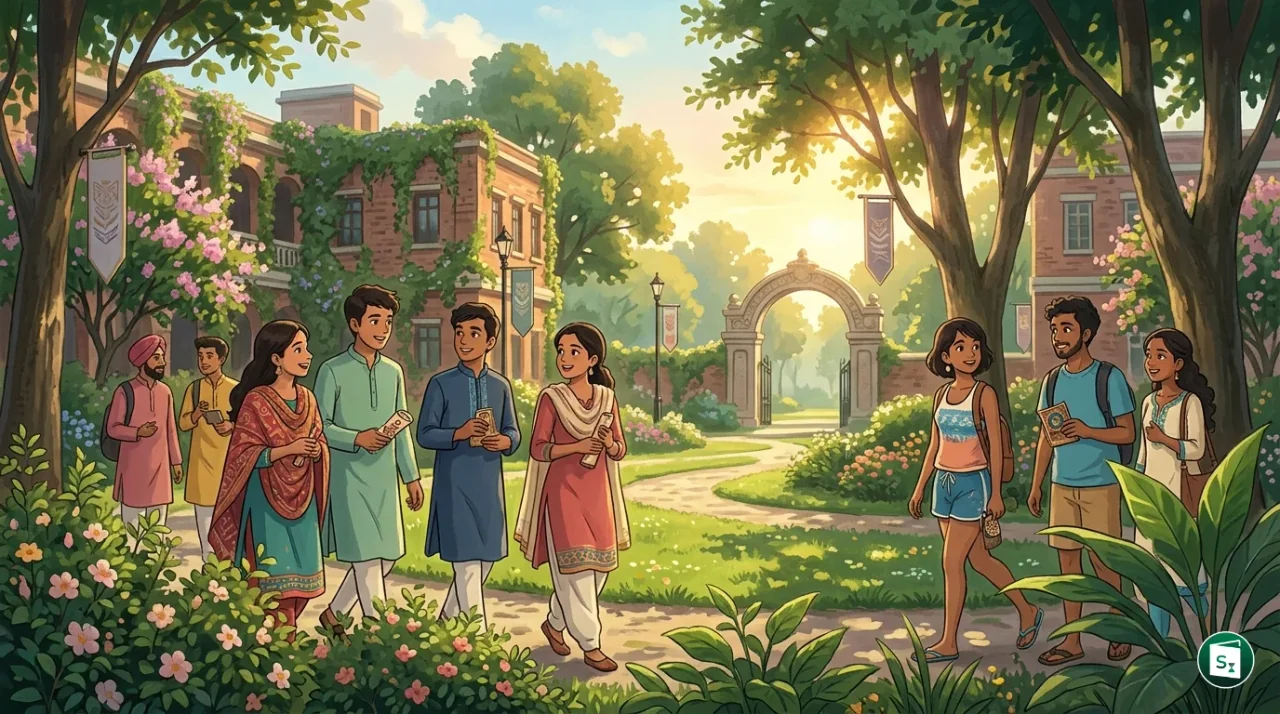
The first Vande Mataram Camp 2026, organised by Mera Yuva Bharat (MY Bharat) under the Ministry of Youth Affairs and Sports, concluded on 30 June 2026 at Brainware University in Barasat, Kolkata. The week-long camp, held from 24 to 30 June, brought together 150 youth delegates from six states and union territories to commemorate the 150th anniversary of India’s National Song, Vande Mataram. Conceived around the theme “One Song, One Spirit, One Nation”, the camp served as a platform for national integration, cultural exchange, and youth leadership development.
What Is Mera Yuva Bharat (MY Bharat)?
Mera Yuva Bharat (MY Bharat) is an autonomous body established by the Government of India under the Ministry of Youth Affairs and Sports. It was approved by the Union Cabinet on 11 October 2023 and formally launched by Prime Minister Narendra Modi on 31 October 2023 (National Unity Day) at Kartavya Path, New Delhi.
MY Bharat functions as a phygital platform (physical + digital) that connects youth aged 15 to 29 years with opportunities for volunteering, skill development, and leadership. For programmes targeting adolescents, the age group is 10 to 19 years. The platform is registered under the Societies Registration Act XXI of 1860 and is accessible at mybharat.gov.in.
The core objective of MY Bharat is to enable youth-led development by shifting the focus from treating young people as passive recipients of government programmes to making them active drivers of change. As of October 2025, the platform had onboarded over 2 crore youth and 1.20 lakh organisations, generating over 14.5 lakh volunteering opportunities. The MY Bharat Mobile App was launched in October 2025 with multilingual support, AI-driven chatbots, and a Smart CV Builder.
About Vande Mataram: 150 Years of India’s National Song
Vande Mataram was composed by Bankim Chandra Chattopadhyay (also known as Bankim Chandra Chatterjee) and first published in November 1875 in the literary journal Bangadarshan. It was later incorporated into his Bengali novel Anandamath in 1882. The song was set to music by Rabindranath Tagore, who first sang it at the Indian National Congress session in Calcutta in 1896.
Vande Mataram became a powerful rallying cry during India’s freedom movement, particularly after the partition of Bengal in 1905. The Constituent Assembly of India adopted it as the National Song on 24 January 1950, granting it equal status with the National Anthem, Jana Gana Mana. The first two stanzas of the poem, which are in Sanskrit, are recognised as the National Song. The Government of India declared 2025-2026 as the 150th anniversary year and launched year-long celebrations, including mass singing events, commemorative coins, stamps, and educational campaigns.
Camp Overview and Participation
The Vande Mataram Camp was organised by MY Bharat’s West Bengal and Andaman and Nicobar Islands regional wing. It brought together 150 youth delegates from Uttar Pradesh, Uttarakhand, Meghalaya, Tamil Nadu, Gujarat, and the Andaman and Nicobar Islands.
The inaugural ceremony was attended by Prof. (Dr.) Sankar Gangopadhyay, Vice Chancellor of Brainware University; Shri Deb Kumar Chatterjee, State Director of MY Bharat for West Bengal and Andaman and Nicobar Islands; and other dignitaries. The ceremony featured a traditional lamp lighting, a floral tribute to Bankim Chandra Chattopadhyay, and a rendition of Vande Mataram by the NSS Unit of Brainware University.
Activities at the Camp
The seven-day camp featured a wide range of sessions designed to build constitutional awareness, leadership skills, and civic responsibility among participants.
Educational and Leadership Sessions
Experts conducted sessions on the Indian Constitution, Directive Principles of State Policy, and key government flagship initiatives. Leadership development workshops equipped participants with practical skills in teamwork, critical thinking, and collaborative problem-solving.
Cultural Exchange and Ek Bharat Shreshtha Bharat
The camp served as a vibrant platform for Ek Bharat Shreshtha Bharat, the government’s flagship national integration programme launched in 2015. Delegates from different states showcased their regional customs, traditions, and folk heritage through cultural performances, peer learning sessions, and traditional art demonstrations. This exchange fostered mutual understanding and reinforced the spirit of unity in diversity.
Educational Visit to Bankim Chandra’s Ancestral Home
One of the most significant highlights was an educational visit to the ancestral residence and museum of Bankim Chandra Chattopadhyay. Participants explored the historical legacy of Vande Mataram and gained deeper insights into India’s freedom movement and the cultural context in which the song was composed.
Community Service Initiatives
In line with the vision of youth-led nation building, delegates undertook several community service activities. These included a cleanliness drive, a plantation drive, and the Nasha Mukt Bharat Pledge, a campaign to create a drug-free India. These initiatives reinforced the values of environmental sustainability and social responsibility.
Innovation and Entrepreneurship
Participants also worked on group presentations proposing solutions for rural livelihoods, sustainable development, and technology-driven social impact. This component encouraged entrepreneurial thinking and connected constitutional values with practical grassroots action.
Valedictory Session
The valedictory session was graced by Shri Pijush Kanti Das, Director of the Department of Youth Services and Sports, Government of West Bengal, along with senior officials of MY Bharat and Brainware University. The dignitaries commended the enthusiasm and active participation of the delegates and underlined the importance of such initiatives in nurturing informed, responsible, and patriotic citizens.
The camp concluded with a collective rendition of the National Song Vande Mataram, symbolising unity, patriotism, and the shared resolve of the young participants to contribute towards the vision of Viksit Bharat through service, leadership, and active citizenship.
Significance of the Vande Mataram Camp
The first Vande Mataram Camp marks an important step in institutionalising youth engagement with India’s cultural and constitutional heritage. By combining patriotic symbolism with structured learning and community action, the camp demonstrated a model for how government youth platforms like MY Bharat can move beyond digital engagement to create meaningful physical experiences.
The choice of West Bengal as the venue holds historical significance. It was in Bengal that Vande Mataram was composed and first popularised, and the visit to Bankim Chandra’s ancestral home connected participants directly with the birthplace of the National Song.
The camp also exemplified the spirit of Ek Bharat Shreshtha Bharat by bringing together youth from diverse regions, including the far-flung Andaman and Nicobar Islands, and creating an environment where cultural differences became sources of learning rather than division. This aligns with the government’s broader vision of using youth as instruments of national integration and social change.
Key Takeaways
- The first Vande Mataram Camp 2026 was organised by Mera Yuva Bharat (MY Bharat) under the Ministry of Youth Affairs and Sports and held at Brainware University, Kolkata from 24 to 30 June 2026.
- The camp commemorated the 150th anniversary of the National Song Vande Mataram, composed by Bankim Chandra Chattopadhyay in 1875.
- It brought together 150 youth delegates from Uttar Pradesh, Uttarakhand, Meghalaya, Tamil Nadu, Gujarat, and the Andaman and Nicobar Islands.
- The camp was built around the theme “One Song, One Spirit, One Nation” and promoted Ek Bharat Shreshtha Bharat through cultural exchanges.
- MY Bharat is an autonomous body launched on 31 October 2023 (National Unity Day) at Kartavya Path, New Delhi, for youth aged 15-29 years.
- Vande Mataram was adopted as India’s National Song on 24 January 1950 by the Constituent Assembly, with the first two stanzas (in Sanskrit) officially recognised.