Senior scientist Dr U.P. Rajeev has been appointed as the Director of the Vikram Sarabhai Space Centre (VSSC) in Thiruvananthapuram, one of the most important centres of the Indian Space Research Organisation (ISRO). He was serving as the Associate Director (Research and Development) at VSSC before this elevation. Dr Rajeev succeeds Dr A. Rajarajan, who has superannuated from the role.
Who Is Dr U.P. Rajeev?
Dr Rajeev brings decades of experience in rocket control and guidance systems, a critical domain that ensures launch vehicles stay on their intended trajectory and deliver payloads to precise orbits. He has led the mission design and mission simulation of several of ISRO’s major launch vehicle programmes, including the Polar Satellite Launch Vehicle (PSLV), Geosynchronous Satellite Launch Vehicle (GSLV), and the LVM3 (formerly GSLV Mk III).
Born in Pathanapuram in Kerala’s Kollam district, Dr Rajeev completed his undergraduate degree in Applied Electronics and Instrumentation from the College of Engineering, Thiruvananthapuram. He then earned a postgraduate degree in Instrumentation and Control Systems from the National Institute of Technology, Calicut (NIT Calicut). Later, he obtained a PhD from the Indian Institute of Science (IISc), Bengaluru, one of India’s premier research institutes, before building his career at VSSC.
His wife, Asha P. Nair, is also a senior scientist at VSSC, reflecting the deep scientific talent pool at the centre.
Understanding the Vikram Sarabhai Space Centre
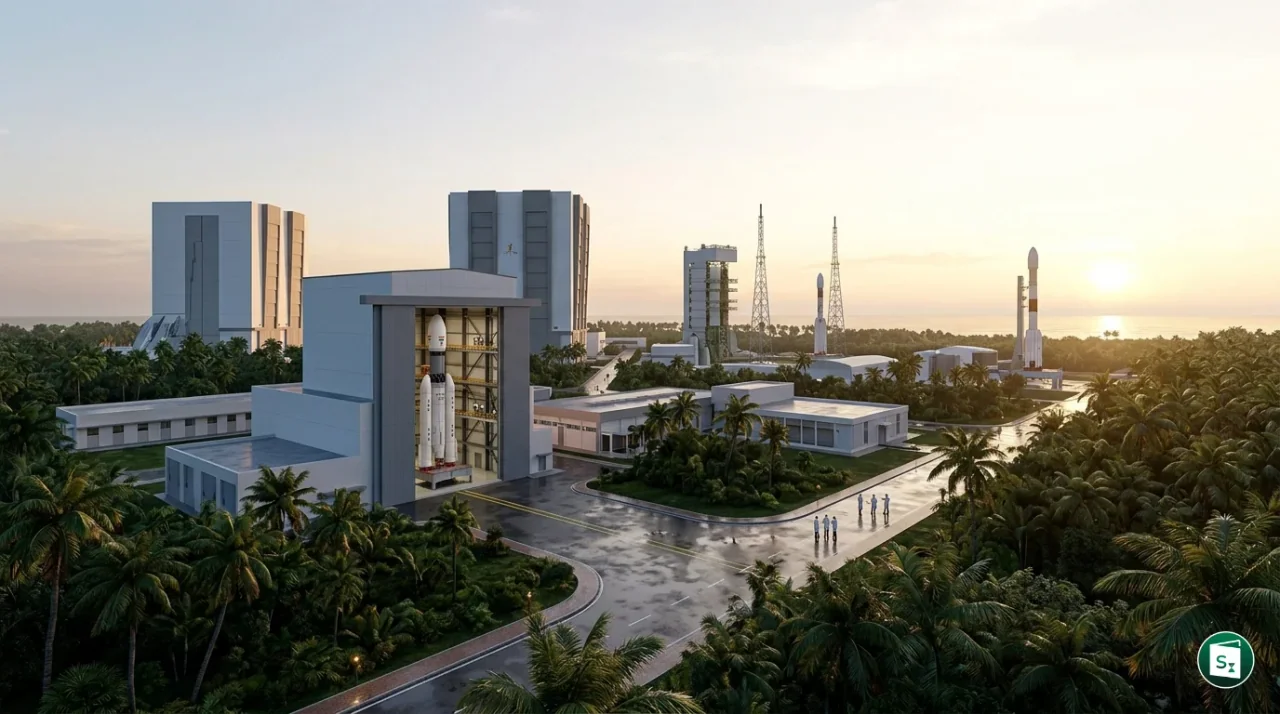
VSSC is the lead centre of ISRO for the design and development of satellite launch vehicle technology. Located in Thiruvananthapuram, Kerala, it is the birthplace of every rocket India has flown, from the early sounding rockets to the mighty LVM3 that carried Chandrayaan-3 to the Moon.
History and Evolution
The centre began as the Thumba Equatorial Rocket Launching Station (TERLS) in 1962, established under the United Nations sponsorship to study the equatorial electrojet phenomenon. The first rocket, a two-stage Nike Apache sounding rocket, was launched from Thumba on 21 November 1963, marking India’s entry into space research. In a remarkable story, the early office and laboratory were housed in the St. Mary’s Magdalene Church, which the local bishop donated to the cause of science.
After the death of Dr Vikram Sarabhai in December 1971, the facility was renamed the Vikram Sarabhai Space Centre in July 1972 in his honour. Dr Sarabhai is widely regarded as the father of the Indian space programme for his vision of using space technology for national development.
Core Mandate and Key Programmes
VSSC is responsible for the end-to-end design, development, testing, and qualification of India’s launch vehicles. Its research spans aeronautics, avionics, materials, propulsion, stage separation systems, guidance and control, and vehicle integration.
| Programme | Type | Status |
|---|---|---|
| PSLV | Polar Satellite Launch Vehicle | Operational |
| GSLV | Geosynchronous Satellite Launch Vehicle | Operational |
| LVM3 | Launch Vehicle Mark 3 (formerly GSLV Mk III) | Operational |
| SSLV | Small Satellite Launch Vehicle | Developmental |
| RLV | Reusable Launch Vehicle | Experimental |
| Rohini | Sounding Rockets (RH-200, RH-300, RH-560) | Operational |
The centre also leads critical technology development for the Gaganyaan human spaceflight programme, including the Human Rated Launch Vehicle (HRLV), crew module structures, and the crew escape system. VSSC operates extension facilities at Valiamala (vehicle integration and testing) and Vattiyoorkavu (composites development), along with the Ammonium Perchlorate Experimental Plant (APEP) at Aluva and the ISRO Inertial Systems Unit (IISU) at Thiruvananthapuram.
A Look at VSSC’s Directors
Dr Rajeev takes charge at a pivotal time for ISRO. His immediate predecessor, Dr A. Rajarajan, a distinguished scientist and composites expert, led VSSC from August 2025 after serving as Director of the Satish Dhawan Space Centre (SDSC SHAR) in Sriharikota. During his tenure at SDSC, Rajarajan oversaw major missions including Chandrayaan-3, Aditya L1, the SSLV programme, and supported the launch of Vikram-S, India’s first privately built rocket.
Before Rajarajan, Dr S. Unnikrishnan Nair served as VSSC Director from February 2022 to July 2025. He was the founding Director of the Human Space Flight Centre (HSFC) and played a pivotal role in shaping the Gaganyaan programme. Prior to him, Dr S. Somanath led VSSC from 2018 to 2022 before becoming the Chairman of ISRO, under whose leadership Chandrayaan-3 achieved its historic lunar landing.
The first Director of VSSC was Prof Brahm Prakash in 1972, and since then the centre has been led by a distinguished line of scientists who have shaped India’s space trajectory.
Significance of the Appointment
Dr Rajeev’s appointment comes at a time when ISRO is pursuing multiple ambitious programmes simultaneously. The Gaganyaan human spaceflight mission is in an advanced stage, with test vehicle flights already completed. The SSLV programme is moving towards full operational capability to serve the growing global demand for small satellite launches. The Reusable Launch Vehicle (RLV) project is progressing towards orbital re-entry experiments, and India’s deep space ambitions, including follow-on missions to the Moon and Venus, are being planned.
As a specialist in guidance, control, and mission simulation, Dr Rajeev’s technical background is directly relevant to the precision requirements of these complex missions. His experience leading mission designs for major launch vehicles positions him well to oversee the next generation of rockets that ISRO is developing, including human-rated variants and reusable systems.
The appointment also reflects ISRO’s tradition of promoting from within, ensuring continuity in leadership and preserving the institutional knowledge that has made India’s space programme self-reliant.
Key Takeaways
- Dr U.P. Rajeev has been appointed as the Director of the Vikram Sarabhai Space Centre (VSSC) in Thiruvananthapuram.
- He succeeds Dr A. Rajarajan, who superannuated after serving as VSSC Director from August 2025.
- Dr Rajeev was previously serving as Associate Director (Research and Development) at VSSC and is an expert in rocket control, guidance systems, and mission design and simulation.
- He holds a BTech from College of Engineering, Thiruvananthapuram, an MTech from NIT Calicut, and a PhD from IISc Bengaluru.
- VSSC is the lead centre of ISRO for launch vehicle technology, established originally as TERLS in 1963 and renamed in 1972 after Dr Vikram Sarabhai.
- VSSC is responsible for India’s major launch vehicles including PSLV, GSLV, LVM3, and technology development for the Gaganyaan human spaceflight mission.