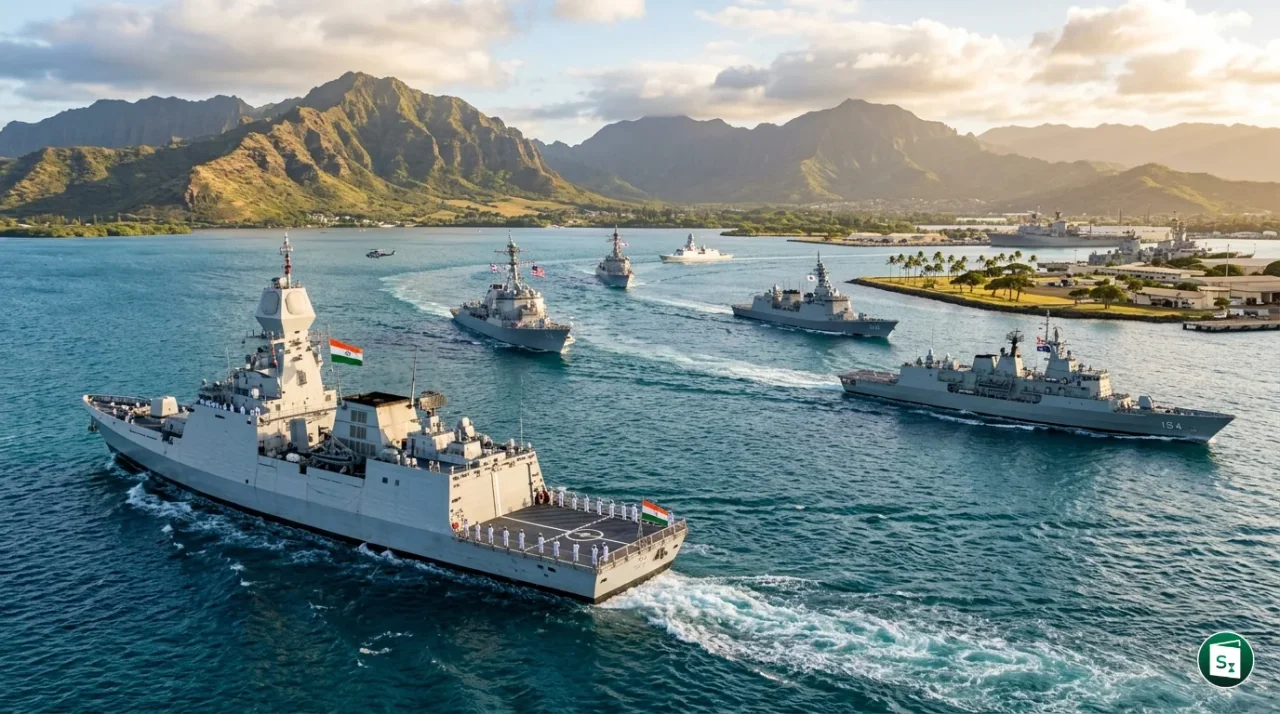
The Indian Navy took part in the 30th edition of the Rim of the Pacific (RIMPAC) 2026 exercise, the world’s largest multinational maritime warfare exercise, hosted by the US Navy at Joint Base Pearl Harbor-Hickam (JBPHH) in Hawaii. The exercise ran from June 24 to July 31, 2026, bringing together 30 nations, over 30 surface ships, five submarines, more than 200 aircraft, and approximately 30,000 personnel to train in and around the Hawaiian Islands. This was the Indian Navy’s seventh consecutive participation in RIMPAC since its debut in 2014, reflecting India’s growing role in Indo-Pacific maritime security.
What Is the Rim of the Pacific Exercise?
The Rim of the Pacific Exercise (RIMPAC) is the world’s largest international maritime warfare exercise, conducted biennially (once every two years) during June and July. It is hosted and administered by the US Navy’s Pacific Fleet and is led operationally by the Commander of the US 3rd Fleet.
RIMPAC was first held in 1971 with five founding nations: the United States, Australia, Canada, New Zealand, and the United Kingdom. The exercise was initially annual but became biennial starting in 1974. Over five decades, it has grown from a small Cold War training event into a massive multinational drill involving navies, air forces, marine corps, and armies from across the globe. Australia, Canada, and the US are the only three nations that have participated in every edition of RIMPAC since 1971.
The exercise’s core purpose is to strengthen interoperability, the ability of different nations’ armed forces to operate together effectively, and to build trust and cooperative relationships among participating nations. These relationships are critical to ensuring the safety of sea lanes and security on the world’s oceans, particularly in the Indo-Pacific region. RIMPAC covers a wide spectrum of naval operations including amphibious operations, anti-submarine warfare, air defense exercises, gunnery and missile proficiency, military medicine, humanitarian assistance and disaster response, counter-piracy, mine clearance, and diving and salvage operations.
RIMPAC 2026: Scale and Leadership
The 30th edition of RIMPAC was the largest in the exercise’s history. According to the US Navy, the exercise featured 31 surface ships, five submarines, 197 aircraft, 1,100 landing forces, and approximately 30,000 personnel from 30 nations. This was an increase from the 29 nations that participated in RIMPAC 2024, reflecting the growing importance of multinational cooperation in the Indo-Pacific.
The aircraft carrier USS Theodore Roosevelt (CVN-71) led the US contingent, which included the guided-missile cruiser USS Chosin (CG-65), destroyers USS Paul Hamilton (DDG-60), USS Decatur (DDG-73), USS Wayne E. Meyer (DDG-108), and USS Carl M. Levin (DDG-120), amphibious assault ship USS Essex (LHD-2) with the 15th Marine Expeditionary Unit (MEU), attack submarines USS Charlotte (SSN-766) and USS Columbia (SSN-771), and multiple support vessels.
Leadership Structure
For the first time, the leadership structure reflected a truly multinational command. Vice Adm. Jeff Jablon, Deputy Commander of the US Pacific Fleet, served as the Combined Task Force (CTF) Commander. The command team included:
| Role | Officer | Nation |
|---|---|---|
| CTF Commander | Vice Adm. Jeff Jablon | United States |
| Deputy Commander | Commodore Andres Howard | Chile |
| Vice Commander | Rear Adm. Takuo Kobayashi | Japan |
| Maritime Component Commander | Rear Adm. In-Ho Kim | South Korea |
| Air Component Commander | Brig. Gen. J.S. Davis | Canada |
South Korea commanded the maritime component for the first time, a significant milestone. Seoul also sent its largest-ever contingent to the exercise.
First-Time Participants and New Capabilities
Five nations participated in RIMPAC for the first time in 2026: Poland, Spain, Guatemala, Greece, and Fiji. Their inclusion highlights the expanding reach of the exercise beyond traditional Pacific Rim nations.
RIMPAC 2026 also incorporated cutting-edge technology. The exercise featured experiments with unmanned systems, including autonomous surface vessels for resupply operations. A Sinking Exercise (SINKEX) was planned involving two decommissioned US Navy ships as targets. The exercise also tested cyber warfare capabilities through a joint cyber workshop conducted alongside traditional maritime operations.
India’s Growing Role in RIMPAC
India’s association with RIMPAC has evolved significantly over two decades, moving from observer status to regular participant with frontline warships. This progression mirrors India’s expanding maritime ambitions and its strategic focus on the Indo-Pacific.
From Observer to Participant
| Year | Edition | Indian Participation | Role |
|---|---|---|---|
| 2006 | 20th | Indian Navy delegation | Observer |
| 2010 | 22nd | Indian Navy delegation | Observer |
| 2012 | 23rd | Indian Navy delegation | Observer |
| 2014 | 24th | INS Sahyadri (Shivalik-class stealth frigate) | First ship participation |
| 2016 | 25th | INS Satpura (Shivalik-class stealth frigate) | Full participant |
| 2018 | 26th | INS Sahyadri | Full participant |
| 2020 | 27th | Scaled down due to COVID-19 | Limited participation |
| 2022 | 28th | INS Satpura and P8I maritime patrol aircraft | Full participant |
| 2024 | 29th | INS Shivalik | Full participant |
| 2026 | 30th | Indian Navy warship | Full participant |
India first participated in RIMPAC as an observer in 2006, followed by observer roles in 2010 and 2012. In 2014, India made its debut as a ship participant when INS Sahyadri, an indigenously built guided-missile stealth frigate of the Shivalik class, sailed into Pearl Harbor. This was the first time an Indian warship operated in US waters for an exercise. Since then, India has sent a Shivalik-class frigate to every subsequent edition.
The INS Shivalik and INS Satpura are 6,000-tonne guided-missile stealth frigates, indigenously designed and built by Indian shipyards. These multi-role frigates are equipped with long-range anti-ship missiles, surface-to-air missiles, anti-submarine warfare capabilities, and carry two multi-role helicopters, making them versatile platforms for multinational exercises.
RIMPAC 2024 Benchmark
In RIMPAC 2024, INS Shivalik sailed nearly 9,000 nautical miles from the Indian coast to reach Hawaii, having completed the bilateral JIMEX 24 exercise with Japan en route. The exercise followed a standard two-phase structure: a harbour phase involving symposiums, planning discussions, and sports competitions, followed by a sea phase divided into three sub-phases culminating in a theatre-level large force tactical exercise involving aircraft carrier battle groups, submarines, and amphibious forces.
Strategic Significance for India
India’s regular participation in RIMPAC carries significant strategic implications across multiple dimensions.
Interoperability with Major Navies
RIMPAC provides the Indian Navy with unmatched opportunities to train alongside the US Navy, Royal Australian Navy, Japan Maritime Self-Defense Force, and other major naval powers. This interoperability is critical as India increasingly operates in the Indo-Pacific through bilateral exercises such as Malabar (with the US, Japan, and Australia), JIMEX (with Japan), and AUSINDEX (with Australia).
A Free and Open Indo-Pacific
India’s participation in RIMPAC aligns with its vision of a free, open, and rules-based Indo-Pacific. The exercise demonstrates India’s commitment to maritime security, freedom of navigation, and adherence to international law, principles that are central to India’s Act East Policy and its role in the Quad (Quadrilateral Security Dialogue with the US, Japan, and Australia).
Showcasing Indigenous Capability
Sending indigenously built warships like the Shivalik-class frigates to an exercise nearly 9,000 nautical miles from India’s coast showcases the Indian Navy’s blue-water capability and the success of India’s indigenous shipbuilding programme under the Make in India initiative. This sends a strong signal about India’s self-reliance in defence manufacturing.
Key Takeaways
- The Indian Navy participated in the 30th edition of the Rim of the Pacific (RIMPAC) 2026 exercise, the world’s largest multinational maritime warfare exercise.
- RIMPAC 2026 was hosted by the US Navy at Joint Base Pearl Harbor-Hickam (JBPHH) in Hawaii from June 24 to July 31, 2026, with the theme “Partners: Integrated and Prepared”.
- The exercise brought together 30 nations, 31 surface ships, five submarines, 197 aircraft, 1,100 landing forces, and approximately 30,000 personnel.
- Five nations participated in RIMPAC for the first time: Poland, Spain, Guatemala, Greece, and Fiji.
- South Korea commanded the maritime component for the first time, while Chile, Japan, and Canada held key leadership positions in the Combined Task Force.
- India first participated in RIMPAC in 2014 with INS Sahyadri after serving as an observer in 2006, 2010, and 2012, and has sent a Shivalik-class stealth frigate to every edition since.
- The Shivalik-class frigates are 6,000-tonne indigenously built guided-missile stealth frigates, showcasing India’s Make in India capability and blue-water naval reach.