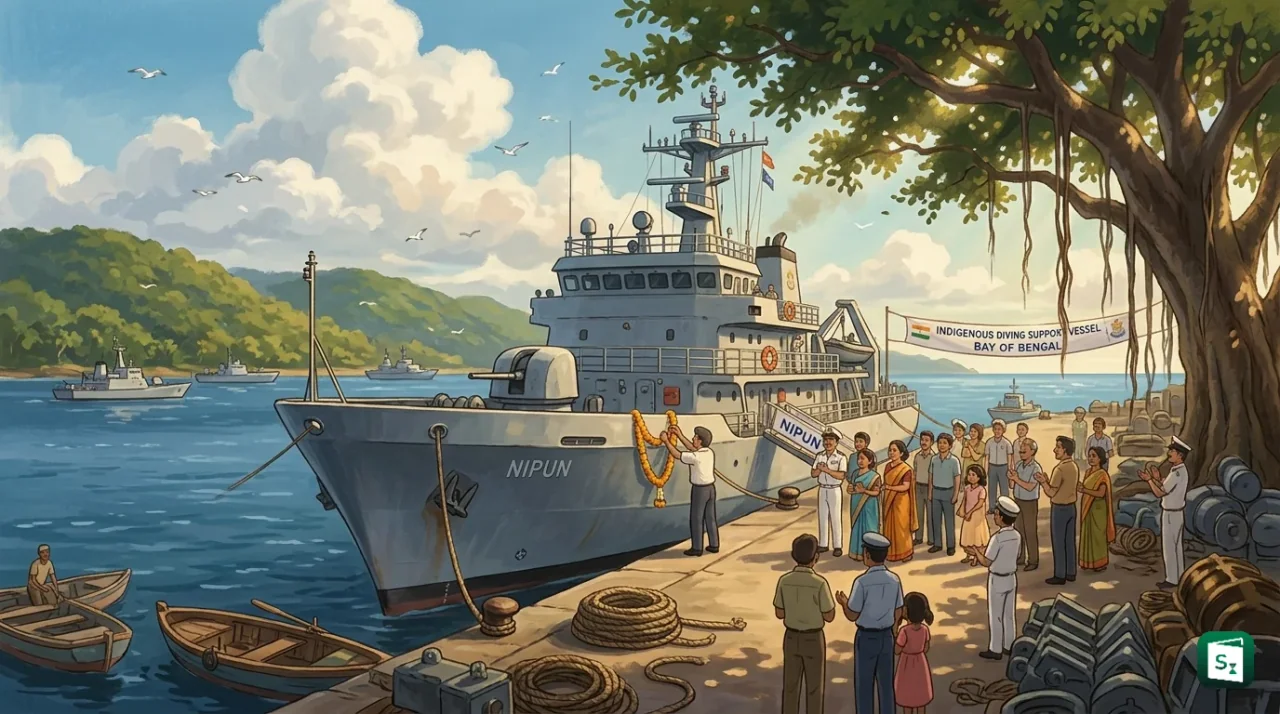
The Indian Navy has inducted ‘Nipun’, the second Indigenous Diving Support Vessel (DSV), constructed by Hindustan Shipyard Limited (HSL) in Visakhapatnam, Andhra Pradesh. The vessel carries nearly 75% indigenous content and has been designed and built in accordance with the classification rules of the Indian Register of Shipping (IRS). With this delivery, HSL has completed both vessels ordered under the Nistar-class programme, giving the Navy a specialised platform for deep-sea diving, salvage and submarine rescue.
What Is a Diving Support Vessel?
A Diving Support Vessel is a specialised naval platform designed to support underwater operations that a normal warship cannot carry out. Its primary jobs include deep-sea saturation diving, underwater salvage, inspection and maintenance of submerged assets, and search-and-rescue missions. These ships carry diving systems, remotely operated vehicles and heavy subsea cranes, and they stay stable at a fixed position even in rough seas so that divers and equipment can be deployed safely.
For the Indian Navy, such vessels fill a critical gap. Submarines operate for months underwater, and when an accident occurs, time is the biggest enemy. A dedicated mother ship that can reach the site, launch rescue equipment and support divers around the clock dramatically improves the chances of saving a crew. The Nistar-class vessels are the first ships of this kind to be indigenously designed and built at an Indian shipyard for the Navy. Until their induction, the Navy relied on commercially leased vessels for these roles after its original submarine rescue ship, the first INS Nistar, was decommissioned in 1989.
Specifications and Key Features of ‘Nipun’
Nipun is a 118.4-metre-long vessel with a beam of 22.8 metres and a displacement of about 9,350 tonnes. It is powered by twin diesel engines, has a top speed of around 18 knots and an endurance of 60 days without replenishment. The ship carries a flight deck that can accommodate heavy helicopters for search-and-rescue and medical evacuation duties. Its hull and equipment have been built to the classification rules of the Indian Register of Shipping (IRS), the national ship classification society.
| Feature | Specification |
|---|---|
| Length | 118.4 metres |
| Beam | 22.8 metres |
| Displacement | About 9,350 tonnes |
| Endurance | 60 days without replenishment |
| Indigenous content | Nearly 75% |
| Classification | Indian Register of Shipping (IRS) rules |
Saturation Diving and Underwater Operations
The ship is fitted with state-of-the-art diving equipment that enables deep-sea saturation diving. Saturation diving is a technique where divers live in a pressurised chamber on board the ship for days, so their bodies saturate with gas and they can work at great depths for long stretches without repeated decompression stops. A side diving stage supports diving operations, and a moon pool, an opening through the ship’s hull, allows divers and equipment to be lowered into the sea safely even in heavy weather.
The vessel also carries Remotely Operated Vehicles (ROVs), unmanned underwater robots controlled from the ship. These robots monitor divers in real time, inspect underwater structures, search the seabed and assist in salvage operations. A Dynamic Positioning System (DP-II) automatically holds the ship’s position and heading during these operations, which is essential when divers or ROVs are working on a fixed point below.
Mother Ship for the Deep Submergence Rescue Vessel
The most important role of Nipun is to serve as the ‘Mother Ship’ for the Deep Submergence Rescue Vessel (DSRV). A DSRV is a small, manned mini-submarine that can dive to a distressed submarine, dock or ‘mate’ with its escape hatch and evacuate the trapped crew to safety. The Indian Navy operates two DSRVs, acquired from Britain and inducted in 2018, but a rescue vehicle is only as good as the ship that carries it to the scene. Nipun and her sister ship INS Nistar now provide the dedicated motherships that launch, track and recover the DSRVs.
The vessel is also equipped with a submersible decompression chamber, a six-person decompression chamber and a self-propelled hyperbaric lifeboat, a pressurised survival craft that can evacuate divers who are under pressure. Together with side-scan sonar for locating objects on the seabed and a 15-tonne subsea crane, these systems give the ship a complete underwater operations suite.
The Nistar-Class Programme: Background
The Nistar class is a series of two diving support vessels ordered by the Indian Navy to support its expanding submarine fleet. The contract to indigenously design, develop and construct the two ships was signed with HSL on 20 September 2018, at a cost of about ₹2,393 crore. The project was awarded to the shipyard on a nomination basis, partly to improve the financial health of HSL, and construction began in 2019. The vessels were designed by HSL with consultancy from the Norwegian firm Vik-Sandvik, which had earlier worked with the yard on the missile tracking ship INS Dhruv.
The deal came at a time when India’s submarine rescue capability needed urgent attention. Before the Nistar class, the Navy’s last dedicated submarine rescue ship had been retired decades earlier, and the Navy had been making do with leased commercial vessels and a flyaway rescue system. The DSRVs acquired in 2018 also needed a capable mother ship to be operationally effective. The Nistar-class programme was designed to close this gap.
Timeline of Construction
Both ships were launched concurrently on 22 September 2022 at Visakhapatnam. Construction faced delays caused by the COVID-19 pandemic and the subsequent lockdowns, which pushed delivery dates back from the original 36-month schedule. INS Nistar, the first vessel, completed her maiden sea trials in May 2024 and was delivered to the Navy on 8 July 2025, before being commissioned on 18 July 2025. The second vessel, Nipun, followed with her delivery on 30 July 2026, roughly a year after her sister ship.
| Event | Date |
|---|---|
| Contract signed with HSL | 20 September 2018 |
| Keel laid (Nistar / Nipun) | December 2019 / March 2020 |
| Both vessels launched | 22 September 2022 |
| INS Nistar delivered | 8 July 2025 |
| INS Nistar commissioned | 18 July 2025 |
| Nipun delivered | 30 July 2026 |
The Namesake
The name ‘Nipun’ comes from Sanskrit and means ‘one who is adept, capable and well versed in a particular discipline’, a fitting description for a ship built for highly specialised underwater work. Her sister ship is named after the original INS Nistar, a submarine rescue ship acquired from the Soviet Union in 1969 which served until 1989. The word nistar means liberation, rescue or salvation.
Hindustan Shipyard Limited: The Builder
Hindustan Shipyard Limited (HSL) is one of the oldest shipyards in India, established in 1941 at Visakhapatnam on the east coast. It was founded by the industrialist Seth Walchand Hirachand as Scindia Shipyard, launched by Jawaharlal Nehru in 1948 and nationalised in 1952. The shipyard was transferred from the Ministry of Shipping to the Ministry of Defence in 2010, and it operates as a central public sector undertaking under the defence ministry. HSL received Mini Ratna status in October 2025 in recognition of its financial turnaround.
The yard builds and repairs warships, submarines and merchant vessels, and it is one of the key yards in India’s defence shipbuilding ecosystem alongside Mazagon Dock and Garden Reach Shipbuilders. Its recent projects include the missile tracking ship INS Dhruv, a nuclear missile tracking vessel commissioned in 2021, and the two Nistar-class diving support vessels. Notably, the steel used in the Nistar-class ships was entirely produced by SAIL (Steel Authority of India Limited), linking the defence build to domestic heavy industry.
HSL has also seen a steady financial recovery. After struggling with losses from the 1980s onward and a negative net worth even after the defence ministry takeover, the yard posted consistent profits from FY 2015-16, driven by reforms in financial management, productivity and technological modernisation. The completion of the two diving support vessels expands its portfolio of specialised naval platforms.
Strategic Significance
The induction of Nipun strengthens the Navy in three interlinked ways: submarine rescue, indigenous shipbuilding and India’s posture in the Indian Ocean region.
Boosting Submarine Rescue Capability
The most direct gain is a credible submarine rescue capability, which is rare among the world’s navies. Rescue operations in the deep sea require a combination of a mother ship, a deep submergence rescue vehicle and trained divers, and only a handful of countries maintain this full capability. With both Nistar-class ships operational, the Indian Navy can keep one mother ship based on each seaboard, the east and west coasts, so that a rescue unit can be deployed rapidly to a distressed submarine anywhere in its area of operations.
The importance of such capability was demonstrated in September 2025, when INS Nistar took part in Exercise Pacific Reach, a multinational submarine rescue exercise held in the South China Sea. India’s DSRV conducted mating operations with submarines of friendly foreign navies on three consecutive days, and the exercise showcased India’s ability to rescue crews from a disabled submarine, a capability that builds confidence among partner navies in the Indo-Pacific.
Indigenous Shipbuilding and Aatmanirbhar Bharat
The two vessels are firsts in Indian naval history: the first diving support ships designed and built indigenously at an Indian shipyard. With nearly 75% indigenous content, including SAIL-produced steel, the project supports the government’s Aatmanirbhar Bharat and Make in India initiatives. Such projects build design and construction capability that can be applied to more advanced platforms, reduce dependence on foreign suppliers and keep defence spending within the country.
The programme also matters for the naval shipbuilding pipeline. The delivery of the second vessel keeps India’s public shipyards busy and demonstrates that complex, specialised vessels can be delivered to schedule by domestic yards, a record that strengthens the case for assigning more warship orders to Indian industry.
The Indo-Pacific Dimension
India’s expanding submarine fleet, which now includes nuclear-powered submarines alongside its conventional diesel-electric boats, raises the stakes for underwater safety. A submarine incident in the crowded waters of the Indian Ocean would demand a quick, reliable response, and self-sufficient rescue capability avoids dependence on foreign assistance in a sensitive security situation. The Nistar-class ships, with their 60-day endurance, are designed for sustained patrolling and long-range deployment, fitting the Navy’s strategy of maintaining a presence across the Indo-Pacific.
The Way Forward
With both Nistar-class vessels delivered, the Indian Navy will now work on integrating Nipun into its operational fleet, including crew training for deep-sea saturation diving and submarine rescue drills. Nipun’s home port is planned at Mumbai under the Western Naval Command, complementing INS Nistar, which is based at Visakhapatnam under the Eastern Naval Command. This east-west deployment ensures nationwide coverage for diving and rescue operations.
The programme is also a stepping stone for HSL. The shipyard’s experience in building specialised vessels positions it for future orders, and the Navy’s growing focus on indigenisation means more advanced platforms could follow. As India’s submarine fleet modernises, the diving support vessels will remain a quiet but critical backbone of underwater safety, ready to act in the moments when every minute counts.
Key Takeaways
- The Indian Navy inducted ‘Nipun’, its second indigenous Diving Support Vessel (DSV), on 30 July 2026 at Visakhapatnam.
- The vessel was built by Hindustan Shipyard Limited (HSL) and carries nearly 75% indigenous content.
- Nipun is a 118.4-metre vessel displacing about 9,350 tonnes, with a 60-day endurance and the ability to perform deep-sea saturation diving.
- It serves as the mother ship for the Deep Submergence Rescue Vessel (DSRV), used to evacuate crew from a distressed submarine.
- Nipun is the second ship of the Nistar class, following INS Nistar, which was commissioned on 18 July 2025.
- The Nistar-class contract was signed with HSL on 20 September 2018, and the ships were built to the classification rules of the Indian Register of Shipping (IRS).
- Hindustan Shipyard Limited, established in 1941 at Visakhapatnam and transferred to the Ministry of Defence in 2010, received Mini Ratna status in October 2025.