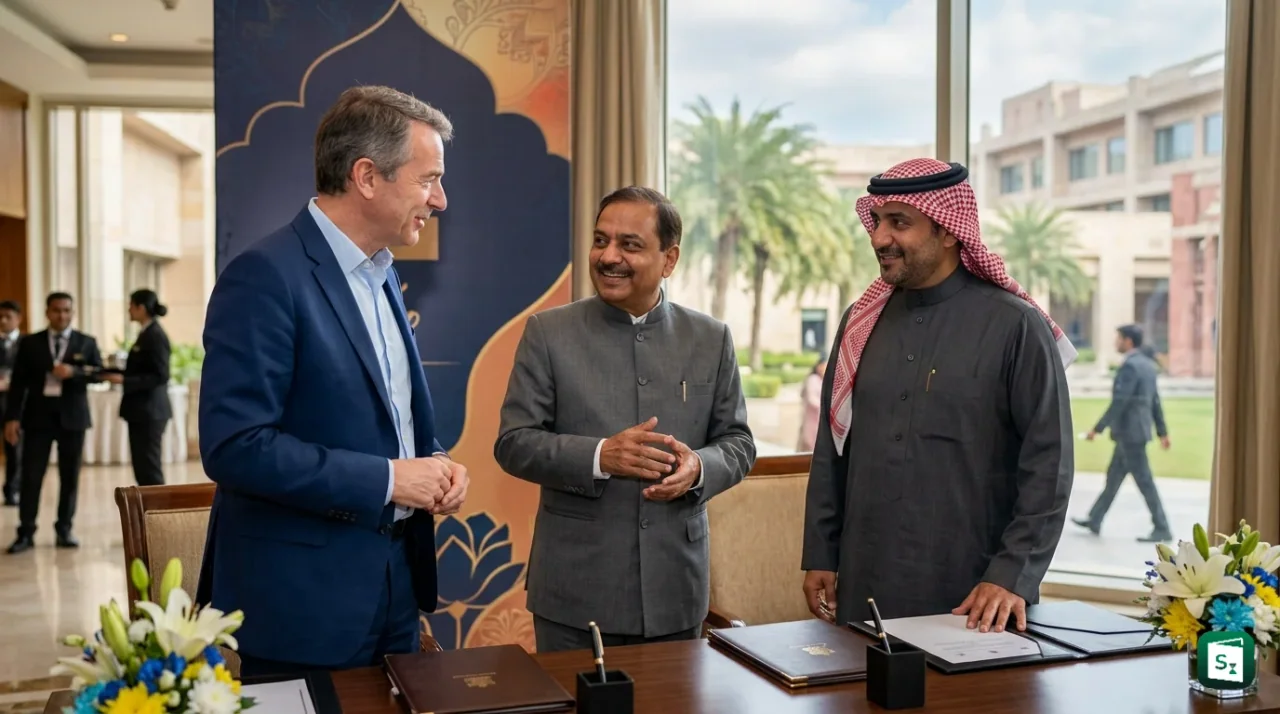
The Associated Chambers of Commerce and Industry of India (ASSOCHAM), the country’s oldest apex business chamber, has signed two Memorandums of Understanding (MoUs) with Business France and the India & Arab Countries Chamber of Commerce, Industry and Agriculture (IACCIA) to deepen trade, investment and technology collaboration between India, France and the Arab world. The agreements were formalised at the ASSOCHAM MoU Signing Ceremony in New Delhi, with the pact with IACCIA concluded on 30 July 2026 and the development announced on 3 August 2026. The two partnerships seek to connect Indian enterprises with the French and Arab markets through business delegations, joint ventures, technology transfer and better market access.
ASSOCHAM Signs Two MoUs at a New Delhi Ceremony
The pacts were signed by Saurabh Sanyal, Secretary General of ASSOCHAM, in the presence of senior representatives of the partner organisations. Vianney Meynier, Head of the Agricultural Export Division at Business France, and Dr Waiel S.H. Awwad, Secretary General (In-charge) of IACCIA, joined the signing ceremony held in the national capital.
The Partnership with Business France
Under the MoU with Business France, the two organisations will jointly promote trade and investment opportunities between Indian and French companies. The cooperation will focus on encouraging technology collaboration and joint ventures, supporting business delegations, and exchanging market intelligence. Both sides will also organise trade fairs, exhibitions, conferences and other business promotion activities to give firms from the two countries a shared platform to interact.
The Partnership with IACCIA
The MoU with IACCIA is aimed at promoting bilateral trade and investment between India and the Arab world. It provides for business delegations, the exchange of trade and investment information, facilitation of joint ventures and technology transfer, and business events that help enterprises explore new markets. The agreement also covers business-to-business engagement, investment promotion, trade missions, policy dialogue and market access initiatives, with a stated focus on helping Micro, Small and Medium Enterprises (MSMEs) reach Arab markets.
What the Agreements Cover
The two MoUs share a common goal of building institutional bridges, though each is tuned to a different market. The table below summarises the key elements of each agreement.
| Element | MoU with Business France | MoU with IACCIA |
|---|---|---|
| Market focus | India and France | India and the Arab world |
| Core activities | Trade and investment promotion, technology collaboration, joint ventures | Bilateral trade and investment promotion, joint ventures, technology transfer |
| Support mechanisms | Business delegations, market intelligence, trade fairs, exhibitions and conferences | Business delegations, exchange of trade and investment information, business events |
| Priority areas | Cross-sectoral, with agricultural exports among the areas of interest | Renewable energy, healthcare, pharmaceuticals, agriculture, food security, manufacturing, logistics, infrastructure, education and digital technologies |
The Three Organisations Behind the MoUs
ASSOCHAM, the oldest apex chamber of Indian industry, traces its origins to 1920, when its first conference was held at the Royal Exchange in Calcutta under the name the Associated Chambers of Commerce of India and Ceylon. A non-governmental trade association headquartered in New Delhi, it represents more than 4,50,000 corporate members, a large share of them MSMEs, and runs over 100 national and regional sector councils along with more than 400 affiliated associations and chambers. It works closely with the government on policy matters and acts as a link between Indian industry and the global business community.
Business France is the national agency for the international development of the French economy. It was created on 1 January 2015 through the merger of Ubifrance, the export promotion agency, and the Invest in France Agency. Set up as a public establishment of an industrial and commercial nature, it works under the joint supervision of the French ministers responsible for the economy, foreign affairs and regional cohesion, and is headquartered in Paris. Its core tasks are supporting French firms in foreign markets, attracting investment into France and managing the V.I.E (Volontariat International en Entreprise) programme, which places young talent in overseas postings. The agency says it supported more than 11,000 French companies in 2025.
IACCIA is a bilateral chamber established in 2017 to advance commercial ties between India and the Arab world. It grew out of the Fifth Arab-Indian Partnership Conference held in Muscat in 2016 and was further endorsed at the Sixth Conference in New Delhi in 2023. The chamber enjoys the backing of the League of Arab States, the Union of Arab Chambers and the Council of Arab Ambassadors in New Delhi, and operates from the Vasant Vihar area of the national capital. Its work spans sectors such as oil and gas, agriculture, healthcare, logistics, infrastructure and renewable energy.
| Organisation | Nature | Founded | Headquarters | Core role |
|---|---|---|---|---|
| ASSOCHAM | Oldest apex Indian industry chamber | 1920 | New Delhi | Policy advocacy and industry representation |
| Business France | National agency of the French government | 2015 | Paris | Export promotion and attracting foreign investment |
| IACCIA | Bilateral India-Arab business chamber | 2017 | New Delhi | Promoting trade and investment between India and the Arab world |
India-France Ties: Trade Riding on a Strategic Partnership
India and France established diplomatic relations soon after India’s independence in 1947. The two countries launched a Strategic Partnership on 26 January 1998, the first such partnership India entered into with a Western nation, covering defence and security, civil nuclear matters and space. In 2023, on the 25th anniversary of the partnership, both sides adopted the Horizon 2047 Roadmap to chart the course of ties up to the centenary year of India’s independence. In February 2026, during President Emmanuel Macron’s visit to India, the relationship was elevated to a Special Global Strategic Partnership, and the 2026 India-France Year of Innovation was inaugurated.
The commercial relationship has moved along a similar upward curve. Within the European Union, France is India’s third-largest trading partner, after the Netherlands and Germany. Bilateral trade has more than doubled over the last decade, touching €13.59 billion (about $15.81 billion) in 2025-26, while India’s exports to France stood at about €6.1 billion (about $7.1 billion) in the same year. France is also the 11th largest foreign investor in India, with cumulative investment of around €10.50 billion (about $12 billion) between April 2000 and December 2025, and 38 of the 40 CAC 40 companies have a presence in India. The conclusion of the India-EU Free Trade Agreement on 27 January 2026, the largest such pact negotiated by either side, is expected to give bilateral commerce a further push.
India and the Arab World: An Enduring Economic Bond
The League of Arab States, commonly known as the Arab League, was formed in Cairo on 22 March 1945 with seven founding members and today has 22 member states spread across North Africa and West Asia. India’s links with this region are among its oldest, built over centuries of maritime trade across the Arabian Sea. The modern relationship rests on strong economic foundations: India-Arab trade stood at more than $240 billion in 2024-25, with the Arab countries supplying nearly 60 per cent of India’s crude oil imports and more than half of its fertiliser needs. Around 9 million Indians live in the Arab League countries, and Indian investments in the region are estimated at $40 billion.
The Gulf Cooperation Council (GCC), a six-nation grouping of Saudi Arabia, the UAE, Qatar, Kuwait, Oman and Bahrain, sits at the economic heart of this relationship. India-GCC trade reached $178.56 billion in 2024-25, accounting for more than 15 per cent of India’s global trade. India has implemented a free trade pact with the UAE, signed a Comprehensive Economic Partnership Agreement with Oman in December 2025, and launched formal negotiations with the GCC in February 2026. At the second India-Arab Foreign Ministers’ Meeting held in New Delhi on 31 January 2026, both sides agreed under the Executive Program of the India-Arab Cooperation Forum 2026-2028 to work towards doubling bilateral trade to $500 billion by 2030.
Why These MoUs Matter
The timing of the agreements is significant. India has concluded a string of trade pacts in recent years, from the India-EU Free Trade Agreement in January 2026 to the India-Oman agreement in December 2025 and the India-UAE trade pact, and is negotiating a fresh one with the GCC. Government-level agreements set the framework, but it is institutions such as business chambers that convert them into concrete deals by connecting companies, arranging delegations and matching investors. This is the gap the two MoUs are designed to fill.
For Indian companies, especially MSMEs, the partnerships offer organised access to two major markets. The European Union and the Arab world together account for a large share of global demand, and chambers are often the first point of entry for smaller firms that lack the resources to scout foreign markets on their own. For France and the Arab countries, the agreements open an equally valuable window into India’s market of more than 1.4 billion people.
The two agreements also reflect a broader shift in India’s economic engagement towards building long-term investment partnerships rather than transactional trade. Institutional linkages of this kind create durable channels for knowledge exchange, technology partnerships and joint production, the building blocks of resilient supply chains in an uncertain global economy.
Looking ahead, the success of the MoUs will depend on follow-through, on the frequency of business delegations, the number of trade fairs organised and the joint ventures that actually take shape. ASSOCHAM has described the pacts as part of its commitment to creating sustainable long-term value for enterprises, and the coming years will show how quickly institutional goodwill turns into commercial results.
Key Takeaways
- ASSOCHAM signed MoUs with Business France and IACCIA to foster trade, investment and technology collaboration between India, France and the Arab world.
- ASSOCHAM, the oldest apex chamber of Indian industry, was founded in 1920, is headquartered in New Delhi and represents more than 4,50,000 corporate members.
- Business France, the national agency for the international development of the French economy, was created on 1 January 2015 through the merger of Ubifrance and the Invest in France Agency, and is headquartered in Paris.
- IACCIA was established in 2017 with the backing of the League of Arab States and works to promote trade and investment between India and the 22 Arab League countries.
- Within the European Union, France is India’s third-largest trading partner, with bilateral trade of about €13.59 billion (about $15.81 billion) in 2025-26.
- India-Arab trade exceeded $240 billion in 2024-25, and the two sides aim to double it to $500 billion by 2030.