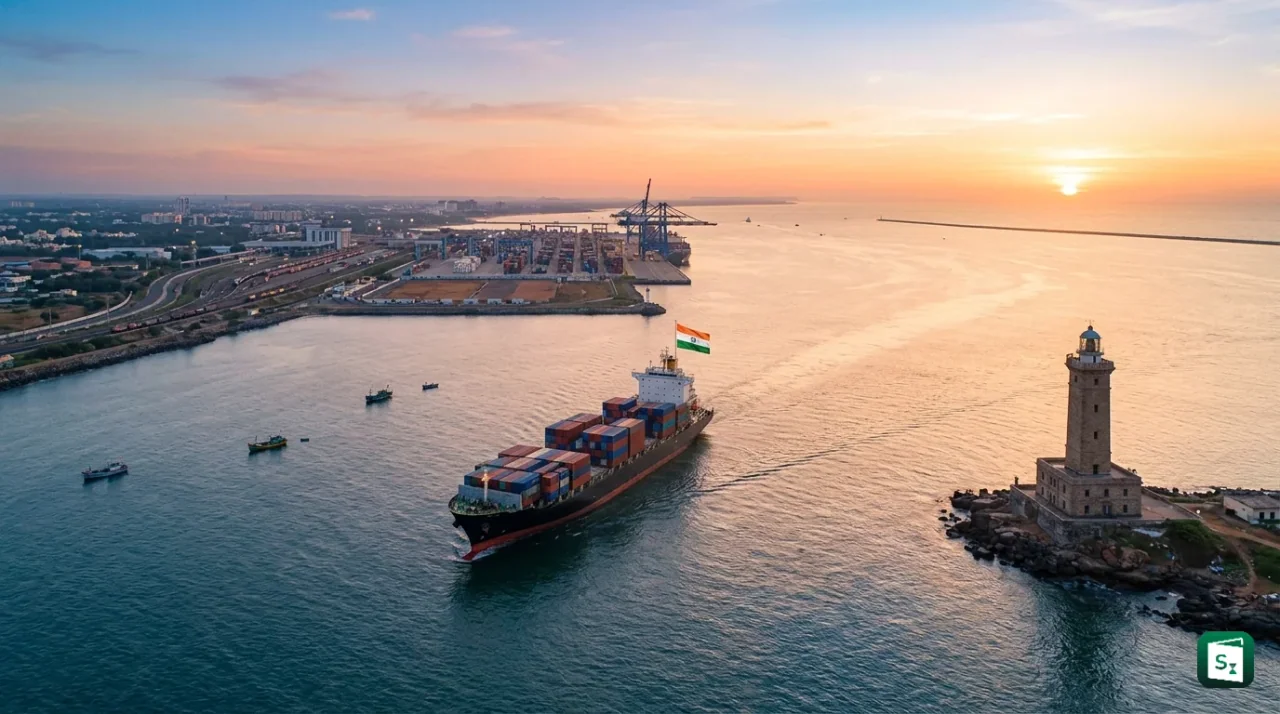
The Department of Financial Services (DFS) under the Ministry of Finance launched India’s first sovereign-backed Protection & Indemnity (P&I) insurance product under the Bharat Maritime Insurance Pool (BMIP) in New Delhi. The product, designed by The New India Assurance Company, provides third-party liability coverage of up to $1.5 billion through the combined underwriting capacity of the pool. At the launch, Financial Services Secretary Sanjay Lohia handed over the first P&I policy document to the Shipping Corporation of India (SCI).
What Is Protection & Indemnity Insurance?
Protection and Indemnity (P&I) insurance is a specialised form of marine insurance that protects shipowners and charterers against third-party liabilities that arise while operating a ship. These liabilities are not covered by a standard hull policy, which only insures the physical vessel and its machinery.
P&I cover typically includes crew injury and repatriation claims, cargo damage, marine pollution and oil spill liability, wreck removal costs, collision liability above the limits of hull cover, and damage to port property or fixed structures. It also extends to fines and penalties faced by shipowners, as well as liabilities related to stowaways and migrants.
Unlike hull insurance, which is bought as a fixed premium product from commercial insurers, P&I cover worldwide is traditionally provided by mutual associations of shipowners called P&I Clubs. These are not-for-profit cooperatives owned by their members, where the premium is effectively an entry contribution into a collective pool that pays out claims.
The Bharat Maritime Insurance Pool: The Parent Initiative
The new P&I product operates under the Bharat Maritime Insurance Pool (BMIP), India’s domestic marine insurance pool. The Union Cabinet approved the creation of the BMIP in April 2026 with a sovereign guarantee of ₹12,980 crore (about $1.4 billion), and the DFS operationalised it on May 12, 2026.
The pool was created in response to a critical strategic gap. India, which carries about 95% of its trade by volume through the sea, was heavily dependent on foreign insurers for maritime cover. During periods of geopolitical instability, such as the West Asia conflict that began in late 2023, international insurers sharply raised war-risk premiums or withdrew cover from volatile corridors like the Red Sea and the Strait of Hormuz, threatening the continuity of India’s trade.
The BMIP is designed to cover all maritime risks, including Hull and Machinery, Cargo, Protection & Indemnity, and War risk, for Indian-flagged or India-linked vessels carrying cargo to and from Indian ports, even when transiting volatile corridors. Policies are issued by insurers that are pool members, using the pool’s combined underwriting capacity.
How the Pool Is Structured
The pool operates with a layered structure. The combined underwriting capacity of about ₹950 crore from 21 underwriters forms the first layer. Claims up to $100 million are met through this pooled capacity, while claims above that threshold are supported by the sovereign guarantee, after reserves and reinsurance arrangements are exhausted.
The pool is administered by the General Insurance Corporation of India (GIC Re), the national reinsurer, with a governing body and an underwriting committee overseeing operations. The P&I product itself has been designed and filed by The New India Assurance Company with the Insurance Regulatory and Development Authority of India (IRDAI).
The New Sovereign-Backed P&I Product
The newly launched P&I product extends the BMIP beyond its original war-risk mandate to cover the third-party liabilities that Indian shipping has historically bought from foreign clubs. The product provides an indemnity limit of up to $1.5 billion through the combined underwriting capacity of the pool, backed by the sovereign guarantee.
The cover includes crew and cargo liability, pollution and oil spill liability, wreck removal, and access to a 24x7 global port correspondent network. This network ensures that an Indian-insured vessel anywhere in the world can quickly get legal assistance, claims support, and emergency response, which is essential for international credibility.
The first policy under the product was issued to Shipping Corporation of India (SCI) for a coastal tug named Trishul and two of its barges. The initial rollout is focused on coastal and inland vessels, which form a high domestic segment, before scaling up. The government has indicated that policies for ocean-going vessels are targeted by the end of 2027, once Indian P&I certificates gain acceptance at ports worldwide.
Why India Depends on Foreign P&I Clubs
Globally, third-party liability insurance for ships is dominated by the International Group of Protection and Indemnity Clubs (IGP&I Clubs), a grouping of mutual clubs based in London that provides liability cover for about 90% of the world’s ocean-going ships by tonnage. Each club is an independent, not-for-profit mutual association owned by its shipowner and charterer members.
India’s dependence on this structure has been deep and costly. About 95% of India’s vessels by gross tonnage take P&I cover from the IG Clubs. During sanction regimes and conflict situations, Indian tonnage faced extra premium payments of up to 200%, while some foreign clubs either hiked rates sharply or withdrew cover entirely from high-risk corridors. This created a strategic vulnerability for a country whose energy imports and trade largely move by sea.
This dependence also caused a significant foreign exchange outflow, as insurance premiums flowed out to London-based clubs, and left claims management in foreign hands. Indian shipping had no domestic mechanism to continue operations if foreign coverage was withdrawn during a geopolitical crisis. The BMIP and its P&I product address this by building local underwriting capacity, retaining premiums within the domestic economy, and ensuring continuity of trade.
Significance of the P&I Product
The launch marks a meaningful shift in India’s maritime risk management from dependence on foreign markets toward domestic capability. Since the BMIP became operational, war-risk premium rates have fallen by roughly 35-40% compared with the levels seen at the height of the West Asia conflict, directly reducing the cost of India’s trade. As of July 29, 2026, the pool had issued 1,608 policies covering cargo war risk and hull war risk.
The P&I product deepens this progress in several ways. It strengthens the resilience of India’s maritime insurance ecosystem by covering the most complex and high-value segment of marine liability, it builds specialised marine underwriting, claims management, and legal expertise within India, and it reduces the risk of trade disruption from sanctions and geopolitical shocks.
The move also carries a clear economic logic. India currently owns just over 1,500 ships, barely 1.2% of the global shipping fleet, despite being one of the world’s largest trading economies. The country spends close to $90 billion annually on freight, most of it going to foreign shipping companies. Retaining marine insurance value within India is part of a broader effort to capture more of this maritime value domestically.
Aligning with the Maritime Self-Reliance Push
The P&I initiative sits alongside other steps toward maritime self-reliance, including the push for domestic shipbuilding, the proposed Maritime Development Fund, and plans to expand the national fleet. Together, these measures support the Maritime India Vision 2030, the government’s long-term blueprint to position India as a global maritime hub, and the broader Atmanirbhar Bharat objective of reducing dependence on foreign markets for critical services.
The initiative also complements India’s broader blue economy ambitions, where the oceans are treated as an economic frontier for growth and job creation rather than just a trade route.
The Way Forward
The immediate focus of the P&I product is on coastal and harbour risks, the highest-value domestic segment, with a gradual expansion to select ocean-going vessels. The ultimate goal, as officials have stated, is for the BMIP to evolve into a non-IG P&I club that can meet India’s liability requirements independently.
The path ahead, however, involves genuine challenges. Indian P&I certificates must gain acceptance at ports worldwide, which requires meeting international standards and compliance regimes without diluting them. Building underwriting discipline, pricing accuracy, and professional risk assessment will determine whether the pool remains financially sustainable over time. A single large maritime accident, oil spill, or cyber incident can trigger enormous claims, and the pool will need strong capital and reinsurance depth to withstand such events.
India has taken the first step in a long journey. If the domestic P&I capacity is developed credibly, it could complement the existing international arrangements, reduce India’s vulnerability to geopolitical insurance shocks, and keep a greater share of the country’s maritime trade value within its own economy.
Key Takeaways
- The Department of Financial Services (DFS) launched India’s first sovereign-backed Protection & Indemnity (P&I) insurance product under the Bharat Maritime Insurance Pool (BMIP).
- The product offers third-party liability coverage of up to $1.5 billion, including crew and cargo liability, pollution, and wreck removal, with a 24x7 global port correspondent network.
- The BMIP was approved by the Union Cabinet in April 2026 with a sovereign guarantee of ₹12,980 crore, and operationalised on May 12, 2026.
- The pool is administered by GIC Re, and the P&I product was designed by The New India Assurance Company, founded by Sir Dorabji Tata in 1919.
- The first P&I policy was issued to the Shipping Corporation of India (SCI) for a coastal tug and two barges, with ocean-going vessel cover targeted by end of 2027.
- Since the BMIP’s launch, war-risk premiums have fallen 35-40%, and 1,608 cargo and hull war-risk policies had been issued as of July 29, 2026.