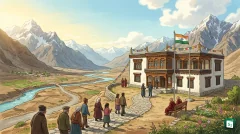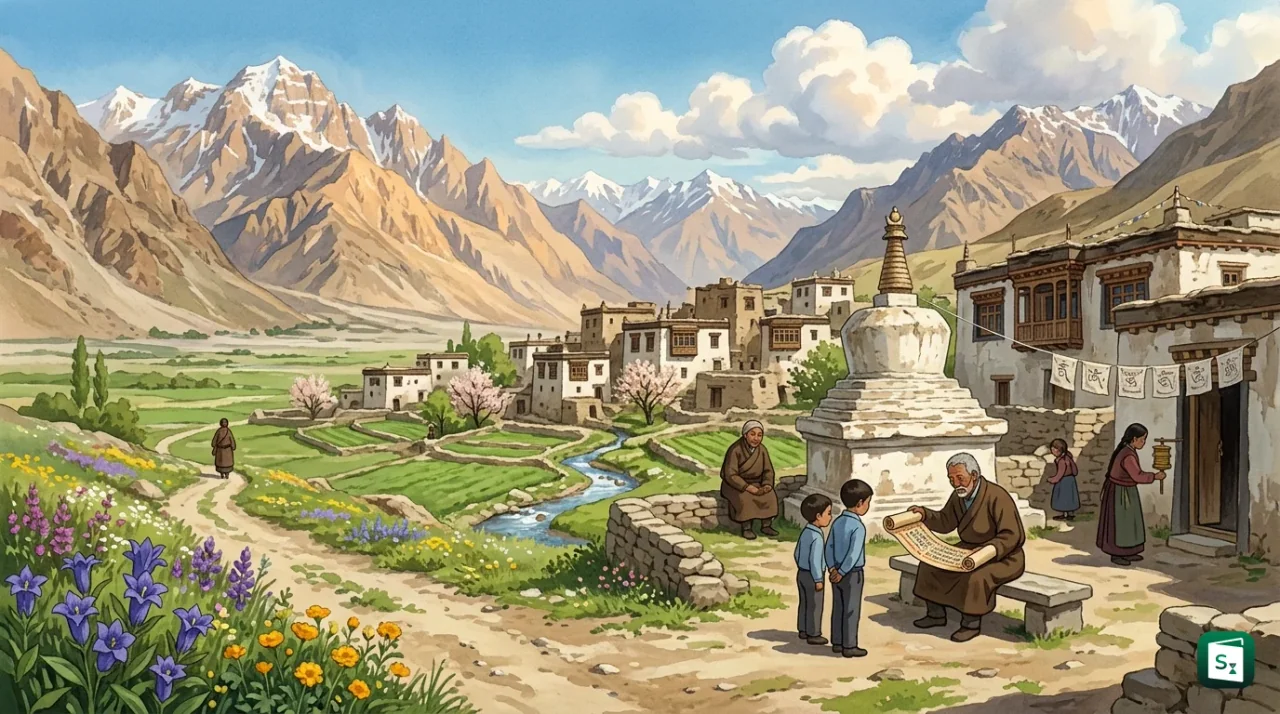
On 15 September 2026, the Lieutenant Governor of Ladakh Vinai Kumar Saxena declared Kumik village in Zanskar Valley as Ladakh’s first Heritage Village during the 11th Ladakh Zanskar Festival 2026 at Sani, Zanskar. The honour recognises Kumik’s Buddhist manuscripts including Kanjur texts, traditional mud and stone houses, sacred spaces and age-old living practices that have survived in one of India’s most remote Himalayan valleys. The declaration, framed under the central vision of Vikas Bhi, Virasat Bhi, links cultural preservation with sustainable tourism as Zanskar celebrates its first festival after becoming a new district.
What Is a Heritage Village?
A Heritage Village is a settlement officially recognised for its outstanding historical, architectural and cultural value where traditional buildings, manuscripts, crafts and living practices are still preserved by the local community. Unlike a single monument, the entire village landscape is treated as living heritage that must be conserved while people continue to live in it.
The term heritage refers to inherited cultural assets that a community passes down across generations, including built structures, texts, languages, rituals and knowledge systems. A heritage site in the technical sense often refers to a place protected under laws such as the Ancient Monuments and Archaeological Sites and Remains Act, 1958 or inscribed on the UNESCO World Heritage List, which India joined in 1977 and where India now has 44 World Heritage Sites (as of June 2026).
A Heritage Village designation used by a state or Union Territory administration is different from these national or global lists. It is an administrative recognition, not a statutory protection under the central monuments act, but it signals priority for conservation funding, tourism promotion and community-led preservation. The designation focuses on living heritage, where daily life itself, from farming and festivals to manuscript custody, is part of what is preserved.
In India, several models exist. Kisama Heritage Village near Kohima in Nagaland was built in 2003 as a purpose built complex to host the Hornbill Festival from 1 to 7 December each year. Raghurajpur in Puri district, Odisha is famed as a crafts village for Pattachitra painters, and Pragpur in Kangra, Himachal Pradesh, notified in 1997 as India’s first heritage village, is known for its slate roofed houses and cobbled lanes. Kumik in Ladakh is distinct because the heritage is not reconstructed, it is still lived in by its residents.
Kumik Village Becomes Ladakh’s First Heritage Village
The Lieutenant Governor of Ladakh Vinai Kumar Saxena declared Kumik village as Ladakh’s first Heritage Village on 15 September 2026 at the inauguration of the 11th Ladakh Zanskar Festival 2026 in Sani, Zanskar. The Ladakh administration confirmed that this is the first such designation in the Union Territory, which was created on 31 October 2019 after the Jammu and Kashmir Reorganisation Act, 2019 bifurcated the former state into two Union Territories.
The announcement was made on the Lieutenant Governor’s official handle and in his festival address. Kumik is a remote high altitude settlement in Zanskar Valley, dotted with traditional houses, sacred spaces, agricultural fields and age old customs that have remained central to community life. The Lieutenant Governor described Kumik as not a monument frozen in time but a vibrant, living heritage and linked the decision to Prime Minister Narendra Modi’s vision of Vikas Bhi, Virasat Bhi, meaning development and heritage together.
The festival setting was deliberate. The Ladakh Zanskar Festival is the UT’s official cultural showcase for Zanskar, and the 2026 edition was the first held after Zanskar attained district status. By linking the declaration to the festival, the administration tied village preservation to a wider push to bring Zanskar’s culture and tourism onto the national map, while signalling that growth will be pursued with respect for environment, culture and traditions.
Why Kumik Was Chosen: Manuscripts, Architecture and Living Culture
Kumik was selected for three interlinked assets that together reflect Zanskar’s role as a centre of faith, knowledge and scholarship.
First, Buddhist manuscripts. Kumik preserves a rich textual tradition that includes precious Kanjur manuscripts and other Tibetan Buddhist materials. The Kanjur, also written as Kangyur, is the Tibetan Buddhist canon containing the teachings attributed to the Buddha Shakyamuni. It comprises 108 volumes with more than 1,100 texts translated from Sanskrit, covering Vinaya, Prajnaparamita, Avatamsaka, Ratnakuta, Sutra, Tantra and other sections. In the western Himalayas, villages and monasteries in Ladakh and Zanskar have safeguarded handwritten Kanjurs for centuries. Kumik’s collections show how knowledge was copied, transmitted and taught in remote Himalayan settlements, offering a different side of Zanskar beyond its trekking routes and monasteries.
Second, traditional architecture. Kumik is noted for mud houses, stone foundations, timber roofs and sacred spaces built with local materials and methods adapted to extreme cold and scarce water. Houses are oriented to conserve heat, store grain and shelter livestock on the ground floor, reflecting mountain resilience. Sacred spaces and agricultural terraces form part of the same landscape, not isolated structures.
Third, preserved cultural practices. Farming rituals, seasonal migrations, folk songs, rituals and custodianship of texts are still practised by families. Earlier proposals from the administration had noted that communities in similar villages had committed to eco sensitive choices such as avoiding cement, adopting low impact construction and exploring car free models. While Kumik’s own future plan will depend on residents’ choices, its selection highlights that heritage here is lived every day, not only displayed during festivals.
Reports after the declaration also noted an underlying stress. Kumik has faced water scarcity that has already led some families to move from the original settlement, raising the question of how to keep a living heritage alive when basic services are under strain. A credible plan would need to link manuscript care, building repair support, water security and livelihood options so that residents can sustain their inheritance while improving their lives.
Where Is Zanskar Valley?
Zanskar Valley is a high altitude semi desert valley in the Union Territory of Ladakh in northern India, located about 250 km south of Kargil on NH 301. It lies on the northern flank of the Great Himalaya, separated from the Indus Valley by the Zanskar Range, and its administrative centre is Padum.
Zanskar was part of the former Kargil district of Ladakh and became a separate district on 27 April 2026 with headquarters at Padum. The question Zanskar Valley is in which state often appears in geography and general knowledge questions. The correct answer is that Zanskar is not in a state at all, it is in the Union Territory of Ladakh, which has been a Union Territory without legislature since 31 October 2019. Ladakh shares borders with Himachal Pradesh to the south, Jammu and Kashmir to the west and the Line of Actual Control with China to the east.
| Feature | Detail |
|---|---|
| Location | Southwestern Ladakh, between Suru Valley and Indus Valley |
| Administrative status | Zanskar district, UT of Ladakh (notified 27 April 2026), carved from Kargil district |
| Headquarters | Padum, altitude about 3,505 metres above sea level |
| Area and population | About 6,688 sq km, population 13,793 as per Census 2011, density about 2 persons per sq km |
| Geography | Isolated valley drained by Zanskar River, formed by confluence of Doda, Tsarap and Stod rivers, flanked by Zanskar Range (about 250 km long) |
| Climate | Cold desert, winter temperatures can fall well below minus 20 degrees Celsius, cut off for more than eight months when Pensi La is blocked, pleasant and dry in summer |
| Connectivity | NH 301 Kargil to Padum, Nimmu Padum Darcha (NPD) Road under development to link to Leh and Himachal Pradesh, no air service |
| Cultural character | Predominantly Buddhist with about 12 monasteries including Karsha, Stongde, Sani, Phugtal, Bardan and Rangdum, polyandry survived in pockets till the late 1990s, known as one of the last surviving cultural settlements of Tibet |
Zanskar remains one of the most sparsely populated and least interfered with microcosms of Ladakh. Its remoteness helped preserve archaic forms of Tibetan Buddhism, cliff side meditation caves and agrarian traditions, but it also imposes high costs on governance, with citizens sometimes travelling more than 300 km for administrative services before district creation. That context explains why improved connectivity through the NPD Road and NH 301 is presented by the administration as infrastructure that can transform local economy, tourism and access to government schemes.
The 11th Ladakh Zanskar Festival 2026
The 11th Ladakh Zanskar Festival 2026 is a two day cultural festival of the Union Territory of Ladakh held on 15 and 16 September 2026 at Sani, Zanskar. It showcases Zanskar’s music, dance, cuisine, handicrafts and monastic heritage and is now part of Ladakh’s official tourism calendar.
The Zanskar Festival is organised by the UT Administration of Ladakh in coordination with the Department of Tourism, UT Ladakh. Unlike many monastery festivals tied to the lunar calendar, the Zanskar Festival has fixed September dates to aid tourism planning, and for 2026 to 2027 the Directorate of Tourism lists it on 15 to 16 September. The question Zanskar Festival celebrated in which state is best answered as Ladakh, which is a Union Territory, not a state, and the festival belongs to the Zanskar district of that UT.
The 2026 edition carried special weight. The Lieutenant Governor noted that it was the first major cultural festival of Zanskar as a new district after the notification on 27 April 2026. He inspected stalls and Doksa exhibitions that displayed local culture, crafts and products, virtually inaugurated completed infrastructure assets in Zanskar district, released Shesrab, the annual magazine of Government Degree College Zanskar, and released a special postal cover on Gonbo Rangjon with India Post.
The Lieutenant Governor used the platform to highlight Zanskar’s tourism potential, citing its monasteries, mountains, rivers, trekking routes, adventure activities and warm hearted people. He said more than 4.05 lakh tourists had visited Ladakh up to 31 August 2026, including over 3.71 lakh domestic and more than 33,000 foreign tourists, and stressed that growing footfall must translate into business for hotels, homestays, taxis, restaurants, shops and artisans while remaining sustainable, responsible and people centric.
Connectivity was a central theme. The Nimmu Padum Darcha Road and the NH 301 Kargil Zanskar Highway were highlighted as projects that will strengthen links to Leh and Himachal Pradesh, open markets for local products and create opportunities for drivers, guides and young entrepreneurs. The festival itself drew enthusiastic participation from local communities and was presented as a cultural window into a valley that remains cut off for much of the year.
| Festival | Location | 2026 Dates | Significance |
|---|---|---|---|
| Zanskar Festival | Sani, Zanskar | 15 to 16 September | Showcases remote Zanskar Valley traditions and archery, crafts and indigenous products, included in UT official calendar |
| Ladakh Festival | Leh | 21 to 24 September | Fixed date flagship festival for entire UT |
| Suru Summer Festival | Kargil | 26 to 27 August | Initiated in 2025 to celebrate Kargil identity |
| Hemis Tsechu | Hemis Monastery | 24 to 25 June | Major monastery festival linked to Guru Padmasambhava |
Festivals in Ladakh in 2026 are therefore spread across seasons, but the Zanskar Festival’s September slot gives visitors a rare chance to reach the valley when the Pensi La is open and the landscape is still accessible.
Heritage Villages in India: How Kumik Compares With Kisama, Raghurajpur and Pragpur
India has several settlements recognised as heritage villages, but each follows a different model. Kumik adds a Himalayan, living Buddhist model to this list.
Kisama Heritage Village in Nagaland is the most widely known benchmark. The name Kisama combines Ki from Kigwema, Sa from Phesama and Ma which means village, the two Angami villages whose land was donated. Built by the Government of Nagaland in 2003, Kisama is a purpose built open air complex about 12 km south of Kohima on the National Highway 2 at about 1,300 metres elevation. It gathers morungs, traditional bachelor dormitories, of all 17 Naga communities around a central arena, with a World War II museum, Bamboo Heritage Hall and Bamboo Pavilion. It is the permanent venue of the Hornbill Festival held from 1 to 7 December each year, one of India’s fastest growing cultural festivals, where songs, dances, crafts, food and indigenous games are showcased.
Raghurajpur Heritage Crafts Village in Odisha, located near Puri, is celebrated as a crafts village rather than a festival ground. It is known for Pattachitra scroll painting and related crafts where almost every household includes artists. Its heritage status rests on artisan skills transmitted within families and supported by craft tourism.
Pragpur Heritage Village in Himachal Pradesh, notified in 1997 as India’s first heritage village, lies in Kangra district. It is known for its slate roofed houses, cobbled lanes, heritage haveli architecture and colonial era core. Garli Pragpur together forms a heritage zone where conservation focuses on built heritage and historic town planning.
Heritage Village Palampur, also in Himachal Pradesh, and similar listings in Kerala at Palakkad or Uppudhipatti reflect state level efforts to protect vernacular architecture and agrarian landscapes, though they vary in legal status and scale.
| Village | State or UT | Year and Type | Core Heritage | Primary Function |
|---|---|---|---|---|
| Kumik | Ladakh, Zanskar | 2026, first Heritage Village of Ladakh, living settlement | Kanjur manuscripts, mud stone houses, sacred spaces, agrarian practices | Living heritage preservation and sustainable tourism, residents still inhabit the village |
| Kisama | Nagaland, Kohima district | 2003, purpose built heritage complex | 16 to 17 Naga morungs, tribal crafts and festivals | Permanent venue for Hornbill Festival and year round cultural complex |
| Raghurajpur | Odisha, Puri district | Craft village model, nationally promoted as heritage crafts village | Pattachitra painting, palm leaf craft, puri art traditions | Artisan cluster and craft tourism |
| Pragpur | Himachal Pradesh, Kangra district | 1997, notified as India’s first heritage village | Slate roofs, Kangra architecture, heritage streets | Built heritage conservation and heritage tourism |
Kumik stands out for three reasons. It is not a reconstruction, it is an inhabited village where heritage is maintained by families. Its significance is textual as well as architectural, linking Buddhist scholarship with daily life. And its setting is extreme, a high altitude cold desert where heritage conservation must be paired with basic resilience measures for water, housing repair and winter access.
Zanskar Becomes a District: The Administrative Context
The heritage declaration can only be understood alongside a major administrative change in Ladakh in 2026. On 27 April 2026, Lieutenant Governor Vinai Kumar Saxena approved the notification for five new districts in the Union Territory of Ladakh, raising the total from two to seven. The Ministry of Home Affairs had given in principle approval for this expansion on 26 August 2024 following a directive from Union Home Minister Amit Shah.
The decision was framed as a step to take governance to people’s doorsteps in a Union Territory that spans about 59,146 sq km but is one of India’s least populated regions, with difficult terrain and habitations often more than 300 km from district headquarters. Before this reform, Ladakh had only Leh and Kargil districts since becoming a Union Territory on 31 October 2019. A committee was asked to examine headquarters, boundaries, staffing and other aspects and to submit its report within three months, after which the final proposal was notified.
| New District | Carved From | Headquarters | Revenue Villages |
|---|---|---|---|
| Zanskar | Kargil district | Padum | 26 |
| Drass | Kargil district | Drass Ranbirpura | 19 |
| Sham | Leh district | Khaltse | 27 |
| Nubra | Leh district | Diskit | 30 |
| Changthang | Leh district | Nyoma | 24 |
| Leh (existing) | Already existing | Leh | 44 |
| Kargil (existing, residual) | Already existing | Kargil | 80 |
Zanskar’s demand for separate district status had been raised for more than 70 years and was supported by the Ladakh Buddhist Association. With district status, Zanskar gains its own administrative structure, closer delivery of Central and UT welfare schemes and a sharper identity in tourism branding. The Lieutenant Governor said district status was not merely an administrative change but recognition of the long standing aspirations and distinct identity of the people of Zanskar. That is why the 11th Zanskar Festival was described as the first major festival of Zanskar as a new district, giving the heritage declaration a larger governance milestone to build on.
Why the Heritage Tag Matters: Culture, Tourism and Sustainability
The recognition of Kumik connects three goals that Ladakh has been pursuing together, cultural protection, tourism growth and ecological sustainability.
What Is Heritage Tourism?
Heritage tourism is travel centred on experiencing the historic, cultural and natural heritage of a place, including its architecture, manuscripts, rituals, festivals, crafts and landscapes. It aims to let visitors learn from living traditions while generating income that helps communities maintain those traditions responsibly.
For Ladakh, heritage tourism is already an economic mainstay. Ladakh Tourism markets the region under verticals such as Spiritual and Culture, Heritage, Diverse Landscape, Adventure and Eco Tourism, with attractions ranging from Hemis Monastery and Petroglyphs to Pangong Lake and Umling La at 19,024 feet, the world’s highest motorable pass. Tourism provides employment in transport, hotels, catering, guiding, homestays and cottage industries, but it also pressures fragile high altitude ecosystems where water, energy and waste management are critical constraints.
The Kumik tag fits the National Strategy for Sustainable Tourism 2022 of the Ministry of Tourism, which stresses socio cultural sustainability, meaning respect for the authenticity of host communities and conservation of their built and living heritage, alongside economic and environmental sustainability. It also echoes the national vision of Vikas Bhi, Virasat Bhi highlighted in the June 2026 government review, which noted expansion of UNESCO World Heritage Sites from 31 to 44 since 2014, digitisation through Gyan Bharatam and the National Mission on Monuments and Antiquities, and schemes such as PRASHAD and HRIDAY for pilgrimage and heritage city development.
For Kumik specifically, the tag can help in several practical ways. It can attract targeted funding for manuscript digitisation and conservation in partnership with custodians, support for repair of traditional houses using local materials, documentation of agricultural and ritual knowledge, and development of community led homestays and guided experiences that keep revenue with residents. It can also place Kumik on the broader Ladakh tourism map, complementing events such as the Zanskar Festival and trekking circuits such as the Chadar trek and trails around Padum, Karsha and Phugtal.
At the same time, experience shows that heritage labels alone do not guarantee preservation. Without reliable water supply, health and education services and livelihood options, younger residents may migrate, leaving houses empty and manuscripts without custodians. Ladakh’s own example from earlier proposals, where villages were asked to avoid cement and consider low impact models, suggests that success will depend on community consent and benefit sharing. Sustainable tourism in Zanskar will need visitor management, waste controls and a principle of more value from nature with less pressure on nature, as articulated during the Black Necked Crane Festival 2026 in Ladakh in August 2026.
If managed well, Kumik can become a small but powerful example of how a Union Territory with 97 percent Scheduled Tribe population and distinct communities such as Balti, Beda, Bot, Brokpa, Changpa, Garra, Mon and Purigpa can secure both development and identity in one policy step.
The Way Forward
The declaration of Kumik as a Heritage Village is a starting point, not a final award. For the tag to endure, the UT administration will need to translate recognition into a detailed action plan with community ownership at its centre.
First, documentation and digitisation can secure the manuscript heritage while respecting custodianship. Cataloguing the Kanjur and related Tibetan texts preserved in Kumik, creating digital copies with the consent of families and monasteries, and linking them to institutions such as the National Mission for Manuscripts or university projects like the Tibetan Manuscript Project Vienna would protect against loss from fire, damp or migration.
Second, habitat conservation needs financing. Traditional houses require periodic repair with mud, stone and timber rather than cement, which alters thermal performance and authenticity. A dedicated grant window, skilled mason training and incentives for households that maintain heritage structures would help residents preserve their homes without bearing the full cost alone.
Third, water security and basic services must be addressed in parallel. In a valley fed by glacial melt and winter snow, reliable irrigation, drinking water and winter connectivity determine whether families stay year round. Integrating Kumik’s heritage plan with district level infrastructure under the new Zanskar district structure, including NPD Road and NH 301 improvements, will be crucial.
Fourth, tourism must remain community led and low impact. Homestays, craft sales, manuscript interpretation centres and festival linked itineraries can generate income, but visitor numbers should be guided by carrying capacity and waste management protocols already advised by the Department of Tourism, UT Ladakh.
Finally, the administration may need to set clear criteria for any future heritage village designations so that the label retains value. If Kumik’s experience is documented openly, including visitor footfall, conservation spend and resident satisfaction, it can serve as a template for other culturally rich villages across Leh, Kargil, Nubra and Changthang without diluting standards.
Key Takeaways
- Kumik village in Zanskar Valley was declared Ladakh’s first Heritage Village on 15 September 2026 by Lieutenant Governor Vinai Kumar Saxena during the 11th Ladakh Zanskar Festival 2026 at Sani, Zanskar.
- Kumik was honoured for its Kanjur Buddhist manuscripts and Tibetan Buddhist texts, traditional mud and stone architecture with sacred spaces and living cultural practices including agrarian traditions.
- Zanskar Valley is in the Union Territory of Ladakh (not a state), with headquarters at Padum (about 3,505 metres), area about 6,688 sq km, and became a separate district on 27 April 2026 after being carved from Kargil district.
- The 11th Zanskar Festival was held on 15 to 16 September 2026, is part of Ladakh’s official tourism calendar, and was the first edition after Zanskar attained district status, showcasing music, dance, crafts and monastic heritage.
- Ladakh was created as a Union Territory on 31 October 2019 under the Jammu and Kashmir Reorganisation Act, 2019; after the 27 April 2026 notification, Ladakh has seven districts: Leh, Kargil, Zanskar, Drass, Sham, Nubra and Changthang.
- The declaration was framed under the vision of Vikas Bhi, Virasat Bhi and links to heritage tourism and sustainable tourism, contrasting with models such as Kisama Heritage Village (Nagaland, 2003, Hornbill Festival 1 to 7 December) and Pragpur (Himachal Pradesh, 1997, India’s first heritage village).