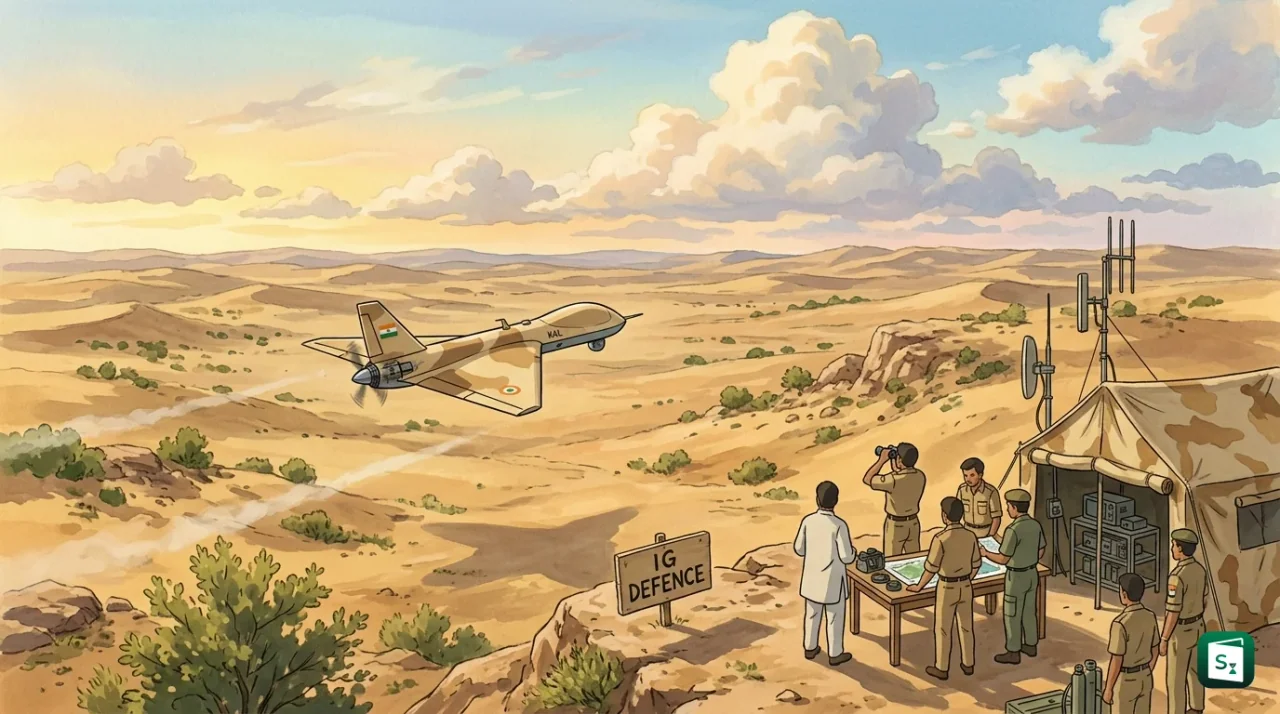
India has successfully flight-tested KAL, its first indigenous long range one-way attack drone, at the Pokhran Field Firing Range in Rajasthan. The loitering munition, developed by Noida-based IG Defence, is built for one-way strike missions deep inside adversary territory. The success places India among the few nations that can design and produce 1000 km class kamikaze drones indigenously, at a time when such low-cost precision systems are reshaping modern warfare.
What Is a Loitering Munition and How Does a Kamikaze Drone Work?
The KAL system belongs to a class of weapons that sits between a drone and a missile, and understanding that class explains why it matters so much for India today.
What is loitering munition?
A loitering munition is an unmanned aerial weapon that can fly over a target area, wait for a target to appear, locate it, and then dive into it to destroy it in a single one-way attack. The munition carries its own warhead and is expended in the strike, so it does not return after launch and is often called a suicide or kamikaze drone.
The term loitering comes from the ability to loiter, which means to hover or circle over an area for time, unlike a cruise missile that flies directly to a pre-set coordinate. A loitering munition can combine surveillance and strike in one platform. It can be pre-programmed, operator-guided, or fully autonomous, and the final attack can be aborted or retargeted until the last moment if needed. In modern conflicts, these systems have allowed forces to hit time-sensitive and hidden targets without risking a pilot or an expensive fighter aircraft.
In Hindi, the concept is often explained as bhatakti hui gola-barood or mandrata hua hathiyar, and in Tamil contexts it is translated similarly to emphasise the wait and strike function. The core idea remains the same across languages, a weapon that waits and then becomes the missile itself.
What is a kamikaze drone?
A kamikaze drone, also called a suicide drone, is the common name for a one-way attack drone that destroys itself on impact. The name recalls the Japanese kamikaze tactics of World War II, but in engineering terms it simply means a one-way attack drone designed for a single lethal mission rather than reuse.
Kamikaze drones differ from conventional unmanned aerial vehicles (UAVs) in one key way. A UAV such as those used for surveillance carries sensors and returns after its mission, while a kamikaze drone is the warhead. It blends the persistence of a drone with the lethality of a missile. This makes it cheaper, smaller, and easier to launch in large numbers.
How attack drones work?
An attack drone in this class typically uses a pusher propeller and a simple delta wing airframe to fly long distances at modest speed. After launch by rocket assist or vehicle ramp, it climbs to its operational altitude, navigates autonomously using satellite and inertial systems, and loiters using day and thermal cameras to identify targets. When the operator or onboard logic confirms a target such as an air defence battery, radar site or logistics hub, the drone executes a steep, high-speed dive and detonates its high explosive payload on target.
Because these drones are small, slow and made of composites, they are harder for traditional radar to detect than fighter aircraft. They also cost a fraction of a cruise missile, which allows forces to launch saturation attacks that can overwhelm air defences. This combination of range, low cost and expendability is why the Russia-Ukraine war, the Gulf conflicts involving Iranian Shahed-136 systems, and more recently Operation Sindoor in India, have highlighted their growing influence.
KAL Attack Drone: India’s First Indigenous Long Range One-Way Attack System
The KAL attack drone is described by its maker as India’s first indigenous 1000 km class long endurance loitering munition and one-way attack drone. The system is designated simply as KAL, and was earlier referred to as Project KAL during development. The KAL flight test at Pokhran in September 2026 is the first publicly confirmed demonstration of this class of weapon built entirely in India.
KAL is a Shahed-class system, which means it follows the same operational concept as the Iranian Shahed-136, the Russian Geran-2 and the American LUCAS (Low-cost Uncrewed Combat Attack System). Only three other countries have publicly demonstrated operational systems in this long range delta wing pusher propeller class. KAL shares the familiar delta wing airframe, rear-mounted pusher propeller and rocket-assisted takeoff, but integrates Indian guidance, airframe and payload subsystems aimed at scalable domestic production.
The drone is engineered for deep penetration missions against high-value strategic targets at operational depth. Typical target sets listed by IG Defence include infrastructure nodes, radar sites, air defence batteries, and soft and semi-hardened field targets. The system is built for field deployment, with features for quick transport, setup on vehicle-mounted launchers, and repeated mission use across plains, deserts, jungle and hilly terrain. The successful Pokhran trial validates the airframe, propulsion and autonomous navigation loop that are central to long range one-way strike operations.
Key Specifications and Autonomous Navigation Suite
The KAL drone combines long range, heavy payload and full autonomy in a relatively lightweight airframe, which is rare for systems in its cost class.
Operational Range, Payload and Endurance
KAL offers an operational range of up to 1000 km, which defines how far it can fly from its launch point to the target. This range places it in the long range loitering munition category, far beyond the 20 to 100 km envelope of most tactical loitering munitions currently inducted by field units. The range allows strikes on strategic depth targets without using manned aircraft or expensive ballistic missiles.
The platform has a maximum take-off weight (MTOW) of 200 kg and carries a 50 kg high explosive warhead engineered for critical strike missions. For comparison, Iran’s Shahed-136 carries 20 to 50 kg, Russia’s Geran-2 carries 50 to 90 kg, and the American LUCAS carries about 20 kg. The 50 kg warhead on KAL is therefore at the upper end of its class and is sufficient to damage radar vans, command posts and fuel depots within a lethal radius that the Indian Army specifies as 50 metres for its Long Range Loiter Munition programme.
The drone cruises at 160 km per hour and reaches a maximum speed of 200 km per hour, while operating at altitudes of up to 5000 metres above mean sea level (AMSL). This altitude band keeps it above small arms fire and many short range air defences, while keeping fuel consumption low for endurance. KAL can stay aloft for 7 to 8 hours, which gives operators time to loiter, confirm targets and execute time critical strikes. Earlier developmental references mentioned 3 to 5 hours, but the current operational variant tested at Pokhran is rated at 7 to 8 hours endurance. The system is also rated for operating temperatures of minus 20 degrees Celsius to plus 60 degrees Celsius, an IP55 ingress protection rating, and compliance with MIL-STD-461E and MIL-STD-810G for electromagnetic and environmental ruggedness.
Other integrated features include a day camera with 1920 x 1080 resolution, a night thermal camera at 640 x 512 resolution, and an encrypted RF datalink with an optional SATCOM relay for beyond line of sight control.
| Parameter | KAL Specification |
|---|---|
| Platform Type | Long range one-way attack drone, loitering munition |
| Range | Up to 1000 km |
| Endurance | 7 to 8 hours |
| MTOW | 200 kg |
| Payload | 50 kg high explosive warhead |
| Cruise / Max Speed | 160 km per hour / 200 km per hour |
| Operational Altitude | Up to 5000 m AMSL |
| Guidance | CRPA antenna based multi-band GNSS and INS |
| Launch Method | Rocket assisted takeoff or vehicle takeoff |
| Communication | Encrypted RF datalink, SATCOM relay option |
| Cameras | Day 1920 x 1080, Night thermal 640 x 512 |
Fully Autonomous Flight at 5000 Metres with GNSS and INS
KAL is capable of fully autonomous flight, which means it can navigate from launch to target without continuous operator input after mission data is fed in. This is essential for deep penetration where jamming may cut radio links.
The navigation suite combines multi-band Global Navigation Satellite System (GNSS) and Inertial Navigation Systems (INS). GNSS is the generic term for satellite constellations that provide positioning, navigation and timing. The four global systems are the American GPS, Russian GLONASS, European Galileo and Chinese BeiDou. Using multiple bands and constellations improves accuracy and resistance to interference. KAL uses a Controlled Reception Pattern Antenna (CRPA), an adaptive multi-element antenna that can electronically steer nulls toward jammers and maintain lock on genuine satellite signals. This gives the drone strong protection against jamming and spoofing, a critical need because modern battlefields feature heavy electronic warfare.
INS is a self-contained system that calculates position by measuring acceleration and rotation, without any external signal. Even if GNSS is fully denied, INS allows the drone to continue toward the target, albeit with gradually increasing drift. By fusing GNSS and INS, KAL achieves autonomous navigation that is both accurate and resilient. The combination also enables operation in GPS denied environments, a requirement that the Indian Army has explicitly laid out for its future long range loitering munition acquisition.
The result is an autonomous drone that can fly a pre-planned route, adjust for wind and altitude, loiter over a designated area for target verification and then commit to a steep, slant or low level attack profile without needing constant communication.
Where Was KAL Tested: Pokhran Field Firing Range
The KAL flight test was conducted at the Pokhran Field Firing Range in Rajasthan, one of India’s most important military test and training grounds.
Pokhran lies about 112 km east of Jaisalmer and about 172 km northwest of Jodhpur, at approximately 27.09 degrees North and 71.75 degrees East on the edge of the Thar Desert. The range falls in Jaisalmer district and is administered by the Indian Army, with dedicated air zones used by the Indian Air Force.
The range is historically significant. India conducted its first nuclear test, Operation Smiling Buddha, here on 18 May 1974, making India the sixth nation to demonstrate nuclear capability. A second series, Pokhran-II or Operation Shakti, comprising five nuclear devices, was carried out on 11 and 13 May 1998. The Pokhran range is divided into four zones. Range A is used for artillery firing with an open area of up to 40 km, Range B for armour exercises, Range C for air force operations, and Range D, the cordoned nuclear test site.
In recent years, the range has become the preferred venue for validating indigenous strike systems. It hosted the VSHORADS (Very Short Range Air Defence System) trials on 3 and 4 October 2024, the Nag Mark 2 anti-tank missile trials in January 2025, the Pinaka Extended Range Rocket proof trials in March 2026 when 24 rockets were fired, and the Indian Air Force’s Rotor Clapp-III counter drone exercise in August 2026 focused on counter Unmanned Aerial Systems. The broad, flat desert terrain, controlled airspace, and instrumentation support make Pokhran ideal for long range drone tests that require safe separation, telemetry tracking and impact assessment over several hundred kilometres.
Choosing Pokhran for KAL therefore signals a system-level validation under realistic field deployment conditions, not just a runway demonstration.
Who Developed KAL: IG Defence of Noida
The KAL drone was designed and developed by IG Defence, a private defence technology company headquartered in Noida, Uttar Pradesh. The corporate address is First Floor, D-23, D Block, Sector 63, Noida 201309. Although officially listed as Noida-based in official briefs, the company is often described as Odisha-linked because of its expanding manufacturing footprint in that state, and it was founded in 2018.
The founder and Chief Executive Officer is Bodhisattwa Sanghapriya (as of September 2026). Senior Vice President Maj Gen R C Padhi (Retd) is among the key leadership associated with the programme. The company, which reports over 25 patents pending and more than 500 flight hours of testing, states its mission as building indigenous autonomous systems under the Make in India and Atmanirbhar Bharat initiatives.
IG Defence operates a production facility in Ghaziabad, which became operational in late 2025, and has announced plans for additional UAV plants in Jhansi in Uttar Pradesh and Ganjam district in Odisha by 2028. The facilities are aimed at scaling output to about 100 KAL units at full rate. The company has previously supplied 5000 FPV drones to the Indian armed forces and is competing for repeat orders.
Beyond KAL, the portfolio includes JWALA MK1, a short range surface to air missile, FPV STRIKER tactical combat drone, GAJA heavy lift logistics drone, NANDI unmanned ground vehicle, SKYHAWK VTOL for intelligence surveillance and reconnaissance, ASTRA swarm system, and counter drone products such as BAJ MK1 and the T-SHUL family. KAL is positioned as the flagship long range precision strike product in this ecosystem.
The company has showcased KAL at the North Tech Symposium 2026 in May 2026 and, according to company statements in August 2026, is in advanced talks with multiple Gulf countries for export, subject to Government of India approvals and export controls.
How KAL Compares with Global One-Way Attack Drones
Global interest in one-way attack drones expanded sharply after Iran’s Shahed series demonstrated that a low-cost drone could achieve strategic effects once reserved for missiles. India now joins the small group of developers in this class.
KAL versus peer Shahed-class systems
| System | Country of Origin | Range | Payload Warhead | Speed | Endurance | Notes |
|---|---|---|---|---|---|---|
| KAL | India, IG Defence | Up to 1000 km | 50 kg | Cruise 160 km per hour, Max 200 km per hour | 7 to 8 hours | Delta wing, pusher propeller, CRPA GNSS and INS, 200 kg MTOW |
| Shahed-136 | Iran | Up to 1000 to 2500 km reported | 20 to 50 kg | About 185 km per hour | 6 to 12 hours estimated | Baseline for Shahed class, widely used in Gulf and Ukraine conflicts |
| Geran-2 | Russia, based on Shahed-136 | Similar to Shahed-136 | 50 to 90 kg | Similar band | Similar band | Russian production variant of Shahed family |
| LUCAS | United States | About 1000 km class | About 20 kg | Comparable | Not publicly disclosed | American low-cost Shahed-type development by reverse engineering |
| Sheshnaag-150 | India, NewSpace Research and Technologies | 1000 to 1200 km | 25 to 40 kg | Not disclosed | About 5 hours | Indian swarming long range drone unveiled alongside Project KAL |
The table shows that KAL is competitive in range and heavier in payload than many peers, while retaining a compact and affordable footprint.
One-way attack drone versus cruise missile versus loitering munition
A frequent point of confusion is how a one-way attack drone differs from a cruise missile and a loitering munition.
| Feature | One-Way Attack Drone | Cruise Missile | Tactical Loitering Munition |
|---|---|---|---|
| Primary Role | Loiter and strike, deep penetration with persistence | Direct high speed strike on fixed coordinates | Short range battlefield precision strike |
| Loiter Ability | Yes, 7 to 8 hours for KAL, can wait over target area | Limited or no loiter, optimized for constant speed cruise | Yes, minutes to hours |
| Reusability | No, expended on impact | No, expended on impact | No, expended on impact |
| Cost | Low, suitable for mass production and saturation attacks | High, more than $1 million for systems like Tomahawk | Very low to low |
| Navigation | GNSS plus INS with anti-jam CRPA, autonomous | Inertial plus satellite plus terrain matching | GNSS, INS, electro-optical |
| Target Flexibility | Can search, retarget, abort | Fixed pre-planned target | Operator in loop targeting |
In simple terms, a cruise missile is faster and more destructive per strike but far more expensive and cannot wait. A one-way attack drone like KAL is slower but can linger, confirm the target, and be produced at scale to overwhelm defences. A tactical loitering munition is similar in concept but shorter in range and used closer to the front line, while KAL is a long range strategic class asset.
Why KAL Matters for India’s Defence Modernisation and Export Ambitions
The successful Pokhran test arrives at a moment when long range loitering munitions have moved from experimental to essential in military planning.
For India, the development supports self-reliance in critical defence technology under the vision of Atmanirbhar Bharat. India has traditionally imported strike drones and loitering munitions. An indigenous 1000 km system reduces dependence on foreign supply chains, lowers lifecycle cost, and allows rapid adaptation, sustainment and upgrades inside the country. The ability to produce the airframe, guidance suite, warhead and datalink domestically also addresses security concerns about embedded foreign components.
The test aligns directly with the Indian Army’s Long Range Loiter Munition (LRLM) programme. In July 2026, the Army initiated a Make II procurement to acquire indigenous one-way attack drones capable of striking at 1000 km with a 25 kg warhead, a kill radius of 50 metres, flight above 5000 m, speed of at least 400 km per hour, AI-enabled targeting and operation in GPS denied environments. The process requires industry to fund development, with the Army committing to acquisition if specifications are met. Procurement will include a launch vehicle, ground control station, simulator and 15 aerial vehicles per set, with variants for plains, deserts, jungles and hills. The Army’s Regiment of Artillery is the nodal arm for this induction, and it is also separately acquiring shorter range drones, including an 850-unit order for 100 km class systems where Tata Advanced Systems and Nibe Defence have been shortlisted. KAL, with its 1000 km reach and autonomous suite, is positioned as a contender for these requirements when formal trials are held.
The economic and diplomatic dimension is equally important. India is seeking to grow defence exports beyond the success of BrahMos, which remains a flagship export missile. IG Defence has stated it is in advanced discussions with multiple Gulf countries and expects to close deals in the current financial year, subject to government export controls. Gulf tensions have increased demand for affordable precision strike systems that can provide deterrence without expensive missile inventories. A Shahed-class drone that is Indian-designed, competitively priced, and supported by secure supply chains fits that demand. If approved, KAL would signal India’s entry into the global market for long range one-way attack systems, a market currently dominated by Iran, Russia and the United States.
Operationally, KAL gives India a low-cost option for strategic deterrence and precision strike without risking pilots. It can hold at risk adversary radar, air defence, logistics hubs and infrastructure at depth, complicate enemy air defence planning through saturation, and be fielded alongside other indigenous systems like Nagastra-1, SkyStriker used in Operation Sindoor, and the emerging Sheshnaag-150. The drone’s encrypted links, thermal imaging and autonomous profile make it suitable for missions where communication may be degraded by jamming.
Challenges remain. Long range one-way drones depend on resilient navigation, secure datalinks and quality control at scale. Mass production of engines, electro-optical payloads, avionics and warheads must be indigenised fully to avoid import bottlenecks. Effectiveness will also hinge on integration with surveillance, command and targeting networks, and on counter drone defences of adversaries. However, the Pokhran validation is a foundational step toward building that complete ecosystem inside India.
Key Takeaways
- KAL is India’s first indigenous long range one-way attack drone and loitering munition successfully flight-tested at the Pokhran Field Firing Range in Rajasthan.
- The system was developed by IG Defence, headquartered in Sector 63, Noida, Uttar Pradesh and founded in 2018, led by Founder and CEO Bodhisattwa Sanghapriya (as of September 2026).
- KAL has a range of up to 1000 km, a 50 kg high explosive payload, MTOW of 200 kg, endurance of 7 to 8 hours, speed of cruise 160 km per hour and max 200 km per hour, and an operational ceiling of 5000 m AMSL.
- The drone uses fully autonomous navigation with a CRPA antenna based multi-band GNSS and INS suite for operations in GPS denied environments and encrypted RF plus SATCOM relay for beyond line of sight control.
- KAL belongs to the Shahed-class of delta wing pusher propeller drones held operationally by only three other countries with Iran’s Shahed-136, Russia’s Geran-2 and the US LUCAS.
- The test supports the Indian Army’s Long Range Loiter Munition (LRLM) Make II programme for 1000 km indigenous strike drones and India’s push to become a defence exporter to friendly nations, including ongoing talks with Gulf countries.