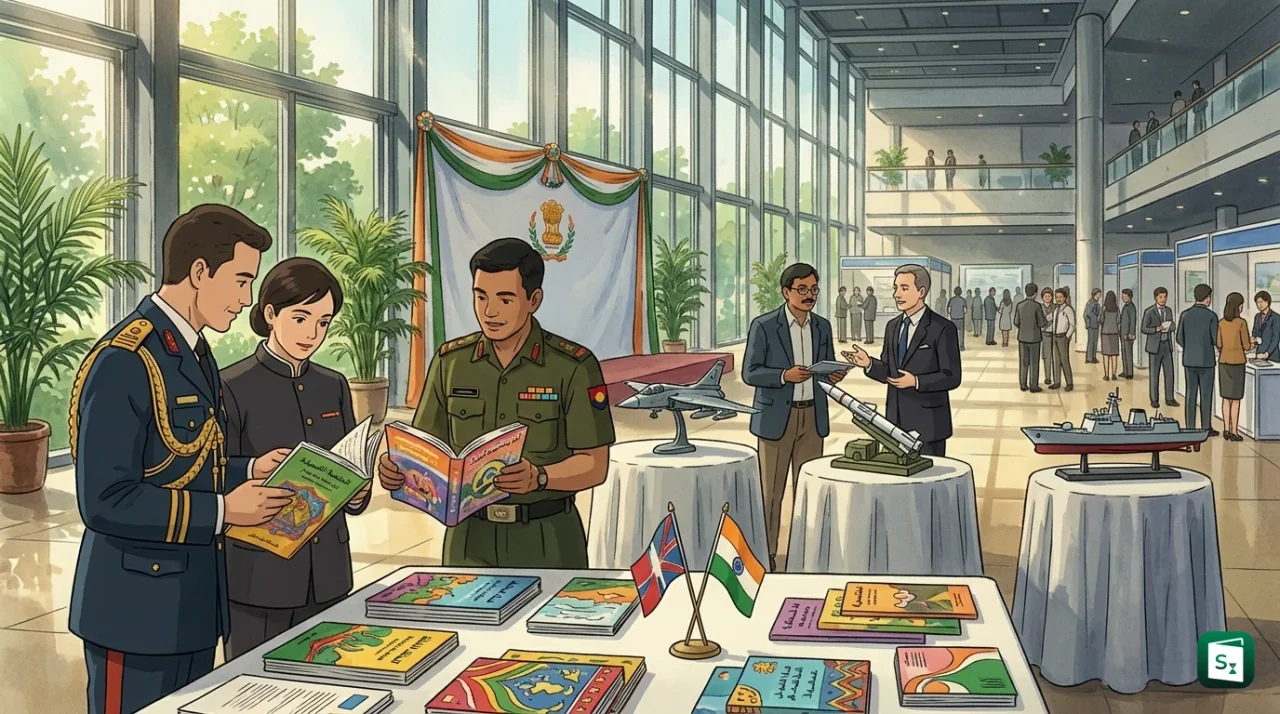
Minister of State for Defence Sanjay Seth inaugurated VISV-2026 at the Manekshaw Centre in New Delhi on 30 October 2026. The Defence Research and Development Organisation (DRDO) organised it with the Centre for Joint Warfare Studies (CENJOWS). He released a DRDO product guide in Arabic, Spanish and French to promote Indian weapons abroad.
What Happened at VISV-2026 in Manekshaw Centre?
VISV stands for Vision, Innovation, Synergy and Values. Written as vishwa in Hindi, the word also means world. The Ministry of Defence chose this name to signal that India wants to link domestic research with global partnerships.
The event took place at the Manekshaw Centre in Delhi Cantonment, New Delhi, on 30 October 2026. Minister of State for Defence Sanjay Seth inaugurated it. The Defence Research and Development Organisation (DRDO) organised it in collaboration with the Centre for Joint Warfare Studies (CENJOWS).
The theme was Showcasing Defence Capabilities, Strengthening Global Partnerships. The main seminar was titled DRDO Defence Solutions for Partner Nations: From Technology to Strategic Partnerships. Technical sessions covered aeronautical systems, land and naval systems, sensing and communications, missile technologies, microelectronics, computational solutions and soldier support systems.
A second interactive session was held on Avenues for Joint Collaborations and Partnerships. It brought together the Department of Defence Production, DRDO, CENJOWS, the Society of Indian Defence Manufacturers (SIDM), Indian industry and Defence Attaches. Senior officials present included Defence Secretary and DRDO Chairman Rajesh Kumar Singh, Foreign Secretary Vikram Misri and Secretary (Defence Production) Sanjeev Kumar, along with officers from the Ministry of External Affairs, Headquarters Integrated Defence Staff and the Armed Forces.
What Is DRDO and How Does It Work?
The Defence Research and Development Organisation (DRDO) is the research and development wing of the Ministry of Defence. It designs and develops weapons, sensors, missiles and other military systems for the Indian Army, Navy and Air Force. DRDO is a government organisation under the Department of Defence Research and Development, and its headquarters is DRDO Bhawan in New Delhi.
DRDO was formed in 1958 by merging the Technical Development Establishment, the Directorate of Technical Development and Production and the Defence Science Organisation. It started with 10 laboratories. Today it runs a network of more than 50 laboratories across India with about 25,000 staff, including around 7,500 scientists of the Defence Research and Development Service.
Its motto is Balasya Mulam Vigyanam, a Sanskrit phrase which means strength originates in science. The head of DRDO holds two posts together, Secretary of the Department of Defence Research and Development and Chairman of DRDO. In 2026 the post is held by Defence Secretary Rajesh Kumar Singh, who took additional charge after Samir V. Kamat, Chairman from 2022 to May 2026.
DRDO works in clusters such as aeronautics, armaments, combat vehicles, missiles, naval systems, electronics, advanced computing and life sciences. It does not manufacture weapons in bulk. It develops prototypes and transfers the technology to public sector units and private firms for production. More than 2,000 industry partners, including Micro, Small and Medium Enterprises and startups, now work with DRDO. Young Scientists Laboratories focus on new areas such as artificial intelligence, quantum technology and smart materials.
What Is CENJOWS and Why Did It Co-host the Event?
The Centre for Joint Warfare Studies (CENJOWS) is a tri-services think tank that studies joint warfare, which means how the Army, Navy and Air Force fight together as one team. It was raised on 27 August 2007 at the initiative of the Ministry of Defence and is registered under the Societies Registration Act, 1860. It functions under the aegis of Headquarters Integrated Defence Staff.
CENJOWS was set up to rise above departmental divides and examine synergy in its entirety. It provides a link between the government, the Armed Forces, industry, academia and civil society. It organises seminars, lectures and its journal Synergy to debate national security and jointness. Its second Annual Trident Lecture was held on 1 September 2026 on national resurgence through the Armed Forces.
DRDO partnered with CENJOWS for VISV-2026 because the event needed both parts. DRDO brought the technology, laboratories and products. CENJOWS brought the strategic view, the diplomatic outreach and the platform for dialogue with Defence Attaches from friendly countries. The Manekshaw Centre, named after Field Marshal Sam Manekshaw, regularly hosts such joint seminars and has earlier hosted defence attaches briefings and technology events.
Why Was the DRDO Compendium Released in Arabic, Spanish and French?
Sanjay Seth released a foreign language compendium of DRDO products for export in Arabic, Spanish and French. A compendium is a ready catalogue that lists proven weapons and systems with their uses and specifications. DRDO already publishes such catalogues in English, most recently the Compendium of DRDO Products for Export.
The new versions help foreign officers read about Indian systems in familiar languages. Arabic reaches partners in West Asia and North Africa. Spanish reaches partners in Latin America. French reaches partners in Africa and parts of Asia. The aim is to build awareness of Indian solutions and support talks on sales, adaptation and joint work.
The catalogue features trial tested systems already inducted in India. These include the Akash air defence missile, the Astra beyond visual range air to air missile, the Pinaka multi barrel rocket launcher, the Arjun tank support systems, radars, electronic warfare sets, torpedoes such as Varunastra, sonars and soldier support gear. Sanjay Seth pointed to the BrahMos supersonic cruise missile, developed with Russia, as a model of successful collaboration. He also listed Indian strengths in radar, surveillance, avionics, electronic warfare and underwater technology.
The compendium links to the Standard Operating Procedure for Export of Military Equipment of DRDO, which follows the Ministry of Defence procedure. The Directorate of Industry Interface and Technology Management at DRDO headquarters helps industry respond to foreign requests, customise products and obtain clearances.
How Does VISV-2026 Fit Into India’s Defence Production and Export Goals?
VISV-2026 reflects a clear policy shift. India no longer wants to remain the largest importer of arms. It wants to design at home, manufacture at home and export abroad. Sanjay Seth linked the four pillars of VISV to this goal. Vision means planning for future wars. Innovation means turning lab research into usable weapons. Synergy means joining the Armed Forces, DRDO, industry and foreign partners. Values means building trust, mutual respect and responsibility.
Foreign Secretary Vikram Misri said defence diplomacy is now moving away from a simple buyer and seller model. The focus is on co-development, co-production, innovation and capacity building. He also referred to the MAHASAGAR vision, which stands for Mutual and Holistic Advancement for Security and Growth Across Regions, to keep the Indo-Pacific free and open.
The numbers show why outreach matters:
| Indicator | Past level | Level in 2025-26 | Target for 2029 |
|---|---|---|---|
| Annual defence production | ₹46,429 crore in 2014-15 | ₹1.78 lakh crore | ₹3 lakh crore |
| Annual defence exports | ₹686 crore in 2013-14 | ₹38,424 crore to more than 80 countries | ₹50,000 crore |
| Defence budget | Sharp rise since 2013-14 | ₹7.85 lakh crore in 2026-27, with ₹2.19 lakh crore capital outlay | Sustained modernisation |
The private sector now makes up 24 percent of production and 45.16 percent of exports. Defence public sector units account for the rest. The government wants more private role in aircraft, propulsion, artillery guns, ammunition and shipbuilding, with space for startups, small firms and universities.
At VISV-2026, industry and attaches discussed product adaptation, technical exchanges, co-development and inclusion in global supply chains. This links research directly to jobs, foreign earnings and long term partnerships with friendly nations.
Key Takeaways
- VISV-2026 stands for Vision, Innovation, Synergy and Values and was inaugurated on 30 October 2026 at the Manekshaw Centre in New Delhi by Sanjay Seth.
- DRDO, formed in 1958 with headquarters at DRDO Bhawan in New Delhi, is the research wing of the Ministry of Defence with the motto Balasya Mulam Vigyanam.
- CENJOWS, established on 27 August 2007, is a tri-services think tank under Headquarters Integrated Defence Staff that co-hosted VISV-2026.
- A DRDO product compendium was released in Arabic, Spanish and French to promote Indian systems such as Akash, Astra, Pinaka and BrahMos among partner nations.
- India recorded ₹1.78 lakh crore in defence production and ₹38,424 crore in exports in 2025-26, with targets of ₹3 lakh crore and ₹50,000 crore by 2029.