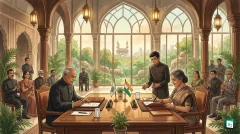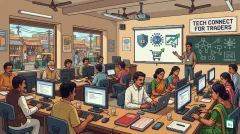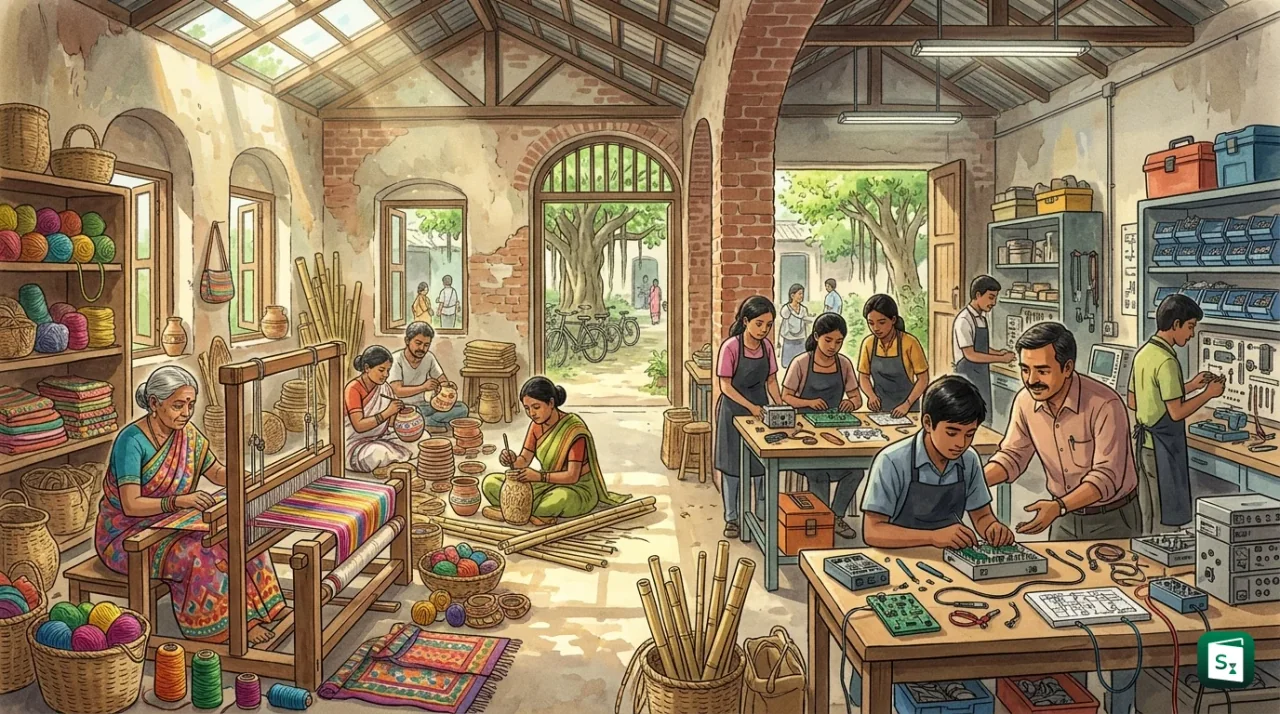
The Ministry of Micro, Small and Medium Enterprises signed two separate agreements on 5 November 2026, one with TRIFED to give tribal artisans registered under PM Vishwakarma Yojana access to Tribes India shops and its online portal, and another with Samsung India to train youth in electronics repair and servicing. The Samsung India training programme will run for three years across 15 MSME Technology Centres. Together, the two moves link traditional crafts to wider markets and connect young workers to industry ready jobs.
What Is PM Vishwakarma Yojana
The PM Vishwakarma Yojana is a Central Sector Scheme fully funded by the central government to give end to end support to traditional artisans and craftspeople who work with their hands and tools. The Ministry of Micro, Small and Medium Enterprises is the nodal ministry for the scheme. It was launched by the Prime Minister on 17 September 2023 on the occasion of Vishwakarma Jayanti with an outlay of ₹13,000 crore for five years up to 2027-28.
The scheme is jointly implemented by the Ministry of Micro, Small and Medium Enterprises, the Ministry of Skill Development and Entrepreneurship and the Department of Financial Services in the Ministry of Finance. It aims to help artisans engaged in family based and informal training traditions, often described as the guru shishya parampara, to improve product quality, access credit and join domestic and global value chains. Recognition under the scheme is given through a PM Vishwakarma certificate and ID card with a unique digital number.
Benefits Available to Registered Artisans
Registered artisans, called Vishwakarmas, receive six linked benefits. Skill training includes basic training of 5 to 7 days and advanced training of 15 days or more, with a stipend of ₹500 per day during training. A toolkit incentive of up to ₹15,000 is given through e-vouchers at the start of basic training.
Collateral free enterprise development loans of up to ₹3 lakh are given in two parts, ₹1 lakh in the first tranche for 18 months and ₹2 lakh in the second tranche for 30 months, at a concessional interest rate of 5 percent. The central government provides interest subvention of up to 8 percent to banks. Artisans also get Re 1 per digital transaction for up to 100 transactions in a month, along with marketing support such as quality certification, branding and onboarding on platforms like the Government e Marketplace (GeM).
Eighteen Traditional Trades Covered Initially
The scheme initially covers artisans in 18 identified trades. These are carpenter, boat maker, armourer, blacksmith, hammer and tool kit maker, locksmith, goldsmith, potter, sculptor and stone carver, stone breaker, cobbler and footwear artisan, mason, basket mat broom maker and coir weaver, doll and toy maker, barber, garland maker, washerman, tailor and fishing net maker.
Registration is free through Common Service Centres using the biometric based PM Vishwakarma portal. The TRIFED agreement focuses mainly on product based trades among these, such as carpenter, metalsmith, sculptor, goldsmith, potter, shoe smith, basket mat and broom maker, coir weaver, doll and toy maker and garland maker.
What Is TRIFED and How Will Tribes India Help Artisans
The Tribal Cooperative Marketing Development Federation of India (TRIFED) is a national level cooperative body under the administrative control of the Ministry of Tribal Affairs. TRIFED was set up in August 1987 under the Multi-State Cooperative Societies Act, 1984 with the mandate to bring socio economic development to tribal communities by organising trade in minor forest produce and surplus agricultural produce. It is headquartered in New Delhi and works through a network of 15 regional offices across the country.
TRIFED acts as a market developer and service provider for tribal products. It started procurement and marketing of tribal art and craft in 1999 through its first retail outlet under the brand Tribes India. The network has since grown to more than 120 Tribes India outlets across India, supported by the online marketplace tribesindia.com. Its portfolio includes tribal textiles, metal crafts, cane and bamboo products, organic foods, tribal paintings, jewellery and pottery.
The agreement was signed in the presence of Dr Rajneesh, Additional Secretary and Development Commissioner in the Ministry of Micro, Small and Medium Enterprises, and M Raja Murugan, Managing Director of TRIFED, along with senior officials of both organisations. Under the agreement, the Ministry of Micro, Small and Medium Enterprises will identify eligible tribal artisans registered under PM Vishwakarma, encourage them to list products on tribesindia.com, hold awareness workshops and coordinate between artisans and TRIFED.
TRIFED will handle onboarding of referred artisans, capacity building, aggregation of products, quality assurance and packaging support for market ready goods. It will also help with initial product photography and cataloguing for mutually identified sellers and provide dedicated display and sales space for identified products. The products will be shown under the proposed Tribes India PM Vishwakarma Collection in retail outlets and online, subject to seller consent and TRIFED policies on eligibility and quality.
How Will the Samsung India Partnership Train Youth at Technology Centres
The Ministry of Micro, Small and Medium Enterprises signed a three year agreement with Samsung India Electronics Pvt Ltd to provide industry oriented skill development and improve employment and self employment for youth. The programme will be run at 15 MSME Technology Centres across the country. It will initially cover 1,600 trainees in the first year, with numbers expected to rise in later years.
Training will follow National Skills Qualification Framework (NSQF) compliant courses in electronics, mobile phones, home appliances, installation, servicing and repair. The courses will cover products such as mobile phones, tablets, smartwatches, televisions, air conditioners, washing machines and professional display products. Samsung will set up modern training facilities with the Centres and supply products and tools for practical work. Samsung will also provide specialised instruction, Training of Trainers support to strengthen faculty skills, technical guidance and continuous handholding to maintain training quality.
Stipend, Internship and Placement Support
The partnership gives trainees direct workplace exposure along with classroom learning. Successful trainees will receive a three month internship through Samsung service networks with a stipend of ₹12,000 per month paid through Direct Benefit Transfer (DBT). The programme also offers career counselling, industry exposure and help with placement.
Scholarships will be available to women and Divyangjan trainees, and batch toppers will receive merit based rewards. The model builds on Samsung DOST Service, a corporate social responsibility initiative launched in 2014 for vocational training in electronics repair, maintenance and installation. Between 2015 and 2023, the initiative trained 5,391 students at 12 MSME Technology Centres and 10,612 students across 22 government Industrial Training Institutes in 16 states.
The 15 centres identified for the current phase include Ludhiana, Chennai, Hyderabad, Varanasi extension centre, Kolkata, Jamshedpur, Bhubaneswar, Bengaluru extension centre, Ahmedabad, Greater Noida, Mumbai, Baddi, Aurangabad, Kanpur and the Ramnagar extension centre in Delhi. These centres are part of the wider Technology Centre network that provides tooling, precision manufacturing and technical training to micro, small and medium enterprises.
What Is MSME and How Are Enterprises Classified
MSME stands for Micro, Small and Medium Enterprises. These are enterprises defined under the Micro, Small and Medium Enterprises Development Act, 2006 on the basis of investment in plant and machinery or equipment and annual turnover. All such enterprises register online on the Udyam Registration portal and receive an Udyam Registration Certificate, which banks also use for priority sector lending.
The classification was revised by notification dated 21 March 2025 and applies from 1 April 2025. An enterprise must meet both investment and turnover limits for its category.
| Category | Investment in Plant and Machinery or Equipment | Annual Turnover |
|---|---|---|
| Micro | Not more than ₹2.5 crore | Not more than ₹10 crore |
| Small | Not more than ₹25 crore | Not more than ₹100 crore |
| Medium | Not more than ₹125 crore | Not more than ₹500 crore |
The Ministry of Micro, Small and Medium Enterprises supports these enterprises through 18 established Technology Centres, earlier known as Tool Rooms and Technology Development Centres, set up between 1967 and 1999. These centres give access to advanced manufacturing technology, train manpower from school dropouts to engineers, and provide technical and business advice. Under the Technology Centre Systems Programme, 15 new Technology Centres are also being set up to expand training capacity and reach more districts.
Why These Two MoUs Matter for Artisans and Youth
The TRIFED agreement addresses a central gap in artisan support, which is market linkage. Many artisans can produce quality goods but lack buyers, branding and steady retail space. By using the existing Tribes India network instead of creating a parallel system, the agreement connects central scheme benefits with an established tribal marketing chain. The Ministry of Micro, Small and Medium Enterprises brings the artisan base and the Ministry of Tribal Affairs brings the retail expertise, which is an example of convergence between ministries.
The Samsung India agreement addresses a different gap, which is the shortage of industry ready technicians in electronics and home appliance servicing. NSQF compliant training, modern labs, Training of Trainers support and a paid internship create a direct path from classroom to workplace. Support for women and Divyangjan trainees and rewards for toppers also widen access to technical jobs. For micro, small and medium enterprises, a larger pool of trained service personnel can improve repair quality and after sales service in a fast growing consumer electronics market.
Key Takeaways
- The Ministry of Micro, Small and Medium Enterprises signed an MoU with TRIFED on 5 November 2026 for market access to tribal artisans under PM Vishwakarma.
- Products of eligible artisans will be sold under the Tribes India PM Vishwakarma Collection through Tribes India outlets and tribesindia.com.
- PM Vishwakarma Yojana was launched on 17 September 2023 with an outlay of ₹13,000 crore and covers 18 traditional trades.
- The Ministry signed a three year MoU with Samsung India to train 1,600 youth in the first year at 15 MSME Technology Centres.
- Successful Samsung trainees will get a three month internship with a stipend of ₹12,000 per month through Direct Benefit Transfer.