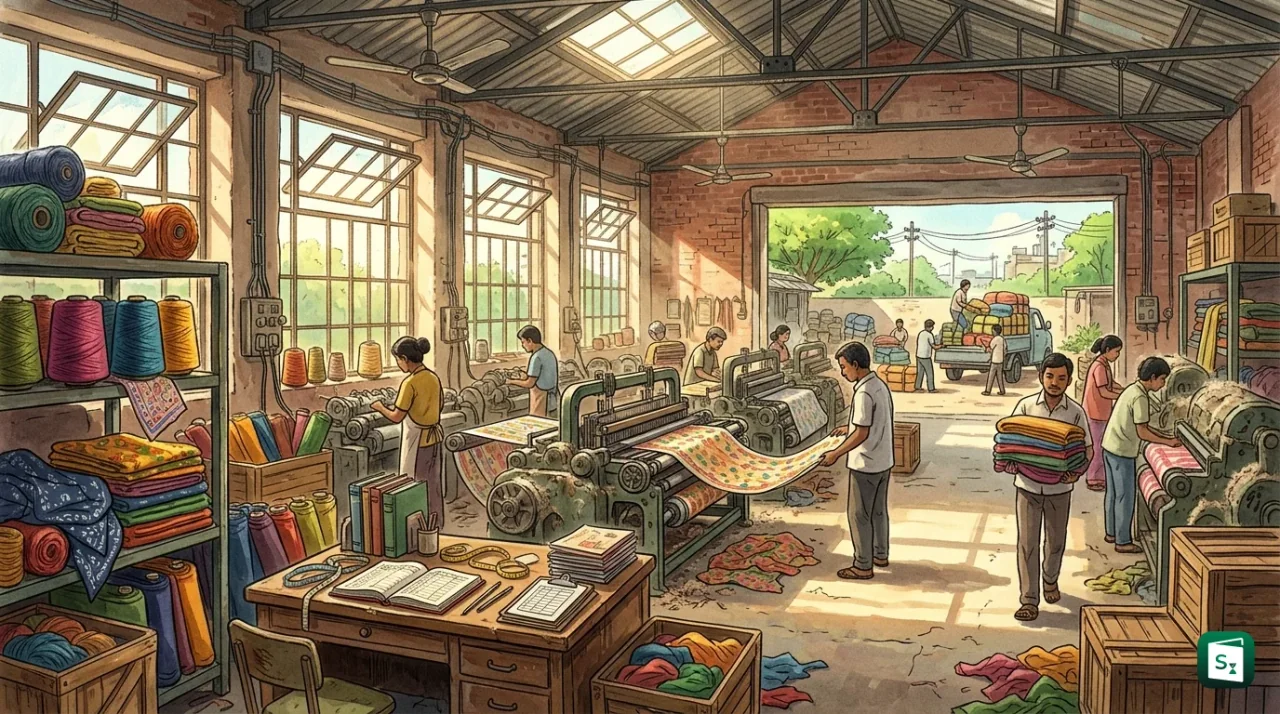
The Ministry of Textiles has reopened the Production Linked Incentive (PLI) Scheme for Textiles for fresh applications under Round 4 from 1 November to 31 December 2026. The Ministry has cut the minimum turnover for Part 2 of the scheme from ₹200 crore to ₹100 crore and extended the scheme tenure to FY 2033-34 only for Round 4 approvals. The changes aim to bring more MSMEs and mid-sized units into man-made fibre (MMF) apparel, MMF fabrics and technical textiles.
What Is the Textile PLI Scheme?
The Production Linked Incentive (PLI) Scheme for Textiles is a central scheme that pays cash incentives to companies for manufacturing notified products in India and increasing their sales year after year. The Ministry of Textiles notified the scheme on 24 September 2021 with an approved outlay of ₹10,683 crore over five years. It covers only MMF apparel, MMF fabrics and products of technical textiles.
PLI means the government rewards higher production. A company that invests the minimum amount and reaches the minimum sales target gets an incentive as a share of its turnover. If it keeps raising sales in later years, it keeps getting incentives at rates fixed in the scheme guidelines.
The textile PLI is one part of a larger national programme. In 2021, the Union Cabinet cleared PLI schemes for 13 sectors with a combined outlay of ₹1.97 lakh crore to build scale, cut imports and create jobs. The textile component is run by the Ministry of Textiles with help from the Department for Promotion of Industry and Internal Trade (DPIIT), the nodal department for all PLI schemes, and a project management agency for field verification.
What Has Changed for Round 4 Applicants?
The Ministry issued the latest changes through a notification dated 28 October 2026. The online portal at pli.texmin.gov.in reopened for Round 4 from 1 November to 31 December 2026. Three changes apply only to companies approved under this round.
First, the minimum turnover under Part 2 has been cut from ₹200 crore to ₹100 crore. The minimum investment for Part 2 stays at ₹50 crore. Both conditions must be met from sales of notified MMF and technical textile products made in India. Sales through normal banking channels count. Trading and outsourced job work do not count.
Second, the scheme tenure has been extended to FY 2033-34 exclusively for Round 4 approvals. The Ministry has fixed a clear calendar for these participants. FY 2026-27 and FY 2027-28 are the gestation period for setting up capacity. The five performance years run from FY 2028-29 to FY 2032-33, with incentive claims paid in the next financial year.
| Period | Financial Years | Purpose |
|---|---|---|
| Gestation period | FY 2026-27 to FY 2027-28 | Investment and plant setup |
| Performance years 1 to 5 | FY 2028-29 to FY 2032-33 | Achieve turnover and incremental growth |
| Incentive claim years | FY 2029-30 to FY 2033-34 | Claim payment for previous performance year |
Third, existing participants from Round 1, Round 2 and Round 3 can shift to Round 4 if they have not claimed or received any incentive so far. The Ministry requires such companies to withdraw their earlier applications. Investment made between 24 September 2021 and 31 March 2026 will be counted at actual cost if production has not started. If production has started, depreciation from 1 April 2026 to 31 March 2027 will apply as per the Companies Act, 2013.
How Does the PLI Scheme for Textiles Work?
The Ministry runs the textile PLI in two parts based on size of investment. A firm or company can apply under either part. It must be registered in India and manufacture notified lines using new plant, machinery, equipment and civil works. Land and administrative building cost are excluded.
| Norm for Round 4 | Part 1 | Part 2 |
|---|---|---|
| Minimum investment | ₹150 crore | ₹50 crore |
| Minimum turnover from notified products | ₹600 crore | ₹100 crore |
| Incentive in Performance Year 1 | 15% of turnover | 11% of turnover |
| Incentive in Performance Year 5 | 11% of turnover | 7% of turnover |
The rate falls by one percentage point each year from Year 2. From Year 2, the company must record at least 10% incremental turnover over the previous year to stay eligible. The Ministry reduced this growth condition from 25% to 10% in October 2025 to ease pressure on firms. Only a limited extra growth of up to 10% above the prescribed growth is counted for incentive calculation.
MMF means man-made fibre. It includes fibres like polyester, nylon and viscose that are made in factories rather than grown on farms. MMF apparel means garments made from these fibres. MMF fabrics means woven or knitted cloth from these fibres. Technical textiles are textile products made mainly for function and performance rather than looks. Examples include airbags and seat belts in vehicles, protective suits for health workers, geotextiles for roads, and nets for agriculture.
Why MMF Apparel and Technical Textiles Were Chosen
India is one of the largest producers of cotton, but its share in MMF is small. Global fibre use has shifted decisively toward synthetics. MMF now forms 70 to 75% of the global fibre market because it offers strength, uniformity and low cost for mass production. Technical textiles depend almost fully on MMF such as polyester, nylon and aramid.
India is the sixth largest exporter of textiles and apparel in the world. Textiles contribute more than 8.6% of total merchandise exports and nearly 2% of GDP. The government has set a target of building a $350 billion textile industry with $100 billion in exports by 2030. Growth in cotton alone cannot meet this goal. The PLI fills the gap by pushing high value MMF garments, fabrics and functional products where competitors like China, Vietnam and Bangladesh moved earlier.
Technical textiles add a second logic. The global trade in these products is close to $300 billion. India holds a domestic market of about $25 billion with exports of about $2.6 billion. Use inside India remains low at 5 to 10% compared to 30 to 70% in advanced economies. The National Technical Textiles Mission, launched in 2020 with an outlay of ₹1,480 crore, supports research, standards and skills in 12 groups such as agrotech, meditech, mobiltech, buildtech and protectech. The PLI works with this mission by creating factory capacity that can absorb research and meet demand from autos, health, agriculture, defence and infrastructure.
Early trade signals support the push. MMF exports from India grew by 6.5% in 2024-25. Technical textile exports grew by more than 15% in the same year.
How Has the Textile PLI Scheme Performed So Far?
The scheme started with 61 approvals in the first selection. The Ministry later added more firms in Round 2 and Round 3. By December 2025, a total of 91 companies, including 36 MSMEs, stood approved. Replies given in Parliament in 2026 place total approvals at 170 companies across segments, with 43 in MMF apparel, 38 in MMF fabrics and 89 in technical textiles. These units are spread across 17 states and one Union Territory.
Funds on the ground are rising slowly. As on 30 September 2025, PLI firms had achieved turnover of ₹7,290 crore and exports of ₹733 crore. As on 31 March 2026, investment reached ₹8,117.64 crore, turnover touched ₹11,241 crore, and fresh jobs numbered 33,427. Committed investment for the approved pipeline exceeds ₹31,000 crore, with projected turnover above ₹58,000 crore in Round 3 alone. Only ₹54.50 crore in incentives had been paid to two firms that met both investment and turnover tests for FY 2024-25, which shows that most units were still in the setup stage.
To speed up response, the Ministry revised the rules in October 2025. It halved the investment limits to ₹150 crore in Part 1 and ₹50 crore in Part 2. It cut the required incremental growth from 25% to 10% from Year 2. It added 17 new HSN codes covering 8 MMF apparel lines and 9 MMF fabric lines. It also allowed firms to set up project units inside existing companies instead of forming a new company. Industry in hubs like Surat had sought lower thresholds, since the earlier ₹200 crore turnover bar kept many local units out. The Round 4 cut to ₹100 crore builds directly on that demand.
Key Takeaways
- The Ministry of Textiles reopened the textile PLI portal for Round 4 from 1 November to 31 December 2026 under notification dated 28 October 2026.
- Minimum turnover under Part 2 was cut from ₹200 crore to ₹100 crore with minimum investment of ₹50 crore to widen MSME entry.
- Scheme tenure was extended to FY 2033-34 only for Round 4 approvals, with FY 2032-33 as the last performance year.
- The textile PLI was notified on 24 September 2021 with an outlay of ₹10,683 crore for MMF apparel, MMF fabrics and technical textiles.
- Round 4 offers 15% incentive in Year 1 under Part 1 and 11% under Part 2, falling by one point yearly with a 10% incremental turnover rule from Year 2.