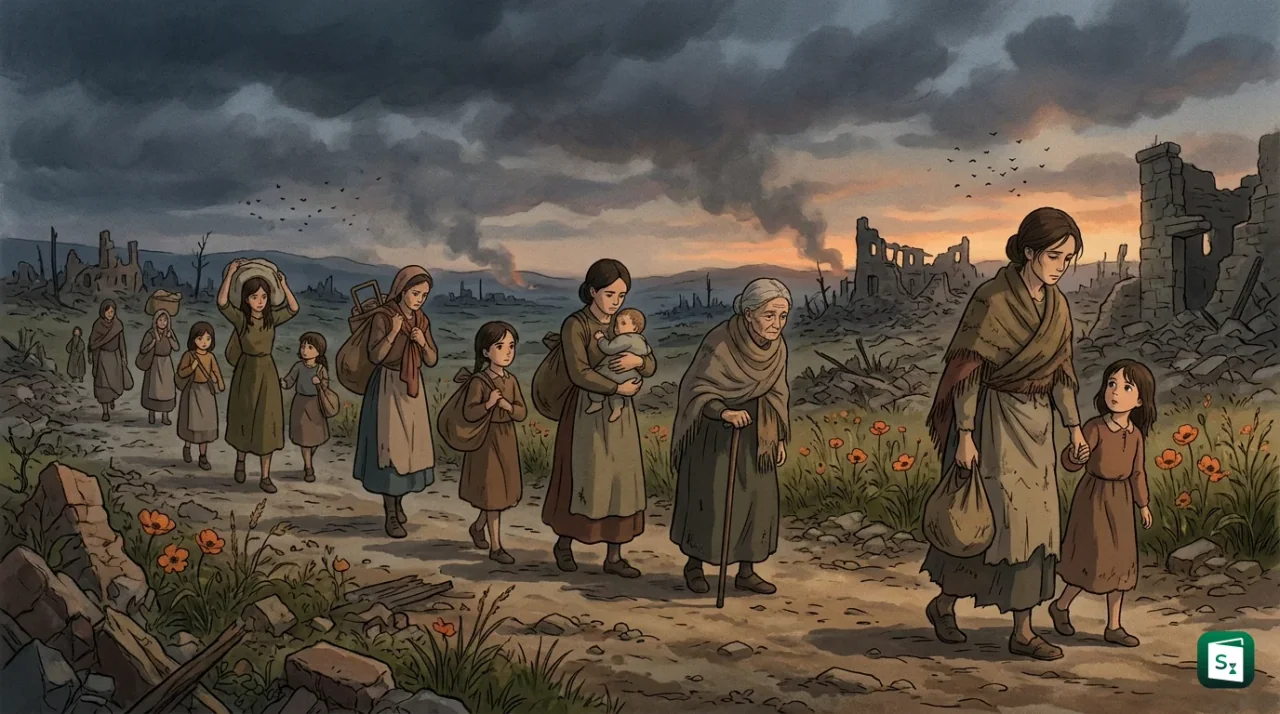
The United Nations released its 2026 Secretary-General report on Women, Peace and Security on 26 October 2026. The report finds that more than 37,000 civilians were killed in armed conflict in 2025, with at least 25 women and girls killed every day. It warns that war is growing deadlier for women even as their role in peace talks keeps shrinking.
What Is Women Peace and Security
The Women, Peace and Security (WPS) agenda is a global framework that links lasting peace to the safety and leadership of women. The UN Security Council adopted the agenda through Resolution 1325 on 31 October 2000. The resolution was the first to state clearly that war harms women and girls in distinct ways and that peace cannot hold without their full part in decisions.
The WPS agenda rests on four pillars. Prevention calls for stopping conflict and all violence against women and girls. Protection calls for defending their rights and safety during war, including safety from sexual violence. Participation calls for equal and meaningful roles for women in all peace and security decisions. Relief and recovery calls for meeting the specific needs of women and girls after crisis and backing women led groups in rebuilding.
Resolution 1325 has been followed by nine more Security Council resolutions on the same agenda. Together they are binding on all UN member states. Countries turn the agenda into action through National Action Plans. More than 110 countries have now adopted such plans.
What the 2026 Report Found on Deaths in Armed Conflict
The UN Secretary-General report on Women, Peace and Security is issued each year ahead of the Security Council open debate on Resolution 1325. The 2026 edition is numbered S/2026/758. It reviews events in 2025 and marks 26 years since Resolution 1325 was adopted.
The central finding is stark. More than 37,000 civilians were killed in armed conflict in 2025. One in four of those killed was a woman or a girl. That share has doubled since 2021. The report translates this into a daily toll of at least 25 women and girls killed every day in conflict settings.
The number of women living close to war has also reached a record. About 750 million women and girls now live within 50 kilometres of an active conflict. That is 40 million more than in 2024 and the highest figure recorded since 1990. The report notes that about 170 million women and girls live both in conflict zones and in extreme poverty on less than $3 a day.
| Indicator in 2025 | Figure reported by the UN |
|---|---|
| Civilians killed in armed conflict | More than 37,000 |
| Share who were women or girls | One in four, double the 2021 share |
| Daily deaths of women and girls | At least 25 per day |
| Women and girls within 50 km of active conflict | About 750 million |
| Rise over 2024 | 40 million more, highest since 1990 |
How Sexual Violence and Daily Hardships Increased
The UN verified 9,788 cases of conflict related sexual violence in 2025. That is more than twice the number verified in 2024 and almost four times the number verified in 2022. The report states that the true number is far higher because many cases go unreported. In Haiti, reported cases rose by 163 percent.
War also harms women far beyond direct attacks. A woman who gives birth in a conflict affected country is five times more likely to die from maternal causes than a woman in a stable country. In conflict countries, women and girls spend five times more hours on unpaid domestic and care work than men and boys. That burden is double the global average. Poverty deepens the risk, as conflict pushes more women into extreme poverty and cuts access to food, health care and jobs.
Why Explosive Weapons and New Technology Raise Risks for Women
The 2026 report links higher deaths among women to the wider use of explosive weapons in crowded areas. Drones and long range weapons are striking markets, schools and hospitals. These are places central to the daily lives of women and girls. Deliberate attacks on such sites increase deaths and injuries.
The report also flags risks from AI enabled military systems. These tools can widen targeting errors and surveillance harms at a time when respect for international law is falling. UN Women, the UN body for gender equality which is headquartered in New York and was created in 2010, said such warfare follows women into wards, classrooms and kitchens where families should be safe.
Why Women Remain Missing From Peace Talks
Women led just a tiny share of formal peace efforts in 2025. Women made up only 5 percent of negotiators across 57 peace processes worldwide. That is down from 7 percent in 2024. The report says 2025 was marked by closed door deals focused on managing fighting rather than resolving causes. Such formats reduced access for women and left their needs out of outcomes.
Peace agreements also show the gap. In 2025, only 19 percent of peace agreements worldwide, or 10 out of 53 agreements, had at least one reference to women, girls, gender or sexual violence. That was lower than the year before. None of the 13 ceasefire agreements tracked in 2025 named conflict related sexual violence as a banned act. All agreements with gender language related to internal conflicts, while deals to end wars between states had no such references.
The report points to the role of women peacekeepers and mediators in filling part of this gap. Women in uniform help improve protection and build trust with local communities. The Elsie Initiative Fund, which supports more women in uniform in UN peace operations, had approved funding by December 2025 for 30 projects across 29 security institutions in 18 troop and police contributing countries.
How Record Military Spending and Falling Aid Hurt Women Groups
Global military spending reached almost $2.9 trillion in 2025. The rise marks the 11th straight year of growth. The Stockholm International Peace Research Institute (SIPRI), which tracks world military spending and is based in Stockholm, estimated the increase at 2.9 percent in real terms over 2024. The report contrasts this with a sharp fall in help for peace work.
Official development assistance from OECD donors fell by 23.1 percent in 2025 to $174.3 billion. Aid for women rights groups in fragile settings fell from $215.4 million in 2023 to $167.9 million in 2024. That is only 0.4 percent of bilateral aid in those settings. Surveys by UN Women found that 40 percent of women groups in crisis areas expect to close temporarily or fully within a year if funds do not return.
The Women Peace and Humanitarian Fund (WPHF) is the only global UN pooled fund that directly backs local women groups in conflict and crisis settings. The Fund was launched on 24 February 2016 and is managed by UN Women. Since 2016 it has mobilised more than $276 million and supported over 1,800 local women groups in 49 crisis affected countries. But the Fund raised only $30.4 million in 2025, down from $65.9 million in 2024. The UN Secretary-General has called for restored aid, firm funding targets for gender equality, and full accountability for violence against women and girls.
Key Takeaways
- The 2026 UN Secretary-General report on Women, Peace and Security (S/2026/758) was released on 26 October 2026.
- More than 37,000 civilians were killed in armed conflict in 2025, with one in four victims a woman or girl.
- At least 25 women and girls were killed every day in conflict settings in 2025, double the female share seen in 2021.
- The UN verified 9,788 cases of conflict related sexual violence in 2025, almost four times the 2022 figure.
- About 750 million women and girls lived within 50 km of active conflict in 2025, the highest since 1990.
- Women formed only 5 percent of negotiators across 57 peace processes in 2025, down from 7 percent in 2024.