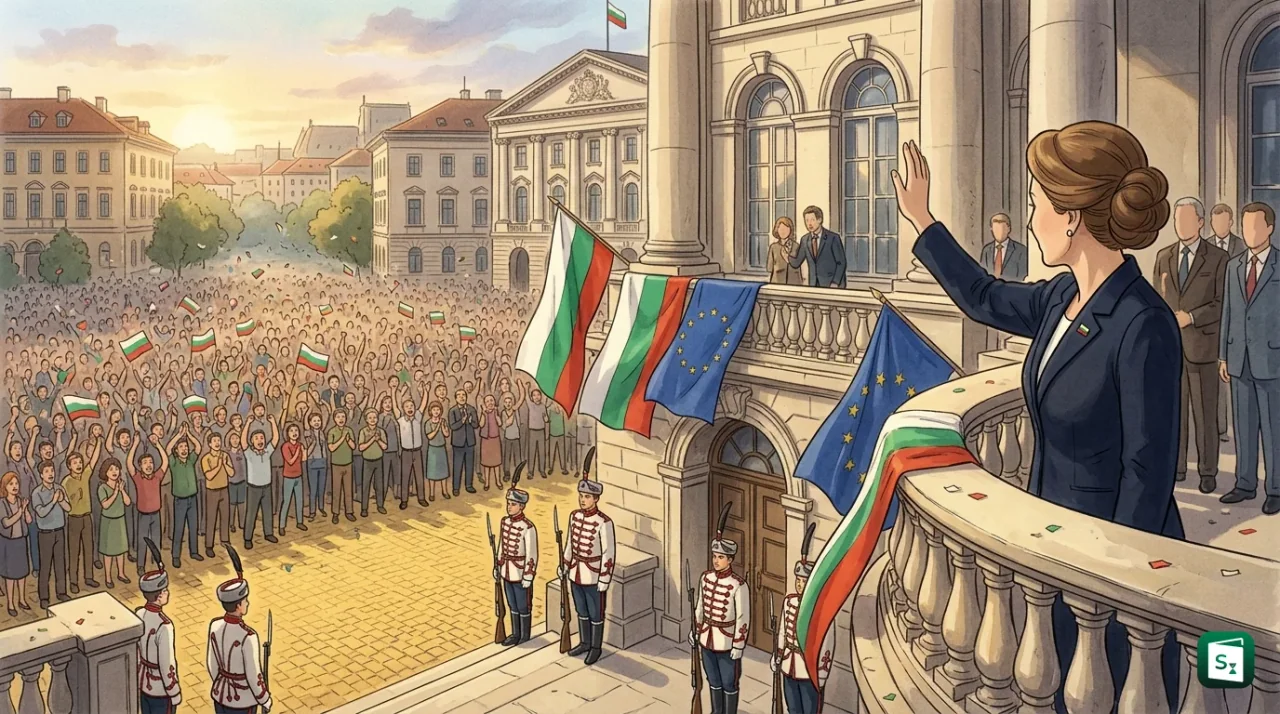
Bulgaria’s acting President Iliana Iotova won the presidential runoff held on 1 November 2026 with 57.56 percent of the votes, becoming the first woman elected President of Bulgaria. She defeated liberal candidate Andrey Gyurov, who secured 39.48 percent of the votes. The Central Election Commission of Bulgaria declared Iotova and her running mate Kiril Valchev elected on 3 November 2026.
How Did Iliana Iotova Win the Presidential Runoff?
Bulgaria held the first round of the presidential election on 25 October 2026. No candidate secured the required majority, so the top two candidates moved to a runoff on 1 November 2026 within seven days, as required by the Constitution.
In the first round, Iotova led with 528,951 votes or 34.76 percent, while Andrey Gyurov was close behind with 486,232 votes or 31.95 percent. A total of 27 candidate pairs contested the first round. Nationalist leader Kostadin Kostadinov finished third with about 12.55 percent. Voter turnout in the first round was extremely low at about 22.98 percent, the lowest in the country’s history.
The runoff produced a clear result. The Iotova-Valchev ticket received 1,093,852 votes or 57.566 percent. The Gyurov-Kandev ticket received 750,251 votes or 39.483 percent. Another 56,080 voters, or 2.95 percent, chose the option of supporting none of the candidates. Turnout improved to 28.67 percent, with 1,902,933 people voting out of 6,637,274 eligible voters.
Iotova won in 28 electoral districts across the country. Gyurov led in only three districts, the 23rd and 24th districts of Sofia and Kardzhali. The pattern reversed among Bulgarians voting abroad, where Gyurov won about 56.23 percent and Iotova won about 41.55 percent. Gyurov accepted the result after polling closed. The Central Election Commission adopted the final result unanimously with all 15 members voting in favour, and the decision will be published in the State Gazette.
Who Is Iliana Iotova?
Iliana Malinova Iotova was born on 24 October 1964 in Sofia and is now 62 years old. She studied at the Alphonse de Lamartine French Language High School in Sofia and earned a degree in Bulgarian and French philology from Sofia University St. Kliment Ohridski. She later specialised at the National School of Administration (ENA) in France and the Centre for European Studies in Strasbourg. She is fluent in French and also knows Russian and English. She is married and has one son.
Iotova began her career as a nurse and then worked in journalism. From 1990 to 1997, she served as a reporter, editor, presenter and director of the News and Current Affairs department at Bulgarian National Television. In 1997, she became head of the press centre of the Bulgarian Socialist Party (BSP) and later served on its National Council and Executive Bureau until 2016.
She entered Parliament as a member of the 40th National Assembly from 2005 to 2007. During this period, she chaired the Bulgarian delegation to the Parliamentary Assembly of La Francophonie and served as deputy chair of the delegation to the Parliamentary Assembly of the Council of Europe. In June 2007, she became a Member of the European Parliament from the Group of the Progressive Alliance of Socialists and Democrats. She served three terms until January 2017 and worked on internal market rules, civil liberties, justice, organised crime and fisheries. She authored the European Parliament’s first report on the Black Sea and its fisheries.
In November 2016, Iotova was elected Vice President of Bulgaria alongside President Rumen Radev. The pair took office on 22 January 2017 and won a second five year term in November 2021. As Vice President, she focused on ties with Bulgarian communities abroad and the promotion of Bulgarian language and education. On 19 January 2026, Radev announced his resignation to enter party politics. The Constitutional Court ended his mandate on 23 January 2026, and Iotova assumed the presidency as acting President. Her elected five year term is due to begin with inauguration on 22 January 2027, and she will serve as the seventh President of the Republic of Bulgaria.
Who Is Vice President Elect Kiril Valchev?
Bulgaria elects the President and Vice President together on the same ticket. Iotova’s running mate is Kiril Valchev, a lawyer and journalist who will serve as Vice President for a five year term.
Valchev studied at the National High School of Ancient Languages and Cultures St. Constantine-Cyril the Philosopher and holds a master’s degree in law from Sofia University St. Kliment Ohridski. He hosted current affairs programmes on Darik Radio and gained experience with Deutsche Welle and the BBC. He also worked as a part time assistant professor in civil law and as a managing partner in a law firm focused on media and intellectual property.
Since 2021, Valchev has served as Director General of the Bulgarian News Agency (BTA) and is now in his second term in that post. He is known for extensive travel and is reported to have visited all 193 member states of the United Nations.
Iotova’s main opponent, Andrey Gyurov, ran with Georgi Kandev. Gyurov is an economist who served as caretaker Prime Minister from February to May 2026. He was backed by liberal and pro Western groups. During the campaign, he presented himself as a supporter of Bulgaria’s European path, while Iotova called herself a president of peace and spoke of national consensus and dialogue to bridge political divisions.
How Is the President of Bulgaria Elected?
The President of Bulgaria is the head of state and is chosen by direct popular vote. The Vice President is elected at the same time, on the same ballot and under the same conditions. Any natural born Bulgarian citizen above 40 years of age who is qualified to be elected to the National Assembly and has lived in the country for the five years before the election can contest.
The term is five years, and a person can be elected to the same office only once more, whether the terms are consecutive or not. The President and Vice President cannot serve as members of Parliament, hold other state or business posts, or lead a political party while in office.
To win in the first round, a candidate needs more than half of the valid votes with more than half of all eligible voters taking part. If no candidate meets this test, a second round is held within seven days between the top two candidates. The candidate with the larger number of votes in the second round wins. This is what happened in 2026, with the first round on 25 October and the runoff on 1 November.
The National Assembly, Bulgaria’s single house Parliament with 240 members, schedules the presidential election. The Central Election Commission conducts the polls. The Constitutional Court decides any challenge to the legality of the election within one month. Under the Constitution, if the presidency falls vacant early, the Vice President assumes the duties until the end of the term. That provision applied when Iotova took charge in January 2026 after Rumen Radev resigned.
What Powers Does the President Hold in Bulgaria?
Bulgaria is a parliamentary republic. The Prime Minister, as head of government, holds the most powerful executive position. The President embodies the unity of the nation and represents the state in international relations. The role is largely representative, but the Constitution gives the President several concrete functions.
The President schedules elections for the National Assembly and local bodies and sets the date for national referendums decided by Parliament. The President concludes international treaties as provided by law, appoints and recalls heads of diplomatic missions on the proposal of the government, and receives the credentials of foreign ambassadors. The President promulgates laws passed by Parliament but can return a bill once for fresh debate with reasons. If Parliament passes it again with more than half of all members, the President must promulgate it within seven days.
The President is the Supreme Commander in Chief of the Armed Forces, appoints senior military command, chairs the Consultative National Security Council, and can proclaim mobilisation or a state of war or emergency under defined conditions. The President also grants citizenship and asylum, exercises the power of pardon, awards orders and medals, and appoints a Prime Minister designate after consulting parliamentary groups. If no government can be formed, the President appoints a caretaker government, dissolves the National Assembly and calls fresh elections. Most presidential decrees need the countersignature of the Prime Minister or the minister concerned.
Is Bulgaria in the EU, NATO, Schengen and the Eurozone?
The Republic of Bulgaria is a country in Southeastern Europe on the eastern part of the Balkan Peninsula. It lies in the continent of Europe, south of the Danube river and west of the Black Sea. It shares land borders with Romania to the north, Serbia and North Macedonia to the west, and Greece and Turkey to the south.
Bulgaria is a member of every core European club. It joined the North Atlantic Treaty Organization (NATO) on 29 March 2004 and the European Union (EU) on 1 January 2007. It joined Schengen for air and sea travel on 31 March 2024 and became a full Schengen member with land borders open on 1 January 2025. It adopted the euro on 1 January 2026, becoming the 21st euro area country.
In short, Bulgaria is in Europe, it is in the EU, and it joined the EU in 2007. The shift to the euro ended the use of the lev, the former national currency issued by the Bulgarian National Bank. The conversion rate was fixed at 1.95583 lev to 1 euro. Lev and euro circulated together until 31 January 2026, and the euro has been the sole currency since 1 February 2026.
Republic of Bulgaria at a Glance
Sofia is the capital and largest city of Bulgaria. Other large cities include Plovdiv, Varna and Burgas. The official language is Bulgarian, written in the Cyrillic script. The country covers about 110,994 square kilometres and has a population of about 6.42 million.
| Fact | Detail |
|---|---|
| Official name | Republic of Bulgaria |
| Capital and largest city | Sofia |
| Other major cities | Plovdiv, Varna, Burgas |
| Location | Southeastern Europe, Balkan Peninsula, west of Black Sea |
| Area | About 110,994 square kilometres |
| Population | About 6,423,207 |
| Official language | Bulgarian in Cyrillic script |
| Capital in focus | Sofia is the political, administrative and cultural centre |
| Currency | Euro since 1 January 2026, earlier lev at 1.95583 lev to 1 euro |
| Political system | Unitary parliamentary republic with 240 member National Assembly |
| EU membership | Member since 1 January 2007 |
| NATO membership | Member since 29 March 2004 |
| Schengen | Full member since 1 January 2025 |
| Head of state | President Iliana Iotova |
| Head of government | Prime Minister Rumen Radev |
Why Does This Election Matter for Bulgaria?
The result keeps the presidency aligned with the current parliamentary majority. Former President Rumen Radev resigned on 19 January 2026 after nine years as head of state. He then founded the Progressive Bulgaria party in March 2026, won an absolute majority in the parliamentary election on 19 April 2026 with about 44 percent of votes and 131 of the 240 seats, and became Prime Minister on 8 May 2026. He is the first person in Bulgaria’s history to serve as both President and Prime Minister. Iotova was backed by his political camp, so her win means the President and the government come from the same political stream.
The election was seen as a test of Bulgaria’s foreign policy direction. Iotova has said she will keep Bulgaria on its European path while supporting better relations with Russia and an end to sanctions linked to the war in Ukraine. Gyurov campaigned on a clear pro Western platform. Observers note that when the presidency and the parliamentary majority are held by the same side, checks and balances on policy decisions can weaken. Low turnout, with more than 70 percent of eligible voters staying away in the runoff, also points to weak public trust after years of political crisis and eight parliamentary elections in four years.
The result is historic for representation. Iotova is the seventh President of Bulgaria and the first woman to be elected to the office through a direct vote. Women heads of state remain rare worldwide, so her election adds Bulgaria to a small group of countries with an elected woman President.
Key Takeaways
- Iliana Iotova won Bulgaria’s presidential runoff on 1 November 2026 with 57.56 percent of votes, becoming the first woman elected President of Bulgaria.
- Iotova secured 1,093,852 votes against 750,251 votes for Andrey Gyurov, with Vice President elect Kiril Valchev on her ticket.
- Bulgaria elects its President by direct vote for a five year term, with a runoff within seven days if no candidate wins a majority in the first round.
- Bulgaria’s capital is Sofia, its currency is the euro since 1 January 2026, and it joined the EU on 1 January 2007.
- Iotova served as Vice President from 2017 to 2026 and as acting President from 23 January 2026 after Rumen Radev resigned to become Prime Minister.