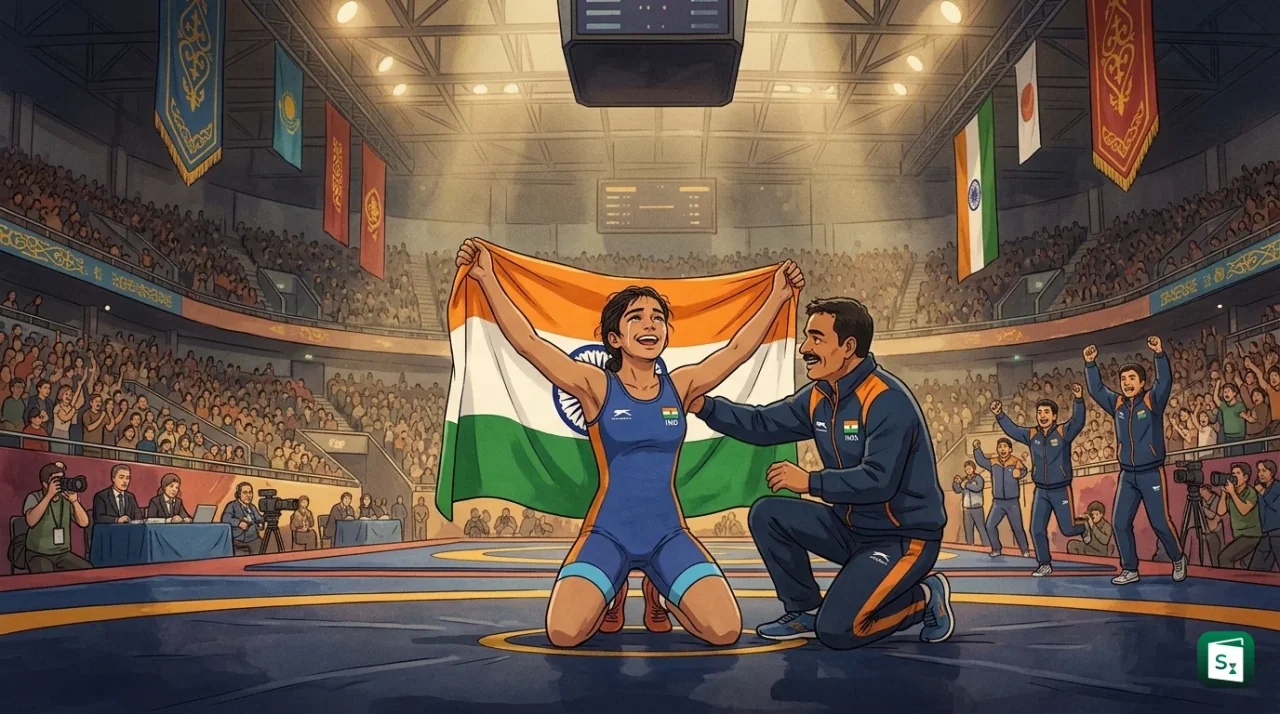
India won four medals at the Senior World Wrestling Championships 2026 held from 24 October to 1 November at Barys Arena in Astana, Kazakhstan. All four medals came from the women’s freestyle squad, with Manisha Bhanwala winning gold in the 59 kg class after an 8-6 comeback win over Abigail Nette of the United States. The result placed India seventh in the overall medal table and fifth in the women’s freestyle team rankings, marking India’s best combined finish at the event.
India’s Four Medals at Senior World Wrestling Championships 2026
The Senior World Wrestling Championships 2026 took place from 24 October to 1 November at Barys Arena in Astana, Kazakhstan. The United World Wrestling (UWW), the global governing body for wrestling, organised the nine day event across three styles: men’s freestyle, men’s Greco-Roman and women’s freestyle. Close to 900 wrestlers competed for 120 medals.
India finished with four medals: one gold, two silver and one bronze. All four medals were won by the women’s freestyle squad. The men’s freestyle and Greco-Roman squads did not win a medal.
| Medal | Wrestler | Weight Class |
|---|---|---|
| Gold | Manisha Bhanwala | Women’s freestyle 59 kg |
| Silver | Neelam Sirohi | Women’s freestyle 50 kg |
| Silver | Kajal Dhochak | Women’s freestyle 76 kg |
| Bronze | Tanu Sharma | Women’s freestyle 72 kg |
The performance gave India its best combined finish at a standard Senior World Championships. India’s previous best was a tied 10th place finish at the 2010 edition in Moscow. In women’s wrestling alone, India stood fourth in the medal table and fifth in the official team rankings with 94 points.
The United States topped the overall medal table with 15 medals, including 7 gold medals. Iran and Russia followed in second and third places. Japan, China and Azerbaijan completed the top six, while India was placed seventh.
In the official team rankings, which are separate from the medal table, the United States finished first in both men’s freestyle with 194 points and women’s freestyle with 137 points. Iran finished first in men’s Greco-Roman. India finished 12th in men’s freestyle and 22nd in Greco-Roman, which underlines how the women’s squad carried the national campaign in Astana.
Who Is Manisha Bhanwala?
Manisha Bhanwala is an Indian freestyle wrestler from Siwaha village in Jind district, Haryana. She was born on 10 February 1997 and is 29 years old. She trains at the Sir Chhotu Ram Wrestling Academy in Rohtak and works as a junior coach there. Her elder brother Rinku, a kabaddi player, encouraged her to take up an individual sport, and she started wrestling in 2015 at the sports school in Nidani.
Manisha competes mainly in freestyle wrestling, a style in which wrestlers can use their legs and hold opponents above and below the waist. She has wrestled in several weight classes, including 57 kg, 59 kg, 62 kg and 65 kg. She won gold at the Asian Wrestling Championships 2025 in the 62 kg class and has won Asian medals in four straight years from 2022 to 2025.
At Astana, Manisha wrestled in the 59 kg class, which is a non Olympic weight. She reached the final with a dominant 10-0 win by fall over Altyn Shagayeva of Kazakhstan in the semifinal. In the final on 30 October 2026, Manisha faced Abigail Nette of the United States, the Pan American champion.
Manisha trailed 0-6 early in the bout. She stayed calm, scored through leg attacks and control in the par terre position, levelled the score at 6-6 and then completed a decisive ankle pick to win 8-6. With this win, Manisha became the first Indian woman to win gold at the Senior World Wrestling Championships. She is only the second Indian wrestler after Sushil Kumar to win a senior world title.
How Neelam Sirohi, Kajal Dhochak and Tanu Sharma Won Their Medals
India’s other three medals also came from young wrestlers in the women’s squad. Two of them came in Olympic weight classes, which adds to their value for the Los Angeles 2028 Olympics cycle.
Neelam Sirohi won silver in the women’s freestyle 50 kg class, an Olympic weight. She beat Natallia Varakina of Belarus 6-0 and then defeated Zeinep Bayanova of Kazakhstan 7-3 in the semifinal with strong defence and counter attacks. In the final, Neelam lost by fall in 2 minutes 13 seconds to Yui Susaki of Japan. Susaki is a multiple time world and Olympic champion and won her fifth senior world gold without conceding a point in the tournament. Neelam joined Anshu Malik as only the third Indian woman to reach a senior world final.
Kajal Dhochak, aged 18, won silver in the women’s freestyle 76 kg class, also an Olympic weight. Kajal is a two time U20 world champion and became the first Indian heavyweight wrestler to win a senior world medal. Her semifinal against Aiperi Medet Kyzy of Kyrgyzstan was one of the bouts of the tournament. Kajal trailed 1-7, then raised the pace with underhook holds and repeated leg attacks to score nine straight points and win 10-7. In the final, Kajal led twice on criteria but lost 6-8 to Anastasiya Alpyeyeva of Ukraine, a two time European champion, after conceding a late takedown and exposure.
Tanu Sharma, aged 20, won bronze in the women’s freestyle 72 kg class on her senior international debut. Tanu lost her opening bout to Wiktoria Choluj of Poland but entered the repechage, a second chance round for wrestlers who lose to finalists. She beat Zainab Sghaier of Tunisia 5-4 and then defeated Precious Bell of the United States 9-5 in the bronze medal bout. The 72 kg class is a non Olympic weight.
What Is Freestyle Wrestling and How Is It Different From Greco-Roman?
Freestyle wrestling is a form of wrestling in which wrestlers can use their entire body to attack and defend. They can grasp the legs of the opponent, trip the opponent and use their own legs to perform holds. Women’s freestyle follows the same rules as men’s freestyle, except that the double Nelson hold is not allowed.
Greco-Roman wrestling is a form of wrestling in which wrestlers can use only their arms and upper body to attack. They cannot grasp the opponent below the waist, trip with the legs or use the legs actively to perform any action. The style depends on throws, lifts and upper body control and is known for its demand on raw power.
The table below sums up the key difference between the two styles.
| Feature | Freestyle and Women’s Freestyle | Greco-Roman |
|---|---|---|
| Use of legs | Legs can be used to attack, trip and defend | Legs cannot be used actively |
| Holds allowed | Holds above and below the waist | Holds only on upper body, above the waist |
| Double Nelson | Banned in women’s wrestling | Allowed under rules |
| Win by technical superiority | Lead of 10 points ends the bout | Lead of 8 points ends the bout |
Both styles are part of the Olympic programme for men. Women compete only in freestyle at the Olympics. Men’s freestyle and Greco-Roman entered the modern Olympics in 1896 and 1904 respectively, while women’s freestyle entered at the Athens 2004 Games.
A bout has two periods of three minutes each with a 30 second break. A wrestler wins immediately by fall, which means holding both shoulders of the opponent on the mat long enough for the referee to confirm control. If there is no fall, the winner is decided on points. Points are given for takedowns, exposures, reversals and penalties. All wrestlers who lose to a finalist enter the repechage for a chance to fight for bronze, which is why two bronze medals are awarded in each weight class.
Wrestling Weight Categories and Team Rankings Explained
Wrestling at the World Championships is fought in 10 weight categories in each style. The Olympic Games use only six weight categories in each style. This is why some world champions, such as Manisha in 59 kg and Tanu in 72 kg, compete in non Olympic weights at the Worlds and must change weight to chase Olympic selection.
Women’s freestyle at the Worlds has these 10 classes: 50 kg, 53 kg, 55 kg, 57 kg, 59 kg, 62 kg, 65 kg, 68 kg, 72 kg and 76 kg. The Olympic programme retains 50 kg, 53 kg, 57 kg, 62 kg, 68 kg and 76 kg. Men’s freestyle has 57 kg, 61 kg, 65 kg, 70 kg, 74 kg, 79 kg, 86 kg, 92 kg, 97 kg and 125 kg.
Team rankings are decided by placement points earned in each weight, not only by medals. The medal table counts gold, silver and bronze, while the team ranking adds points for finishes up to 10th place. This explains why India stood fourth in the women’s medal table but fifth in the team rankings.
| Place | Points |
|---|---|
| Gold | 25 points |
| Silver | 20 points |
| Bronze (two medals) | 15 points each |
| Fifth place (two wrestlers) | 10 points each |
| Seventh place | 8 points |
| Eighth place | 6 points |
| Ninth place | 4 points |
| Tenth place | 2 points |
At Astana 2026, the final women’s freestyle team standings for the top five were:
| Rank | Country | Points |
|---|---|---|
| 1 | United States | 137 |
| 2 | Japan | 135 |
| 3 | China | 121 |
| 4 | Ukraine | 106 |
| 5 | India | 94 |
India’s 94 points came mainly from its four medal winners, who contributed 80 points, with the rest from other placements. The narrow gap between the United States and Japan shows how every placement, even seventh or ninth, can decide the team title.
United World Wrestling and the Barys Arena Event
The United World Wrestling, universally known as UWW, is the international governing body for wrestling. UWW was formed in 1921 in Stockholm and is headquartered in Corsier-sur-Vevey, Switzerland. It has 176 national federations as members and is led by President Nenad Lalovic. Its flagship event is the World Wrestling Championships. UWW sets the rules, approves mats and referees, and runs the ranking series that decides seedings at the Worlds and the Olympics.
The 2026 Senior World Championships were held at Barys Arena in Astana, the capital of Kazakhstan. The event ran from 24 October to 1 November and followed the order of Greco-Roman, then women’s freestyle, then men’s freestyle. Astana was named as a replacement host after Manama in Bahrain, the original choice, postponed hosting. Astana had earlier hosted the 2019 Worlds, then under the city name Nur-Sultan, with close to 1,000 wrestlers taking part.
The choice of Astana matters for India. Kazakh wrestlers are strong at home and Zeinep Bayanova won bronze in the 50 kg class in front of home fans after losing to Neelam in the semifinal. For Indian wrestlers, winning medals in such a high quality field, in a non Olympic year with full participation, makes the 2026 result more valuable than medal hauls in Olympic years when many top wrestlers skip the Worlds.
Wrestling in India: From Sushil Kumar to a New Generation
Wrestling in India has deep roots in the akhara tradition of Haryana, Delhi, Maharashtra and Uttar Pradesh. India won its first world medal through Udey Chand, bronze in men’s freestyle 67 kg at Yokohama in 1961. Bishamber Singh then won silver in New Delhi in 1967, still the only time India has hosted the World Wrestling Championships. After a long gap, Alka Tomar won bronze in 2006 in Guangzhou and became the first Indian woman world medallist.
The turning point came on 12 September 2010, when Sushil Kumar beat Alan Gogaev of Russia 3-1 in the men’s freestyle 66 kg final in Moscow. Sushil remains India’s most decorated wrestler, with bronze at the Beijing 2008 Olympics and silver at the London 2012 Olympics. His gold inspired a rise in enrolment in village akharas, including among girls, and new centres emerged beyond the traditional strongholds.
Bajrang Punia has won the most world medals for India with four, including silver in 2018 and bronze in 2013, 2019 and 2022. Women wrestlers have driven the recent surge. Geeta Phogat and Babita Phogat won bronze in 2012, Anshu Malik won silver in 2021, and Vinesh Phogat and Antim Panghal added bronze medals in 2019, 2022 and 2023. Since 2018, India has won 18 world medals, and women have won 12 of them, including the historic gold in Astana.
The Astana result also highlights a clear gap. Indian men have now gone four straight editions without a world medal. In 2026, Sujeet Kalkal exited in the quarterfinals in men’s freestyle after a 24 match winning run, while Lalit Sehrawat reached the bronze bout in Greco-Roman 55 kg and became the first Indian in 13 years to fight for a Greco-Roman world medal. The women’s squad, with an average age under 25 except for Manisha, now leads India’s road to Los Angeles 2028, especially in the Olympic weights of 50 kg and 76 kg where India won silver.
Key Takeaways
- The Senior World Wrestling Championships 2026 were held from 24 October to 1 November at Barys Arena in Astana, Kazakhstan under the United World Wrestling (UWW).
- India won four medals (1 gold, 2 silver, 1 bronze), finished seventh in the overall medal table and fifth in the women’s freestyle team rankings with 94 points.
- Manisha Bhanwala won gold in women’s freestyle 59 kg with an 8-6 comeback win over Abigail Nette of the United States, becoming the first Indian woman world champion and the second Indian after Sushil Kumar in 2010.
- Neelam Sirohi (50 kg) and Kajal Dhochak (76 kg) won silver while Tanu Sharma (72 kg) won bronze, with all four Indian medals coming from women’s freestyle.
- The United States topped the overall medal table with 15 medals and led both freestyle team rankings, while Iran led the Greco-Roman team rankings.