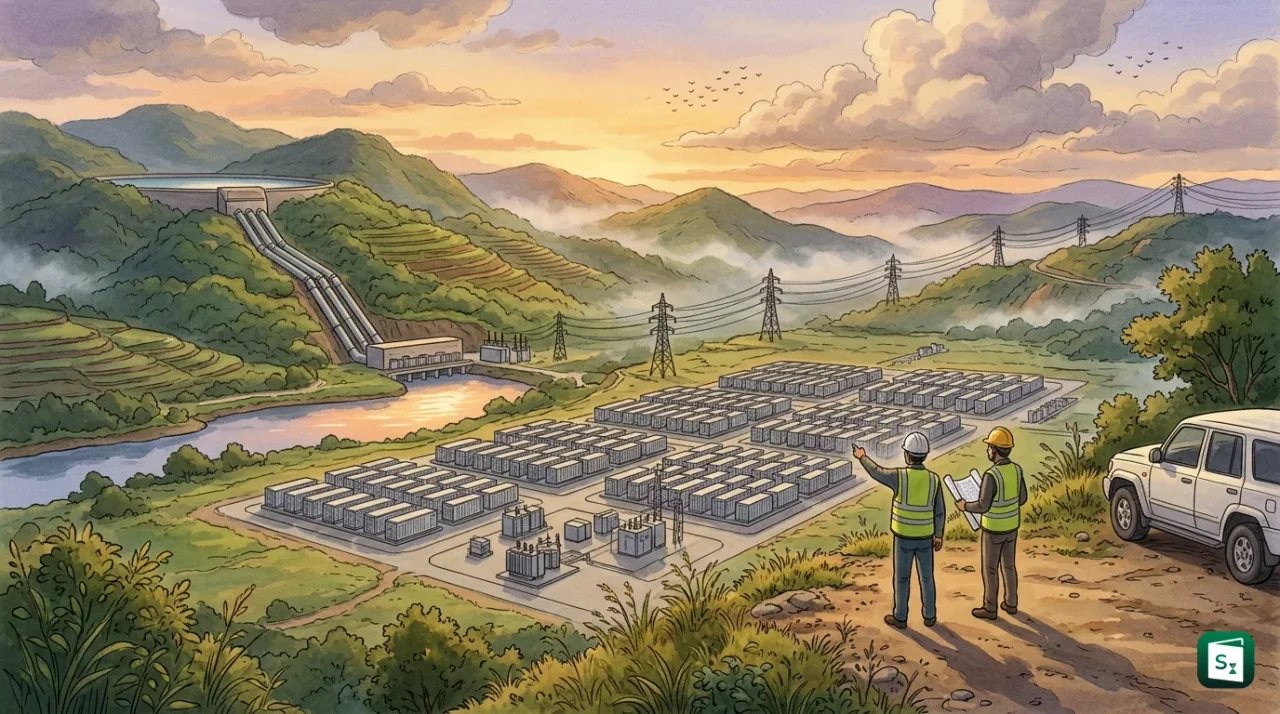
The Union Cabinet chaired by Prime Minister Narendra Modi approved a ₹14,500 crore Viability Gap Funding scheme for grid-scale energy storage on 4 November 2026. The battery energy storage system scheme will support 92 GWh of new storage capacity between FY27 and FY31 with a total investment of ₹97,600 crore. It will help India store surplus solar and wind power and supply reliable round the clock electricity.
What the Cabinet Approved for Grid-Scale Energy Storage
The Union Cabinet approved financial support of ₹14,500 crore for the development of Grid-Scale Energy Storage Systems (GSESS) for the period from FY27 to FY31. Grid-scale storage refers to large storage plants connected to the transmission network that can store electricity in bulk and feed it back to the grid during peak hours.
The scheme targets 92 GWh of energy storage capacity that is yet to be commissioned. GWh stands for gigawatt hour, a unit that measures how much electricity a storage plant can deliver over time. The new capacity equals 170 percent of present day storage capacity in India and will require a total investment of ₹97,600 crore.
The Cabinet decision was announced on 4 November 2026 by Information and Broadcasting Minister Ashwini Vaishnaw after a meeting chaired by the Prime Minister. The Ministry of Power will steer the rollout, with the Central Electricity Authority (CEA) expected to play a central role in screening proposals and tracking progress, as in earlier storage schemes.
What Is a Battery Energy Storage System
A Battery Energy Storage System (BESS) is a large rechargeable battery plant that stores electricity when supply is high and releases it when demand is high. The system uses battery packs, inverters that convert power between direct and alternating current, and software controls that decide when to charge and discharge.
BESS units charge during the day when solar output is strong and power is cheap. They discharge in the evening when solar output falls but household demand rises. This shifting of power is called time shifting. It helps grid operators manage peaks, control frequency, and reduce dependence on costly peak power plants.
In solar projects, BESS is often co-located with the solar park or connected to the same substation. The stored solar power can then be supplied after sunset as firm round the clock power. BESS plants can be built in months and can be placed close to cities or renewable parks. They are best suited for short duration needs of two to four hours per cycle.
What Is Viability Gap Funding
Viability Gap Funding (VGF) is a one time capital grant given by the government to infrastructure projects that are useful for the economy but cannot earn enough revenue to attract private investment on their own. The grant fills part of the gap between project cost and expected income and makes the project bankable for lenders.
The general VGF framework in India is administered by the Department of Economic Affairs in the Ministry of Finance and supports projects built through public private partnership. Under the framework, projects are chosen through competitive bidding, and the bidder who asks for the lowest grant wins. VGF is paid as construction linked support and not as running subsidy.
In power storage, costs are still high and tariffs from distribution companies alone may not cover the full cost. The new GSESS scheme will use VGF to lower the upfront cost for developers. Lower capital cost will reduce the storage tariff discovered in bidding and make stored renewable power cheaper for distribution companies and consumers.
What Is Pumped Storage Hydropower
A Pumped Storage Plant (PSP) is a water battery that uses gravity to store electricity. The plant has two reservoirs at different heights connected by tunnels and a powerhouse. When surplus power is available, the plant pumps water from the lower reservoir to the upper reservoir. When demand rises, water is released downhill through turbines to generate electricity.
Pumped storage is the oldest and largest form of grid storage in the world. As of August 2026, India had 7.43 GW of operational pumped storage capacity across 10 projects, with another 15.87 GW under construction and 10.40 GW cleared by the CEA. The plants have a long life of several decades and can store large volumes of power for six to ten hours or more.
India classifies pumped storage by the link of its reservoirs to rivers. In an on-stream project, both reservoirs sit on a river or stream. In an off-stream open loop project, only one reservoir sits on a river. In an off-stream closed loop project, neither reservoir sits on a perennial river. Policy now favours off-stream sites because they can be built faster and have lower impact on river ecology.
How the 92 GWh Capacity Is Divided Among Three Technologies
The VGF scheme covers 92 GWh of new capacity across three technology groups. The break up reflects the complementary roles of long duration and short duration storage in the Indian grid.
| Technology | Capacity | Share of 92 GWh | Main Role |
|---|---|---|---|
| Hydro Pumped Storage Plant | 60 GWh | About 65 percent | Long duration storage for six to ten hours, seasonal balancing and peak support |
| Battery Energy Storage System | 30 GWh | About 33 percent | Fast response for two to four hours, frequency control and evening peak supply |
| Alternative storage technologies | 2 GWh | About 2 percent | Pilot scale options such as compressed air, flow batteries and thermal storage |
Pumped storage will form the bulk because India has large identified potential, especially in the Western Ghats region, and because it suits long duration shifting of monsoon and solar season surplus. Maharashtra alone accounts for a large share of the national pumped storage potential assessed by the CEA.
Battery storage will handle fast and local needs. It can respond in milliseconds, needs less land and water, and can be placed near solar parks or load centres. Alternative technologies will be tried at small scale to test options for eight hour or multi day storage, including flow batteries and compressed air systems.
The table below compares the two main options in simple terms.
| Feature | Pumped Hydro Storage | Battery Storage |
|---|---|---|
| Storage medium | Water held in upper reservoir | Chemical energy in battery cells |
| Best duration | Long, often six to ten hours | Short, often two to four hours |
| Build time and site need | Needs hills and water, takes years to build | Modular, can be built in months near demand |
| Life and cost pattern | Very long life, high civil cost but low running cost | Shorter life, falling cell cost but replacement needed |
How Projects Will Be Allocated and Made in India
The Ministry of Power has said energy storage capacity under the scheme will be allocated through tariff-based competitive bidding under Section 63 of the Electricity Act, 2003. In this method, developers quote the annual fixed charge they will accept, and the lowest quotes win after factoring in the VGF support.
Public and private sector electricity distribution companies will be eligible for VGF support for BESS and pumped storage projects. Projects based on alternative storage technologies can be implemented by public and private entities. The model follows the pattern of earlier BESS VGF schemes, where states and central agencies invite bids either directly or through renewable energy implementing agencies.
A central condition aims to build domestic industry. All BESS projects under the scheme must meet a minimum Domestic Content Requirement (DCR) of 40 percent. This means at least 40 percent of content must come from Indian sources. The government has said the rule will create demand for Indian factories and support existing supply side steps such as the Production Linked Incentive (PLI) scheme for Advanced Chemistry Cells, which covers 50 GWh of cell capacity with ₹18,100 crore of support.
The scheme also links to grid reforms. The government has waived inter-state transmission charges for co-located battery projects commissioned up to June 2028 and for pumped storage projects where work is awarded by June 2028. Storage has been recognised as part of the power system and included in the harmonised master list of infrastructure, which helps projects get long tenure finance.
Why Grid-Scale Storage Is Central to India’s Clean Power Plan
India needs large storage because solar and wind power vary with time and weather. Solar output peaks at midday and drops to zero after sunset, exactly when evening demand rises. Without storage, surplus daytime power must be curtailed, or cut back, while costly thermal or gas plants must run in the evening.
The National Electricity Plan prepared by the CEA projects a need for 411.4 GWh of storage by FY32, comprising 236.22 GWh from batteries and 175.18 GWh from pumped storage. Demand for storage is set to rise from about 82 GWh in FY27 to 336.4 GWh by FY30 and then to 411.4 GWh by FY32. The new 92 GWh scheme will meet about 22 percent of the FY32 need. CareEdge estimated in October 2026 that operational capacity was only 54 GWh in June 2026, so India must add more than 350 GWh in six years.
Storage also supports national pledges. India aims to reach 500 GW of non-fossil fuel capacity by 2030 and net zero emissions by 2070. The National Framework for Promoting Energy Storage Systems, issued in 2023, along with resource adequacy norms and ancillary service rules, places storage at the centre of this shift. Past steps include two VGF schemes for about 43.8 GWh of batteries approved in September 2023 and June 2025, within which the first scheme grew from 4 GWh to 13.8 GWh as battery prices fell.
Reliable storage will cut curtailment, lower peak power costs, and improve energy security by reducing fuel imports. It will also help manage extreme weather and rising demand from electric vehicles, data centres, and rapid electrification.
Key Takeaways
- The Union Cabinet approved a ₹14,500 crore VGF scheme on 4 November 2026 for grid-scale energy storage from FY27 to FY31.
- The scheme will support 92 GWh of new storage with a total investment of ₹97,600 crore, equal to 170 percent of present capacity.
- The capacity split is 60 GWh of pumped storage, 30 GWh of battery storage, and 2 GWh of alternative technologies.
- Battery projects under the scheme must meet 40 percent domestic content requirement to boost Indian manufacturing.
- India needs 411.4 GWh of storage by FY32 under the National Electricity Plan to meet its 500 GW clean power goal.