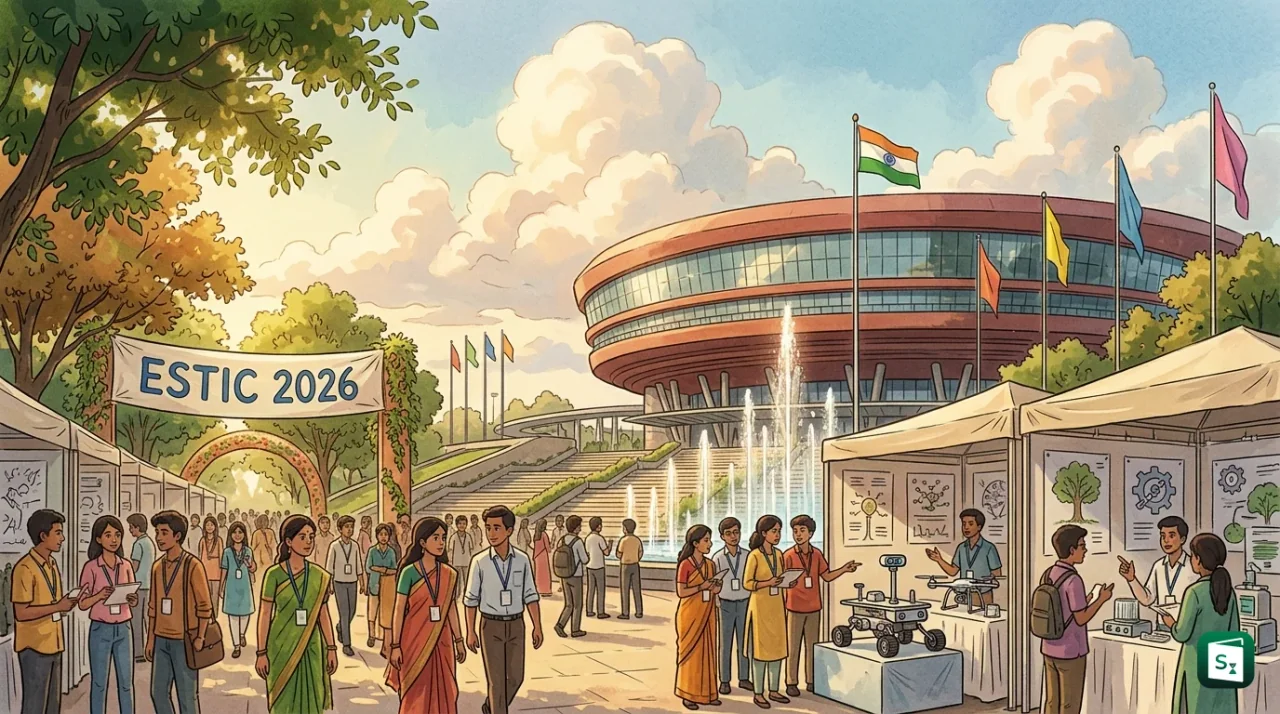
Prime Minister Narendra Modi inaugurated the Emerging Science, Technology and Innovation Conclave (ESTIC 2026) on 27 October 2026 at Bharat Mandapam in New Delhi. The three day conclave, organised by the Council of Scientific and Industrial Research (CSIR), brought together more than 5,000 delegates including scientists, policymakers and deep tech startups. Modi asked every researcher, industry leader and startup founder to fix a concrete technology goal and deliver a measurable outcome within the next three years.
What Is ESTIC and What Is Its Full Form?
ESTIC stands for the Emerging Science, Technology and Innovation Conclave. It is India’s flagship annual science meeting that brings ministries, researchers, industry and startups onto one common platform to set research priorities and move ideas from the laboratory to the market.
The conclave is linked to the national vision of Viksit Bharat 2047, which aims to make India a developed nation by 2047. It was conceived to replace many scattered science events held through the year with a single national forum.
The first edition, ESTIC 2025, was held from 3 to 5 November 2025 at Bharat Mandapam. It was organised by the Department of Science and Technology (DST) with the International Advanced Research Centre for Powder Metallurgy and New Materials in Hyderabad as partner. That edition had 11 thematic areas, plenary talks by Nobel laureates, an exhibition of more than 35 deep tech startups and a startup pitch platform called PitchX. The Research, Development and Innovation (RDI) Scheme of ₹1 lakh crore was launched during ESTIC 2025.
The second edition, ESTIC 2026, is being held from 27 to 29 October 2026. This year the responsibility for organising the conclave was given to CSIR, working under the guidance of the Office of the Principal Scientific Adviser to the Government of India, with 13 ministries joining the effort.
What Happened at the ESTIC 2026 Inauguration in New Delhi?
ESTIC 2026 took place at Bharat Mandapam in New Delhi from 27 to 29 October 2026. The Prime Minister inaugurated the conclave on the evening of 27 October and addressed scientists, industry leaders, startup founders and students.
The theme for 2026 is Creative Minds, Catalyzing Science, Empowering Technologies. The theme highlights the role of creativity in turning scientific discovery into useful technology for society.
The inaugural session brought together Union Minister of State for Science and Technology Jitendra Singh, Principal Scientific Adviser Ajay K. Sood and CSIR Director General N. Kalaiselvi. Three Nobel laureates joined the conclave as plenary speakers. They are Joachim Frank, Richard J. Roberts and Kostya Novoselov.
The opening day drew more than 5,000 global delegates. The programme included addresses by science leaders, two Nobel laureate plenary talks, three parallel technical sessions, a startup exhibition and poster track, and an evening panel discussion. Jitendra Singh opened the startup exhibition and poster track on the same day.
12 Key Thematic Areas Covered at ESTIC 2026
ESTIC 2026 is organised around 12 thematic priority domains. Each domain has invited talks, panel discussions and presentations by science leaders, women entrepreneurs and chief executives of deep tech startups.
| Code | Thematic Area |
|---|---|
| 01 | Advanced Manufacturing |
| 02 | Energy Technologies |
| 03 | System and Synthetic Biology |
| 04 | Ocean Science and Maritime Technologies |
| 05 | Intelligent Networks and Quantum Communication |
| 06 | Semiconductors and Next Gen Chips |
| 07 | Agri Tech, Food Systems and Nutrition |
| 08 | Generative and Autonomous AI |
| 09 | Autonomous Systems, Physical AI and Robotics |
| 10 | Preventive Medicine and Advanced Healthcare Solutions |
| 11 | Immersive Tech: Generative XR and Spatial Computing |
| 12 | Space Science and Technologies |
The list shows a clear shift from 2025, when the conclave had 11 areas. The 2026 programme gives separate space to semiconductors, quantum communication, robotics and space, along with health, energy, agriculture and ocean science.
A few sessions illustrate how research is linked to industry. The Generative and Autonomous AI session was chaired by IndiaAI Chief Executive Officer Saurabh Vijay and featured a keynote by Mitesh M. Khapra of IIT Madras. Speakers discussed homegrown large language models, access to high performance computing, agentic AI and frameworks for safe deployment. The Preventive Medicine session brought the Indian Council of Medical Research (ICMR) together with computing and semiconductor groups, since modern diagnostics and drug discovery depend on both biology and computing power.
Alongside the technical sessions, the conclave hosts around 150 deep tech startup stalls and 100 poster presentations by young scientists, faculty and engineers. A new invite only feature, the Global Connect Networking Event, brings more than 300 participants from Indian and foreign universities, research bodies and industry to build research partnerships and industry academia links.
Why Scientists and Deep Tech Startups Were Given a 3 Year Target
The central message of the inauguration was accountability. The Prime Minister asked every researcher to decide which technology, prototype, pilot project or product they would deliver in the next three years. The conclave, he said, should become a platform for measurable outcomes and not remain only an exchange of ideas.
The speech stressed that success should be judged by lives improved and problems solved. Science must move from the laboratory to the land and serve health, agriculture, education, employment and disaster management. India views science as an instrument for human welfare and self reliance under Atmanirbhar Bharat, and not as a weapon.
To show what this means in practice, the address listed Indian examples. A startup is working on wearable EEG technology that records electrical activity in the brain. Indian firms are building indigenous wireless and satellite communication solutions and new semiconductor products. Other teams are developing nutrition products for special dietary needs and methods to reuse industrial waste such as steel slag. An Indian space startup placed a satellite in orbit with a Made in India rocket in its first attempt, and India has demonstrated satellite docking. The IIT Madras brain imaging platform for high resolution digital 3D images of the human brain was also highlighted.
The funding push behind this target rests on two pillars. The Anusandhan National Research Foundation (ANRF) is being strengthened to support research, while the RDI Fund provides long term finance for technologies ready to move toward the market. The Prime Minister said nearly ₹12,000 crore had been committed in the past year for such technologies, with private investors adding an equal amount. This creates a combined commitment of ₹24,000 crore in one year.
The RDI Scheme was approved by the Union Cabinet on 1 July 2025 with a total outlay of ₹1 lakh crore for six years. The Department of Science and Technology is the nodal department, and the fund is held in a Special Purpose Fund within ANRF. Support flows through second level fund managers such as the Technology Development Board (TDB) and the Biotechnology Industry Research Assistance Council (BIRAC). The scheme supports projects at Technology Readiness Level 4 and above, covers up to 50 percent of project cost as low interest loans or equity, and does not give grants. Priority sectors include energy transition, quantum computing, robotics, space, artificial intelligence, biotechnology, synthetic biology, pharma, medical devices and the digital economy. Patent filings, often used to track research output, have risen from fewer than 50,000 a decade ago to nearly 1.5 lakh last year.
The startup base for this work has widened fast. The number of recognised startups has grown from about 400 in 2014 to more than 2.3 lakh today. An estimated 50 to 60 percent of these startups are based in Tier 2 and Tier 3 cities, which shows that innovation is no longer limited to large metros.
CSIR and CSIR-NIIST: Organisers Behind ESTIC 2026
CSIR stands for the Council of Scientific and Industrial Research. It is India’s largest publicly funded research network and operates under the Department of Scientific and Industrial Research within the Ministry of Science and Technology, which was formed in May 1971.
CSIR was established as an autonomous body on 26 September 1942. Its headquarters is at Anusandhan Bhawan in New Delhi. The network today includes 37 national laboratories, 39 outreach centres and innovation complexes across the country. The Prime Minister is the president of the CSIR society and the science and technology minister is the vice president. The current Director General is N. Kalaiselvi, the first woman to hold the post. The founding role of scientist Shanti Swaroop Bhatnagar is central to its history, and the Shanti Swaroop Bhatnagar Prize is named after him.
The organising partner for ESTIC 2026 is CSIR-NIIST in Thiruvananthapuram, Kerala. NIIST stands for the National Institute for Interdisciplinary Science and Technology. It began in 1975 as the CSIR Trivandrum Complex, became the Regional Research Laboratory in 1978 and was renamed NIIST in 2007. It served as the nodal laboratory for this edition. The institute works on agro processing, chemical sciences, materials, biotechnology and environmental technology, with a mandate to use regional resources and support industry. It completed 50 years in October 2025 and is led by Director C. Anandharamakrishnan.
Bharat Mandapam and the Push Towards Viksit Bharat 2047
Bharat Mandapam is the convention centre inside the Pragati Maidan complex in New Delhi. It was inaugurated on 26 July 2023 as the International Exhibition cum Convention Centre, built at a cost of about ₹2,700 crore on a campus of nearly 123 acres.
The centre has a multipurpose hall and plenary hall with a combined capacity of 7,000 people, which is larger than the seating capacity of the Sydney Opera House in Australia. Its amphitheatre can seat 3,000 people. The complex hosted the 2023 G20 New Delhi Summit on 9 and 10 September 2023 and is now India’s largest meetings and exhibitions destination.
The choice of venue fits the larger policy message of ESTIC. India has said it wants to move from adopting technologies developed elsewhere to creating new technologies for India and the world. Recent markers cited at the conclave include hosting the AI Impact Summit, launching an Indian AI model, shipping the first India made chips to global markets and building battery storage capacity based on domestic raw materials.
The address also placed weight on safety. For AI, synthetic biology and autonomous systems, safety and security must get priority. The call includes work on AI based solutions and quantum communication methods that can protect financial networks and national systems from cyber threats. This balance between fast innovation and trusted use is presented as essential for the road to 2047.
Key Takeaways
- ESTIC stands for Emerging Science, Technology and Innovation Conclave and its second edition was inaugurated on 27 October 2026 at Bharat Mandapam in New Delhi.
- The 2026 theme is Creative Minds, Catalyzing Science, Empowering Technologies and the conclave covers 12 thematic areas, up from 11 areas in 2025.
- ESTIC 2026 was organised by CSIR, established on 26 September 1942, with CSIR-NIIST Thiruvananthapuram as the nodal laboratory.
- The Prime Minister asked researchers and deep tech startups to deliver measurable outcomes within 3 years through technologies, prototypes or pilot projects.
- The conclave hosted more than 5,000 delegates, around 150 deep tech startup stalls and a Global Connect event with 300 participants.
- The ₹1 lakh crore RDI Scheme, launched during ESTIC 2025, saw commitments of ₹12,000 crore from government and an equal amount from private investors in the past year.