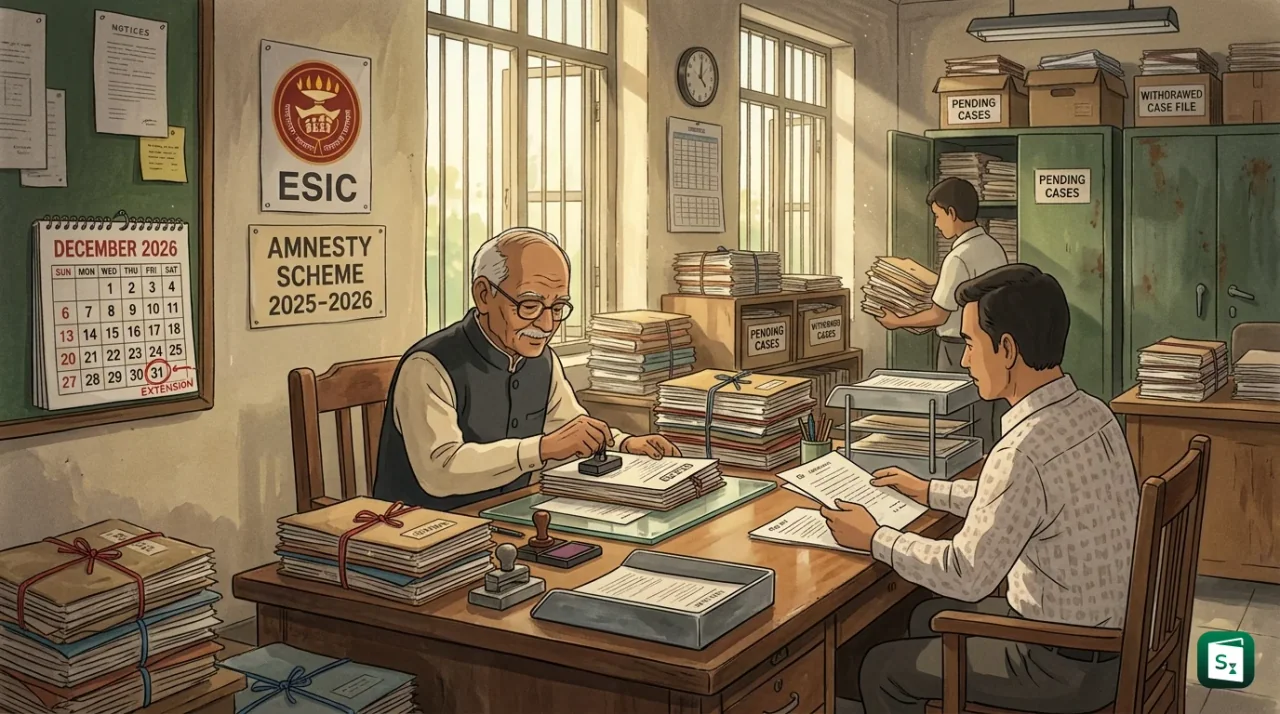
The Employees State Insurance Corporation (ESIC) has extended its New Amnesty Scheme 2025 by three months till 31 December 2026. The one-time scheme, which first ran from 1 October 2025 to 30 September 2026, allows employers and insured persons to settle court cases filed up to 31 March 2025 outside court. The extension keeps all existing terms unchanged and gives eligible stakeholders a final window to close long pending disputes.
What Is ESIC and What Does the ESI Scheme Provide?
The Employees State Insurance Corporation (ESIC) is a statutory body set up under the Employees State Insurance Act, 1948. It functions under the Ministry of Labour and Employment and is headquartered in New Delhi. The ESI Scheme was first launched on 24 February 1952 in Delhi and Kanpur, and it was the first major social security law for workers in independent India.
ESIC runs a contributory social security scheme. It provides medical care and cash support in case of sickness, maternity, disablement and death due to employment injury. Medical care is available from the first day a worker enters insurable employment, and it also covers family members. Other core benefits include sickness benefit at 70 percent of average daily wages for up to 91 days in two consecutive benefit periods, maternity benefit at full wages, disablement benefit, dependants benefit for families of workers who die due to work injury, and funeral expenses. Workers who lose jobs involuntarily can also get support through the Atal Beemit Vyakti Kalyan Yojana.
Coverage depends on wages and size of the unit. The scheme applies to non-seasonal factories with 10 or more workers, and state governments have extended it to shops, hotels, restaurants, cinemas, transport units, newspaper units, private medical and educational institutions and similar units. At present, employees earning up to ₹21,000 per month are covered, while the limit is ₹25,000 per month for persons with disabilities. Workers earning up to ₹176 per day are exempt from paying their own share, though the employer still pays.
Contributions have two parts. The employer pays 3.25 percent of wages and the employee pays 0.75 percent, a combined rate of 4 percent in force since 1 July 2019. Payment is due within 15 days of the end of the month. Delayed payment attracts simple interest at 12 percent per year, along with damages under Section 85B of the Act.
The scale is large. As on 1 January 2026, the scheme was notified in 713 districts across all 36 states and union territories, with about 29.63 lakh registered employers, 3.29 crore registered employees, 4.08 crore insured persons and 15.83 crore beneficiaries. ESIC also runs its own hospitals, dispensaries and medical colleges across the country.
What Is the New Amnesty Scheme 2025?
The New Amnesty Scheme 2025 is a one-time dispute resolution plan to cut court backlogs and improve voluntary compliance under the ESI Act. ESIC approved the scheme at its 196th meeting held on 27 June 2025 in Shimla, chaired by Union Labour and Employment Minister Mansukh Mandaviya. Detailed guidelines were issued on 24 July 2025.
The scheme first operated from 1 October 2025 to 30 September 2026. It creates a clear path for employers and insured persons to settle disputes outside court in a time bound way. ESIC has said every settled case should be closed within six months from the date of application.
Only cases filed up to 31 March 2025 are eligible. This covers employer disputes under Section 75 (adjudication by the Employees Insurance Court) and appeals under Section 82 of the ESI Act, 1948, petitions under Article 226 of the Constitution where no major legal question is involved, and prosecution cases under Sections 84, 85 and 85A. Employers who had used earlier amnesty schemes can also apply under this scheme.
Which Cases Are Covered and What Are the Settlement Terms?
The scheme groups pending cases into four broad types. The main principle is simple. Pay the actual contribution and interest based on records, and ESIC waives or sharply cuts damages. Then ESIC and the employer jointly ask the court to record the settlement and close the case.
| Type of dispute | Who it covers | Settlement condition |
|---|---|---|
| Coverage disputes | Employers who challenged whether their unit was covered | Produce records, pay accepted contribution with interest, no damages. Closed units shut for over 5 years with cases pending for over 5 years and no assessment can seek withdrawal. Units registered voluntarily through Form-01 are excluded. |
| Contribution disputes under Sections 45A, 45AA, 75, 82 and Article 226 | Employers who challenged assessed dues | Pay employer and employee share with interest as per records. If records are missing, EPFO or Income Tax records can be used. If no records exist, pay at least 30 percent of assessed contribution. No damages, plus an undertaking to stay compliant. |
| Damages disputes | Employers who paid dues but challenged damages | Pay only 10 percent of disputed damages. If ESIC had appealed to a higher court, the lower court amount is accepted. |
| Prosecution cases under Sections 84, 85 and 85A | Employers and insured persons facing criminal cases | Insured persons under Section 84 must refund excess payment in full with an undertaking, with no interest. Employers under Sections 85 and 85A must pay contribution with interest as per records or alternate proof, with no damages. |
Small and old cases get extra relief
ESIC has added three special categories to clear very old files where court costs exceed the dues.
First, cases under Sections 85(a) and 85(g) pending for over 15 years as on 31 March 2025 with dues up to ₹25,000 (excluding interest and damages). Closed units where the employer cannot be traced can seek withdrawal. Running units must update compliance and pay 30 percent of contribution with interest.
Second, cases under Section 85(e) for non-submission of contribution returns filed up to 31 March 2025. Since payments are now digital and half yearly returns are redundant, ESIC will withdraw these cases if contribution and interest for the period have been paid.
Third, cases of late filing of declaration forms pending for over three years can be withdrawn if compliance is complete and any accident claim is settled.
Cases involving criminal conspiracy and forgery are excluded. Forgery and fraud cannot be settled through this window.
How settlement is processed
Regional Directors and officers in charge of regional and sub-regional offices are fully empowered to approve settlements. A field committee of legal and finance officers with a panel advocate reviews each case. To keep the process fair, the officer who made the original assessment should not handle the same case under amnesty as far as possible.
ESIC clarified in March 2026 that prior court permission is not needed to apply. The employer can settle with ESIC first, then place the settlement before the court for orders to dispose of or withdraw the case. This reading follows Section 89 of the Code of Civil Procedure, 1908, which supports out-of-court settlement recorded by the court.
Why ESIC Extended the Scheme Till 31 December 2026
ESIC extended the scheme after receiving requests from employers, unions and other stakeholders. The competent authority approved a three month extension from 1 October 2026 to 31 December 2026 on the same terms and conditions. Field offices have been asked to give wide publicity through local press, regional boards, local committees and employer and worker associations.
The backlog explains the need. As on 31 March 2025, total arrears of contribution and interest stood at ₹6,182.70 crore, of which ₹2,364.33 crore was immediately recoverable and the rest was blocked in court disputes, liquidation, closures or untraceable units. In 2024-25, ESIC recovered ₹642.82 crore. Prosecution cases pending at the end of March 2025 numbered 9,661 under the ESI Act, apart from cases under the Indian Penal Code. A settlement route saves court time and brings money into the fund faster than long trials.
The extension also fits a wider push for voluntary compliance. A separate drive, the Scheme for Promotion of Registration of Employers and Employees (SPREE 2025), ran from 1 July 2025 to 31 January 2026 for unregistered units. It allowed registration without inspection or demand for past dues and added 1.38 lakh employers and 1.12 crore employees. The amnesty scheme picks up where SPREE stopped. It deals with units already in the system but stuck in disputes over coverage, assessments, damages or prosecution.
How ESIC Differs From EPFO and Provident Fund
Many workers see two deductions in salary slips, one for ESIC and one for provident fund. The two systems serve different goals and are run by different bodies.
| Feature | ESIC | EPFO and Provident Fund |
|---|---|---|
| Full form | Employees State Insurance Corporation | Employees Provident Fund Organisation |
| Law | Employees State Insurance Act, 1948 | Employees Provident Funds and Miscellaneous Provisions Act, 1952 |
| Main purpose | Health insurance and cash benefits for sickness, maternity, injury and death | Retirement savings, pension and insurance on death |
| Wage limit for coverage | Up to ₹21,000 per month (₹25,000 for persons with disabilities) | Up to ₹15,000 per month for mandatory PF membership |
| Contribution in 2026 | Employer 3.25 percent, employee 0.75 percent | Employer 12 percent, employee 12 percent in most cases |
| Benefit timing | Benefits during service, from day one for medical care | Benefits mainly at retirement, withdrawal or death |
| Applicability | Non-seasonal factories with 10 or more workers, plus notified shops and units | Factories and units with 20 or more workers in most cases |
ESIC is mandatory where it applies. An employer cannot opt out because the unit is small once the threshold is crossed, and both shares must be deposited on time. The new wage code and the Code on Social Security, 2020 will carry these ideas forward, with Chapter IV dealing with ESIC, though the government is notifying its provisions in stages.
Key Takeaways
- ESIC extended the New Amnesty Scheme 2025 by three months till 31 December 2026 on unchanged terms.
- Only court cases and prosecution cases filed up to 31 March 2025 under Sections 75, 82, 84, 85 and 85A are eligible.
- Ad hoc assessments can be settled by paying actual contribution with 12 percent interest and no damages.
- Employers who already paid dues can close damages disputes by paying only 10 percent of disputed damages.
- ESIC, set up under the ESI Act, 1948 and headquartered in New Delhi, covers workers earning up to ₹21,000 per month with employer and employee rates of 3.25 percent and 0.75 percent.