PM Narendra Modi has inaugurated and laid the foundation stone for rail and road infrastructure projects worth over ₹5,470 crore at Jalandhar Cantonment in Punjab.
This includes the inauguration of 75 redeveloped railway stations across 20 states under the Amrit Bharat Station Scheme, executed at a cost of ₹1,570 crore.
The Ministry of Housing and Urban Affairs (MoHUA) has approved projects worth ₹2,719.80 crore under the Urban Challenge Fund (UCF) initiated by PM Narendra Modi. The funding is designated for 6 transformative urban development initiatives in Ahmedabad, Gujarat.
PM Narendra Modi has visited New Zealand at the invitation of PM Christopher Luxon, marking the final leg of his 3-nation tour which also included Indonesia and Australia. He received a traditional Maori powhiri ceremonial welcome at the Government House in Auckland, followed by bilateral talks.
The meeting resulted in 18 major outcomes, including the signing of 10 MoUs and the elevation of India-New Zealand bilateral ties to a Strategic Partnership (SP). Both nations also adopted the 'Roadmap to 2030'.
Key announcements included a target to double bilateral trade to NZD 7 billion (₹35,000 crore) by 2030 and the establishment of a Maritime Security Dialogue. It is to be noted that New Zealand has nominated Maritime Security as a priority pillar under the Indo-Pacific Oceans Initiative (IPOI) and has officially joined the Global Biofuels Alliance (GBA), led by India.
PM Narendra Modi has dedicated development projects worth ₹14,700 crore to the nation in Haryana, aimed at enhancing road connectivity and medical infrastructure.
During the event, he flagged off India's first hydrogen-powered train. He also inaugurated the 157.92 km long, four-lane, fully access-controlled Delhi-Amritsar-Katra Expressway, developed at a cost of ₹9,680 crore.
Prime Minister Narendra Modi has inaugurated and laid the foundation stone for multiple development projects worth over ₹4,700 crore in Chandigarh.
The projects focus on the expansion of healthcare, education, and road infrastructure. As part of the connectivity projects, the PM inaugurated the IT City–Kurali six-lane Greenfield Highway.
Skyroot Aerospace has successfully launched 'Vikram-1', India's first privately developed orbital-class rocket, into a 450 km Low-Earth Orbit (LEO). The mission, titled 'Mission Aagaman' (meaning arrival), marks India as the third nation with private orbital launch capabilities, following the US and China.
The 4-stage, 7-storey-tall rocket, named after Vikram Sarabhai, the father of India's space programme, has a payload capacity of up to 350 kg. It was launched from the Satish Dhawan Space Centre (SDSC) in Sriharikota, Andhra Pradesh.
The mission successfully deployed technology demonstrators from Grahaa Space, Cosmoserve, DCubed, and the SCOPE satellite. It also carried symbolic payloads, including an 18-karat gold rocket, an artistic lab-grown diamond, and a handwritten postcard from PM Narendra Modi bearing the message 'Vande Mataram'.
The Cabinet Committee on Economic Affairs (CCEA) has approved two infrastructure projects to relieve Varanasi, Uttar Pradesh. The first project involves the development of a 43.218 km Link/Connector Corridor connecting National Highway (NH)-31 and the Varanasi Ring Road along the Varuna River, at a cost of ₹10,998 crore.
The second project entails the development of a 46.039 km Link/Connector Corridor between NH-19 and the Varanasi Ring Road along the Ganga River, at a cost of ₹14,447 crore. Both projects will be implemented by the National Highways Authority of India (NHAI) under the Hybrid Annuity Model (HAM).
PM Narendra Modi visited Australia at the invitation of PM Anthony Albanese, where he received a ceremonial welcome and met the Governor of Victoria, Margaret Gardner AC in Melbourne.
Both leaders addressed the Australia-India CEOs Forum (established in 2012, relaunched in 2023). AustralianSuper, the largest pension fund of Australia, pledged an investment of AUD 500 million in the National Investment and Infrastructure Fund (NIIF) of India, raising its total investment in the country to AUD 3.3 billion.
The two nations launched the Australia-India Partnership on Cyber, Critical Technologies, and Supply Chains (PACTS), replacing the 2020 Framework Arrangement on Cyber and Cyber Enabled Critical Technology Cooperation. PACTS is based on 5 pillars: supply chain resilience, critical technology, cybersecurity, digital resilience, and defence research and collaboration.
India and Australia finalized the Administrative Arrangement of the India-Australia Civil Nuclear Agreement (signed in 2014) and signed a Joint Declaration on Defence and Security Cooperation (JDDSC), replacing the 2009 joint declaration on security.
Australia also announced the voluntary repatriation of 3 Indian artefacts: an 11th-12th century granite Nandi sculpture, an 11th-century bronze trident of Goddess Bhadrakali, and a 12th-century basalt sculpture of a six-headed Skanda (Karttikeya).
The India-UK Comprehensive Economic and Trade Agreement (CETA) and the Agreement on Social Security came into force on July 15, 2026. This agreement aims to double bilateral trade to over $100 billion within the next 5 years by removing critical market barriers and easing cross-border professional mobility.
CETA provides zero-duty access for nearly 99% of exports from India. On the first day of the implementation of the agreement, export consignments worth over $140 million were flagged off.
The Union Cabinet, chaired by PM Narendra Modi, has approved the Mobile Phone Manufacturing Scheme (MPMS) with a budgetary outlay of Rs 62,500 crore. The scheme will be implemented over 5 years, from FY27 to FY31.
The MPMS aims to scale up production, deepen domestic value addition, strengthen supply chain resilience, and enhance global competitiveness in the mobile phone manufacturing sector. The scheme offers incentive support on eligible sales for manufacturing mobile phones in India at rates ranging from 2.25% to 5%.
Additional incentives include up to 1.5% for domestic sourcing of key components or sub-assemblies, and an extra 3% for product design and Research and Development (R&D) to build Indian brands. Cumulative mobile phone production in India is expected to reach Rs 39 lakh crore during the scheme's tenure, alongside a projected increase in exports.
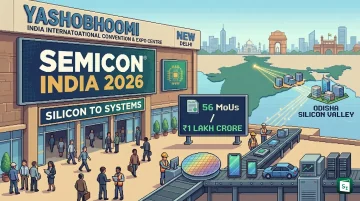
The Union Cabinet has approved 'Semicon 2.0' with a total outlay of ₹1.27 lakh crore to holistically develop the semiconductor design and manufacturing ecosystem in India.
The scheme is structured around 6 key pillars: Design, Machines and materials, setting up more fabs, strengthening the Assembly, Testing, Marking, and Packaging (ATMP) and Outsourced Semiconductor Assembly and Test (OSAT) industry, Research & Development (R&D), and Talent development.
To date, the government has approved 12 semiconductor manufacturing units with a cumulative investment of over ₹1.64 lakh crore. Additionally, 24 semiconductor design projects from start-ups and Micro, Small and Medium Enterprises (MSMEs) have been approved for financial support, and 105 entities have been granted access to industry-standard Electronic Design Automation (EDA) tools.
PM Narendra Modi has visited Indonesia at the invitation of President Prabowo Subianto to strengthen bilateral ties and strategic cooperation between the two nations.
He became the first Indian PM to address the Indonesian Parliament in Jakarta, where he unveiled the 'Ganga-Mahakam Vision' to foster a long-term strategic partnership. During the visit, he was conferred with the 'Bintang Adipurna of the Republic of Indonesia,' the highest civilian honour of the country.
PM Modi visited the Prambanan Temple and inaugurated its restoration project, which is proposed to be led by the Archaeological Survey of India (ASI). India has agreed to establish a branch campus of the Indian Institute of Management (IIM) Bangalore in Jakarta. The visit resulted in 20 key outcomes, including the signing of 14 MoUs and agreements.
Prime Minister Narendra Modi has inaugurated the CG Semi Outsourced Semiconductor Assembly and Test (OSAT) facility in Sanand, Gujarat. This facility marks the commencement of commercial chip production.
Japanese PM Sanae Takaichi visited India to participate in the 16th India-Japan Annual Summit at the invitation of PM Narendra Modi. Both leaders held a bilateral meeting at Hyderabad House in New Delhi.
During the summit, both countries announced 16 key outcomes to expand bilateral cooperation. The leaders also attended the Japan-India Joint Economic Forum, hosted by the Japan External Trade Organisation (JETRO) in New Delhi. The forum witnessed the inauguration of the 4th vehicle manufacturing facility of Maruti Suzuki in Kharkhoda, Haryana.
PM Narendra Modi has dedicated the first greenfield integrated refinery-cum-petrochemical complex of India to the nation at Pachpadra in Balotra, Rajasthan.
Additionally, the PM laid the foundation stone for Phase 2 of the Jaipur Metro Rail Project, which entails an investment of more than ₹13,000 crore.
PM Narendra Modi visited Seychelles at the invitation of President Dr. Patrick Herminie and held a bilateral meeting in Victoria, Mahe. He attended the Golden Jubilee celebrations of the National Day of Seychelles as the Guest of Honour, marking 50 years of independence of the nation.
During the visit, PM Modi was conferred with the honorary "Guardian of the Blue Horizon" title, the highest distinction of Seychelles. Both countries signed 9 MoUs to strengthen bilateral relations. India extended a Line of Credit (LoC) of ₹1,250 crore for development projects and handed over a Fast Patrol Vessel (FPV) named 'LESPWAR'.
Mintage World, the world's first online museum for coins, stamps, and banknotes, has released a 200-page coffee table book titled "Stamps, Coins, and Banknotes Issued During the Premiership of Narendra Modi" in New Delhi.
The book, conceptualized and curated by Sushilkumar Agrawal (CEO of Mintage World), features a compilation of stamps with diverse designs, coins minted at facilities in Mumbai, Kolkata, Hyderabad, and Noida (Uttar Pradesh), along with currency notes printed across Indian security printing presses.