India observes Partition Horrors Remembrance Day, or Vibhajan Vibhishika Smriti Diwas, on August 14 every year to honour the victims and survivors of the Partition of India in 1947. The day was declared by Prime Minister Narendra Modi on 14 August 2021 and was first observed that same year. It reminds the nation that freedom in 1947 came with one of the largest and most painful displacements in human history.
What Is Partition Horrors Remembrance Day?
Partition Horrors Remembrance Day is an annual national memorial day observed on 14 August in India. Its Hindi name is Vibhajan Vibhishika Smriti Diwas. The day commemorates the victims, survivors and suffering of people affected by the Partition of British India in 1947.
The observance was announced by Prime Minister Narendra Modi on 14 August 2021 through a message on social media. He said the pain of Partition can never be forgotten and that millions were displaced and many lost their lives due to hate and violence. Hours later, the Ministry of Home Affairs (MHA) issued a gazette notification declaring that 14 August would be observed every year as Partition Horrors Remembrance Day. The first observance was held on 14 August 2021, just a day before India celebrated its 75th Independence Day.
The stated objectives of the day are to honour the memory of those who lost their lives, acknowledge the suffering of displaced families, and remind present and future generations of the need to remove the poison of social divisions and disharmony. It also aims to strengthen the spirit of oneness, social harmony and human empowerment and to ensure that such hatred and violence are never repeated.
Historical Background: How the Partition Happened
The Partition of 1947 did not happen overnight. It was the result of decades of political developments, communal tensions and hurried decisions at the end of British rule.
From the Two Nation Theory to the Mountbatten Plan
The demand for a separate Muslim homeland gained formal shape with the Lahore Resolution passed by the All India Muslim League on 23 March 1940. Led by Muhammad Ali Jinnah, the League argued that Hindus and Muslims were two distinct nations and needed separate states. The Indian National Congress, led by figures such as Mahatma Gandhi, Jawaharlal Nehru and Sardar Vallabhbhai Patel, wanted a united India. Gandhi opposed Partition till the end, while Nehru and Patel accepted it reluctantly as the only way to ensure a quick transfer of power.
After the failure of efforts like the Cabinet Mission Plan of 1946 to keep India united and the outbreak of communal violence, including Direct Action Day on 16 August 1946 in Calcutta, Partition became seen as unavoidable. British Prime Minister Clement Attlee announced in February 1947 that Britain would leave India by June 1948 and appointed Lord Louis Mountbatten as the last Viceroy. Mountbatten advanced the date and presented the Mountbatten Plan, also called the 3 June Plan, on 3 June 1947. The plan accepted Partition and laid out how British India would be divided into two independent dominions, India and Pakistan.
The plan was given legal shape by the Indian Independence Act, 1947, passed by the British Parliament on 5 July 1947 and granted Royal Assent on 18 July 1947. The Act came into effect on 15 August 1947, creating the Dominion of India and the Dominion of Pakistan. Pakistan, which then included both West Pakistan (present day Pakistan) and East Pakistan (present day Bangladesh), came into being on 14 August 1947, while India became independent on 15 August 1947. The Act also ended British suzerainty over the 562 princely states, leaving them free to join either dominion.
The Radcliffe Line and a Hasty Division
To divide the provinces of Punjab and Bengal along religious lines, Mountbatten set up two Boundary Commissions chaired by British lawyer Sir Cyril Radcliffe. Radcliffe had never visited India before and was given only about five weeks to draw the borders. He used outdated census data and had little knowledge of local realities.
The new boundaries, known as the Radcliffe Line, were ready by early August but were published only on 17 August 1947, two days after Independence. The delay meant millions suddenly found themselves on the wrong side of the border overnight. Villages, families and even water sources were cut in two without warning. The hasty and secretive process worsened confusion and panic.
Scale of Displacement and Suffering
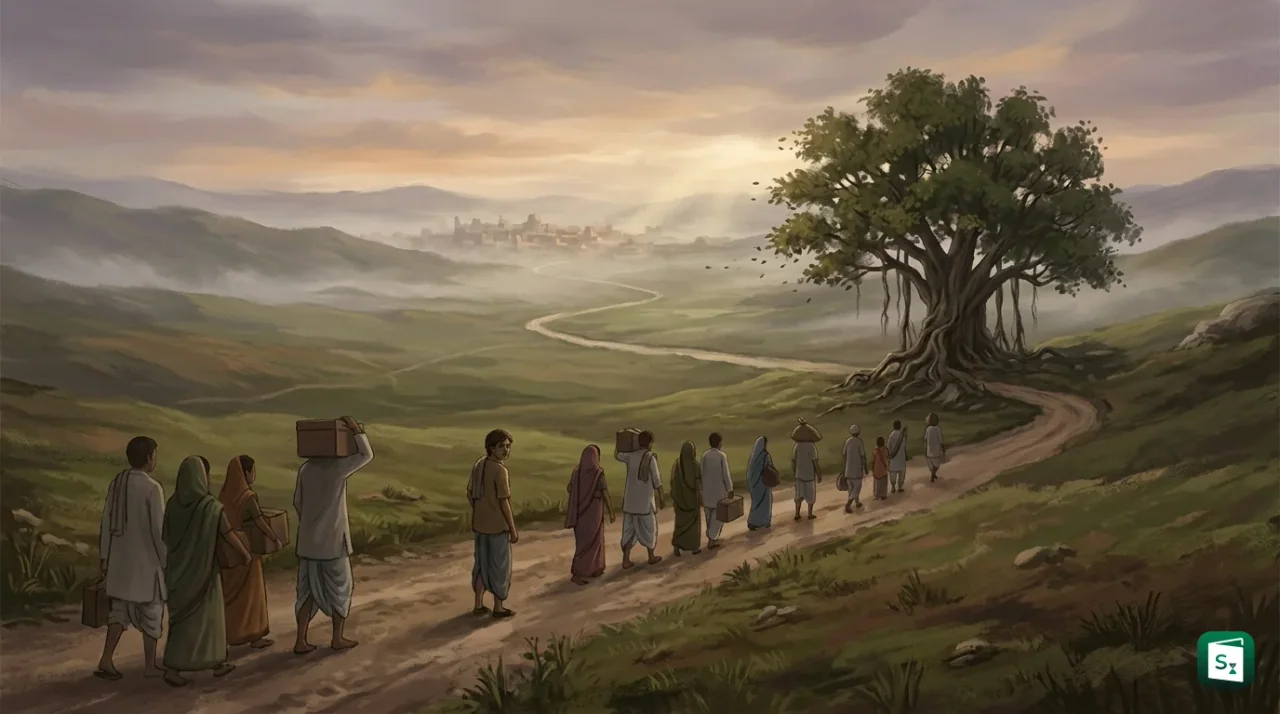
The human cost was staggering. Partition triggered one of the largest mass migrations in recorded history.
| Aspect | Estimate / Fact |
|---|---|
| People displaced | About 14 to 20 million across the subcontinent, about 12 million in Punjab alone |
| Deaths due to communal violence | Widely estimated between 2 lakh and 20 lakh, many historians place it around 10 lakh |
| Women abducted | About 75,000 to 1 lakh women and girls, subjected to abduction, sexual violence and forced marriage |
| Most affected regions | Punjab and Bengal, which were split between the two countries |
| Nature of violence | Communal massacres, attacks on refugee trains and columns, destruction of homes, separation of families |
Refugee columns stretched for miles, with people travelling on foot, bullock carts and overcrowded trains. Trains arriving at stations often carried only bodies and became known as ghost trains. Those who survived lost homes, land, livelihoods and identities and had to rebuild life in refugee camps. The Partition Museum in Amritsar, established on 25 August 2017 by the Arts and Cultural Heritage Trust (TAACHT) in the historic Town Hall building, now preserves these personal stories through photographs, oral histories, letters and belongings donated by survivors. It is considered the world’s first museum dedicated entirely to the 1947 Partition.
Why August 14 Was Chosen
The choice of 14 August is deeply symbolic. The date falls one day before India’s Independence Day on 15 August, linking memory and celebration. While 15 August celebrates freedom from nearly 200 years of British rule, 14 August remembers the price paid for that freedom.
The government stated that observing the two days together helps citizens understand the twin realities of 1947. Freedom was achieved, but it came with enormous suffering. Remembering the horrors on the eve of Independence Day encourages reflection on the value of unity and tolerance.
The date also coincides with the day Pakistan observes its Independence Day. Pakistan became an independent dominion on 14 August 1947, with ceremonies held in Karachi where Muhammad Ali Jinnah took office as its first Governor General. In India, the transfer of power ceremony was held in New Delhi on 15 August 1947, where Jawaharlal Nehru became the first Prime Minister and Lord Mountbatten served as the first Governor General of independent India until June 1948.
How the Day Is Observed
Since 2021, the day has been marked by remembrance activities across the country and abroad, focused on education and reflection rather than celebration.
Government bodies take the lead. The Ministry of Culture, often with the Indian Council of Historical Research (ICHR) and the Indira Gandhi National Centre for the Arts (IGNCA), curates exhibitions that display photographs, newspaper clippings, maps and survivor accounts. These exhibitions are shown at prominent public places such as railway stations, post offices, metro stations, government offices, schools and universities. The Amrit Kaal portal (amritkaal.nic.in) provides downloadable exhibition material, films and scripts for plays on Partition to help institutions organise events.
The University Grants Commission (UGC) has asked all universities and colleges to observe the day through photo exhibitions, seminars, panel discussions and screenings. In 2022, the Delhi Metro set up special panels at Rajiv Chowk and Kashmere Gate stations showing wrecked buildings in Lahore and Amritsar. The University of Kashmir, Jamia Millia Islamia in Delhi, IIT Bombay and many other institutions have held photo exhibitions and talks. Sikkim University, Victoria Memorial Hall in Kolkata and Manipal Academy of Higher Education are among those that organised exhibitions in 2025.
Indian missions abroad also participate. The High Commissions in Ottawa and London and the Consulate in Sydney have hosted exhibitions to educate global audiences. The aim in every case is to bring individual human stories to the front, so that history is felt not just as a political division but as a shared trauma of ordinary families from all communities.
Significance and the Message of Remembrance
The remembrance is not meant to reopen wounds or assign blame to any community. The official message stresses three ideas, to remember, to reflect and to reconcile.
First, it preserves the memory of victims and survivors whose stories were often absent from textbooks for decades. By honouring their resilience, it ensures that future generations know what hate, division and hurried political decisions can cost.
Second, it underlines the value of communal harmony, unity and peace. Prime Minister Modi’s announcement noted that the day should remind citizens to remove the poison of social divisions and strengthen human empowerment.
Third, the proximity to Independence Day creates a balanced narrative. It acknowledges that the joy of freedom was inseparable from the sorrow of Partition. The Partition Horrors Remembrance Day therefore completes the story of 15 August by asking citizens to cherish independence while committing to tolerance and dialogue, so that such a tragedy is never repeated.
Key Takeaways
- Partition Horrors Remembrance Day, or Vibhajan Vibhishika Smriti Diwas, is observed every year on 14 August to commemorate victims of the 1947 Partition.
- The day was declared by Prime Minister Narendra Modi on 14 August 2021 and notified by the Ministry of Home Affairs, with the first observance in 2021.
- The Mountbatten Plan was announced on 3 June 1947 and enacted through the Indian Independence Act, 1947, which received Royal Assent on 18 July 1947.
- The Radcliffe Line was drawn by Sir Cyril Radcliffe in about five weeks to divide Punjab and Bengal, and its boundaries were published on 17 August 1947.
- Partition displaced about 14 to 20 million people and caused between 2 lakh and 20 lakh deaths, with Punjab and Bengal worst affected.
- The Partition Museum in Amritsar, the world’s first museum on Partition, was established on 25 August 2017 by the Arts and Cultural Heritage Trust in the historic Town Hall.