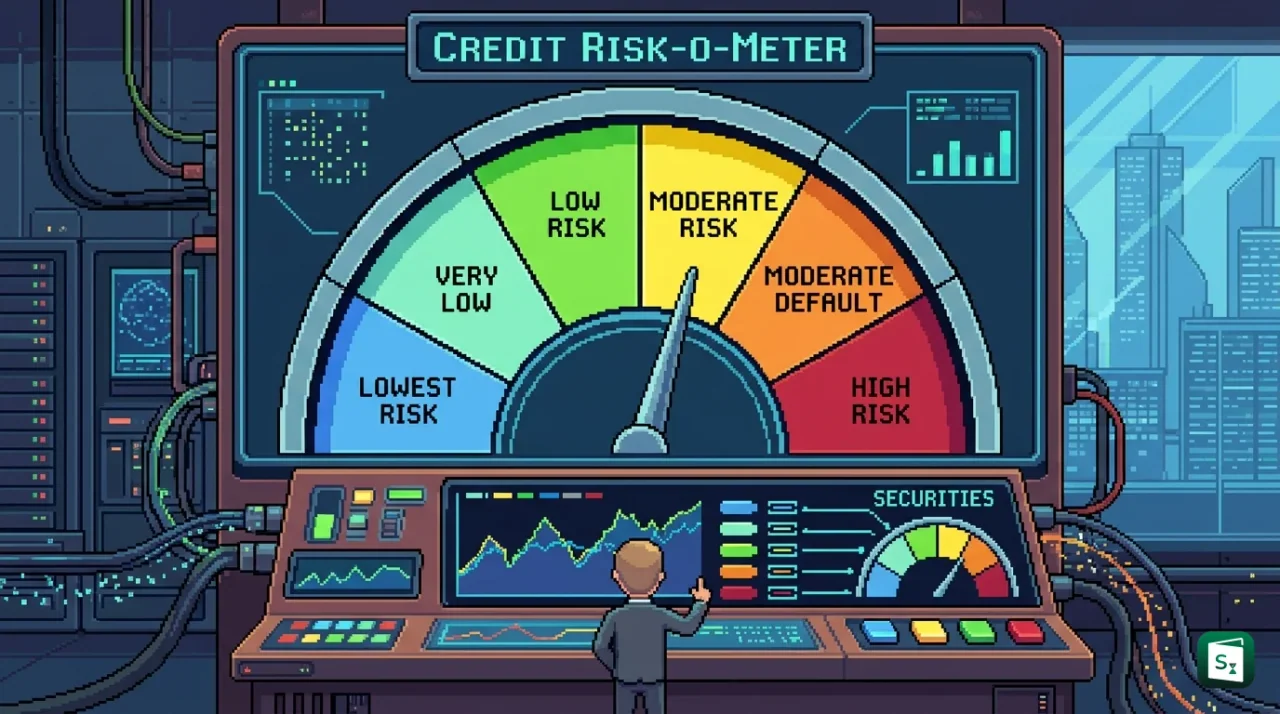
The Securities and Exchange Board of India (SEBI) on 13 August 2026 released a consultation paper proposing a mandatory, colour-coded Credit Risk-o-Meter for debt securities. Modelled on the mutual fund Risk-o-Meter, the tool will translate alphanumeric credit ratings from AAA to D into six visual risk levels to help investors, especially retail participants, assess and compare credit risk at a glance. Comments on the proposal have been invited until 3 September 2026.
What Is the Proposed Credit Risk-o-Meter?
The Credit Risk-o-Meter is a standardised, colour-coded visual scale that shows only the credit risk of a specific debt security, that is the chance that the issuer may delay or fail to pay interest or principal on time. It does not capture market risk or liquidity risk. The meter translates the existing alphanumeric credit rating, like AAA, AA+, A, BBB-, BB, B, C or D, into an intuitive picture with an arrow pointing to one of six risk levels.
Debt securities covered under the proposal are instruments where the investor lends money to an issuer for a fixed period in return for interest. They include Non-Convertible Securities (NCS), Commercial Papers (CPs), Securitised Debt Instruments (SDIs), Security Receipts (SRs) and Structured Debt or Market Linked Debentures (MLDs). These can be issued through public issues or private placements.
The framework was prepared by SEBI’s Department of Debt and Hybrid Securities (DDHS) after inputs from market participants, review by the working group on Online Bond Platform Providers (OBPPs) and deliberations in the Corporate Bonds and Securitization Advisory Committee (CoBoSAC). If finalised, SEBI proposes to insert it as Chapter II-C in the Master Circular for issue and listing of Non-Convertible Securities, Securitised Debt Instruments, Security Receipts, Municipal Debt Securities and Commercial Paper, dated 15 October 2025. The circular would apply 30 days after issuance and covers all categories of issuers.
The problem it seeks to solve is simple. Retail investors often find ratings like AAA versus BBB- versus BB+ hard to interpret. A visual meter, similar to nutrition labels, makes comparison immediate and helps align the investment with the investor’s personal risk appetite.
How the Six Colour-Coded Risk Levels Work
The meter maps SEBI’s standardised credit rating scale, which runs from AAA (highest safety) to D (default), into six levels. Each level has a distinct label and a fixed colour. The mapping follows the rating definitions in SEBI’s Master Circular for Credit Rating Agencies (CRAs) of 11 July 2025.
| Risk-o-Meter Level | Credit Rating Range | Colour Designation | Meaning |
|---|---|---|---|
| Lowest credit risk | AAA | Irish Green (#08A04B) | Highest degree of safety, lowest expectation of default |
| Very low credit risk | AA+, AA, AA- | Chartreuse (#7FFF00) | High safety, marginally lower than AAA |
| Low credit risk | A+, A, A- | Neon Yellow (#FFFF33) | Adequate safety in normal conditions |
| Moderate credit risk | BBB+, BBB, BBB- | Caramel (#C68E17) | Lowest investment grade, moderate risk |
| Moderate risk of default | BB+, BB, BB- | Dark Orange (#FF8C00) | Speculative grade, higher vulnerability |
| High to very high risk of default | B+, B, B-, C+, C, C-, D | Red (#F70D1A) | Significant distress or already in default |
Ratings BBB and above are generally treated as investment grade in India, while BB and below fall in speculative grade, often called junk. The same colour scheme will apply to all digital and printed promotional materials. On web and mobile platforms of OBPPs, the entire six-level scale must be shown with an arrow pointing to the applicable level, with a condensed but complete view on mobile screens.
For transparency, the name of the Credit Rating Agency (CRA) and the actual alphanumeric rating must appear in text immediately below the meter. Where a security carries ratings from multiple SEBI-registered CRAs, the meter must be based on the lowest rating, while all ratings are disclosed. For unsecured debt instruments, the word unsecured must be shown in bold red text below the meter.
Where the Meter Will Have to Be Displayed
SEBI proposes to make display of the Credit Risk-o-Meter mandatory at every investor touchpoint. Issuers and Online Bond Platform Providers (OBPPs) will be required to show it in the offer document for public issues, the abridged prospectus that summarises key issue details, the Private Placement Memorandum (PPM) or information memorandum for private placements, all advertisements issued by the issuer or by an OBPP, and on the web and mobile platforms of OBPPs, specifically on the bond listing page and the bond details page before the investment action buttons.
OBPPs are entities that run electronic systems offering listed debt securities to non-institutional and retail investors. They must be incorporated in India and registered with SEBI as stock brokers in the debt segment of a recognised stock exchange such as NSE or BSE, under the framework introduced in November 2022. Their permitted offerings include listed debt securities, municipal debt securities, securitised debt instruments, listed government securities, State Development Loans (SDLs), Treasury Bills and listed Sovereign Gold Bonds, among other SEBI or RBI regulated products.
The proposal also prescribes standardised disclaimers. These include a statement that the meter represents only credit risk, is not investment advice or a recommendation, and that debt securities remain subject to market and liquidity risks. For unsecured perpetual bonds such as Additional Tier 1 (AT1) bonds, an extra disclaimer must warn that the instruments carry risk of total loss of invested capital and investors should read the information memorandum carefully. Another disclaimer will advise investors to consult financial advisers if suitability is unclear.
How It Differs from the Mutual Fund Risk-o-Meter
The familiar Mutual Fund Risk-o-Meter already helps investors compare schemes, but it measures something different.
SEBI first introduced product labelling for mutual funds in March 2013 with three colours, blue for low risk, yellow for medium and brown for high. The current six-level meter was launched on 1 July 2015 and expanded to six categories from 1 January 2021 following SEBI’s circular of 5 October 2020. Since then every mutual fund scheme displays a meter with levels ranging from Low to Very High, updated monthly based on portfolio data. The mutual fund meter is composite. It combines several parameters including market volatility based on equity exposure, credit risk of debt holdings, interest rate risk or duration sensitivity, and liquidity risk.
The proposed Credit Risk-o-Meter for debt securities is narrower and more specific. It reflects only the credit risk of a single security, derived directly from its credit rating assigned by a SEBI-registered CRA. It does not blend multiple risks. In simple terms, the mutual fund meter answers how risky a portfolio is overall, while the credit meter answers how likely a particular bond is to default. Both use a six-level visual scale, but their inputs and purpose are distinct. The mutual fund meter is recalculated from holdings, while the credit meter follows the CRA rating and changes only when the rating changes.
Coverage, Agencies and Compliance Requirements
Which instruments are covered
The draft circular applies to all issuances of Non-Convertible Securities, Commercial Papers, Securitised Debt Instruments, Security Receipts and Structured Debt or Market Linked Debentures, whether through public issue or private placement, and to all categories of issuers as well as to OBPPs.
Who assigns the ratings
Credit ratings in India are assigned by Credit Rating Agencies (CRAs) registered and regulated by SEBI under the SEBI (Credit Rating Agencies) Regulations, 1999. There are seven such agencies, including CRISIL, formed in 1987, ICRA in 1991, CARE Ratings in 1993, India Ratings and Research, Acuite Ratings and Research, Brickwork Ratings and INFOMERICS Valuation and Rating. Agencies assess business risk, financial risk, management quality and industry outlook, and surveillance is done periodically with upgrades or downgrades when conditions change. OBPPs must derive the meter solely from ratings assigned by these SEBI-registered CRAs.
What compliance is required
OBPPs must maintain automated systems to generate the meter from CRA data, with no manual overrides allowed, and keep full audit trails. They must update the meter within 24 hours of receiving intimation of a rating change and immediately communicate any change in the meter on their platforms. All orders for eligible securities placed on OBPPs must be routed through the Request for Quote (RFQ) platform of recognised stock exchanges and settled through clearing corporations, as per SEBI’s October 2022 framework. Stock exchanges will monitor OBPP compliance and data integrity, while OBPPs must maintain records in easily retrievable, secure form and disclose conflicts of interest.
SEBI itself was established as a non-statutory body on 12 April 1988 and became a statutory regulator on 30 January 1992 under the SEBI Act, 1992, with headquarters at Bandra Kurla Complex, Mumbai. It functions under the Ministry of Finance and is currently chaired by Tuhin Kanta Pandey. Its mandate is to protect investor interests, regulate the securities market and promote its development.
Significance for Investors and the Debt Market
For retail investors, the meter reduces reliance on technical jargon. An Irish Green AAA tag instantly signals lowest credit risk, while a Red B to D tag warns of high to very high risk of default. Combined with the CRA name, actual rating, and the bold red unsecured flag, the display makes comparison across issuers straightforward. This can curb mis-selling, where high coupon rates are highlighted while risk is understated, especially in private placements and on online platforms.
For the bond market as a whole, standardised visual disclosure can build trust among non-institutional participants. India’s corporate bond market has grown sharply, with private placement volumes rising from about ₹20,548 crore in 2007-08 to more than ₹4.14 lakh crore in 2023-24, and listed corporate bond outstanding at about ₹58 lakh crore. SEBI and the Reserve Bank of India (RBI) are also working together on measures to deepen liquidity, including a market-making framework and derivatives on corporate bond indices, as highlighted by SEBI’s leadership in 2026. A clearer risk signal complements these reforms by improving price discovery and encouraging wider retail participation through regulated OBPPs. SEBI has separately cautioned investors in November 2025 to verify that a platform is a registered OBPP before transacting, underlining the regulatory perimeter.
There are limits to what the tool can do. A rating is an opinion at a point in time, not a guarantee of repayment, and downgrades can lag events, as seen in past stress cases such as IL&FS in 2018. The meter will not cover market price swings due to interest rate moves or the ease of selling a bond. Investor awareness will therefore remain essential, and the mandatory disclaimers reinforce that the meter is not a substitute for due diligence.
The Way Forward
The proposal is currently at the consultation stage. Feedback received by 3 September 2026 through SEBI’s online public comments form will shape the final circular. If implemented, issuers and OBPPs will need to upgrade offer documents, advertisement templates and platform interfaces within 30 days of issuance. Stock exchanges will need to update bye-laws and monitor automated compliance.
Over time, the Credit Risk-o-Meter could become as familiar as the mutual fund Risk-o-Meter, giving India’s fixed-income market a common language for credit risk. Its success will depend on accurate and timely rating actions by CRAs, strict adherence by platforms, and continued investor education that visual simplicity does not erase underlying risks.
Key Takeaways
- SEBI’s consultation paper of 13 August 2026 proposes a mandatory, colour-coded Credit Risk-o-Meter for debt securities, with public comments open till 3 September 2026.
- The meter maps ratings AAA to D into six levels, from Lowest credit risk (AAA, Irish Green) to High to very high risk of default (B+ to D, Red).
- It will be displayed in offer documents, abridged prospectuses, private placement memorandums, all advertisements and OBPP web and mobile platforms.
- Where multiple CRA ratings exist, the meter uses the lowest rating, shows the CRA name and actual rating below it, and marks unsecured instruments in bold red text.
- Unlike the Mutual Fund Risk-o-Meter, which blends market, credit, interest rate and liquidity risks, the Credit Risk-o-Meter shows only credit risk of a single security.
- The framework covers NCS, CPs, SDIs, SRs and Structured Debt or Market Linked Debentures, applies to public and private issues, and will take effect 30 days after the final circular, as Chapter II-C of the NCS Master Circular.
- SEBI, established on 12 April 1988 and given statutory powers on 30 January 1992 under the SEBI Act, 1992 and headquartered in Mumbai, regulates CRAs under the SEBI (Credit Rating Agencies) Regulations, 1999, and OBPPs must be registered as debt segment stock brokers and update the meter within 24 hours of rating changes.