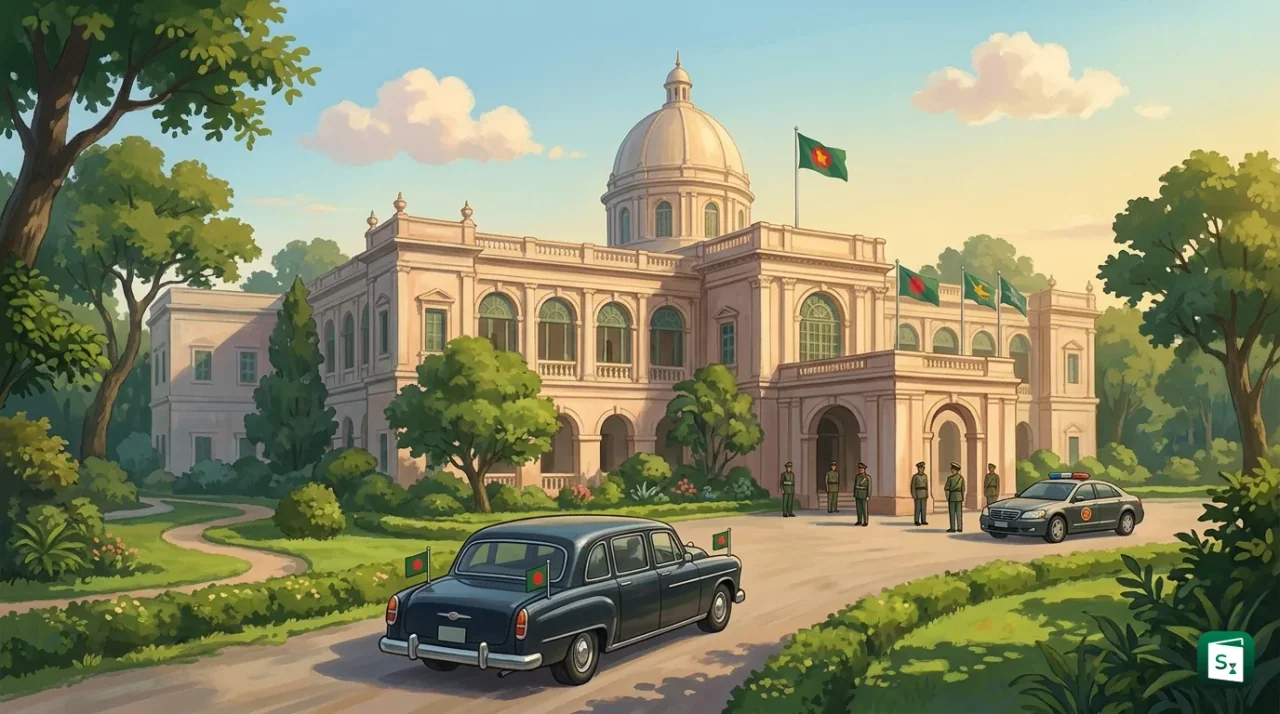
Veteran Bangladesh Nationalist Party leader Mirza Fakhrul Islam Alamgir was elected as the 23rd President of Bangladesh on 20 August 2026, winning a rare contested presidential poll. He secured 255 votes against 88 votes for his opponent Oli Ahmed, succeeding Mohammed Shahabuddin who resigned nearly two years early on health grounds. Alamgir took the oath of office on 21 August 2026 at the Darbar Hall of Bangabhaban in Dhaka for a five year term, marking the first multi candidate presidential election in Bangladesh in 35 years.
Who Is Mirza Fakhrul Islam Alamgir
Mirza Fakhrul Islam Alamgir is one of the most senior leaders of the Bangladesh Nationalist Party (BNP), the centre to centre right party founded by former President Ziaur Rahman on 1 September 1978 in Dhaka. He was born on 26 January 1948 in Thakurgaon District in northwestern Bangladesh to Mirza Ruhul Amin, a noted lawyer who was elected as a member of parliament several times and later served as Minister of Agriculture, and Mirza Fatima Amin. His family has deep political roots, his uncle Mirza Golam Hafiz served as Minister of Land, Minister of Law and Parliamentary Affairs and as Speaker of the Jatiya Sangsad from 1979 to 1982.
Alamgir studied Economics at the University of Dhaka, where he earned his master’s degree with honours. He began his career as a lecturer at Dhaka College through the Bangladesh Civil Service (Education Cadre) and taught in several government colleges. He also worked as Deputy Director at the Directorate of Inspection and Audit and with the UNESCO National Commission. From late 1979 to 1982, he served as Personal Secretary to Deputy Prime Minister S. A. Bari in President Ziaur Rahman’s administration.
He entered electoral politics in the mid 1980s. He was elected Chairman of Thakurgaon Municipality as a neutral candidate in 1988 and joined the BNP in the early 1990s during the anti Ershad movement. In 1992, he became President of Thakurgaon District BNP. He was elected to the Jatiya Sangsad (National Parliament) from Thakurgaon-1 in the eighth general election in 2001 and served as State Minister for Agriculture and later as State Minister for Civil Aviation and Tourism between 2001 and 2006 in Prime Minister Khaleda Zia’s government. He contested the 2008 election as well but did not win then.
Inside the party, Alamgir rose steadily. He became Senior Joint Secretary General at the BNP’s 5th National Council in December 2009, a post previously held by Tarique Rahman. After the death of Secretary General Khandaker Delwar Hossain in March 2011, BNP Chairperson Khaleda Zia named him Acting Secretary General on 20 March 2011. He was confirmed as Secretary General on 30 March 2016 and held the post for more than 16 years, making him the longest serving secretary general in the party’s history. On 13 August 2026, he resigned from that post and from the National Standing Committee, the party’s highest decision making body, to contest the presidency, as the Constitution bars a president from holding a party post.
In the government formed after the BNP’s landslide win in the 12 February 2026 general election, Alamgir served as Minister for Local Government, Rural Development and Co-operatives from 17 February to 20 August 2026 under Prime Minister Tarique Rahman before resigning to file his presidential nomination. He is married to Rahat Ara Begum, who studied at the University of Calcutta and works in the insurance sector in Dhaka. The couple has two daughters, Mirza Shamaruh, a post doctoral fellow in Australia, and Mirza Safaruh, a teacher in Dhaka.
The 2026 Presidential Election: A Rare Contest
Bangladesh held its 23rd presidential election on 20 August 2026 after the office fell vacant. Chief Election Commissioner A. M. M. Nasir Uddin declared Mirza Fakhrul Islam Alamgir elected with 255 votes, defeating Oli Ahmed of the Liberal Democratic Party (LDP) who is the candidate of an 11 party alliance. Voting was held by open ballot in the Jatiya Sangsad Bhaban (Parliament House) in Dhaka from 2:00 pm, with members of the 13th Jatiya Sangsad formed after the February 2026 general election acting as the electoral college.
The contest was historic. Since the return to a parliamentary system through the Twelfth Amendment in 1991, almost every presidential election in Bangladesh has been uncontested, with a single nominee from the ruling party declared elected unopposed. Under the Constitution, candidates must be proposed and seconded by members of parliament, but in practice Article 70, which bars MPs from voting against their party, combined with a clear parliamentary majority, usually ensures only one valid nomination. This time, two valid nominations were filed, triggering an actual vote for the first time in 35 years, since the contested election of 1991.
Alamgir had been nominated by the BNP, which controls 209 seats out of 300 directly elected seats following its two thirds majority win in February 2026, and enjoys support from allied parties taking its parliamentary strength to more than 250. Oli Ahmed, a former minister and president of the LDP, was fielded by a grouping of smaller opposition parties. The result followed party lines, reflecting the composition of the House which has 300 directly elected seats plus 50 reserved seats for women allocated in proportion to party strength.
Alamgir was sworn in the next day, on 21 August 2026 at 7:30 pm in the Darbar Hall of Bangabhaban, the official residence of the President in Dhaka. The oath was administered by Acting Speaker Kaisar Kamal (also reported as Barrister Kayser Kamal), who had been performing duties as officiating presiding officer after Speaker Hafiz Uddin Ahmad assumed charge as Acting President during the vacancy. Senior leaders including Prime Minister Tarique Rahman, Chief Justice, cabinet members and diplomats attended the ceremony.
Quick Snapshot of the Poll
| Detail | Information |
|---|---|
| Date of election | 20 August 2026 |
| Oath taking | 21 August 2026, 7:30 pm, Darbar Hall, Bangabhaban |
| Winner | Mirza Fakhrul Islam Alamgir (BNP) - 255 votes |
| Runner up | Oli Ahmed - 88 votes |
| Declared by | Chief Election Commissioner A. M. M. Nasir Uddin |
| Term | Five years |
| Nature of poll | First contested presidential election since 1991 |
Why Mohammed Shahabuddin Resigned
Mohammed Shahabuddin resigned as President on 24 July 2026, nearly two years before his five year term was due to end in April 2028. He had been elected unopposed in April 2023 as the candidate of the Awami League, the party of then Prime Minister Sheikh Hasina, and was seen as the last constitutional office holder linked to the previous government that was ousted in the student led uprising of August 2024.
The 76 year old cited serious health reasons. In his statement released by Bangabhaban, he said recent medical examinations had diagnosed him with Autonomic Neuropathy, a disorder of the involuntary nervous system, which sometimes caused momentary loss of consciousness, along with related heart, diabetes and kidney ailments. He told the media, “I am suffering from various health complications.” His office said his representatives carried his signed resignation letter to Parliament Speaker Hafiz Uddin Ahmad for formal acceptance.
Under Article 54 of the Constitution, when the office of president becomes vacant due to death, resignation or removal, the Speaker of the Jatiya Sangsad discharges the functions of president as Acting President. Accordingly, Hafiz Uddin Ahmad, aged 80 and a Bir Bikrom decorated freedom fighter, assumed the role of Acting President on 24 July 2026. The Constitution requires a new presidential election to be held within 90 days of a vacancy, and the Bangladesh Election Commission scheduled the poll within that window.
Shahabuddin’s tenure had been unusual. He remained in office after the dissolution of the 12th Jatiya Sangsad on 6 August 2024, the appointment of Nobel laureate Muhammad Yunus as Chief Adviser of the interim government on 8 August 2024, and the February 2026 general election that brought the BNP under Tarique Rahman, son of Ziaur Rahman and Khaleda Zia, back to power after nearly 20 years. His exit completed the transition from the interim arrangement to a fully elected political order.
How Bangladesh Elects Its President
The President of the People’s Republic of Bangladesh is the head of state and takes precedence over all other persons in the State. Under the current system restored by the Twelfth Amendment in 1991, Bangladesh is a parliamentary democracy where executive power is exercised by the Prime Minister and Cabinet. The president’s role is therefore largely ceremonial and bound to act on the advice of the prime minister, except in two matters, appointing the prime minister under Article 56(3) and the Chief Justice under Article 95(1).
Key constitutional features are found in Part IV, Chapter I (Articles 48 to 54) of the Constitution of Bangladesh, which was adopted on 4 November 1972 and came into effect on 16 December 1972.
Election method: The president is elected by members of the Jatiya Sangsad through an open ballot in accordance with law, not by direct public vote. Any political party represented in parliament can nominate a candidate.
Eligibility: A person must be at least 35 years old, qualified to be elected as a member of parliament, and must not have been removed from the office of president by impeachment under Article 52. No person can hold the office for more than two terms, whether consecutive or not.
Term and tenure: The term is five years from the date of assuming office. The president continues to hold office even after the term expires until a successor enters office.
Resignation and vacancy: The president may resign by writing under his hand addressed to the Speaker. A vacancy due to death, resignation, removal or incapacity is filled by an election held within 90 days. During the vacancy, the Speaker acts as president, and if the Speaker is unavailable, the Deputy Speaker does so.
Oath: Before entering office, the president takes an oath or affirmation prescribed in the Third Schedule and required by Article 148. The oath is administered by the Speaker of the Jatiya Sangsad and includes a pledge to faithfully discharge duties according to law, to bear true faith and allegiance to Bangladesh, to preserve, protect and defend the Constitution, and to do right to all manner of people without fear or favour.
Powers: The Constitution grants formal powers such as assenting to bills passed by parliament, appointing the prime minister who commands majority support in the House, appointing judges of the Supreme Court, appointing the Chief Election Commissioner and other Election Commissioners under Article 118, granting pardon and reprieve under Article 49, and serving as nominal commander in chief. The president also has enhanced responsibility after parliament is dissolved and before a new cabinet takes over, when the executive authority of the presidency is temporarily broader to ensure continuity.
Removal: Parliament can impeach the president for violation of the Constitution or grave misconduct. The motion requires a two thirds majority of the total members of parliament after giving the president a chance to defend himself. Historically, the provision has never been successfully used.
Residence and symbol: The president lives and works at Bangabhaban (House of the Nation) in central Dhaka, a former British era Government House that became the presidential palace after 1971. An additional retreat, the Uttara Ganabhaban in Natore, is also at the president’s disposal. The office is protected by the President Guard Regiment and the Special Security Force.
Numbering Confusion
Bangladesh’s official numbering of presidents has varied because some lists count only distinct elected presidencies while others separately count acting and interim holders. By the consecutive numbering of distinct elected presidencies used by the Election Commission and most contemporary records, Mohammed Shahabuddin was the 22nd and Mirza Fakhrul Islam Alamgir is the 23rd president. Government publications have at times shown different numbers due to alternative counting methods, which is why historical charts sometimes show conflicting ranks for the same person.
Political Context: From Interim Rule to BNP Government
The presidential change cannot be understood without the turbulent political transition that Bangladesh has undergone since 2024. Sheikh Hasina, who had been prime minister almost continuously since 2009, was forced to resign and fled to India on 5 August 2024 after weeks of mass student led protests known as the July August Uprising. The movement began over quotas in government jobs but widened into a broader demand for democratic restoration, with high youth unemployment, inflation and questions about electoral fairness adding fuel.
After the ouster, President Mohammed Shahabuddin dissolved the 12th Jatiya Sangsad and, with the support of the army under General Waker uz Zaman and student representatives, invited Nobel Peace laureate Muhammad Yunus to head an interim government as Chief Adviser on 8 August 2024. The Supreme Court’s Appellate Division affirmed the legality of the interim arrangement to manage state affairs and fill the constitutional vacuum. The Yunus administration set up reform commissions for the constitution, election system, judiciary and police, and governed with limited powers focused on routine administration and organizing a credible election.
Facing pressure from the BNP to hold polls early, Yunus initially suggested April 2026, then agreed after talks with Tarique Rahman in London in June 2025 to hold the election before Ramadan in February 2026. The 13th general election was held on 12 February 2026 along with a national referendum on constitutional reforms known as the July Charter. The Awami League was legally barred from contesting. The BNP, led by chairman Tarique Rahman, who returned to Dhaka in December 2025 after 17 years in exile in London, won a decisive mandate with 209 seats out of 297 contested and, with allies, more than 212 seats, securing a two thirds majority. The Bangladesh Jamaat e Islami and its allies emerged second with about 70 seats. Voter turnout was close to 60 percent, with nearly 128 million voters eligible and about 900,000 security personnel deployed.
Tarique Rahman, born 20 November 1968 and son of Ziaur Rahman and three time prime minister Khaleda Zia, was sworn in as prime minister on 17 February 2026 at the South Plaza of the Jatiya Sangsad Bhaban, the first open air swearing outside Bangabhaban, and formed a cabinet of 25 ministers and 24 state ministers. He is the country’s 11th prime minister and the first male prime minister in 35 years since Khaleda Zia first took office in 1991. The Awami League’s ban, the rehabilitation of the BNP, and the referendum’s approval of reforms including a proposed upper house and prime ministerial term limits have reshaped the institutional landscape in which the new president will function.
The election of a veteran BNP leader as president therefore aligns the ceremonial head of state with the political executive for the first time since the transition, ending a period where a president appointed by the old parliamentary majority coexisted with an interim and then a new opposition led government.
Significance for India and the Region
Bangladesh shares a 4,096 kilometre border with India, its longest land boundary with any country, and developments in Dhaka have direct implications for New Delhi. India is Bangladesh’s largest regional trading partner and a key partner in connectivity, energy and security in the eastern neighbourhood.
The BNP has historically maintained a foreign policy described as Bangladesh First, with closer ties to China as a development partner and a more cautious approach to India than the Awami League era. However, the new government under Prime Minister Tarique Rahman has signalled a desire to balance relations and to revive regional cooperation mechanisms such as the South Asian Association for Regional Cooperation (SAARC), which was founded in 1985 on the initiative of President Ziaur Rahman. Prime Minister Narendra Modi congratulated Rahman immediately after the February election, emphasising inclusivity and the welfare of minorities, while Foreign Secretary Vikram Misri met Jamaat leaders as part of outreach.
For India, the choice of president matters less for day to day policy, which is driven by the prime minister, and more for constitutional stability. A president aligned with the parliamentary majority reduces the chance of friction over appointments, assent to bills, or the formation of a future caretaker arrangement, which was a point of contention before the 1990s reforms. Observers note that Dhaka’s stance on issues sensitive to India, from water sharing on the Farakka Barrage and Teesta, to border security, to the return of Sheikh Hasina who faces a death sentence in Bangladesh for her role in the 2024 crackdown, will be shaped by the prime minister, but a cooperative presidency helps ensure smooth conduct of state visits, credentials of envoys, and pardons.
Economically, the new administration aims to more than double GDP from about $450 billion to $1 trillion by 2034 according to its manifesto, with priorities of controlling inflation, rebuilding foreign reserves, attracting foreign direct investment and strengthening the garment sector, which makes Bangladesh the world’s second largest garment exporter. Political stability provided by a settled presidency is seen as a prerequisite for that recovery, after the economy slowed under high inflation and falling reserves during the crisis years.
Key Takeaways
- Mirza Fakhrul Islam Alamgir was elected as the 23rd President of Bangladesh on 20 August 2026 for a five year term, succeeding Mohammed Shahabuddin.
- The presidential poll was the first contested election in 35 years since 1991, with Alamgir securing 255 votes against 88 votes for Oli Ahmed.
- Alamgir took oath on 21 August 2026 at the Darbar Hall of Bangabhaban in Dhaka, administered by Acting Speaker Kaisar Kamal.
- Mohammed Shahabuddin resigned on 24 July 2026 citing Autonomic Neuropathy and other health complications, nearly two years before his term due in April 2028.
- Under the Constitution of Bangladesh (Articles 48 to 54), the President is head of state elected by members of the Jatiya Sangsad by open ballot and acts on the advice of the Prime Minister.
- Alamgir, born 26 January 1948 in Thakurgaon, was the longest serving Secretary General of the BNP (2016 to 2026) and served as Minister for Local Government, Rural Development and Co-operatives from February to August 2026 under Prime Minister Tarique Rahman.